Category Archives: weekly words

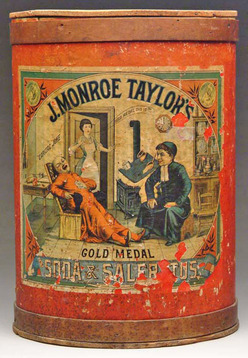
sal·e·ra·tus


Bonneville Salt Flats


Today, we have a guest post from writer and friend of the project, Julie Lauterbach-Colby*:

sal·e·ra·tus (sal’e’ra’tes), n. [Mod. L. sal aeraius, aerated salt], sodium (or sometimes potassium) bicarbonate; baking soda, as used in cooking.

A space opens to provide context—topographic lines separating what runs away (what I have run from). Almost as soon as we crossed the Californian border into Nevada we start to see the dried salt flats. What used to be lakes, appear as opening voids on the altas. Points, here. An exact location rendered gone. Those first explorers into the open lands: the badlands, wastelands. Where the earth has dried and cracked, opened up from sudden change, sudden pressure (the constant ebb of flow of life, of family units), chasms of depth and darkness. How deep is each cut (of the earth)? Around the outer rims, white powder still visible. Traces of. Portraits of. The past. Water marks: where seawater dug its way gently into the sides of the land. With each receding, circular line: a closing in upon itself. Earth’s vacuum effect. From a bird’s eye view, cartographers map each concentric shape wider, farther apart from the last. On a map, what we have is an inverse mountain, a valley that appears to create a wide vortex but which, from the ground, appears nothing but flat for miles and miles and miles.


saleratus cannister


The cake, too: flat and even when I peek into the oven to check its progress. Sudden change, sudden pressure: my mother, a lesson. Set on the counter to cool, the soft center closes in upon itself. Baking soda, saleratus powder, likes heat and time to converge with the flour. What I have is (What appears from my bird’s eye view.) cartographic crater.

My family, driving the winding Californian coast each summer, past Carmel and Monterey out to the coast where we dug for abandoned shells and overturned abalone. On the edge, where saltwater plunges itself into porous rock, what remains? Collected in shallow pools, sun-evaporated during low tide, this white powder. Remains of after collected on the tip of one’s finger.

Ground up and put next to each other, sodium chloride (sea salt) and sodium bicarbonate (baking soda) look almost identical. (As in the saying, Like mother, like daughter.) But we must think back to the tracing of one’s concentric circles: each enclosed within the other (Do we interpret those inner rungs, those that, on a map, appear to be digging themselves into a hole?) but standing on the edge one sees that no: what we have is (       ).


*Julie Lauterbach-Colby is a writer, teacher and artist living in Tucson. She is currently working on a project that incorporates cartography, mathematical equations and cadavers, and owns her own editing business called Chicken Scratch Editing.

1 Comment

Filed under weekly words

bat·tle

Francisco José de Goya, Y no hay remedio (And there's no help for it), 1810-1820 Plate No. 15 from Los Desastres de la Guerra, etching on paper

bat·tle (bat´’l),  n. [ME. & OFr.  Bataile; L.  battalia, battualia, exercises of gladiators and soldiers in fighting and fencing  <  battuere; see BATTER (to beat)],  1. a fight, especially a large-scale engagement, between armed forces on land, at sea, or in the air.  2. armed fighting; combat or war.  3. any fight or fighting; conflict.  v.t. & v.i. [BATTLED (-‘ld), BATTLING], to fight.  give (or do) battle, to engage in battle; fight.

When I was a senior in college, I took a class on “Catholic Social Thought.” We went through the different teachings the Church had about equality and justice and we ended the semester with the idea of peace and of just war. I remember vividly a day when we were talking about war and the need to step in with things that got out of hand. Dr. Barbieri, the instructor of the course, was very good about exposing us to charged issues and the different sides and then getting out of the way to let us hammer it out on our own. On that day, an outspoken senior, who was on ROTC, sitting far down the conference table from me talked about how war was justified in many cases. He said that war had happened since the beginning of time and that man’s natural tendency was towards war, was towards fighting as a way to resolve issues.

Although I was an outgoing person, I hesitated to speak in that class. I was worried I would say something wrong, and the absence of a set way of thinking from the professor meant I had to decide for myself. What if I decided the “wrong” thing. But that day, I disagreed with him. I opened my mouth, not knowing exactly what I was going to say, and I told him that I didn’t believe men and women’s natural tendencies were towards violence but towards compassion. I said that I didn’t think war was ever justified.

He brought in World War II. How were we not to fight in that instance? And I surprised myself in that moment in saying that I didn’t know the answer to that, but that neither did any of us. Did I believe that the Nazis needed to be stopped? Yes, absolutely. But how could we know we could not have been stopped in another way if it hadn’t have been through war? History had already played out and we were living with the reality of what had occurred. But none of us knew what would have happened if the war hadn’t occurred. Could the mess of Nazi Germany have been conquered in a way absent of violence and war? Maybe not. I certainly didn’t know the answer. But neither did he.

The definitions listed above are all literal battles. They refer to physical battles, to violence that involves bodies. But the newer Webster’s dictionary also refers to battles as “an extended controversy.” A controversy has been brewing in the state where I reside, Arizona. The controversy is in regards to HB1070, a bill that passed on Friday, April 23. Jan Brewer signed into law a bill that mandates police officers to pull over anyone that they have “reasonable suspicion” may be in the country illegally.

Native American Dancers at May Day Rally, Tucson, May 1, 2010

We are a proud nation and we often forget the legacy of our forefathers, that our foundation was built upon genocide and slavery. We feel so proud of our citizenship that we forget that unless we are Native American, our ancestors were once citizens of another country. And many of them didn’t come over here with any legal papers on hand. They came on boats for a better life. Mexicans often come by car or on foot. The difference is that we have decided that we want our country to ourselves. That “they” are too much.

It is in these kind of battles that I think it is important to bridge the divide between those on different sides. It doesn’t help for us to yell at one another. It doesn’t help for us to categorize each other as “those people.”

My mother’s first language was Cajun French. When she and her classmates began kindergarten, they were forbidden from speaking French. Many of them didn’t know any English but they were expected to communicate nonetheless. As punishment, six-year-olds were made to kneel on dry rice in the corner or write “I will not speak French in school” hundreds of times on the blackboard. The ensuing result for my mother is that she didn’t teach me French and until ten years ago when it was required by her job, she barely spoke it herself.

I genuinely believe that much of the problem white citizens have with Mexicans immigrating here is not because they take jobs away or because they don’t come here legally. I believe many Americans of European heritage feel threatened by the Mexican culture, which has a rich language and deeply rooted traditions. I believe that White Americans have suffered a great loss and are still grieving for it.

We came here from our European countries in search of a new land and a place where we could be ourselves, to practice our own religion and our own traditions. And the truth is that America has not always supported this. Many of our ancestors abandoned their traditions to become American and we don’t like seeing other people have their cake and eat it too. We didn’t have that chance. Why should they? They should because no one should have to abandon their cultural traditions when they go to another country. Our culture is embedded in us. The places we come from, the people who love us are within us and that doesn’t change when we change physical locales.

This country was founded on the tragedy of one culture dominating another, but does that mean we should continue in this very dangerous path? It seems that now White Americans want immigrants from other traditions to give up what we had to, to sacrifice their cultural roots to be part of this country. But just because we had to go through this suffering doesn’t mean we should continue this cycle.

It seems to me that beyond this being a political battle or even a cultural battle, this law and many other anti-immigrant laws are about the internal battles within all of us. What do we need to do to find our own identity so that we don’t feel threatened by others? What can we do to appreciate our country as a place that is full of people of all different ancestral roots, people who come from rich, cultural traditions? Can we learn from what has been lost before we ask others to sacrifice who they are and where they come from? What can we personally do to reclaim our own traditions so that we can make ourselves whole again?

Leave a comment

Filed under weekly words

myth·i·cize

I guess "Perfection" does have a zipcode. Perfection, North Carolina. Photo by Wessel Kok

myth·i·cize (mith´i-siz´),  v.t. [MYTHICIZED  (-sizd´),  MYTHICIZING], to make into, or explain as, a myth.

&

myth (mith),  n. [LL. mythos; Gr. mythos, a word, speech, story, legend],  1. a traditional story of unknown authorship, ostensibly with a historical basis, but serving usually to explain some phenomenon of nature, the origin of man, or the customs, institutions, religious rites, etc. of a people: myths usually involve the exploits of gods and heroes: cf. legend.  2. such stories collectively; mythology.  3. any fictitious story.  4. any imaginary person or thing spoken of as though existing.

I think it is almost impossible for us to not buy into certain cultural myths. The myth of what is beautiful. The myth that “truth” has one clear-cut meaning. And, of course, the myth of perfection. Much of the time—and much of that time without awareness of it—I live under the myth that I have to be perfect. Somewhere in my head is a stubborn part of me that believes that if I do not take the right steps, if I don’t have every aspect of my life in order, if I do not appear to be always together, the world—or at least my personal world—will crumble.

This is not a new myth in my life. I went to nationals in speech and debate my senior year of high school with an original oratory entitled “The Art of Perfectionism.” Using advertising, psychology, and personal narrative, I crafted a speech, a cautionary tale of shorts, that documented the dangers of trying to be perfect all the time, the dangers of believing that perfection was even possible. When I was a child, I was anchored in doing things right. I tried to be the model child and my desire to please others and to be perceived as strong and smart and creative has continued in my adult self.

I know this myth of perfection is inherently flawed, impossible and ultimately undesirable, and yet I tend to apply that knowledge to everyone but me. Why is it that I am able to be so generous when it comes to other people and their slip-ups and simultaneously be so hard on myself?

I think of a quote from Anne Lamott’s book Bird by Bird. She writes: “I think perfectionism is based on the obsessive belief that if you run carefully enough, hitting each stepping-stone just right, you won’t have to die. The truth is that you will die anyway and that alot of people who aren’t even looking at their feet are going to do a whole lot better than you, and have a lot more fun while they’re doing it.”

Beyond not having fun, the problem with buying into the myth of perfection is that it is just that: a myth. It is a story, a legend, a fiction. I am not perfect. No matter how hard I try to juggle all the balls in my day-to-day life, I always end up dropping one. And this week, I was reminded in very visceral and difficult ways that I am not perfect and that I have to let go of the myth and embrace the reality.

Scenario #1 or “The Scenario In Which I Beat The Crap Out Of Myself”

Wednesday. 9:30 a.m. I have just crawled out of bed and am going to get food to feed my dog. It’s April 14, the day before tax day. I have not started my taxes. I have opened my computer to tackle this task, but first I have to feed the dog. I am not quite awake yet as I have not yet made the coffee. On the way into the kitchen, I open a high kitchen cabinet and get out some napkins to blow my nose (as I have been stopped up from allergy season). Leaving the door open, I get my dog some food and put it in a bowl. On any other day, I would have looked up as I exited the kitchen, avoiding the open cabinet by stepping to the right. Or perhaps as I passed it, I would close the cabinet with my free hand, laughing at my absentmindedness. But this is not any other day. This is the day when, with Maggie’s bowl in hand, I walk directly into the cabinet, my forehead hitting the sharp metal clasp that is meant to close the cabinet. I keel over to the floor in pain, still trying to process what just happened. Maggie runs around me, fixated on her food dish, and I yell at her, “Mama’s hurt. How can you be worried about food right now?”

At first, I think I just hit my head really hard, but when I put my hand to my forehead, I feel the blood before I see it. Running into the bathroom, I pull my bangs backed and look at my forehead and see a vertical red line where the skin had broken open. Too deep to be a scratch. Too surface for the emergency room. I grab a soda out of the freezer and put it to my head with a Kleenex to catch the blood. I call my mom and dad to ask for advice. They tell me to check it out. I call some friends, but I only get voicemails.

I decide to go to urgent care. Sitting there, all I can do is chastise myself. Why hadn’t I been more careful? Why hadn’t I closed the cabinet? Why hadn’t I watched where I was going? Why was I such a klutz? I wondered whether I had messed up my face forever. I wondered whether I needed stitches. About a half an hour into my stay, my friend E called. She was just getting done with class and got my message. She was coming to meet me there. I wonder what would have happened if she would have asked what I needed.


What can I do?

Oh, it’s okay, I’m just here waiting.

or

I’ll be okay by myself.

or

Well, really, if you don’t mind too much. I mean, it would be kinda cool to have company.

It is so hard to ask for help.

She comes and the doctor puts a strip on the wound to help the skin close. He says I am young and the laceration doesn’t look bad. I still don’t know how it will heal. I don’t know if there will be a mark. I hope there won’t be, or that it will be slight if there is one, but I don’t know. And I have to accept myself regardless. I too have to accept that I am capable of great things and also of accidents, of fuck-ups, of times when I bleed and cry. And I can’t see myself reflected only in the flaw of my bumping into the cabinet or the potential flaw of the wound. I am not my flaws alone.

Scenario #2 or “The Scenario in Which I Run On Empty…Literally”

Friday. 7 p.m. Because of the difficult emotionality of the past few days, I have decided to treat myself to some Dairy Queen. I noticed the other day that I was running low on gas but I forgot about it. I put it on a list of things to do later. On the way back from the DQ, driving down a four-lane street near the university, I think about whether I should stop at the Circle K for gas on the way home. That would probably be a good idea. Then, just a block away from the Circle K, I feel the car begin to shake. The needles are pulsing up and down. The car is sputtering. Please, I think to myself, I only have a block to go. Please, please let me make it to the gas station.

But I don’t make it. I stall in the middle of the street. I put my hazards on and just sit there, beginning to panic. Headlights of other cars brighten as they swerve around me, no doubt pissed that I am in their way. What am I going to do? I can’t move the car by myself. I step out of the car.

I see two college kids walking down the sidewalk.

“Hey, I’m out of gas. Y’all think you could help me out?”

They shrug and tell me “sure.” I don’t know what to do, I tell them. This has never happened to me.

“Put it in neutral.”

We begin to push. With them in the back and I by the driver’s side, I turn the wheel to keep us moving straight. Then another girl and guy come up and ask if we need help.

“You had almost made it,” the girl said, smiling at me.

More quickly than I would have thought possible, the five of us push car to the station. They didn’t needed to help me, but they had. There was something reassuring in that.

I thank them and offer them slushies, offer them a drink, anything. But they wave off my offer, heading back down the street in direction they were headed before.

I fill the tank up all the way, telling myself I will not let it come that close again. Before the light went on, I will fill the tank up. I get in the car, still feeling grateful for help in a bad situation.

In the car, I turn the key. The engine turns over for a minute, then nothing. I try again. Again. I call my mom, on the verge of tears.

“I ruined the engine. I ran out of gas and then filled it up. Now the car won’t start. I ruined the engine.”

“You can’t ruin the engine for being out of gas. Oil, yes. Water, yes. Not gas. Let it fill up the pipes. Wait five minute and try again.”

I wait and the car did start. I move slowly back home.

Two scenarios in which I messed up and had to suffer the consequences. Two scenarios in which I was humbled. And two scenarios in which I had to ask for help. The thing about letting go of the dream of perfection is that we also have to admit that we cannot do everything ourselves. Let me remove the plural pronoun: I cannot do everything by myself. We, and I, need other people. I spend many of my days under the illusion that I have crafted for myself that I can handle all I need to handle on my own. And I am reminded almost every day that this is another fallacy. I cannot handle everything on my own. There is, however, one some trick to getting others to help you… you have to ask for help. My friend E wasn’t going to telepathically sense that I needed her to sit with me in the urgent care office. The students walking may have responded, may have realized I needed help, but they also might have easily walked on by. What I had to do in both of these situations is admit, not only to myself but to other people, that I needed help, that I was not perfect, that I was in a dilemma that I could not get out of on my own.

Mythology and legend often depicts the feats of heroes as we humans attempt to understand the planet we live on and the nature of the human spirit. These stories are useful in some ways. They are creative and exuberant. They depict both the beauty and the imperfections of gods as a way to help us understand our own beautiful and imperfect natures. And these stories, just like the people they feature, are limited. We can mythicize as long as we also understand that myths are only one part of a longer, much more complicated story.

[full disclosure: I considered chucking this whole post and rewriting it because it doesn’t feel totally done and because some of the material here makes me vulnerable. But in the interest of what this post discusses (dispelling the myth of perfection, accepting that I am not perfect), I’m letting the post stand. Thank you for accepting it as is]
1 Comment

Filed under weekly words

fa·ble

fa·ble (fa´b’l), ), n. [ME; OFr. <  L.  fibula, a story < fari, to speak; see FAME],  1. a fictitious story meant to teach a moral lesson: the characters are usually animals.  2. a myth or legend.  3. a story that is not true; false-hood.  4. [Archaic], the plot of a literary work.  v.i. & v.t. [FABLED   (-b’ld),  FABLING], to write or tell (fables, fiction, falsehoods).

When I was small, my dad used to read to me every night before bed. One of my favorite books for a time was an illustrated paperback collection of Aesop’s Fable. Although I’m sure I would remember more if I thought about it, the one that stands out most vividly to me is the story of “The Fox and the Grapes.” Maybe it was because I liked the way that the fox was drawn (or at least how I remember him begin drawn) with a bright orange in a suit and bowtie or because I liked grapes. For whatever reason, I remember requesting that story more than the others.

The Fox and the Grapes

The Fox and the Grapes (although not the same image from the book I grew up with)

I thought the story was much longer (maybe because the story was interspersed with drawings) but the fable itself is short:

One hot summer’s day a Fox was strolling through an orchard till he came to a bunch of grapes just ripening on a vine which had been trained over a lofty branch.

“Just the thing to quench my thirst,” quoth he.

Drawing back a few paces, he took a run and a jump, and just missed the bunch.

Turning round again with a One, Two, Three, he jumped up, but with no greater success. Again and again he tried after the tempting morsel, but at last had to give it up, and walked away with his nose in the air, saying: “I am sure they are sour.”

It is easy to despise what you cannot get.

Perhaps one of the reasons I loved Aesop’s fables is because I was a very serious child. I was a very serious child who was good at following rules. I liked rules and structure. For some reason, from a very young age, even though I was in a home that was stable with two parents who loved and supported me, I had a sense that the world was an instable, chaotic place. Rules and boundaries brought order. They made me feel safer.

When I was in fourth grade, I decided to run for student council representative. My parents and I spent hours coming up with a campaign and writing “For a good deal, vote Lisa O’Neill” on the edges of playing cards covered in red hearts and diamonds, black spades and clubs. But when the day came to make speeches, I was terrified. I cried. I made myself sick with worry and my parents let me stay home from school. Problem solved, I remember thinking. I was relieved that it was all over and even though I still wished to be on student council, I felt better. But when I returned to school, I found that they had postponed the election for me. Mrs. King, my fourth grade teacher, asked me to come to the front and give a speech. I was stunned and completely unprepared. I said something I don’t remember for about ten seconds and then sat down. Liz Heard won (her campaign had involved something with lizards). I remember being caught off guard by having a chance to give the speech even though I wasn’t there the day the election was scheduled. Mrs. King was not following the rules, and I found it disconcerting.

I also sought out clear moral lines as a child. In my endless effort to be good, I needed more and more examples of how to be good and what to avoid so as to not be bad. Aesop’s Fables were appealing to me because there was a clear moral answer to each story:

“It is easy to despise what you cannot get.” (The Fox and the Grapes)

“It is best to prepare for the days of necessity.” (The Ant and the Grasshopper)

“Better no rule than cruel rule.” (The Frogs Desiring a King)

“We would often be sorry if our wishes were gratified.” (The Old Man and Death)

I took solace in the clarity of each story, the simple answers, the ease with which I could understand how Aesop arrived at each moral.

The problem is that these morals are without context. There are no tips or explanations of  how to apply them to our lives. “Better no rule than cruel rule” is a nice enough saying, but what do you do if you have no control over who the ruler is? How do we “prepare for days of necessity”? What does “days of necessity” even mean?

When I was ten years old, my parents and I traveled to the Southwest to explore the Grand Canyon. We flew from our home in New Orleans to El Paso, Texas. Because we had arrived early in the day, my dad decided it would be fun to take an impromptu trip to Mexico. This was before you needed a passport to make the passage. Neither one of my parents had been to Mexico and neither knew what to expect when we crossed over into Juarez.

Crossing the border only took a few minutes and then we were there. I had been lying down resting in the back seat. I remember sitting up and immediately being greeted with the faces of children my age, but skinnier and with brown skin, who reached their arms out, cupped hands towards our car and the cars in front of us. I don’t remember if we gave any of them change, but I think we kept driving. Ten feet later, there were more children, and then more. Their clothes were torn. Their eyes were vacant. Watching them, I began to cry. I asked my parents where their parents were. I asked them why they had to beg on the street for money. I don’t remember exactly what my parents offered up as an explanation, but I do remember that for the first time ever, my parents did not have a real answer. They couldn’t give me a good reason why these children were poor instead of me or why they didn’t have any food. They couldn’t explain my grief away.

I wish that life was as easy as “We would often be sorry if our wishes were gratified” but the truth is that we often would be satisfied or healthy or happy if our wishes were gratified and we struggle when they are not. Fables are helpful only to explain values to young children who don’t yet have the level of understanding to understand that morality is complicated.

"A Portrait of Aesop"; a marble figure in the Villa Albani, Rome

Although biographies of Aesop’s life hold contradictory information, most concur that he was a slave and many reference that he was not attractive or even that suffered from physical deformity. Some mention that he had a speech impediment from early youth. Given this information, I see his fables differently. It seems possible that, for him, these moral lessons were a coping mechanism. “It is easy to despise what you cannot get” seems fitting for someone born into slavery, someone who cannot be handsome, someone who cannot speak clearly. Were the stories he created ways for him to reconcile with his own challenges and impediments? Did they serve as a way to make him feel better regardless of his limitations? Did he create moral lessons that made his individual problems feel more tolerable?

There can be beauty in simplicity, but sometimes there is real limitation. I think of people who quote a Bible verse with no regard for the verses before or after to make their argument. Sometimes, we just have to be okay with the fact that the choices that we make in this life and the way that our lives are intertwined with others are infinitely complicated.

This somewhat relates to the third definition of the word: “a falsehood.”  We have all heard of lying by omission. Although fables tell us a moral through story, they assume that our lives will play out the same as in the stories. But the truth is that there are no easy solutions for how to make decisions or how to be a good person. We do the best we can. We make mistakes. We discern given our situation what the best steps to take are. And sometimes, the fables may apply. And other times, we have to tap into our own mind and heart and write the parting lesson ourselves.

The Old Man and Death

The Old Man and Death

The Ant and the Grasshopper

The Frogs Desiring a King

The Frogs Desiring a King

Aesop's Fables

Leave a comment

Filed under weekly words

de·pop·u·la·tor

de·pop·u·la·tor n. a person or thing, as war or famine, that depopulates.

This word feels appropriate given recent disasters and the current state of the world. Massive earthquakes in Haiti and Chile. The tsunami in Indonesia and hurricanes of growing strength in the Gulf of Mexico. Two wars being led by the United States—one against Iraq, one against Afghanistan. When you add perpetual famine and civil wars in Africa, we are already up to a sizable amount of depopulation.

What seems to be shocking is not that depopulators happen, but that we seem to encourage them and to act in ways that only add to the problems when depopulators occur. Indebted countries that don’t have the resources for building infrastructure or planning for natural disasters become further indebted just to meet the basic needs of their citizens, while lending countries thrive. Citizens of wealthier countries, we who can afford it, give money after the fact, but this money is not enough to rebuild, just to provide in the moment so that people do not starve or die from lack of medical attention or access to prescription drugs. Even our act of population, of producing children, in the United States means more depopulation elsewhere. For it is our children who utilize so many resources. It is we who leave the largest footprints. Our needs and desires mean that people in other countries get less.

Today is the vote for healthcare in Congress. One search of “depopulator” leads me to “Obama Depopulation Policy Exposed” on a website called “infowars” run by a man named Alex Jones. The video’s caption explains that panelists “warn of the revival of eugenics under Obama’s modern healthcare through the denial of care to millions who would be judged ‘not fit to live’, just as in Nazi Germany.” Besides the obvious offensive idea that a man who is half African and who has faced racism all his life would institute policies similar to a race genocide in Europe, I wonder if the spread of misinformation and the encouraging of talking points over a real conversation are not other forms of depopulators. Because the truth is that if healthcare is not more accessible in this country, more citizens will die. And the right is doing everything possible to encourage Americans that healthcare options for all will make us all suffer, financially and physically. This is just not an accurate representation of the bills proposed by Congress nor of the ideals of those in power.

I worked for three years at a San Francisco nonprofit that served the city’s poor and homeless. One of our programs was a free medical clinic. Many of the people we served were skilled workers or people with multiple degrees but they were unable to afford health insurance (http://www.soundpartners.org/node/1606). Because of this, so many poor and homeless people do not receive preventative care. This means that when they actually get to a clinic or hospital, their conditions are critical. And they can’t pay. We are paying for people who can’t afford insurance now, but we are paying more than if we would provide preventative care for everyone in this country.

Yesterday, I was taking a walk with a Canadian friend, who has not paid much attention to the debate here. I told her the vote was today. “What’s the big deal? I can’t understand why people don’t want to have universal healthcare,” she said.

“Well, this isn’t even for universal healthcare,” I told her. “It is just to give people who don’t have insurance an option besides through private companies.”

She looked at me, stunned. “That just seems ridiculous to me.”

I am a writer and an educator. I teach adjunct at a local university and community college. I make meager pay, but I do it because I love teaching writing. I am encouraged when students can tap into their own voice and I appreciate being a person who conveys to them that their voice matters. As a writer, I create work that seeks connectivity. In answering questions for myself, I hope to invite others into my journey and have a pseudo conversation with them. However, I do not receive benefits for my work. I currently pay forty-seven dollars a month for a plan that does little more than cover catastrophic or emergency care. I don’t want to be uninsured and my parents don’t want that. So I pay the money, even though I can’t really afford it. But I don’t know how much longer I will be able to. And I don’t know when or if I’ll have a job that offers benefits. I don’t believe that I, or anyone else, should have to do work we are dispassionate about to be healthy. I don’t think we should abandon the work that is important to us so that we are protected in case of accidents or chronic disease.

I think there is an undercurrent of the health care debate that is seldom identified. I wonder how many people who are adamant about opposing health care reform are uninsured. My guess is not many. If people who have continued to obtain jobs and stay in jobs not because they are following their passions or using their gifts but because they are steady jobs with good health insurance, I can imagine that offering healthcare to everyone could engender a bit of bitterness. What if artists, musicians, writers, freelance educators, woodworkers, pottery makers can have insurance that allows them to be well in their body and still produce art? When then did many people stay in their jobs for? What if people who don’t have “real jobs” get the same benefits as them? What if these freeloading lazy artists get to produce their crappy art on the public’s dime? My sense is that people who have not allowed themselves to create may not want to be a part of a program that takes care of artists, who often sacrifice stability and security because they have to produce their work.

Physical depopulation is a dangerous thing. But so is depopulation of the mind and soul. We need to be mindful of starting wars or of turning away from those in our world that are hungry. We also need to be mindful of spreading untruths or of discouraging people from pursuing what is important to them. Through aid, through dialogue, through healthcare for all, and through a genuine attempt at understanding, we can work against depopulators of our community and of the wellness of our community members. We cannot blame the environment or the government for these casualties for they are our responsibility as well.

2 Comments

Filed under weekly words

pa·ter·nal·is·tic

pa·ter·nal·is·tic (pe-tur´n´l-is´ti-k), adj. of or characterized by paternalism.

pa·ter·nal·ism (pe-tur´n´l-iz´m),  n. [paternal  +  -ism],  the principle of system of governing or controlling a country, group of employees, etc. in a manner suggesting a father’s relationship with children.

It should be noted (since I haven’t made note of it in awhile) that the dictionary I have been picking from is the Webster’s “New World” of 1955. It’s a lovely dictionary with more character and history than my new paperback edition. However, its age also creates some issues when presented with certain words. The definition of paternalism seemed particularly interesting to me because it seemed to reflect that world and not to carry any of the negative associations that I have come to associate with paternal, paternalistic, patronizing, and so on.

Although paternalistic is not in my 2004 Merriam-Webster, paternalism is:

n:  a system under which an authority treats those under its control paternally (as by regulating their conduct and supplying their needs)

That still doesn’t seem to implicate the nuances of the word that I have come to know. According to these definitions, my father acted paternally when he gave me chores around the house and gave my mom money for groceries. But there is an inherent value judgment, a gendering of roles that is not considered with these definitions of the word. The definitions imply that there is a certain way that a father must act. As in the first definition “in a matter suggesting a father’s relationship with children,” we are left to our own judgments based on stereotypes and socializing messages that have been given to us over the years.

I suppose this works if we give ourselves a very narrow definition of who fathers are. Fathers are providers. They are the disciplinarians. They are the heads of the households. Fathers set expectations for their children. They are loving but stoic. The problem here is that this description no longer suits many fathers. It certainly doesn’t suit mine.

My dad is one of the most sensitive people I know. I mean this as a compliment. I get my sensitivity—my compassion for others and my ability to be easily moved—from him. It was my dad who read me stories every night before bed, who I talked through my issues and problems with as a child and teenager. My dad was the one who was a softie when it came to punishments. I would’ve quicker been fearful of upsetting or angering my mother than my dad. She was stricter and she would stand her ground. With Dad, I knew I could get off easy.

Furthermore, my dad is a therapist. His job is to be a sensitive and compassionate listener so that people can work through their issues. He is part of a circle of men who gather to support one another—to appreciate their masculinity while recognizing the importance of building strong and intimate male friendships, something our culture does not often value and more often discourages outright.

A college English professor of mine, Steve Wright, said this of the word paternalistic: “It should mean being a good father, but it doesn’t. To me, it means the opposite. My job as a father is to empower my son so that he can be a strong individual, completely independent of me in terms of the choices he makes as he decides the best way to live his life and cherish his own values.” Thus in his perception, the definition of “being a good father” as defined by our culture is to impose authority on a child versus his decision to empower his child to be the authority on his own life. But isn’t that also being a good father? Doesn’t it depend what we define as good, what we define as paternal?

I tell my college composition students that all meaning is situated. That a given text or a given string of words inherently does not have meaning without considering the author of the text, the context for it and its audience. I can read the definition of the word paternalistic, that it is “characterized by paternalism.” And “paternalism”: “governing or controlling a system or country…as the relationship of a father to his child.” But I never felt governed or controlled by my dad. I felt loved. I felt cared for. I felt both encouraged and challenged by him.

I think oftentimes when we consider masculine qualities as a culture, we do so without considering the healthy range of these qualities. There is a desire for power but there is also a desire to be an authority/to be in a position of leadership. There is a difference between exerting control and being controlling. There is a healthy sense of confidence and there is a huge ego that makes you ignore others viewpoints and ideas. One can support or one can demand. I think part of our problem in our patriarchal, often paternalistic, culture is when we privilege the more drastic end of the scale. We don’t value the more moderate versions of masculine qualities.

Perhaps we need a new definition for paternalistic, based on a new understanding of fathers—of the range of who they are and qualities they possess. Fathers as sensitive and strong, as loving and demanding, as supportive and challenging. Fathers who teach their daughters how to believe in themselves so they can become the best person they can, so they can become experts at whatever they want to do. Fathers who teach their sons to be gentle on themselves, to value color and arts and to honor their own feelings. Fathers who show their sons how to be good fathers.

Leave a comment

Filed under weekly words

his·to·ri·an

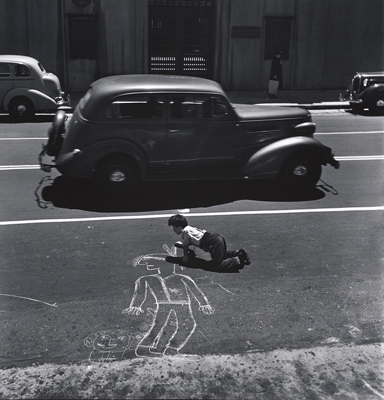
Love Hate Graffiti New Orleans, 1937

Love Hate Graffiti New Orleans, 1937

his·to·ri·an (hist-tor’i-en, hist’to’ri-en),  n. [Fr. Historien], 1. A writer of history; chronicler.  2. An authority on or specialist in history. Abbreviated hist.

On Friday, I visited the Center for Creative Photography, where there was an exhibit by John Gutmann entitled “The Photographer at Work.” Gutmann’s work, with its dynamic use of contrast and figure placement, moved me. My response to his images was gutteral, emotional. I found myself scrutinizing each photo—trying to better understand his subjects, why he was drawn to them. I found his story equally moving. Gutmann was an artist who lived life, with his photos as a documentation of that life lived. A Jewish man fleeing the Nazis in Germany, he arrived in the United States in the thirties. He was attracted to those marginalized—carnival performers, misfits, people often ignored or left unconsidered by others. And he made them the focal point of his work.

Many of his photos took place in San Francisco, a city where I lived for three years, and I enjoyed seeing the place revised in my own mind with these images from the 1940s of places I was familiar with: City Hall (except with a Nazi flag hanging next to the American one from a visit from German leaders), Mission Street (with a corner store that looked exactly like ones I used to walk by), and the Golden Gate Bridge (including a photograph of the first post before the bridge was even completed). In addition to his interest in people, animals and buildings as his subject, Gutmann also liked to see the interplay of language as seen through his lens. He took pictures of graffiti: art depicting art. He elevated graffiti on walls and popular culture signage to high art. He wanted to consider the way people used language in their day to day lives, what meaning could be made, and by doing so, he made all those who saw his photos consider the same questions about language.

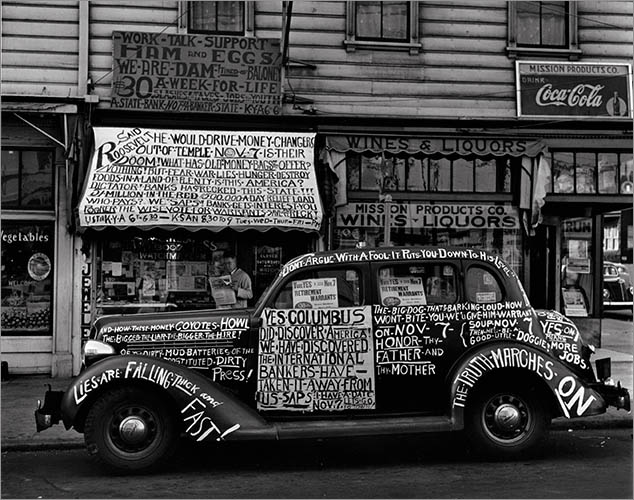
The curator’s biography of Gutmann described his fascination with the intersection of language and physical environments. Rather as seeing billboards or signs on grocery windows as the backdrop of photographs, he saw them as the focus. Not only were they interesting to examine but they were markers of the time. One of his photographs of a painted car reveals the scribbler’s politics and hopes for the next election. The language painted on the car is critical of banking, of Roosevelt, of war, and of poverty even in “a land of plenty.” While it could be seen as discouraging to some since the same troubles we face today were ones of yesterday that are reoccurring, I see it differently. For me, this image reminded in, in a hopeful and inspirational way, that there have always been dissenters, that there will always be political art. Remembering that it was that way, is that way now and will continue to be that way helps me stay grounded, helps me feel better about the struggles we have to face as a country and world. These political signs are next to signs advertising ham and eggs, liquor and wine. The political and the everyday. The criticism of the greed of those that keeps others hungry and the advertising for food that would feed us all. In capturing images like this, Gutmann is a witness to what people saw in their everyday lives but maybe did not really look at.

I talked to my friend who visited the gallery with me about Life magazine. “We don’t really have a publication like that anymore since Life stopped in the seventies,” I told him. “A mainstream magazine that is responsible for iconic photographs, for photographs that are artistically done.” I find it intriguing that as photography has become more accessible to the masses, photography as art is less accessible. You have to visit galleries to see it. You have to buy expensive magazines to see it in print. The role of photographers was often that of documentarian. In a time when cameras were more challenging to use and oftentimes prohibitively expensive, photographers were the holders of collective memory, they were the ones who rendered cultural issues and time periods into treasured artifacts. They were our visual historians.

Now, everyone has access to a picture-taking device—whether it be a digital camera or their cellular phone. Images are taken hastily, without thought, and quickly forgotten. It seems now that we are all able to document our own lives we are less concerned with or create less demand for good photojournalism. There is very little sacred in picture taking now. How many people actually keep photo albums instead of folders on their computer?

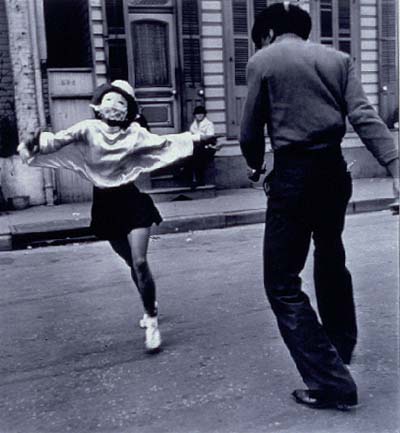
Walking into the second room of the gallery, I saw images of men and women wearing masks. “Jitterbug in New Orleans,” one of the images read. The curator’s notes said that Gutmann had intentionally stopped in New Orleans for Mardi Gras, not to document the celebration but to examine and capture the complicated racism and race politics of the city. One of the pictures shows a “Black Davy Crockett,” with a jokey smile and fur coat and hat, surrounded by well-dressed white people. I was reminded of how African-Americans were not permitted to celebrate “White Mardi Gras,” and thus were forced to develop their own parade (Zulu), to come up with their own traditions (Mardi Gras Indians, Skeletons).

While it may sound silly as it is often artists that are challenging the status quo, I found myself surprised at Gutmann, a white European man, and his interest in issues of race. It is true that in some ways, his Jewish faith made him marginalized but his skin was white. I felt grateful that he was invested in exposing inequality even when he personally had little at stake. I appreciated his interest in those who were not paid attention to by many in power in this country at the time. He saw the beauty of a life fully lived and the people he thought lived that life were those at the margins, people who for lack of acceptance or belonging in the mainstream made their own communities—the poor, the working-class, minorities, women, drum majorettes, horse stunt women, tattooed sailors, members of the Indian school band, rural farm boys winning competetions, little black boys who made soap box cars.

Undoubtedly his own placement on the fringes, from being a Jew in Nazi Germany and then an immigrant in the United States, made him more appreciative of and interested in others who shared this same trait.

Gutmann chronicled the lives of people we might not otherwise know about and he depicted them in strong contrast, with interesting angles. His work not only brought these subjects to life both also offered a critique of the environment around them that placed them on the outskirts.

I think the thing that most struck me looking at the images is that I could tell by the picture itself the respect that Gutmann had for his subjects. This wasn’t just about artful composition to him. It wasn’t just getting paid. Gutmann was committed to the integrity of the people and landscapes in his images. That sincerity is something that cannot be faked.

"We Want The 40 Hour Week", San Francisco, 1934

Jitterbug, New Orleans, 1937

"Yes, Columbus Did Discover America!", San Francisco, 1938

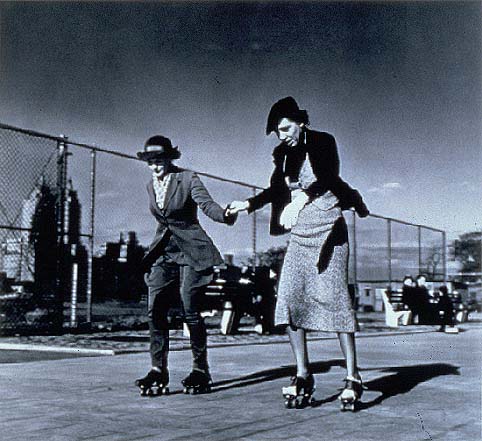
The Lesson, Central Park, New York, 1936

The Artist Lives Dangerously, San Francisco, 1938

Indian High School Band Traveling Through Desert, Arizona, 1937

The Game, New Orleans, 1937

Pop Advertising, San Francisco, 1939

Leave a comment

Filed under weekly words

saint

saint (sant), n. [ME.; OFr. seint, saint; L. sanctus, holy, consecreated],  1. a holy person. 2. a person who is exceptionally meek, charitable, patient, etc.  3. [S-], a member of any of certain religious groups calling themselves Saints. 4. in certain churches, a person officially recognized as having lived an exceptionally holy life, and thus as being in heaven and capable of interceding for sinners; canonized person.    adj. holy; sacred; blessed  v.t. to canonize; make a saint of. Abbreviated St., S., s.


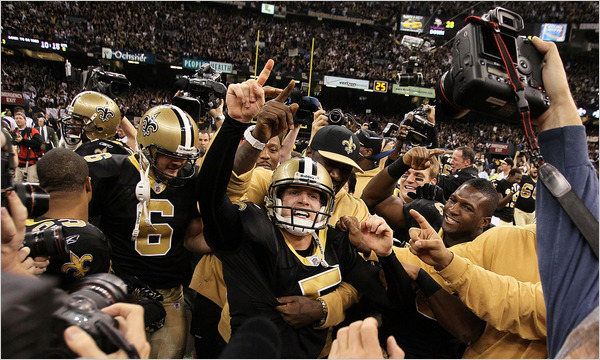
This is a special post, not one that follows the normal rules of this blog. I felt I had to weigh in on the New Orleans’ Saints victory over the Minnesota Vikings today to win the N.F.C. Championship just a few hours ago.

I am not a big football fan. I enjoy watching the game but only in the company of others. As a New Orleans native, I became quite used to the Saints losing year after year. When others were watching, I would watch too and cheer and ultimately, be disappointed. Over the past few months, I have watched the Saints both win and lose, but I have watched them play with diligence and commitment and a spirit of camaraderie. I have also watched my friends and strangers from my hometown become overcome with excitement at having a winning team, at having something from our city to believe in.I have seen the Superdome full, the fans decking themselves out in elaborate black and gold gear. I have seen post after post on facebook, friends echoing their enthusiasm about the team winning.

New Orleans isn’t always united. The town had its share of problems even before the levees broke–a failing education system, deep scars and open wounds of racism, corrupt politicians, disintegrating wetlands that make the city even more unstable. But the thing is, the city is also a place of deep spirit, of commitment, of passion that cannot be squelched, of celebration that will not be denied. And we have seen that in the way its citizens–and many people from around the country–have rallied around the Saints this year.

The truth is: We needed this. It has been a long long road since Katrina. We watched our city, our neighborhoods, our blocks and our homes covered with water. This was about more than a football team. This was about more than a championship game. Today was about feeling proud of our city and ourselves. I’m not saying that winning this championship game or even winning the Superbowl, if that’s what comes to pass, solves the city’s problems. There is still so much to rebuild. There is a deep disparity of wealth. There are problems that will not be erased without much work and dedication. But when I watched the Saints win today, I kept thinking of the song “Do You Know What It Means To Miss New Orleans?” I thought of it in terms of this game. I don’t think that everyone knows what it means to see a team that has never, in its 43 year history, made it to the Superbowl  realize that dream. I don’t think everyone knows what it means to see the Superdome–a place ridden with memories of despair from when it was a shelter for Hurricane victims–turn into a place of redemption and hope.

Perhaps some might say that I am blowing this out of proportion, that this is afterall just a sports game, that it is made up of overpaid players and by people who want to make a ton of profits. All I can say in rebuttal is how it felt today to see the Saints win. I, a person who doesn’t really care about sports, was overcome with a spirit of joy as I watched fans in the dome hug each other and confetti fall from the ceiling. I was unable to get through to my parents on the phone for an hour because the 504 lines were all tied up, everyone was calling each other to scream into the phone, to cry, to celebrate.

I will argue with anyone who says this was just a game. Today provided the citizens of New Orleans with fulfillment of a long awaited dream and with a chance to showcase our city and be proud of one another. No matter what our differences, today we all have a team we can believe in, and for the moment, that feels like enough.

Leave a comment

Filed under weekly words

fustigate

So, I am working on finalizing a draft of a long writing project. Although there is much work to be done, I feel proud of myself for all the work I’ve put in.

And I was thinking of starting to go to Bikram Yoga–healthy body, healthy mind, healthy heart.

In this spirit, I sat down to pick out the new word. I actually felt a sensation–a sort of warmness, a good wholeness sort of vibe–shooting up my chest as I flipped through my dictionary. This sensation grew as I moved my finger across the page. I opened my eyes and found… fustigate. Fustigate: to beat with a stick. Are you fucking kidding me? I’m trying to do good things for myself and in my warm and fuzzy mindset, the word the universe sends me to is one about being beaten with or beating someone with a stick. Okay. Well, I am not ready for this post, clearly. To be continued…

Back…It has been a few weeks since I picked that word.

fustigate (fus’te’gat’), v.t. [FUSTIGATED (-id), FUSTIGATING], [<L. fustigatus, pp. of fustigare, to beat with a stick < fustis, a stick], to beat witha  stick; cudgel.

objects used: bastinado, bat, belt, billy, billyclub, birch, blackjack, bludgeon, cane, club, cosh, ferule, mace, nightstick, paddle, rod, sap, shill, shillelagh, spontoon, stick, switch, truncheon

action taken: bang, bash, bat, batter, belt, box, break, bruise, buffet, cane, castigate, chastise, clobber, clout, club, collide, crush, cudgel, cuff, drub, flaggelate, flail, flax, flog, hammer, hide, hit, knock, lambaste, larrup,  lash, lather, leather, lick, maltreat, mash, maul, paddle, pelt, pound, pummel, punch, punish, put over one’s knee, ram, rap, slap, slug, smack, sock, spank, stike, sawt, tan, tan one’s hide, thrash, thresh, thump, thwack, trounce, wallop, whale, whelp, whip

objects receiving action: arm, brow, cheekbone, eye, ear, elbow, thighs, knee, foot, nose, organs, crown, forehead, temple, ankle, finger, wrist, shin, back of the knee, back of the head, back of the back, jaw, head, nails, neck, clavicle, breast, chest, abdomen, hipbone, pelvis, toe.

result: broken, fractured, bruised, bent, torn, lacerated, bleeding, scarring, ripped open, searing, gone to pieces, fragmented, injured, dismembered, mangled, mutilated, pulvirized, riven, ruptured, separated, severed, shattered, shredded, slivered, split.

reasons given: so he can learn a lesson lesson, to knock some sense into her, so she’ll know better next time, tough love, to know life isn’t easy, to not mess up, screw up, fuck up again, he had it coming, she had it coming, she/he/they should have known better, he’s a fuck up, she’s worthless, if he wasn’t around, my life would be easier, she makes me do it cause she makes me so angry, he deserves to be taken down a notch, she knew I was like this when she got together with me, because I can.

http://www.abanet.org/domviol/statistics.html

Leave a comment

Filed under weekly words

synthetically

syn·thet·ic·al·ly (sin-thet i’k’l’i, sin’thet ik-li), adv. In a synthetic manner; through synthesis

thus:

syn·thet·ic (sin-thet ik), adj. [Fr. Synthetique; Gr. Syntetikos], 1. of, involving, or using synthesis: opposed to analytic. 2. produced by synthesis; specifically, produced by chemical synthesis, rather than of natural origin, hence 3. artificial; not real or genuine: as, synthetic enthusiasm. 4. characterized by the use of inflectional adjuncts, or affixes, to express syntactical relationships: opposed to analytical. n. something synthetic; specifically, a substance produced by chemical synthesis. –SYN, see artificial.

Truths:

I picked this word about a month ago.

I have been in the throes of a major project which has demanded my attention and moved to the top of my priorities.

I also just felt stumped. What a cool word, but for some reason, I couldn’t figure out what to write.

I do want to move on and in order to move on, I have to have a post about this word. That’s the rule.

So here is my post about this word.

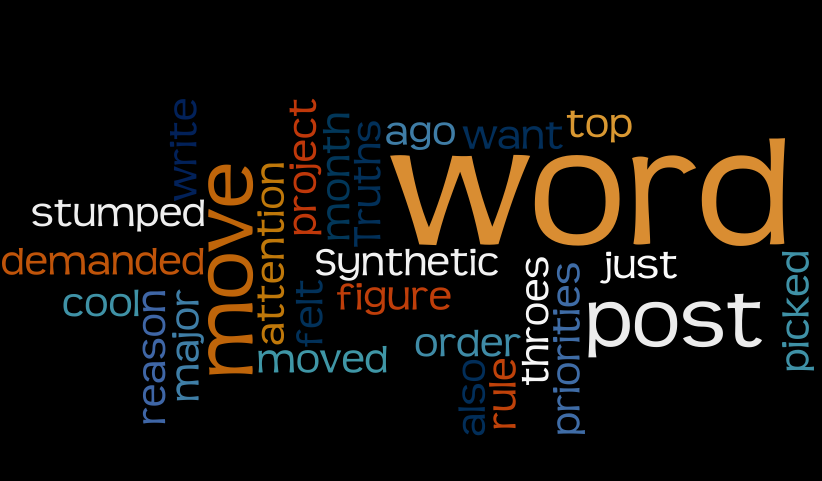
When I put the words above into wordle.net (which, by the way, you have to check out if you haven’t already), I got the an image. Here you go, my random thoughts synthetically created into this image:

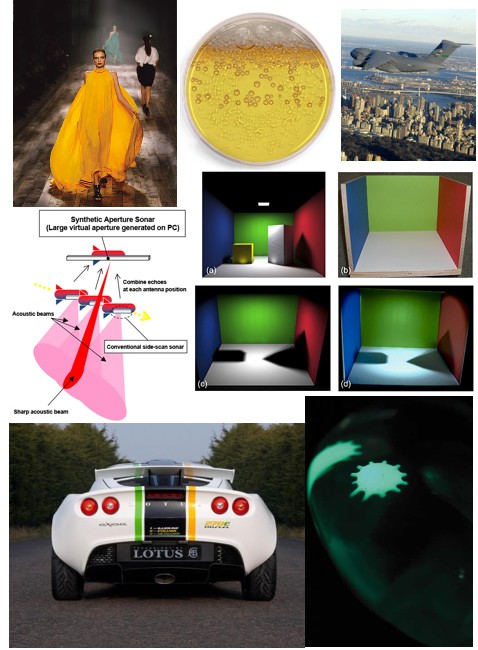
In addition, here are images that came up on the first page when I did a google search for synthetically, synthetically arranged:

Leave a comment

Filed under weekly words