Tag Archives: dictionary

New York·er

“Above Fifth Avenue, Looking North,” a 1905 print by Underwood & Underwood


New York·er  (yôrkər), a native or inhabitant of New York (State or, especially City)

This week, we are lucky to have a guest post contributed by writer Julia Gordon. Enjoy!


When Lisa asked me to be a guest blogger (thanks Lisa!) on The Dictionary Project and told me that the word she’d chosen was “New Yorker,” I immediately started to think about what it means to be a New Yorker, and the different connotations that appellation carries within different spheres: upstate, downstate, Manhattan, boroughs, suburbs. I thought about all of these things and I thought that I would try to touch upon all of them, in some sort of expansive way…and then I realized that all I could possibly talk about as a New Yorker was my own experience of the city, the people, of my life before I got there, of my life while I was there, and of my life before I left. This is nothing less and nothing more than my New York, my version of its reality, my corner of its soul.


This slideshow requires JavaScript.


//     New York, 1978-1996/1999-2009     \\


Knee-high landscapes. Stiletto heels. Subway suits. Blue-suited coffee cups. New gum under new soles. Trains jerk to a stop. Bodies pressed together. Shoulders: intimate friends. Tunnels to nowhere. Tunnels that are homes. Tunnels with rats. Tunnels with mice. Tunnels with spiders. Tunnels in walls. Tunnels underfoot. Tunnels under water. Tunnels through bedrock. Rainboots are in style. Snow is never white. More cars yellow than not. Steaming asphalt. Smell of rain on tar. Rockefeller Center. Times Square smells of guilt. You can only buy chestnuts in winter. The steps to the Met are bigger each time you see them. The Temple of Dendur is magic. You fit your head into a library lion’s mouth. Central Park. Shakespeare outdoors. Class trips to see the dinosaurs. The planetarium was better before. Class trips to see the monkey house. Class trips to the old Westchester manors. Class trips to the Tenement Museum. Guss’ Pickles. Ten feet of buried cobbles. Ten streets of hidden Jews. Class trips to South Street Seaport. Dates who take you to South Street Seaport. The Avenue of the Americas has many fountains. Running through fountains will get you wet. Metro North trains. The subway is a train. Getting on a train going the wrong way. Getting on a train going the right way. Getting on the wrong train. Realizing trains are not right or wrong except for the one that goes to Roosevelt Island. Trying to take a ferry to Roosevelt Island. Finally taking the tram. Perfect makeup. No makeup. Umbrellas open under scaffolding. Getting mad that umbrellas are open under scaffolding. Scaffolding. Ice falling off midtown roofs. Soho costs too much. Smell of parties on tar roofs. Climbing up fire escapes. Climbing down fire escapes. Barred windows. Sixth floor walk-ups with no elevators. Crumbling marble staircases. Intercoms that don’t work. Lowering keys tied to twine on fishing reels. Bodegas on every corner. Ailanthus cracking concrete. Blue trains, green trains, yellow trains, red trains, three brown trains, then two. Living in Brooklyn. Living in Manhattan. Living in Queens for two minutes. Living in Brooklyn. Living in Brooklyn. Living in Brooklyn.

It is Tuesday and we are very busy. It is Election Day and we are even busier than usual. There are planes and they crash. Planes have crashed before; we are still very busy. The governor has yet to speak. People are calling their wives. People are calling their children. People are flying to the ground. Ash is falling from the sky. The governor has yet to speak. We are still very busy. Upper left-hand corners of envelopes with return addresses of One and Two are falling from the sky. The governor speaks. It was Tuesday and we had a plan and now there is not one. We go to the roof. We are on the roof and the big cloud gets bigger and bigger and biggest and there is one shadow less in the world. We climb down off the roof. We get high. We get higher. We get highest. She kept her bunny ears and so we go there. There is snow everywhere: broadcast snow, ash snow, concrete snow, bone snow. Snow is never white. We get more high. We sleep in a tangle. My arms are his and his legs are mine as I always wished they would be, and I am glad and I am guilty that I am glad and it is morning. There is a train that will run. It is yellow. It goes above ground. It crosses the bridge. In unison, we stand. We go to the western windows. They are dirty but we do not care. We press our palms to them, our foreheads, or mouths, our cheeks, we cannot get close enough to the western windows or what lies beyond. What lies beyond is burning. It is people burning. There are Jews on the train and they do not like that there are people burning. There are gentiles on the train and they do not like that there are people burning. There are no Muslims on the train. There are no Muslims on the street. Then there are Muslims on the street with American flags. It will not stop the Sikhs from getting knifed. We go to St. Vincent’s. There is nobody to help. There is nobody there. Everybody is already buried. Everyone is already dead. We vomit tears on Seventh Avenue.

We hear helicopters and we cower. We hear firecrackers and know they are guns. The lights go out and we cry. The lights stay on and we cry. We are very friendly unless you look Muslim. Which means we are very friendly unless you are a certain kind of brown. Or we are overly friendly if you are a certain kind of brown. We watch the news. We can’t watch the news. We wear flag pins. We tie yellow ribbons. We pray. We refuse to pray. We blame prayer. We blame God. We are dogs. We travel in packs. We lie awake at night. We sleep all day long. We drink too much. We smoke even more. It looks like 1986 in that bathroom, there’s so much cocaine. The green trains run. The blue trains run. The red trains run except for the stop that doesn’t exist anymore. There are smoking holes in the ground. It smells like rotting flesh. We drink and smoke and do lines on rooftops against the backdrop of jet fuel flames. We forget. We remember. We forget.

We love each other on the subway. We love each other on the crosstown bus. We smile at each other like it’s Christmas. We talk a lot about just how much we love each other. We wait patiently at stop signs. We stop at red lights. We wave pedestrians past.  We hold the door open. We offer coffee. We put change in tin cups. We buy beers. We go to soup kitchens. We donate coats to the homeless.  We gather our canned goods. It gets colder. We smile a little bit less. We try to get warm. We make love in Prospect Park. We make love in Fort Greene Park. We make love in Green-Wood cemetery. We make love in Brooklyn Bridge Park. We make love under the war memorial at Grand Army Plaza. We make love at Manhattan Beach Park. We make love at Coney Island Park. We try to make love in Central Park but it hurts too much. In Washington Square Park we fare better but stop halfway through to buy pot. We are remembering again but we are trying to forget. This will go on for years.

It has been years. We are better. Firecrackers are firecrackers. Guns are guns. The lights go off and we laugh. The lights stay on and we laugh. Helicopters are helicopters. Thunder is thunder. Rain is rain. We frown again on the train. We lean on our horns. We block the box. We do not like our mayor. We do not like each other. We do not make love. We do not go to holes. We do not look out western windows. We do not wear flag pins. There are no lights in the sky. There are no cranes in the holes. We do not talk about it. We talk about it too much. We lie awake at night. It has been years.

Movies in Bryant Park. Concerts in Prospect Park. Shakespeare in The Park. The monkey house is gone. We are too big to ride the giraffes.  Holiday parties at the MOMA. Coworker trips to the Guggenheim.  Rockefeller Center. Times Square smells like the color pink. The steps at the Met are smaller than they used to be.  The library lions roar. You can’t buy chestnuts at all anymore. There is a right train and a wrong train. There is your train. There is your corner. There is your store. There is your door. Tar roof smells are memories. The planetarium isn’t that bad.  The Temple of Dendur is still magic.  Running through fountains will get you arrested. The cobblestones were always Belgian blocks. You told me it was time to go. We drive across the Brooklyn Bridge. We drive up the West Side Highway. We drive up the Saw Mill Parkway. We drive west on the Cross County Parkway. We drive west. We drive west. We drive west. Ailanthus trees push through the concrete, rock bricks loose from mortar, twist around fire escapes. We always take the stairs.


\\     July 2011     //


Julia R. Gordon is a writer with over ten years of experience in the non-profit sector as well as a background in government and political media, fundraising, and message development. Since 1998 she has worked as a writing consultant, providing one-on-one tutoring in writing skills, public speaking, and resume development as well as editing services for academic papers, research projects, and creative writing endeavors. She currently works at the University of Arizona and Raise the Bar LLC, and serves on the Board of Directors for Casa Libre en la Solana, a Tucson, AZ-based literary arts organization. She also writes for The Skein (www.theskeinblog.com), an online blog she created to explore politics, government, society, and interpersonal relationships through language and the written word. Julia was born and raised in downstate New York, and made her home in Brooklyn for a decade, prior to relocating to Tucson in 2009. During her time in New York she worked for such organizations as The Center for Literacy Enrichment at Pace University, Cornell University Medical College, the New York City District Council of Carpenters, Alliance for Quality Education and East River Media. During her career she has also held positions with several city- and statewide political and issue-based campaigns throughout the country. Julia is a graduate of Cornell University.
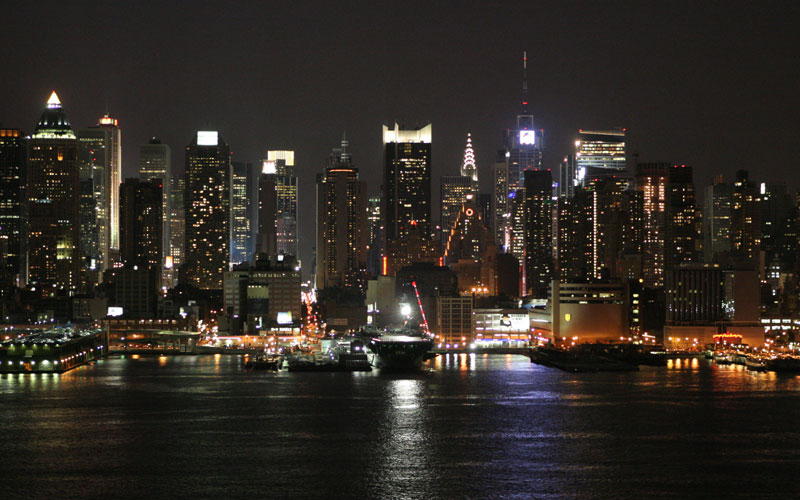


Modern NYC Skyline


Ryan Adams’ album Gold, on which the song “New York, New York” appears, was released September 25 , 2001. The video for the song (below) was shot in the streets of New York four days before September 11, 2001.


Leave a comment

Filed under weekly words

poly·sty·rene

poly·sty·rene /ˌpäliˈstīrēn/ n: a rigid transparent nonconducting thermoplastic used esp. in molded products and foam.

Yesterday, a status update went viral on facebook. People began posting and reposting the quote that was attributed in its entirety to Martin Luther King.

This quote was:

“I mourn the loss of thousands of precious lives, but I will not rejoice in the death of one, not even an enemy. Returning hate for hate multiplies hate, adding deeper darkness to a night already devoid of stars. Darkness cannot drive out darkness: only light can do that. Hate cannot drive out hate: only love can do that.” Martin Luther King, Jr.

The message was posted in response to the United State’s killing of Osama Bin Laden on Sunday and was posted by numerous facebook users, of which I was one. By yesterday evening, articles began springing up pointing out the inaccuracy of the quote. The Atlantic had an article entitled “Out of Osama’s Death, a Fake Quotation is Born.”This headline is inaccurate. The quote wasn’t a fake, a fraud, made up. A part of it, less than a third, was misattributed.

The first sentence of this quote was not written or said by Martin Luther King, Jr., but the rest of it was. Okay, I thought, we all have a little egg on our face. We should make sure we have researched the quote before posting, but it is the solidarity of that message, the need to speak to that sentiment of love and of nonviolence after this violent act that counts, right? Apparently, wrong.

More articles emerged talking about the “fake quotation” and how immediately it went viral without people checking their facts. (I won’t even go into the fact that this is a facebook status message, not an investigative report.)

This kind of focusing on the minor detail in lieu of the whole, the attempt to find the piece that invalidates the whole message is what I detest most about news networks like Fox News, who spread information completely skewed and out of context to masses who are genuinely and earnestly seeking information. It reeks of that “Gotcha” mentality. Look what we found, look at this detail and how silly, how stupid, how wrong this sentiment, this speech, this movement, this entire group of people is. Taking this first sentence that was misattributed and blowing it out of proportion makes us lose sight of what was really happening here. Individual people were taking action, were responding in a way that was in opposition to the jubilant celebration of Osama Bin Laden’s death.

Here is what I take from the status updates of yesterday. People who posted were trying to call on a bit of solemnity in relationship to the killing of a man by our country. People who posted felt conflicted about the act of violence that occurred when the U.S. took the life of Osama Bin Laden. Even if he was a person who was responsible for the needless death of thousands of innocents, he was also a human being. Our act of murdering him was returning hate with hate, violence with violence. People who posted felt conflicted about and embarrassed by the drunken St. Patrick’s Day style celebrating and jubilation that they witnessed after seeing images of our fellow Americans thumping their chests and screaming “USA,” holding American flags and hanging out of trees. Maybe they, like me, had a hard time reconciling that sort of response to a man’s death, even if it was the death of a man who had caused such tragedy and suffering to our community. In status updates that their friends posted, these facebook status posters found a sense of solidarity, of community and of compassion in the midst of a situation they were wrestling to understand and make sense of a personal level. They were looking to the words of one of our greatest leaders of nonviolent social change. They were seeking to model him. They were trying to think about what creative problem solving we might employ to be a country that engages in peaceful diplomacy, that attempts to find ways to better understand others in the world so that this kind of violence is not necessary.

By posting the words of MLK and by what I write here, I am not saying I don’t understand the ways in which this feels like necessary closure to those Americans who lost family and friends in the attacks and even to those who didn’t. We, as a country, were all affected in a major way by 9/11. I grieve with my fellow Americans for the losses we suffered, and I understand how this event can feel like a satisfying resolution. What I am saying is that our response involved more violence, involved stoking the fire of hatred, and I am not at ease with that. (Furthermore, I don’t believe that this act will resolve our problems with al Qaeda nor cause them to disengage and desist. I think it might exacerbate it all. But this is not my focus here. My focus is this one status update, this one response.)

I think its important to recognize that what a large group of people felt called to do yesterday, in the wake of the death of Bin Laden, was to think of major leaders of the nonviolent movement, like Martin Luther King, Jr., like Gandhi, like Dorothy Day. People that said: No. No matter what the violence. No matter what the mistreatment. We will, in fact, conquer, but we will work as a peaceful people.

For me what makes the United States great is not the times we use force but the times we use creative thinking and diplomacy to relate to other people and to get the outcomes we need.

And I don’t want to sit by while the fine line is scrutinized, while these statuses are viewed as unfortunate and inaccurate. The sentiment embedded in the quote was there. These facebook users wanted to suggest and seek out the ways in which we can add lightness to the dark, the ways in which we can drive out hatred with the power of our love. And that is what is important in this: the amount of people that message resonated with. Not that the first sentence of it didn’t come out of the mouth of Martin Luther King, Jr.

7 Comments

Filed under weekly words

flo·ta·tion

Inside a Hot Air Balloon. Provence, France. Photographer Unknown


flo·ta·tion (flōˈtāSHən)  n.  [earlier floatation, respelled as if < Fr. Flottatison],  1.  the act or condition of floating or launching.  2. the act of beginning or financing a business by selling an entire issue of bonds, securities, etc.; hence, 3. the act of beginning; becoming established.  4.  in mining, a method of ore separation in which finely powdered ore is introduced into a bubbling solution to which oils are added: certain minerals float on the surface. And others sink. Also spelled floatation.


And from another definition: “involves phenomena related to the relative buoyancy of objects”


Thoughts on floating, in three sections


I.

It is difficult for us human types to be buoyant when water is not involved. There is a gravity to us, not just the weight of our skeletons, our sinew and tendons and muscles. There is a gravity to the way we think about and interact with the world. Just the nature of our consciousness and our ability to consider ourselves, to reflect on our lives and our relationship to other lives, means that we hold ideas and concerns within us that weigh us down. I don’t think this is necessarily a bad thing. Without weights, balloons fly off into the sky. Being grounded is often a necessary, satisfying feeling. Some of the poses that feel most challenging to me in hatha yoga are balancing poses, where I am required to suspend most of myself in the air without both feet firmly planted on the ground. There is satisfaction in rooting.

However, I do think there are moments when we need to be able to experience lightness to balance out the things that keep us weighed down. For hundreds of years, different seekers have tried to achieve a greater form of lightness.

English scientist Henry Cavendesh isolated hydrogen in 1766 and doing so, commented on the idea of “negative weight” and the possibility of lifting objects above the earth.

The hot air balloon was invented by French brothers Joseph and Jacques Montgolfier seventeen years later. This invention began as a smaller experiment when they found that in filling a silk bag with hot air, containing less density than the air surrounding it, it rose to the ceiling. They created a larger bag to hold the air, attached a basket and sent several farm animals aloft. A few months later, they launched a seventy-foot high balloon that raised Jean Francois Piltre de Rozier and the Marquis d’Artandes three thousand feet above the ground. One hundred and twenty years prior to the Orville Brothers’ first successful flight by plane, these men were the first to have that feeling of rising far above the ground and being held by the air, of being sustained in a sort of static flight.

But long before this hot air balloon flight, Francesco Lana de Terzi, an Italian Jesuit priest, mathematician and

Francesco Lana De Terzis Flying Boat Design, c. 1670

naturalist, designed his own airship, one that moved from force of wind in the bellows. He is often referred to as the Father of Aeronautics for his designs, innovation and exploration and for legitimizing aeronautics as a field of study. The airship design itself resembles a sea ship, with its crescent sails and curved boat-like bottom. Instead of moving through water, this ship would navigate the sky.

By 1663, he had developed plans for his airship and published them in a book. His invention was designed after and would be steered as if it were a sailboat. The ship was to be made of a central mast with a sail attached and four smaller masts to which were attached copper foil spheres. He calculated the size of these spheres and the air that would be pumped inside them, in vacuum conditions, so that they would be less dense than the air surrounding them. No one had the capacity during his time to manufacture the thin copper foil. As it turned out, no such capacity exists. Even if done in vacuum conditions, the pressure of surrounding air would immediately flatten the thin metal.

The idea itself was problematic even to its inventor, but for other reasons besides actualization of the design. De Terzi expressed concerns that the ship could be used ultimately as a weapon in war, saying, “God will never allow such a machine be built…because everybody realizes that no city would be safe from raids…iron weights, fireballs and bombs could be hurdled from a great height.”

Bartolomeu de Gusmãos airship

Fellow Jesuit priest and Brazilian naturalist Bartolomeu de Gusmão redesigned an airship, in the tradition of de Terzi, and in 1709, he shared his secret plans and blueprints with King John V of Portugal. His design was for a large sail to be spread across a boat-shaped base like a rainbow. The momentum of the vessel was to be derived from magnets in two balls on either side of the ship. The planned public test of the machine never took place, but some reports say that he did more informal experiments and was able to make the vessel fly. Gusmão later worked on a newer invention of an airship, with a gas-filled pyramid above the vessel, but he died before he could bring his design to fruition.

I think about these thinkers and inventors and their desire to sail through the air. They had the yearning be above the ground, not merely for a given practical purpose but for the experience of it, the change in perspective, the ability to see the earth that we know assume a different shape as we rise above it.

There is a beauty to the way that we humans constantly try to defy our own gravity. We jump on trampolines, we bungee jump, we suspend ourselves from ropes, we hang on trapezes, we fly in airplanes and helicopters, we parasail, we gondola, we zipline. We manufacture all kinds of ways where we experience freedom from the ground, where we experience little more than air encasing our bodies. I don’t think these are merely executions of adventure but ways in which we experience the ephemeral nature of our lives and our spirits. We are born into bodies and these keep us grounded. We are made up of matter—of water and stardust—but there is something about us that seeks to reconnect with the air, and with the lightness that is also present within us. It would be injurious to not recognize this quality about ourselves as substantial as well, even if not as easily measured, weighed or quantified. For it is this lightness of our beings that encourages us to take risks, to try to create, to find ways to suspend ourselves in mid-air, if only for a moment.


II.

Today, I read a modern day fairytale that was a transformation of “The Little Mermaid” by Hans Christian Anderson. This story takes place not underwater or in a fabled land, but rather, in San Francisco, a city I called home for three years. So I was immersed from the get go in being told of the Victorian on Divisadero—a street I lived one block away from, in another Victorian, during my time in “the City.”  In this fairytale, a long-married but strained couple set up a huge water tank in their living room and take turns competing to see how long they can hold their breath before they must, inevitably, float up to the surface.

For me, the story was about both the beauty and danger of being underwater and the beauty and danger of allowing ourselves to rise up, to surface again.

Another focal point in the piece “What the Conch Shell Sings When the Body is Gone” by Katherine Vaz* is the aquatic ballerina Annette Kellerman. She was once called “The Ideal Woman” because the shape of her body mimicked the proportions of Boticelli’s Venus de Milo. But Kellerman was born with a defect in her legs and had to wear braces to walk. She was hardly an ideal candidate to be a ballerina. However, Kellerman found her physical limitations were completely resolved after she took up swimming. She created ballets underwater, her feet flicking in the same quick movements as other dancers did in the air, momentarily floating above the ground. The video I watched of her on youtube is in black and white and there is a dreamlike ethereal quality to it. She is visible and yet her features are awash. Her movements are clear but the video lacks sharpness. I found myself taken by the beauty she creates of appearing to be rooted in this underwater world. She holds onto items as she moves through the water but it is not a grasping.

Annette Kellerman

When I was about ten, Disney’s The Little Mermaid came out. I memorized all the words to “Part of this World,” the song when the mermaid Ariel muses about the oddness of the human world and all of the things she wants but, by nature of her fins, cannot be a part of. She has collected trinkets from this world, but she has no context for them. She wants to be a part of a world that she does not understand. And while this story ends happily and the Anderson version does not, both rely on the prince’s decision and affection for their endings. In neither story does the mermaid herself have a sense of volition.

I think of Annette Kellerman, who is credited for creating and bringing to popularity the first one-piece women’s bathing suit, a full-length form-fitting jumpsuit. She needed to be able to move through the water and create art with her body so for practicality’s sake created a costume that allowed her to do so, and defied expectations for women in the early 1900s. I think of Annette Kellerman, who is credited as the mother of synchronized swimming. I think of Annette Kellerman, creating her dance underwater, the beauty of her movement and the ability to create the vision she had, without becoming wrapped up in other’s expectations of what she should do, how she should dance.

When you watch the video of her dancing underwater, you can see the grace of her movements and you can also see the tiny bubbles of air floating from her mouth to the surface. She is doing kicks and splits and backbends, she is forming her body into elegant shapes, and, she is breathing.


III.

In mining, flotation is a process whereby a mineral-bearing substance is concentrated into an ore. The raw substance is treated using chemicals so that the desired mineral articles attach to air bubbles and the air bubbles carry these to the surface of the pulp. Undesired minerals remain submerged.

The process is also called “frothing” or “froth-flotation” because once the desired minerals rise to the surface, the froth is then sweeped from the top, collected and distilled. This process is used for many minerals, most popularly, silver.

Frothing is done according to minerals “wettability.” The chemicals used are chosen to completely wet one of the types of particles while partially wetting the other type. It is the partially wet type that will attach to air bubbles and will lift up to become part of the froth.

Although initially developed for mining, the froth flotation process is now used for other needs of modern society, like treating wastewater, like de-inking paper so it can be recycled into new paper.

by Anthony B. Bannister, Copper-Gold Froth Flotation at Rio Tintos Northparkes Mine-NSW-Australia

Images of froth flotation resemble the bubbling up of sparkling water, of soda, of hot springs. Except these bubbles are opaque. The minerals attach to the bubbles and color them shades of gray, of silver, of black, of copper, of brown. The mineral particles attach to the air bubbles, become part of them for a while, and they float for just a moment before they are then separated again, distilled out.

I have never been good at chemistry. I can get some of the basic concepts. I can memorize formulas. I can understand that matter can change in structure, in form. But I have never been good at understanding or identifying the precise moment when pieces of matter conjoin or divide, at being able to envision the exact time in which matter transforms, becoming suddenly more heavy or becoming weightless.


*published in the amazing collection, My Mother She Killed Me, My Father He Ate Me

Leave a comment

Filed under weekly words

hale

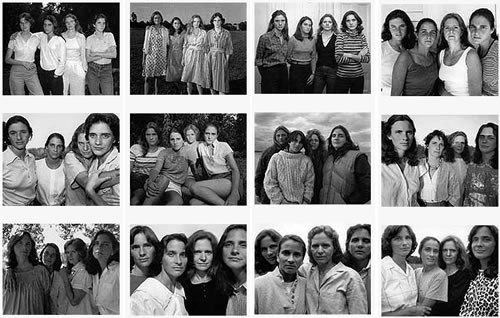
Every year since 1975, photographer Nicholas Nixon has taken a black and white image of his wife Beverly "Bebe" Brown and her three sisters. In each image, the sisters are photographed in the same order.


hale (ˈhāl),  adj. [northern ME, hal, same as Midland hool (see WHOLE); AS. hal, sound, healthy)  sound in body; vigorous and healthy, especially as used of an older person: also spelled hail. –SYN. see healthy.


By the time I was ten, I had lost both my grandfathers. By the time I was twenty, I had lost my grandmothers too. I look on my friends who have their elders still in their life with no small bit of envy because I wish I had gotten the opportunity to get to know these beloved family members as an adult.

Our culture in this country is so youth-centered. We are anti-aging. We deny death. We deny our own impermanence. We buy creams designed to stop fine wrinkles. We do crosswords to keep our minds active. Tummies are tucked. Faces are lifted. But this is just crown molding. Structurally, we are the age we are. Our bones know how long they have belonged to this body. Our sinew stretches, our skin shifts, our faces and our minds begin to lose some of their elasticity.

Something is lost in our inability to recognize our own mortality, in our unwillingness to acknowledge the act of death as inexorable from life as the act of birth.

As we age, several things happen to us physically. Among them: our cells multiply slower. We produce fewer of some cells, like T-cell lympocytes, which help with our immunity. Other cells don’t die when they are meant to and we can be at increased risk for infection. Aging changes our responses when exposed to environmental toxins. We lose height because our discs compress, our posture changes, our hips and knees curve, our joints shift. We lose the arches in our feet. Our bodies can’t regulate temperature as easily as we age. Our weight changes: by the time we are seventy-five, the amount of our body made up of fat has doubled since we were twenty-five.

Other things happen to us mentally. With the normal aging process, not accounting for instances of Alzheimer’s and dementia, we begin to lose our memory. This process actually begins around age thirty and progresses steadily from then. Monika Guttman writes in the article “The Aging Brain” that brain weight and brain volume decrease as we age, with brain weight decreasing five to ten percent from age twenty to ninety. Other physical changes in the brain include the grooves on the brain’s surface widening and the swellings on the surface decreasing. Also, we develop clusters of dying or damaged neurons, called “Senile Plaques.”

Our bodies and minds age largely not only in accordance with our genetics and environment but with how we treat them. If we exercise and eat well, our bodies age better. If we keep active and keep learning, our minds age better.

However, whatever we do to keep healthy, inevitably, we age. We age because that is a natural part of the process of life. And as we lose certain aspects of our body and mind, we gain others. Our bodies bear the marks of our experiences in the form of stretch marks and scars and injuries. Our minds serve as containers for all the stories we have learned, the books we have read, the conversations we have had. Containers for days of celebration and days of mourning. And as these memories pile on each other, we may have less control over which ones appear, but we also have way more to choose from.

I know I am young still, but I have, even over the past five years, seen changes that reflect aging in my face and in my body. For the first time ever last month, I had an experience with tendonitis from overusing the muscles in my shoulder. And while sometimes I bemoan these changes, I also recognize that these changes mean that I have had this time to live, these experiences to live in and through.  I look back at pictures of myself in my early twenties and what I notice more than the changes in my physical appearance is the difference in my experience which seems to be evidenced in my carriage, in my eyes. So much has happened since then.

The last pose in all forms of hatha yoga is shavasana or corpse pose. Some yoga teachers say this is the most challenging pose, to lay on the ground, completely still, feet and hands facing up. In taking care of our bodies but not trying to stop their natural process of aging, we honor all that is contained within them. In doing the shavasana pose in yoga, we prepare ourselves for our final shavasana. In this position, our entire being is vulnerable. And this is how we are in death, when our lives are over and we have no more left to do. We rest.

Leave a comment

Filed under weekly words

un·sound (2)


un·sound (un-so̵und),  adj. 1. not sound, whole, or perfect; not in perfect health or condition.  2. at variance with fact, truth, or reason; false; ill-founded. 3. not safe, firm, or solid; insecure. 4. not deep; light: said of sleep.


Well, we are in the final hours of February and this is the final post for this year’s flash fiction february. Enjoy this story from the mind and pen of writer Liz Warren-Pederson.


A Church-Going Woman


Marjorie! In English, while you slept bent over your desk, I actually listened to Mr. Blankenship go on about Horace, and do you know what he said? He said, “For the sins of your fathers you, though guiltless, must suffer.”

Oh, Marjorie. The Romans weren’t as funny about gender equity as the Greeks, but we know better now. For the sins of your mother, you too will suffer. I am sorry about that!

Marjorie, your mother’s shop is cluttered and smells like granny soap, so the yarn my mother buys when she buys from your mother is saturated with granny soap smell. And then the afghans she crochets with that yarn smell like granny soap, and so I always know which afghans came from your mother’s yarn. I’d like to go through the house and smell all the afghans and take the ones that came from your mother’s shop and set them on fire in the backyard. But it’s not the afghans’ fault, it’s your mother’s, and besides, my mother loves her afghans.

Marjorie, I’m tracking you. Have you noticed? I saw you making out with Tommy Jarman on Fifth Street. Does your mother know about Tommy Jarman? …would she like to know?

No one hates a browser like your mother, Marjorie. She gave us the beady eye right away when we came into the shop, but I thought she’d be content just to glare. I went to look at magazines, because I don’t “craft,” but my mother gets lost in all the yarns and beads and pretty colors, and everyone knows that Marjorie. Everyone. The people who don’t know it for sure can guess just by the way she acts, and your mother doesn’t have to guess, she knows: my mother is unsound. She is not of sound mind.

Marjorie, your mother is two parts 1950s librarian to one part Dog the Bounty Hunter. Your mother sells yarn, but she gives the scorn away for free.

Did my mother’s mother do something to your mother’s mother, Marjorie? Are we stuck in a terrible cycle? I can break the cycle, Marjorie. While you and Tommy Jarman pump out librarian-Dog daughters bent on my destruction, I will leave this little place, and go far far away, to the city, and to college, where I will be happy and free. There are more cycles to break than the one your mother continued, Marjorie. No one should have to live the way my mother has to live, and her genes can die with me.

Marjorie, your mother pushed by me where I stood looking at the magazines and she left a powerful granny soap scent in her wake. When I looked up, she was holding my mother by the upper arm as if my mother was a sticky toddler. She muscled my mother halfway across the store, past the mailman and the mayor’s wife, and scolded her about shoplifting. Unjust, Marjorie!

Marjorie, I saw you cheating off Teresa Johnson’s geometry test. Did you know that besides teaching geometry, Mrs. Billings is the drama club advisor? Did you know that I am her star pupil? Marjorie, I can cry on demand. It is true that everyone hates a tattletale, but Mrs. Billings loves academic integrity, and when I blow the whistle, it will be reluctantly, through many tears.

Your mother made my mother cry, Marjorie, did she mention that to you while your whole family sat down to a pork chop dinner?

By the time I got to them, Marjorie, your mother had dumped everything in my mother’s purse out on the counter. Her apple, her crochet hooks, her lipstick, her Kleenex, her paperclip necklace collection, her colored pencils, her small jar of mayonnaise, her peacock feather (snapped in half), her glass marbles, her dusty crumbs of a piece of toast, her lined notebook, her rubberbanded stack of motel keycards my father gave her, her chess pieces, her bobby pins. Do you know, Marjorie, there was no yarn, there were no beads, there was nothing from your mother’s shop.

You must know, Marjorie, that there are church-going people and there are good people, and they are not always the same. I know your mother is a church-going woman, but I have it on authority that she’s no good. We are alike in that way, at least, your mother and me.

Oh, Marjorie, I am so sorry for the awkwardness you will feel when you have to tell your mother you need new underwear. It is so strange, the way they seem to disappear from your locker while you shower during P.E. I hear they’ve been turning up in Tommy Jarman’s locker! He must think you’re a very naughty girl.

Marjorie. My mother is still in bed. Did you know a person could stay in bed for twenty-one days? I feed her toast and tea, so she must have the strength, but still she will not crochet.

Your grandmother and my grandmother live here, Marjorie, and their mothers did too. We cannot help it if they hate each other or if until now their hatred lived in us, dormant, unnoticed, until I saw your mother decide my mother was a thief. Did you know your mother called the police on my mother, and on me? Would you have done the same?

I see your mother in you, Marjorie, and you are easier to reach.


Liz Warren-Pederson lives and writes in Tucson, in a 1950s bungalow overflowing with pets. Her novel-in-progress follows the attempts of a bit-player from Andy Warhol’s post-Factory days to reexamine her experiences in his entourage and reconcile her self-imposed exile to Sedona. Liz blogs about herself in the more natural first person at Girl of the Golden West and can be reached at liz dot pederson at gmail dot com.


On the creation of “A Church-Going Woman”:

I was really excited about the word “unsound,” but discarded the first story that came from it, or rather, the story just kind of petered out. This story started out in a really old-timey vein, a sort of frontier gothic, with this precocious 13-year-old narrator and a situation (suspicious shopkeep/mother with unspecified mental issues) that just arrived fully-formed in my mind, along with the name Marjorie. Things got really overwrought, so I updated the time period, but kept the antiquated diction, ‘cause that’s how I roll. It’s still pretty overwrought. And I’m not sure what to make of all the repetition; it’s heavy-handed for sure, but I figured flash fiction is about the only place I could get away with such shenanigans. It’s over quick, like a shot.

Leave a comment

Filed under flash fiction february, weekly words

un·sound


un·sound (un-so̵und),  adj. 1. not sound, whole, or perfect; not in perfect health or condition.  2. at variance with fact, truth, or reason; false; ill-founded. 3. not safe, firm, or solid; insecure. 4. not deep; light: said of sleep.


It is the final week of flash fiction february here at the dictionary project. I’m grateful to all the writers who took on the challenge, with no knowledge of what word they might receive, and shared their creations here.

For this final word, we have two writers sharing their work. Today, please enjoy this story by writer Esmé Schwall.


Unsound


They chose Minsk. A river coursed—Eloise could envision it—through a plateau steamrolled by longing. Icy frigate. Impenetrable bastion. It was before she learned that to name was not the same as to imagine. In September, the dignitaries arrived, the teacher among them. He wore glasses. She held a sign—Your Sister City Welcomes You—and he paused to read it, his gaze a prism. The picnic was her idea.

The teacher stood near the chain-link fence that separated the shelter area from the now-closed pool. He was dressed like the other dignitaries, in t-shirts from the natural history museum where she had brought them that morning, shirts tucked into their brand new jeans, jeans bought a size too large and belted, jeans bought because they could be bought cheaply here. “Eloise,” the teacher said, “your city has undone itself.”

Eloise stuck a fork into her macaroni salad. She corrected her reflex to correct, and looked away from him toward the Frisbee players. Her son was one of the Frisbee players. Her mother had cautioned her to call her son something innocuous and unreal while he was in utero. Hershey, her son had been. He or she. Now he was fifteen, his face soft, but his jaw fiercening. The mayor approached the microphone and tapped it. The teacher had seemed on the cusp of speaking. The feedback whined. The teacher winced. Eloise saw her home particled like paint on the edge of a curb.

In the teacher’s hotel room she saw the river again, the crest of water, the land gone flat in its wake. The teacher brought his face to her belly. When she was pregnant her belly button had looked like a little nose within her belly’s swollen face. Her son’s father had drawn a pig face around the sticking-out belly-button, making it into a snout.

“Next year, in Minsk,” the teacher said.

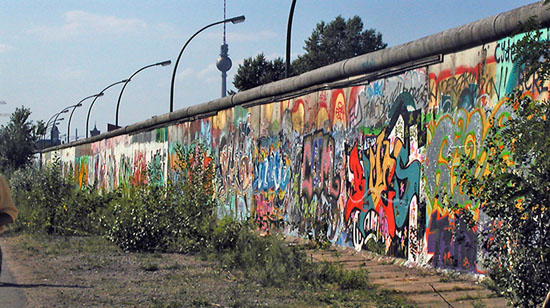
For two months, the teacher wrote. He sent her a map with the sites he promised to show her: castles, a fortress, Baroque churches. He wrote the letters on very thin paper. In November, on TV, Eloise saw a woman pleading with East German soldiers. Eloise’s son made fun of the implacable men in uniform. He growled, imitating them, his voice thick with accent. “You are prompted to return,” he said. “We are not immured—we are protected.” By the end of the weekend they had seen the Wall chiseled at, tugged down by ropes. The graffiti reminded her of her son’s skateboard. She wrote to the teacher that her son was failing even English.

One day, the city employees’ head of human resources called Eloise in for a chat. She must stop using the advantages of her office as a vehicle for romance.

“What are they going to do, censor your mailbox?” her son said. From the couch they watched David Hasselhoff on the Wall. His jacket pulsed with Christmas lights. “They don’t get to decide shit like that.”

“Language,” she said.

Her son rolled his eyes. “This sucks,” he said. “They should’ve invited Fugazi.” Even when they sat in a room together his voice sounded like something coming through a radio.

There were no more letters from the teacher. There were two rivers in Minsk, she learned, the Svislach and the Niamiha. Minsk reminded her of Pittsburgh. She bought a dress for the mayor’s annual tree-trimming event. The tree-trimming was held downtown where no one shopped anymore. Parking was expensive. They stood near the fountain where her son skateboarded on weekends; they stood in front of the head shop where he bought Converse from the clearance rack. The mayor scaled a ladder to grace the top of the tree with a giant dreidl made from Kwanza-colored lights. Celebration was a tea they steeped in.

As the mayor climbed down, her son said, “Here goes nothing,” and ran forward through the small crowd, pushing his way toward the tree just as the mayor stepped off of the ladder. Most news cameras missed the shot. Eloise only saw her son’s back and the mayor’s recoil. The gestures had no meaning yet, the way, in Berlin, resistance and retreat had made the same sound at first: a matter of footfalls. Her son vanished into the hold of a bystander.

It was only a joke, he said later, when he was allowed his phone call from juvenile detention. And anyway, did she think it had been fun to drink ipecac?

Eloise pictured the shiny buttons of the mayor’s suit gone milky with vomit. She had already been faxed a copy of the mayor’s dry-cleaning bill. “I’ll come get you in the morning,” Eloise told her son. He needed consequence. She knew this, and yet her voice shook, delivering it. The East German soldier she’d seen on TV had claimed that normal humans wear down after a mere twenty-four hours without sleep. “But we don’t tire,” he said.

In the morning, she waited in the lobby for her son to be escorted out. “Mom,” his lips mouthed when he saw her. She couldn’t hear him yet through the glass.


Esmé Schwall earned an MFA in creative writing at the University of Arizona. She teaches writing to high school and college students and plays cello with the band Seashell Radio. She can be reached at esmeschwall at gmail dot com. This is her first attempt at flash fiction.


On the creation of “Unsound”:

The protests in Egypt, Libya, Algeria, and Wisconsin have been on my mind. I’ve been in awe. I’ve been fearful. I’ve been enraged. I started my teaching career in the Madison public schools. Many of my friends and family members continue to work there. I’m now a teacher in a state without collective bargaining. I’m now a teacher in a border state. I’ve been thinking about inexorability and permeability. I heard that people in Egypt ordered pizza for the protestors in Madison. Minsk and the Hoff came up in separate conversations this week. That led to a memory of my hometown’s sister city project (not with Minsk), which led to a memory of a schoolmate puking on the mayor in protest of slick deals with big business. I remember watching the Wall fall—I was in ninth grade, sitting on the floor of my friend’s living room. Her dad, a social studies teacher, was with us. I was aware of the moment as one that I would remember. In memory, the footage is clamorous. But when I YouTubed it yesterday, I was surprised by the quiet. It’s interesting that in remembering, I’ve imposed victory and sensibility on the struggle. In the actual moment of protest or action, we don’t know how it will turn out.

Leave a comment

Filed under flash fiction february, weekly words

hy·dri·od·ic


hy·dri·od·ic (hī-drē-ˌäd-ik),  adj. [hydr- iodic], designating or of an acid, HI, produced by the direct combination of hydrogen and iodine or by the hydrolysis of phosphorus tri-iodide: it is a colorless gas, readily soluble in water, and forms salts called iodides.

Here we are, week three of flash fiction february, and I’m pleased to present a story by writer PR Griffis.


FIVE-DOLLAR WORDS OUT OF NOWHERE

My girlfriend, Stacy, she had this problem with her brain a few years back. Not an aneurism, but something like that. Pressure on the brain. They went in to operate, to relieve the pressure, because it got so that she would blank out on the words for commonplace objects—phone, lighter, keys, wallet. That thing, she’d say, pointing, brow furrowing. That thing there.

They went in to operate, like I said, but they nicked something in her brain. Some something that at first didn’t seem like a serious something. The doctors had told the family they should expect some slight change in mood, or maybe told them it was possible. Not to be surprised if it happened. One of the risks of the procedure.

Had they not operated, apparently, the pressure would have built until it crushed out voluntary motor functions: speech, walking, like that. Then involuntary motor functions—breathing, heartbeat, temperature regulation. I mean, at least for a while, you could remember to breathe, at least while you’re awake, but I wouldn’t know how to start reminding my heart to beat. And temperature regulation? Humans, so I understand, have a very narrow band of core temperature—something like 95 to 103—where the organs can continue to operate. How would you know when you were too cold or too hot, and what would you do about it? Had they not operated, it would have been fatal, like I said.

This thing that they nicked, it didn’t so much bring about a personality change as it did fundamentally change her relationship to things. That’s the best way I know how to describe it. The first place her family noticed the difference was with words. Before, she would stare at the vacuum cleaner for five minutes, trying to remember what to call it, knowing that she knew or had known—now, apropos of nothing, she would up and say saponification. Or transmogrify. Or hydriotic. Five-dollar words, out of nowhere. She had no idea what they meant. Who knows where she got them?

Had that been all—dropping into everyday conversation contextless SAT words—maybe it would have been okay. But her relationship with the world changed as well; she was at some kind of remove. She would tell her family, for instance, in thanking them for birthday presents, “I deeply appreciate this token of kinship, and I hereby agree to the implicit contract to provide you with a gift of equal or greater value when your birthday comes around.”

At first, her family was so happy she wasn’t dead that they didn’t mind too much. More words is better than no words, and a different Stacy was certainly better than no Stacy. Even if that Stacy was vastly different than the one they’d known up to then. But after a while of this—her being the human dictionary with no definitions, her seeing the process of courtship, for instance, as a series of exchanges culminating in a tacit agreement regarding when and with whom and to what end it was appropriate to engage in procreative acts—there was some talk among her family members about suing the doctor who did the surgery.

There was talk, but they’re the kind of people that tend to pony up for the electric bill right after it gets cut off for nonpayment. As in, for instance, one of the younger kids (her family’s the have-the-kids-at-home-types), he’s six or seven now, they’ve still got his umbilical cord and placenta in the deep-freeze out on the porch. They’re planning on doing something with them, they say. Something symbolic. Hopefully they’ll get to it before the power gets cut off for long enough for it to go bad.

All this happened a few years before I met her. The Stacy she is now is the only one I’ve known, this other one something that gets related by her family at reunions, Sunday dinners, Fourth of July celebrations. She doesn’t really ever talk about it.

“What good does it do to talk about what was but isn’t anymore?” she says when I ask her. She shrugs when she says it—a lift and release of the shoulders, a tilt of the head, the raising of one eyebrow, a flip of the hands. Gone today, gone tomorrow, she seems to be saying. So it goes. Nothing to be done.

In the three years we’ve been together, she’s been writing down the words, looking up the definitions. Committing them to memory. Hundreds of them. Thousands. At night, in bed, she repeats these words to herself, her finger tracing the pages of her notebook, trying to fill in the blanks.

Saponification,” she says, her voice flat and odd. “Verb. From the Latin sapo- for soap. Chemical reaction that occurs when a vegetable oil or animal fat is mixed with a strong alkali.”

“Okay,” I say.

“Transmogrify,” she says. “Noun. Pseudo-Latinate. Process by which something changes, especially in a surprising or grotesque manner.”

“What else?” I say.

Hydriodic,” she says. “Adjective. From the Greek hydro-. Designating of an acid produced by the direct combination of hydrogen and iodine; a colorless gas, readily soluble in water, forming salts called iodides.”

“Io-dines?” I ask.

“Io-dides,” she corrects me.

“What’s that?” I ask.

“I don’t know,” she says.

“Where does this end?” I ask her sometimes.

“Death, certainly,” she says. “And maybe before. I can’t really say.”

“When are we going to have a kid?” I ask her.

“At whatever point the male and female gametes—the sperm and the egg—join and turn into a zygote,” she says.

“I love you,” I tell her, turning off the bedside lamp.

“Perspicacity,” she says in the darkness.

“What’s that mean?” I say.

“I don’t know yet,” she says.

Tonight, in bed—me supine, arm wrapped under my pillow, her sitting up, her back supported by the headboard—her brow is furrowed.

“I don’t know,” she says.

“You don’t know what?” I say.

“It seems like it should matter,” she says. “And if it seems like it should, then it does.”

“What?” I say.

“There was supposedly another person here,” she says, pointing to indicate herself. “This is what my family says. This is what they tell me. This is what they tell you. But what if there wasn’t?”

“If you were always the way you are?”

She holds her hands out, palms up, in a gesture reminiscent of her what’s to be done about it? Except now she turns them over. And again.

“What if everything you were ever told about me was a lie?” She says. “What if everything I was ever told about me was a lie?”

I don’t know what to say to this, so I say nothing.

“Including this,” she says.

“And this,” she says.

“And this.”


PR Griffis is a writer and editor for The Murky Fringe, an online-thingie reachable at themurkyfringe.com. He lives with his wife, the writer Mika Taylor, in a defunct mill town in northeastern Connecticut. He is currently at work on a novel; his shorter work has previously appeared in Devil’s Lake and The Rio Review.


On the creation of “Five-Dollar Words Out Of Nowhere”:

I felt like I’d been dealt a crap hand with this word, kind of like when you come to a point of desperation in your dating life where you say “I’ll ask out the next person who walks in that door, give myself up to fate,” only to have it be your best friend, or your mom, or someone wildly unapproachable. But there was something in the “production of salts” portion of the definition, a metaphorability of the sort I enjoyed very much in Ron Carlson’s “Towel Season,” which if you haven’t read it, you should. From there, I started sketching in my head, and the logical impossibility implied by the statement “everything I say is a lie” presented itself to me. Most of the writing I’ve done of late is either on a novel or in 200-word bursts, so it was interesting to work under a different set of constraints. My main focus as a writer of late is trying to disprove the notion that all short fiction has to be slit-your-wrist-tragic or laugh-out-loud funny. In this, I’m trying to make my fiction more like life.

Leave a comment

Filed under flash fiction february, weekly words

dis·cuss

Preservation Hall, August 2009, Lisa O'Neill


dis·cuss (di-ˈskəs),  v.t. [ME.  Discussen, to examine, scatter < L. discussus, pp. of discutire, to strike asunder, shake apart, scatter  <  dis-, apart + quatare, to shake, beat], 1. to talk or write about; take up in conversation or in a discourse; consider and argue the pros and cons of.  2. [Colloq.] to eat or drink (something) with enjoyment.  SYN.—discuss implies a talking about something in a deliberative fashion, with varying opinions offered constructively and, usually, amicably, so as to settle an issue, decide on a course of action, etc.; argue implies the citing of reasons or evidence to support or refute an assertion, belief, proposition, etc.; debate implies a formal argument, usually on public questions, in contests between opposing groups; dispute implies argument in which there is a clash of opposing opinions, often presented in an angry or heated manner.


This second Sunday, the dictionary project‘s flash fiction february features a flash fiction story by writer César Díaz. Enjoy!


Preservation Hall

Life of vagrant alleys, of pool halls and restaurants, and whiskey n’ beer taverns soak into the walls of Preservation Hall and sets them throbbing to jazz. At night, these doors open to people who come in stamping feet and nodding. Road shows torch songs that meld into the swollen hearts of lovers of bebop, of blues, of hot jazz. These songs sop the walls; seep out towards the life of New Orleans alley rats and barflies. During the afternoons, these houses are dark; the walls sleep before the musicians plug in, before the singer rehearses. Or until Hayward comes within them, that’s when the walls pulse and the shadowed air grows luminous.

Hayward is the owner’s brother. He is seated at the back by the bar, watching the stage just before rehearsal. Light traces down upon him from the ceiling. Half of his face is a balmy orange, the other in shadow. A dim glow of the club rushes to and Hayward’s mind wonders. He asks the bartender for whiskey.

Stage lights are soft focus, as if they shine through fingertips. Beneath them, hid only by a mere shadow of a set, is Marian. She sings without piano, without ensemble. Hayward begins to feel as if his body was an audience listening and singing, and snapping fingers, swaying heads, eyes closed, all smiles. He singles Marian out.

The pianist’s hand slips onto the keyboards, improvises. The walls awaken. The pianist’s arms, limbs, fingers—fiddling and shifting and lifting. In the air, on the floor, fills the rhythm of the music.

Hayward to Marian in thought: Soon the pianist will herd you, tame you, darlin’. Blunt your sharp pith into soft gestures. Soon the audience will see you, call you beautiful.

Marian croons, intones. The pianist follows suit in snatches and jazz turns. Voice and strings, spare with loose passion, whelm the room. It stops, and the music retracts. The walls again are off. The stage once again, silent. Men clap.

Hayward: She whom I’d love. I’d leave before she knew that I was with her.

Hayward’s blood presses in. He wills his thoughts, gulps his whiskey to rid his mind of this lust.

Hayward stares.

“Missus Blake, wonderful! Bravo!” says the hall’s manager.

He wants the rehearsal done with. He wants quiet before the men and women from as far away as Mandeville on the north shore of Lake Pontchartrain come and dine, drink, and dance up and down the Quarter. He’s noticed Hayward’s songstress. He watches her. He wants her, and Hayward observes the hall’s manager from the bar.

Marian lines up, the piano next to her. She snaps her fingers—music starts. This time a saxophone. Its sound carries and flows where it will not strain Marian’s throat. Marian allows herself to carry, to flow. Her lips are curiously full, and very red. Her legs in thin tan stockings make her lovely.

Hayward: Oh, stage-bird. Music girl. Lil’ stuck-up West Coast jazz girl. You’re all up there. Murmur your music, paint the walls in sounds. Bartender, more whiskey!

Another music break. Marian sees Hayward. She knows he’s been looking at her. She’s been watching too, off and on. She plays coy.

“Who’s that?” she asks.

“The owner’s brother,” says the pianist.

The pianist stares at Marian.  He notices her glances, how she tilts her head, her dark brown locks wave over her bare shoulders. She moves for Hayward around the stage until she sees she has him. Then she withdraws proudly.

The pianist adds, “I hear he’s no good.”

Marian: Oh, hun, I know respectable folks, lotta of ‘em. New York to Chicago to Philadelphia. I’ve had better men. Doctors and lawyers. Not the hall’s owner’s brother. My.

A haughty laugh, a smile and glance back at Hayward.

His eyes are fixed. He waits for her to fly, paint the walls with her sound. Her bare shoulders coaxing, her thighs firm against her purple dress.

Hayward: I bet she can… I got my place close by. Gotta get her right. Keep her loveliness.

Marian: “What’s eating that guy, anyway?”

“He loves you, darlin’ just look at his gaze,” the pianist says.

She swings to the front of the piano. She leans a bit, her brown hair revealing her bare back. Marian feels his eyes. She moves for Hayward. Her back towards him but projected.

The pianist again strokes his keys.

Music starts, again. Hayward’s head bobs.

The saxophonist plays his notes softly. A fluttering butterfly. Taunting. Undulating. O’ just a little more.

Hayward asks for another shot.

Marian to Hayward in thought: I bet you can’t love. You’re too skinny. Like making love to paperclips. Your lips are slight. You couldn’t love me anyways. But I could get dinner or a gift, a dress out of you anyways. Men like you will marry if you love. Would you love me? Give me kids, a home, everything? Oh, you will. If I make you. Just watch, hun.

Marian sings. For a moment, she forgets her tricks. She forgets Hayward off in the distance, drunk by the bar. She bellows glorious notes like muscular limbs. Her croons like sugar heartaches. The walls press in, she is in control. The wall come alive, a flesh-throbbing body that for a split moment pushes Hayward and Marion together. His heart against his mind.

And then, just then, the shaft of light from the ceiling goes out. Hayward’s eyes follow it. Along with the light, pulled upward, goes his mind…. into dreams:

Marian sings—

Marian dressed in black. A thin garment. She waits alone on stage. Hayward dressed in a suit and tie approaches. His feet shuffle forward, floating as if on air. The air sweet with a nutty scent, roasted and warm. Marian knows he’s coming. At that moment she steps off the stage. Her face is tinted a yellow glimmer of autumn leaves. Old Southern flowers, her perfume. Hayward’s eyes speak, “I saw you first, I did.” His melancholy runs deep, sealing all his senses but his eyes. Marian walks away. He reaches for her. She nears the shadows and glides away from the soft light of the stage. “She’s not for me, even in a dream.”

—Marian croons.

They’re at Preservation Hall. It’s as if Hayward knows nothing of it. Only that Marian is its walls. They are singing walls, tender lights throbbing, bobbing, and pushing inward. On Hayward. It is how he feels. It is the whiskey and not his instincts. He has lost his faculties. Hayward enraptured. Marian, his butterfly.

The pianist crashes a chord. Her walls collapse.

The light above him is no longer.

Marion turns and seeks his face, his eyes and they are not there, but shadow. She looks one way, then the other. Pulls her hair, sways her hips. But it’s no longer the same. Hayward’s eyes are not there. His mind gone elsewhere. He has made a decision. She is not for him.

“Missus Blake? Missus, are you okay?” asks the pianist.

Her eyes flood with tears, she stares at the ceiling lights no longer shedding the light towards the bar. On Hayward.

Hayward is gone. He has let her go.


Preservation Hall, August 2009, Lisa O'Neill


César Díaz is a writer living in Austin, Texas. He is a recent graduate of the nonfiction program at the University of Arizona in Tucson. He’s working on his first book. He can be reached at diaz.cesar at gmail dot com.


On the creation of “Preservation Hall”:
When I received my word, I immediately jotted down keywords that rang out to me, words that elicited an emotional and visual response. These words from the Latin root meaning of ‘discuss’: to “examine, scatter, strike asunder, shake apart,” got me thinking about an idea for a story where two characters interact without ever speaking a word with one another. I’m fascinated by the way we “talk” through body language, eye contact, and what I think is pure human instinct. In my story, I wanted for Hayward and Marian to have an entire discourse with one another, a back and forth argument where one tries to figure out the other, and in doing so a decision or course of action is made by the story’s end. I wanted my story to have a very “hot jazz'” feel to it, where the language, the tone, and delivery of the story becomes the lens by which the reader examines this interaction between Hayward and Marian. I wanted the reader to feel the jazz club, to see how the walls throbbed and came alive with the music, while also gently lulling the reader into an imagined space before dropping them back in reality. All in all, my word inspired the creation of a lyrical story, a sort of verbal minstrelsy that mimics what Marian does to Hayward: moves around the stage to attract your attention before withdrawing proudly.

Leave a comment

Filed under flash fiction february, weekly words

auld lang syne

auld lang syne

auld (ôld) Scots adj. Old.

lang·syne also lang syne (lăng zīnˈ) Scots. adv. long ago; long since.  n. time long past; times past.


For times gone by. For old times. The song that no one knows*, that everyone mumbles while exchanging kisses on the striking of the New Year seems to be really all about what we all do at the end of the year. We remember. We reflect. We think back on what has happened since our last December 31st. We wonder about what the year to come will bring, and we also consider the experiences that have changed our lives in those twelve months. For me, from year to year, I seem to have polarizing reactions. Either it is “Amen, this year is over. Good riddance!” or it is “How will next year ever compare?” So this year, I challenge myself to remember all of the happenings of this past year and to move forward with a spirit of adventure, acknowledging and letting go of this past year, the joys and the sorrows, as I head forward into the next.


Happy New Year!


*The original song was written by Scottish poet Robert Burns in 1788, and, for the record, here are the original lyrics and the English translation:

Burns’ Version English Translation
Should auld acquaintance be forgot,
and never brought to mind ?
Should auld acquaintance be forgot,
and auld lang syne?CHORUS:

For auld lang syne, my jo,
for auld lang syne,
we’ll tak a cup o’ kindness yet,
for auld lang syne.

And surely ye’ll be your pint-stowp !
and surely I’ll be mine !
And we’ll tak a cup o’ kindness yet,
for auld lang syne.

CHORUS

We twa hae run about the braes,
and pu’d the gowans fine ;
But we’ve wander’d mony a weary fit,
sin auld lang syne.

CHORUS

We twa hae paidl’d i’ the burn,
frae morning sun till dine ;
But seas between us braid hae roar’d
sin auld lang syne.

CHORUS

And there’s a hand, my trusty fiere !
and gie’s a hand o’ thine !
And we’ll tak a right gude-willy waught,
for auld lang syne.

CHORUS

Should old acquaintance be forgot,
and never brought to mind ?
Should old acquaintance be forgot,
and old lang syne?CHORUS:

For auld lang syne, my dear,
for auld lang syne,
we’ll take a cup of kindness yet,
for auld lang syne.

And surely you’ll buy your pint cup !
and surely I’ll buy mine !
And we’ll take a cup o’ kindness yet,
for auld lang syne.

CHORUS

We two have run about the slopes,
and picked the daisies fine ;
But we’ve wandered many a weary foot,
since auld lang syne.

CHORUS

We two have paddled in the stream,
from morning sun till dine ;
But seas between us broad have roared
since auld lang syne.

CHORUS

And there’s a hand my trusty friend !
And give us a hand o’ thine !
And we’ll take a right good-will draught,
for auld lang syne.

CHORUS


And here’s a clip from one of my favorite movies of all time:

Leave a comment

Filed under other words

strum*

1strum \ˈstrəm\  noun : an act, instance, or sound of strumming

2strum \ˈstrəm\ verb strummed  strum·ming

transitive verb 1.  a : to brush the fingers over the strings of (a musical instrument) in playing <strum a guitar>; b: to play (music) on a stringed instrument <strum a tune>           2. : to cause to sound vibrantly <winds strummed the rigging — H. A. Chippendale>

intransitive verb

1: to strum a stringed instrument 2: to sound vibrantly

strum·mer noun

(definitions this week taken from merriam-webster.com)

I took piano lessons for eight years. I started when I was six. I don’t remember if I asked for lessons or whether my parents just signed me up. In any case, the decision would have been a logical one as I adored music. From an early age, I loved to sing and did so pretty much all the time to anyone who would listen. My dad remembers me sitting fixated in front of the television as a young child, watching ballet and opera. As a toddler, I carried around my Fisher Price tape recorder with attached microphone everywhere I went.

I was always very moved by music, but as memory serves, I never really enjoyed playing or practicing the piano. I appreciated the delicacy of the movements of fingers over the keys and the sort of sweetness that emerged when a classical piece was played by someone who understood the instrument. It’s just that I always had the feeling that that someone was not me.

My father played the guitar in the evenings when I was small. If he knew more than two songs, I don’t know them. My memories are of dancing around in my Annie nightgown and accompanying him with my toy tambourine to the sounds of Peter, Paul and Mary’s “I’m in Love with a Big Blue Frog” and Captain and Tenille’s “Muskrat Love.”

When I was in seventh grade and a guitar class was being offered at my new school, I decided to take it. I packed up my dad’s old Takamine in a soft case and toted it with me to school. The first week we learned “He’s Got the Whole World in His Hands” (This was a logical choice for the instructor: All of us attended a Catholic school and the entire song is two chords: G and D). We also learned to pick the riff to “Can’t Touch This”: neer-neer-neer-neer-neer-neer-neer-neer (And by now, you should be able to pretty accurately assess my exact age). I scanned the room that first day, and I noticed quickly that I was the only girl there. I didn’t know hardly any women who played guitar. I had vaguely heard of Joni Mitchell and Joan Baez, but I hadn’t heard of Joan Jett, Bonnie Raitt, Sarah McLachlan. Instead of feeling empowered, I felt like I didn’t belong, and I quit.

Dar Williams

In college, I met my friends Julie and Sarah, who both played guitar, and I became curious again. I was also exposed to a world of music I hadn’t heard before. I found a home in contemporary folk music and here there were women playing guitars all over the place: Dar Williams, the Indigo Girls, Ani Difranco, Erin McKeown, Lucy Kaplansky, And yes, some of my early attempts at finger picking were to songs from Jewel’s first album.

I got a guitar for Christmas my freshman year of college and I began to play. And immediately, there was something different here than with piano. From that first strum, I felt a current in my body. It sounded like a heart beat. It sounded like a footstep. It sounded like the hitting of a boot on a plank of wood, like the hollow clang of a metal, like a voice echoing in a tower.

Woody Guthrie

Also, I was really, really bad. It took me three hours to make chord changes, and initially, I couldn’t sing when I played unless I phrased my singing in time with chord changes. But I didn’t care. There was something about the sound that kept me coming back. There was something about the sound that was satisfying, even if I wasn’t good. There was something about the sound that made me want to be better at making it.

The music I am most attracted to is music that over all else feels sincere. I love music that is sung on porches or in living rooms. I love music that has imperfections, where voices crack or one note is picked a lot louder than the rest. It gathers its beauty not from its proficiency but from its earnestness. It is beautiful because I can tell that the person making it needed to make it. This music is made to fill a void or to celebrate a milestone. This music is made because in the making, life becomes a little easier. Or suffering is shared. Or something needs to be said and this is the way to say it.

Sonny Terry and Brownie McGhee

One of the definitions of strum is: “to cause to sound vibrantly.” I guess this is what drew me to the guitar and what draws me to folk music, to the blues, to old country. There is a vibrancy in these songs that ultimately reminds me of what it means to be alive—in all its loveliness and heartbreak, in its seamlessness and messiness.

A few years ago, a very talented singer/songwriter friend of mine and I recorded some songs together. We had sung together in college and after years apart, we reconnected and we sang again. The first time we attempted to record one song, Stephen Foster’s “Hard Times,” we did it in parts. I played the guitar. Then I sang. Then she did. But it felt mechanical. It didn’t work. We decided to do it the way we actually performed it. And when we sang, I played guitar and we harmonized, singing together with eyes closed because we didn’t need to look at each other to know when to begin or when to end. And that creation of sound is one of my favorite moments.

Elizabeth Cotton

Just a few songs that come to mind in relation to strum:

Disclaimer: Some of these don’t have “strumming” at all, the first one is acapella, actually. Many of them are finger-picked. But I mean strum as in “to sound vibrantly.”

Hazel Dickens “Little Pretty Bird” (even though there is no strumming involved in this one; it’s acapella)

Gillian Welch & David Rawlings “Time (the Revelator)”

Stephen Foster “Hard Times (Come Again No More)”

Elizabeth Cotton “Freight Train”

Woody Guthrie “Do Re Mi”

Dar Williams “If I Wrote You”

Bob Dylan “Don’t Think Twice”

Mark Erelli “The Only Way”

Lucinda Williams “World Without Tears”

Joni Mitchell “A Case of You”

Sonny Terry & Brownie McGee “A Better Day”

Doc Watson “The Coo Coo Bird”

Patty Griffin “Sweet Lorraine”

Po’Girl “Old Mountain Line”

Jeff Buckley “Hallelujah”


*It’s funny that this word is assigned this week as I’m playing a gig with an old bandmate Mark at The Neutral Ground in my hometown New Orleans.

1 Comment

Filed under weekly words