frag·men·tal


ribcagefragment


For our second post in this year’s flash fiction february, we have a piece by writer Michael Sheehan. Enjoy Michael’s piece, embodying the word in form and content, and see further notes on the creation of the piece in his bio.


frag·men·tal  (frag-men’t’l) adj.   1.  fragmentary. 2.  in geology, designating or of rocks formed of the fragments of rocks that had existed previously; clastic.


Fragmental


The memory, one that is increasingly fragmented. In the car, at the end, with my wife and children. Night. September.

The radio is now silent. No media coverage. There is now no history of the massacre, the goriest details. Armed people in the streets. Protests.

The incipient incident was well publicized.

Then it was the president, armed insurrection. The states, Illinois, Colorado, Oklahoma, Connecticut, New York. The flood of gory details.

In the car, paralyzed with fear. We were no match for them, run amok, their pervasive open presence in the streets. I heard numerous calls, invitations to retreat.

It is difficult to articulate.

Like so many families we joined the crowd, like a convening of friends, now lining up. Out there, in the streets, heartache and bloodshed. Atomistic individuals were sliding toward extremism. Voters with a holster on their hip.

Ominous warnings: the Newtown shootings, the Aurora movie theatre massacre, college campuses, a fatal visit to a coffee shop.

The memory. The landscape looks bleak. It is night. The shootings. Four more struck down.

Since the mid 1970s, political and corporate interests promoted apprehension, suspicion, mistrust, and fear. Always suspected power, that hierarchy which precipitated our regime change. But at that point where civil society is vanished, an autocratic government has risen, composed of free people with weapons, ammunition clips, an armed society. Completely unbounded, unfettered, and free. Experimentation. The liberty to be reckless.

Ominous warnings. The Arab Spring, Zucotti Park.

But these were non-violent. Nonetheless. Fragmented society in some fundamental way.

We were mute. No one engaged; no one dared approach. In the car, at the end.

A man, the bearer of a sign: that famous quote from Thomas Jefferson, tyranny.

Liberty is definitively a hallmark of any democracy; a gun in every pocket, brandished in the street: criminals, teachers in the classroom. A monumental hierarchy undermines equality; a distinctive feature of American democracy.

Our culture, the words, our media. We had speech, but we didn’t know what it was for. To insult and offend our thinking. Speech was a weapon. We fended others off. Speech dominates; it is characteristic of the master-slave relationship, a violence.

Words could expose basic fallacies in our arguments, but our arguments were words and our fallacies were words, and we could close off reflection and defeat aggression against our ideas—withstand even the most seemingly rational. With words.

After all, a society of speakers leaves no one listening.

My wife and children. Difficult to articulate. The car, the end. Guns in the street, my son in the street. No one dared approach.

Our media was mute on rights, on history in this nation; had become a showing of a film of the school shootings.

Fear, fear that others were against us, were targeting us. An armed society is the ultimate safeguard, a preemptive strike. The fear that out there everywhere lurked potential criminals: what choice but to be armed, at any time, in any place? Steeling themselves against government aggression, the best defense a good offense.

We are all so alone now. Our words wall us off, our words keep good neighbors out. We are a pre-political polis, solipsists. Violence ultimately imposes its arbitrary will.

Guns don’t kill people after all. It is us, we do. We give license, allow those extreme, contrary, eccentric individuals to carry weapons, allow them to exert control over us. We are told, had the children been armed… Imagine what that would have looked like.

That’s what the media tells us. Media, which, as the name suggests, links, is between. Words a web that bonds us, bring us together. No more. The story is over.

Fear. Senseless shootings. A powerful deterrent to teachers in the classroom. Guards at every door, guns at every hip. Safety is not in speech, safety is mute. Violence communicates.

Difficult to articulate, the end. Night, September, the fifteenth. Paralyzed with fear, my wife and children in the back of the car.

A statement on the organization’s website: it strives for a day when the open carry of powerful weapons might be normal. It argues this is how we save society.

Fear of protecting private rights brought them out into the streets, to protest recent legislative aggression, albeit limited. They became drunk with power and possibility. Guns, ammunition. Self-evident ferocity.

The human condition: watch what we say, how we act, whom we might offend; do not make any sudden, unexpected moves.

Violence, ferocity, fear: the marks of human association, the fear of the polis devoted to its component members.

Guns. Speech stopped holding us together and we fractured, fragmented, e pluribus unum splintering into pluralities, fissiparous, fissile, fractious, frangible. Hallmark of American democracy. Egg :: omelet.

But it was not just those others that fell as we heard it on the radio, as we watched. Now it was our families, our children.

In the car. Paralyzed with fear. My son in the street. The guns, high caliber weapons, violence worthy of the name, violence worthy of the Ancient Athenians, Achilles in his destructive rage.

The memory. The landscape, my family, no longer recognizable. In the car. Night. Raucous, the ferocity, crowd of combustible ingredients. My family. My wife, my children. My son will never now come home to me.

And what is the word, what syllables could express, could name it, that place, the erasure: my family is vanished at that point.

What word could witness, such unspeakable—there is only silence.

Tell me the name for it, the word that speaks this grief, I dare you.

Speech is only an echo now, across the open air.


TDP PhotoMichael Sheehan lives and writes in Washington DC with his wife Mary Woo and their dog Miles. He is the author of Proposals for the Recovery of the Apparently Drowned, published by Colony Collapse Press, and is an assistant fiction editor and the reviews editor for DIAGRAM. Currently, he is working on a novel about a has-been’s would-be rock opera, an Iraq War veteran, and a recovering alcoholic itinerant preacher, among other things. This story is composed of the words, phrases, and in some instances the letters of “The Freedom of an Armed Society,” by Firmin DeBrabander. http://opinionator.blogs.nytimes.com/2012/12/16/the-freedom-of-an-armed-society/

1 Comment

Filed under flash fiction february

ly·ric


Screenshot of Woody's Journal taken from "The Making of The Works," album with music by Jonatha Brooke and lyrics by Woody Guthrie (click for video)

Screenshot of Woody’s Journal taken from “The Making of The Works,” album with music by Jonatha Brooke and lyrics by Woody Guthrie (click for video)


ly·ric  (lir ik),  adj.  [ < Fr. Or L.; Fr. Lyrique; L. lyricus; Gr. lyrikos],  1.  of a lyre.  2.  suitable for singing, as to the accompaniment of a lyre; songlike; specifically, designating poetry or a poem expressing the poet’s personal emotion or sentiment rather than telling of external events: sonnets, elegies, odes, hymns, etc. are lyric poems.  3.  writing or having written lyric poetry.  4.  in music, a) characterized by a relatively high compass and a light, flexible quality: as, a voice of lyric quality.  b)  having such a voice: as, a lyric tenor. Opposed to dramatic.  n.  1.  a lyric poem.  2.  Usually pl. the words of a song, as distinguished from the music.


the words of a song/as distinguished from the music


“The object of art is not to make salable pictures. It is to save yourself.”

 –Sherwood Anderson, letter to his teenage son, 1927


Lyrics have always been a kind of savior.  From times before written word when sounds were bellowed round a fire, when epic poems were sung as a way to pass down history and legend of how a people came to be. Even the sound of the word om, a mantra for invocation, deemed sacred in part because of the vibrations sent out and the resonance of the sound when sung, a-u-m.


Lyrics have saved me at various moments in my life. I think perhaps the greatest gift of these words set to music is their ability to do away with the notion that we are alone. When I am in pain, that is the moment I find it hardest to see beyond myself. There is a meditation practice Pema Chödrön writes about called tonglen. Tonglen is a practice where you get in touch with your own suffering and then breathe in the pain of others. This is in direct opposition to many new age practices that promise relief through visualization: go to your happy place, imagine a bridge covered with ivy and a brick cottage, breathe in the scent of your favorite flower. Tonglen instead asks that you connect with and breathe in the intensity of your own pain and breathe out relief. Then, tonglen asks that you think of all the people in the world who at this very same moment are experiencing the same pain as you—whether grief, loneliness, anger, jealousy, or fear—and to breathe in their pain and breathe out relief. Tonglen makes you aware that you are not the only one feeling what you are feeling. Tonglen gives you an opportunity to offer relief by seeing outside the parameters of your own pain. Lyrics do the same thing.


I have an uncanny memory for song lyrics; they are stacked, filed, catalogued in my brain—the ones I want to remember and the ones I wish I could forget. I also have a habit from when I was very young of spontaneously breaking into song, singing about what’s happening to me or things I see, or inserting song lyrics when someone says a word that reminds me of the song they come from.


I noticed past this fall that I listen to music less and that I sing along less in the car. I’m not sure exactly when this began, but I recognize some of it. Sometimes, even things I love can become things I resist or deny myself. I go through periods of not writing when I am overcome with doubt, when I become focused on product instead of process. When I’m not feeling good about my songwriting or my singing or when I feel I’m not doing enough, I deny myself the moments of even singing along in the car or playing guitar for fun in my home. I even start watching movies as I move about my home instead of listening to music, so permeating is the feeling that I should be doing more. I resist that which matters to me when I don’t allow myself space for it. This is a harsh reality for so many of us: When do we not provide space and time for that which we love out of fear? When does what’s made become more important than the making?


I think in truth that most of us have ideas and words and architecture running just under the surface of our skin. The power of all that we could create scares us into not making time, into making excuses, into making work that is so much more superficial than that which our deepest knowing dares us to make.


Too often, we are liars.


We tell ourselves that the world doesn’t need one more song, one more story, one more sketch.


We are wrong.


The best songs I have written have been the ones that have come out quickly and seamlessly, seemingly out of nowhere. I have sat down with a pen, a notebook, a guitar, and the song has spilled out. This is not evidence of the quickness of art but rather how quick art can come if we pay attention and allow space for it to emerge. Songwriting is a sort of channeling. I know there are people in Nashville who can turn a phrase, who make their living shaping songs for superstars. But like writing, even those who are prolific, would tell you of a certain spark, a certain word or turn of phrase, the key turning in the lock that opened the way to the rest of the song. A crack in the dam. A snap in the hinge. A pull in the thread that unravels the whole hem,  one seam untying to stitch another.


And the lyrics that are made and sent into the world become a place for others to rest within. For hours after a college boyfriend, the first guy I really fell hard for, left to return to the country he was from, I lay on my bed listening to the same song on repeat for hours. It was a Sundays song called “When I’m Thinking About You.” I remember my dorm room and where my bed was positioned by the window. I remember feeling that I had never loved like this before, fearing I would miss him so much my heart would surely break open inside my chest. There were many tears: so many verses and so many choruses worth. I found comfort in the repetition of the same lyrics over and over again. I listened and I cried and by the time I turned the cd player off hours later, I felt better, even if my heart was still broken.


Lyrics become a way of organizing our experiences in life, a place to store our suffering and our solace. The spectacle of karaoke feels less about nostalgia or the desire to be the center of attention than it feels like confession. Singing in unison, the resonating feeling of these words that everyone knows. I, too, have felt this way. Like communion, me too.


“I hate a song that makes you think you are not any good. I hate a song that makes you think that you are just born to lose. Bound to lose. No good to nobody. No good for nothing. Because you are too old or too young or too fat or too slim. Too ugly or too this or too that. Songs that run you down or poke fun at you on account of your bad luck or hard traveling. I’m out to fight those songs to my very last breath of air and my last drop of blood. I am out to sing songs that will prove to you that this is your world and that if it has hit you pretty hard and knocked you for a dozen loops, no matter what color, what size you are, how you are built, I am out to sing the songs that make you take pride in yourself and in your work. And the songs that I sing are made up for the most part by all sorts of folks just about like you.”

—Woody Guthrie


Several friends have spoken with me about the songs that saved them. These songs held words they needed to hear during dark times. And somehow the fact that the song existed provided a shelter. These lyrics, a place for solidarity and witness. These lyrics, a kiva, where a voice reaches out of the speaker to our waiting bodies, mouths, hearts, skin as these parts of us echo back a simple reply, yes.


One of my favorite songs is Stephen Foster’s “Hard Times, Come Again No More.” The first time I heard it, I was in my early twenties and these three young men, handsome and brilliant musicians, were coming through town on a Woody Guthrie Tribute tour. They played this song in harmony on guitars and accordion and it broke something open in me.


Foster wrote the song about people living in deep poverty and deep despair, something I knew  nothing about at the time, something I know a little more about now but not in the way the people he is writing about knew it. And yet, I could hear myself in the chorus. Hard Times, Come Again No More. I feel a sort of yearning in this song and a feeling that the song itself beckons a wish, that in singing the song loud enough, often enough, we could somehow stave away suffering. A hope. An impossibility. When I play the song now, I experience it as a remembrance and a tribute, an acknowledgement of the pain and suffering that is an inevitable part of being human.


Researcher Brené Brown talks about how: “When you ask people about love, they tell you about heartbreak, when you ask them about belonging, they tell you their most excruciating experiences of being excluded. When you ask people about connection, the stories they tell you are about disconnection.” It makes sense then that for many of us the songs that resonate most are the ones that reveal that aching aspect of being human: having loved and lost, having reached out and been turned away, and the hope we hold for a future when things will turn out in a way that meets our needs and desires.


Lyrics feed us. Because we require constant attention and ever-present opening. Because we cannot do it alone. Because we have lived through heartache and heartbreak and have to learn what it means to stand again. Because we must uncover our hands once more from atop our hearts. Because if you needed me, I would come to you. Because there is no other way. Because this fuel, this fire, this field, this flood; this avalanche, this arc, this arch, this aspen; this meeting, this movement, this martyr, this made; this sacrifice, this sepulcher, this sergeant, this soot; this tandem, this tangent, this target, this tongue; this blanket, this buckle, this banter, this bare. Because in singing and seeking, we come to know each other better and we come to know ourselves.


I sing because I’m grateful for having been sung to. And I sing because it is when I am singing that I feel most alive. And I sing because no matter how hard my day has been, no matter how uncertain the road ahead is, no matter the current state of things, I need to be reminded of the beauty that can be found curled up inside a long held note and the calm of the silence in between one sound and another. Songs are of us and for us. They are of our making and they are how we are made.


4 Comments

Filed under weekly words

con·tig·u·ous

bettydoctor'soffice


Today is our first guest post for flash fiction february, crafted by talented writer Jennifer Rice Epstein! You can check out some more about her writing at her food blog Meals, Squared.


con·tig·u·ous (kənˈtigyo͞oəs),  adj.  [L. contiguous, bordering upon  <  base of contigere, to touch upon, border upon; see CONTIGENT],  1.  in physical contact; touching  2.  near; adjoining.  –SYN. see adjacent.


The waiting room was smaller than her own small living room. There she sat, in an uncomfortable chair, her hands folded across the knitting in her lap. A hobby she’d tried, in recent months, to develop. Her husband, Jimmy, sat next to her. He’d taken the day off work to drive her here; she couldn’t figure out if he was annoyed about it.


She looked up at him, and he looked over to her and smiled. I’m nervous, she whispered. It’s just something in the air, he said. It’s the newness. She began to cough; he patted her hand and stood up, walked toward the reception desk.


Her name was Beth, and she was 21, a newlywed, a new college dropout. At night, she sat up, coughing, while her husband slept. He would be in their room, she on the sofa. Her husband slept through her coughing fits, even when they lasted several minutes, even when she was in bed with him. He slept through everything—maybe a result of his mission to Samoa, where packs of dogs roamed the street outside his house at night, hunting and howling. Maybe that was just how men slept.


Jimmy returned with a glass of water. She took it gratefully. He stood beside her. I need some fresh air, he said. I’ll come right back. I’ll be waiting right here when you get out. He walked away, and she wondered where to look. An old man sitting across from her caught her eye and smiled. She looked at the half-knit blanket in her lap.


She was 21 and lived in a suburb at the edge of Chicago suburbs. Behind their little house was a cornfield, but they were not farmers. Her husband worked at the Chicago Board of Trade. He liked to say he looked no further than his own window to see what his day at work would be like. He joked, but she knew his job was difficult, though she knew not, exactly, what he did.


Her husband thought the cough was allergies. At first, they both thought the cough was from allergies, something in the Midwestern air, something in the house. It had started just a few weeks after they’d moved in. At first, she was only a little put off by it, but he was very worried. They found a doctor in town, who said she was allergic to dust. The doctor’s confirmation put her husband at ease. Now, it was her turn to worry. The cough persisted, no matter how much she cleaned, whether she opened or closed windows, whether she did her shopping or stayed home. Contrary to her imagined married self, the coughing fits kept her from being a gracious host or charming guest. At parties, she sipped water and tried to speak as little as possible. In sacrament, she sat next to the door and, more often than not, missed part of the service.


In the waiting room, another Bethany was called, a woman in every way her opposite—older, darker, happier, pregnant. Perhaps she’d be that Bethany soon enough. She coughed into a handkerchief dotted with blood. This was new; it was the blood that prompted her to seek a second opinion. She was grateful in that moment that Jimmy had gone outside; he didn’t know. It was probably dust, allergies, the air. She’d probably strained something with her coughing.


She was a newlywed 2,000 miles from home. It was October; she had been out of school for five months. Jimmy was her high school sweetheart, a boy she met at a church dance, an Eagle Scout, descended from pioneers. She was still in high school when he left for his mission. Time stood still the first summer he was gone, but then she started her college studies, and that, with church, kept her mind occupied. In her sophomore year, he proposed by mail from Samoa. She remembered opening the letter, postmarked before Christmas, in February. This was his Christmas present to her and his requested gift from her. That’s what the letter said. She had waited several days to answer him, so that her reply would be postmarked on Valentine’s Day. It had all been very romantic. When Jimmy came home and got the job offer at CBOT, they decided to be married right away. She had a year of college left in Reno, but they did not want to be apart another year. At the time, she hadn’t minded the thought of moving. Illinois was just another adventure.


The nurse called her to the back and weighed and measured her. She took her temperature and sent her to the bathroom for a urine sample. When Beth returned to the examination room, it was empty. She sat on the chair, then on the examination table. She wasn’t sure where to sit.


The temple closest to their home had been in Salt Lake, seven hours from Reno by car, but they made the drive for their wedding. She remembered arriving at Temple Square, her own Vatican City, dress and hat and sensible shoes, feeling reverent and sophisticated. The families went sight-seeing, and, as she and Jimmy strode arm-in-arm past bronze statues of Joseph Smith and the Handcart Pioneers, she felt a wash of well-being. Everything here made sense. The day after they arrived, they married and were sealed. The reception was a luncheon with their families, and the next day she said good-bye to her parents. Their honeymoon was the drive to Chicago, where her husband had already leased the house.


It was hard to be so far away from her mother and sister in this cold, flat place that was making her sick. But she had Jimmy. She began to cough and reached for her handbag, but it wasn’t there. She’d left it, along with her coat, on a chair in the waiting room. She coughed, searching the room for a tissue. She found, instead, the faucet and drank from it eagerly, hoping it could soothe her throat. She drank and thought about her impeccably clean house, her husband’s letters, her fine, clear wedding day, and her hastily abandoned belongings safe on the chair, waiting for her. It was nearly enough to calm her.


jenriceepsteinJennifer Rice Epstein lives with her husband and two young sons in Chicago. Follow her on Twitter @jriceepstein.

Leave a comment

Filed under flash fiction february

flash fiction february


IMG_8758 IMG_9594 IMG_6820


Well, it’s February. Month of groundhogs. Month of valentines. Month of Mardi Gras. Month of celebrating Black History. Month of (for those who don’t happen to live in the Southwest) bitter cold subzero temperatures. Apparently today, in addition to what would be the 100th birthday of the amazing Rosa Parks, is “Create a Vacuum Day” and “Thank a Mailman Day.”


And by now, you should know what February means at the dictionary project:


Flash. Fiction. February.


All month, we will be featuring original flash fiction pieces inspired by bibliomanced dictionary project words and composed by guest writers of the fiction persuasion.


Stay tuned!

Leave a comment

Filed under flash fiction february

the dictionary project author interview: anna joy springer

I’m so pleased to share with you all today this author interview with Anna Joy Springer. I find Anna Joy’s work to be immediate, visceral, meditative, guttural, melodic, charged. We are lucky that she doesn’t limit herself in medium of expression.

 AJ promo photo


1. Please share a memory/story/thought in relation to a dictionary/dictionaries:


When I was very small, I ate every word in the dictionary, slowly. The dictionary had been wheat-pasted to the lower half of the walls of my small attic nursery for insulation. As the pages were so thin, many pages were layered in order to create a barrier from the draft. I was an extremely hungry child, and lonely.  Sometimes my mother, who couldn’t bear the sound of “crying babies” left me in the nursery for longer than she should have. She put bottles of formula in my crib, and, when I was not sleeping curled around a bottle or two, I would play a game of “throw the bottle.” Later I would scale the white dowels of my tiny bed-prison and drop myself the floor to retrieve the bottles, warmed sometimes by sun coming in through the small round window. I would find myself soon on the bare wooden floor with empty bottles all around. Teething, needing something less forgiving than a rubber nipple to chew, I would gum the walls to feel their delicious pressure against my swollen gums, and I would suck on the words there until they were soft enough for me to pull off strips of the dictionary pages and suck and gum them into balls. Then, I would swallow them. I didn’t learn to read this way, but I did learn that words are a kind of nutriment and thing to busy oneself with to keep oneself from dying of boredom and loneliness.


2. What is your current favorite word?

My current favorite word is “oodle.” I say it many times a day and I sing it.  It is what I call my new poodle, Percival. It is satisfying and sensuous and silly all at once.


3. What is the most obnoxious/insidious/annoying word?

Finger.


4. What word has been your (recent or past) muse?

Aviary.


5. I heard you read from your fabulist memoir The Vicious Red Relic, Love, and it was really, in form and content, unlike anything I’ve ever heard before. I may be making this up, and forgive me if I am, but I think I remember you saying something about how this was the only way to tell this particular story. Could you talk a little bit of your process in writing the book? And your decision about the form, the container for these stories?


Hmm. I don’t know what I was referring to about this being the only way to make this story, but I do know that I didn’t feel right about “just telling a story” because that wouldn’t be a very dimensional representation of the bigger and smaller pictures touching and affecting each other.  “The story” isn’t a dramatic rendering of events in this piece – it’s more like a collection of evidence about a period, place, and subculture, with a love story as its emotional emblem. The other love stories are like echo lines all around the central one, and they provide a sort of vibe that runs between ancient Sumerian and late 20th c urban
queer punk.  And I guess the thesis, if there is one, is “if we believe ourselves to be something like characters in a story that we’ve heard in different ways a million times, we might consider the interesting possibilities and dangers of creating new ‘liberating’ kinds of stories, even while knowing all stories will somehow reference, reflect, refract, and resist that initial one.”


6. You are a visual artist as well as a writer and you speak of your creations as grotesques. Could you offer your own definition of that word?


Things that both seduce and freak you out and make you feel like your thinking isn’t as big as some other unknown sense that may also be a part of your mind or spirit.


7. Please respond to the following words and definitions*, picked exclusively at random for you:


Dem·bow·ski (dem bou skē),  n.  a walled plain in the first quadrant of the face of the moon: about 16 miles in diameter.


Dembowski died on the moon and nobody outside of the organization found out.


rhen·i·um  (ˈrēnēəm),  n.  Chem. a rare metallic element of the manganese subgroup: used, because of its high melting point, in platinum-rhenium thermocouples. Symbol: Re; at. no: 75; at wt.: 186.2.  [ < NL, equiv. to L Rhen (us) RHINE + ium –IUM]


Dembowski had discovered rhenium in the first quadrant of what we call “the face” of the moon. Dembowski was going to be very wealthy, very taken care of. We all were.


plas·ter (ˈplastər), n.  1.  a composition, as of lime or gypsum, sand, water, and sometimes hair, applied in a pasty form to walls, ceilings, etc. and allowed to harden and dry.  2.  powdered gypsum.  3.  see plaster of Paris.  4.  a solid or semisolid preparation for spreading upon cloth or the like and applying to the body for some remedial or other purpose. –v.t.  5.  to cover (walls, ceilings, etc.) with plaster.  6.  to treat with gypsum or plaster of Paris.  7.  to lay flat like a layer of plaster.  8.  to daub or fill with plaster or something similar.  9.  to apply a plaster to (the body, a wound, etc.)  10.  to overspread with something, esp. thickly or excessively: a wall plastered with posters.  [ME, OE  <  ML  plastr(um) plaster (both medical and building senses), aph. Var. of L emplastrum    < Gk emplastron salve, equiv. to em- EM2  + plass(ein) (to) mold, form  + tron  -TRON] –plas·ter·er, n.  –plas·ter·i·ness, n.  plas·ter·y, adj.


Instead, we were instructed to plaster over the face of the moon. In essence, to create a new face indistinguishable from the last. This plastering would render the rhenium undetectable, and we would be able to return to the site after our mission, when the organization was down for holiday break.  We knew this plan was infeasible, but we couldn’t disobey command, not with the example that’d been made of Dembowski. We pushed Dembowski into the dust and plastered over that too. When we finished, we
felt destroyed.


Ka·ma·su·tra  (kä′mə so̵̅o̅trə), n.  an ancient Hindu text on mystical erotics.


On our return, we didn’t speak except necessary commands and professional responses. Some secrets are powerful and should remain unuttered. One of mine was that I had removed a small book from Dembowski’s leg pocket before the plastering. It was a Kama Sutra, printed in Sanskrit. He had carried it out on his quadrant sweep, and I can’t imagine why. He may have planned to leave the book there in the great hole now known as “Dembowski,” in order to pretend, on a later mission, to have “found evidence” of earliest cultures’ space travel. He might have imagined presenting this quadrant as the former location of a university of lunar sensuality and erotic moon worship. But his plan was unsuccessful. The greatest anthropological and religious scam of the century, at least, was averted when Dembowski broke his neck.


mil·le·fi·o·ri  (miləfēˈôrē),  n.  decorative glass made by fusing multicolored glass canes together, cutting them crosswise, joining them into new groups, embedding the groups in transparent glass, and blowing the resultant mass into a desired shape. Also, mil·le·fi·o·re.  [  < It equiv. to mille thousand ( < L)  + fiore, pl. of fiore  <  L  flori- (s. of flos) FLOWER]


He had tripped over something hidden beneath the moondust. The organization kept it. It was an oblong millefiori bead. No one ever confirmed whether it was ancient or modern. No one outside the organization knows about the bead except for the buyer, my mother. She wears it, dangerously, on a leather thong around her wrist. She still refuses to tell me the results of the tests she’s had done on the bead. She’s mocked me with farfetched millefiori origin stories for years, a new one every time I’ve asked. I have my own fun, too. I have put Dembowski’s volume of the Kama Sutra in Sanskrit under her bed. I would like very much to inherit the bead. I will hold it in my mouth wherever I go.


Anna Joy Springer is the author of The Vicious Red Relic, Love (Jaded Ibis, 2011), a fabulist memoir with soundscape and images. She’s now making a book-length rebus called Thieves With Tiny Eyes.  An Associate Professor of Literature at UC San Diego and the director of its MFA Program in Writing, she teaches experimental writing, feminist literature & graphic texts. She’s played in punk bands Blatz, The Gr’ups, and Cypher in the Snow and toured with the all-woman spoken word troupe Sister Spit.


*Definitions taken from Webster’s Encyclopedic Unabridged Dictionary of the English Language, copyright 1989

2 Comments

Filed under author interviews

de·cap·i·tate

IMG_8294

Washington, D.C., Lisa O’Neill


Phoenix, Lisa O'Neill

Phoenix, Lisa O’Neill


Detroit, Lisa O'Neill

Detroit, Lisa O’Neill


de·cap·i·tate (di-ˈka-pə-ˌtāt)  v. behead


The word architect comes from the Middle French architecte, from Latin architectus, from Greek arkhitekton “master builder, director of works,” from arkhi- “chief” + tekton “builder, carpenter.” An Old English word for it was heahcræftiga “high-crafter.”


To be an architect is to use your mind to conceive of bodies, buildings, frameworks. It is to see how objects could align, could fit together. To be an architect is to construct a dwelling made of many parts.


Structures are about foundations and support and design. They are also about absence. They are about what is contained and what is uncontainable.


Last night, I saw two improvisational dance groups perform: The Movement Salon and The Architects. A dozen years ago, I would have been dismissive of improvisational dance—much as I was of abstract painting or performance art. I would have sat there making myself miserable as I picked apart what was wrong with art created in the moment, without “preparation” or “process.” I would not have thought about all the process and preparation that went into being ready to construct something in and of the moment.


But much has happened over the last twelve years, so tonight I was in awe. I was deeply moved and lightened and full of gratitude. Here’s why: because improvisational dance is not only amazing to watch: the spontaneity, the interplay of the performers, the moments of synchronicity in movement, song, speech. The experience of improvisational dance provides amazing practice for life. Life requires risk and being vulnerable. Life requires presence in the moment and paying close attention to the actions, movements, needs, bodies, thoughts, feelings of all those around you. Life can have you laughing one minute and crumpled on the floor the next. Life is made in the living, no matter our designs or plans. Life contains multitudes.


After the performance, some friends and I, one of them a performer, were having a conversation about the show. I shared what came up for me while watching. That we—okay, I’m going to take out the safe plural pronoun—I can live my life so contained. I am often measuring myself. How small do I need to be in a given situation? How large a space am I allowed? It’s as if I’m on a rollercoaster and must keep my limbs inside, as per the instructions. Only instead of just my limbs, my emotions, thoughts, opinions, heart, and mind must be contained as well. How little can I be to make myself safe?


But how limiting is that? How constrictive?


These performers embodied expansiveness. They committed to their movements, to their words, to their interaction with one another. They stomped on the floor. They slid across. They took one another’s hands. They lept from one side of the stage to the other. They cracked jokes. They sang. They plucked strings and then led the bow across them.


Many people in my life have told me about the process of growing a bigger container, to hold the richness and fullness of life: the light and the dark, the weightlessness and the gravity.


“We have an expression we use all the time,” my performer friend said, “Even when you are out, you are in.”


Even when choosing to push yourself into the corner of the stage.


Even when you aren’t moving.


Even when your voice is a whisper.


You are in.


The only decision is whether we acknowledge that we are.


To live is to be vulnerable, regardless of what we tell ourselves. No matter how many barriers we construct, no matter how small we make ourselves, we will face pain, suffering, rejection. But we do get to decide whether or not we reject ourselves. We get to choose how small or big we are. It’s the difference between folding our arms tightly across our chests or stretching our arms wide.


When I was in my mid-twenties and going through a particularly shitty period of my life, my younger cousin sent me a card she had made with a painting of a girl outlined in black and colored in red. But instead of the red being contained within her figure, it spilled outside. Across the top, she had painted: “Some passions are uncontainable.” Inside the card, she told me the girl was me. That is maybe the best compliment anyone has ever given me.


I want to spill over, to spill out, under, through. I want to live my life in a way that when I’m done, I will have spent it. I will have left this earth with heart, mind, body used up. No more paint in the tube. No more tea in the cup. No more pennies in the jar.


We can live in our heads, constantly marking and processing how to be in any given situation. Or we can choose to fill up a space with our entire bodies, to be all in. We are the master builders, the high-crafters of our lives. We have the materials. We have the time. We have all the space we allow ourselves. The only question is: what will we build?

Leave a comment

Filed under weekly words

the dictionary project author interview: thomas page mcbee

Today, we feature an author interview with Thomas Page McBee. I first became familiar with Thomas’s work through this piece on Salon.com and his ongoing column on The Rumpus, and I was struck by the smartness and poignancy of his writing. I appreciate the way he observes people and incidents, keenly and from all angles, like turning a glass object around in your hand. Enjoy his words.


Thomas


1. Please share a memory/story/thought in relation to a dictionary/dictionaries:

I do a lot of fact checking for my day job, which sounds dry but is actually a beautiful thing. I find I don’t know what I think I know (how to spell “Robert De Niro,” for instance). I have to adopt a position of healthy skepticism, which is different than doubt. It’s a curiosity. So, that’s a metaphor. Though I no longer work with a paper dictionary, my life is rich with reference material: online dictionaries that contradict my spell-check chief among them. I’m always reading definitions, figuring out how words work. I love the logic behind AP Style, grammar as architecture, the construction of language. Metaphors everywhere! I traffic in them.


2. What is your current favorite word?

I’ve been drawn to muscular words like hamstrung lately. I like the combination of jargon, a powerful image, and the right kind of sound in the mouth.


3. What is the most obnoxious/insidious/annoying word?

Ugh. Moist. It’s effective; just too effective.


4. What word has been your (recent or past) muse?

Vulnerability. Though now I think I’m moving into a different space. Instead of looking at the phrase “Be Vulnerable” before I write, I’m visualizing “Have heart.” For me, there are a lot more dimensions in the latter, and it’s a key shift. With vulnerability, courage can be a byproduct, but with heart, courage — in all of its forms — is the actual engine. I see my relationship to this imaginary reader like I would anyone: sometimes there’s room for all of me, but usually you’re getting a slice. And that’s connection, that offering. It feels more real to me than just full-blown exposure, then asking to be understood. I’m not asking any more, I’m making a dynamic and welcoming you in.


5. For The Rumpus, you write a column—or essays in installments—entitled Self-Made Man? If you were to write a dictionary entry for “self-made,” what would it say?

To construct, with awareness and authenticity, a meaningful sense of self; an imprecise, endless fashioning.


6. In a recent essay of yours: “Self-Made Man: In Real Life,” you talk about the intersection of public vs. private and visibility vs. invisibility, particularly having to do with other people’s expectations and perceptions of you. I particularly loved this: “I think that we need to quit feeling obligated to trumpet our multitudes at the start of every interaction.” I’m wondering if you could speak a little to these concepts of (in)visibility and public/private life in terms of language and particular words. How can language serve to make us visible or invisible? Or, when does language fail us in our interactions with one another?

I think a lot about public and private space; what we reveal and what we hide and why. I think about it more now that I’ve experienced a gender transition, which just highlights for me all the ways I pass. It makes me question what passing even means; the negative implication is around being something we’re not, but I think it’s about being interpreted through one lens. I used to want to eliminate reductionism of that sort, but now I’m moved into a sense of it as not only a necessary way to maintain privacy and boundaries, but an opportunity to learn more about who I am through the ways I’m visible and invisible, the echolocation of what I put out there in all my shifting.

I think a lot about invisibility, about accepting what it has to offer. I think about the way identity is created and curated on the Internet in fragments; how self-conscious it is. And I think that’s a neutral quality, self-consciousness, where I used to feel otherwise. I’m just interested in what it is to be human, and I think narrative is a way to create a visibility that holds even in moments of invisibility: by which I mean, I think understanding oneself is to understand others, and that’s what allows us to not fail each other — in language or otherwise.

Also, it’s okay that we fail each other.


7. Please respond to the following words and definitions*, picked exclusively at random for you:


bar·rel  (ˈbarəl),  n.  [ME. barel; OFr. baril; ?  <  LL. barra, a stave, bar; see BAR, n.],  1.  a large, wooden, cylindrical container with sides that bulge outweard and flat ends, made usually of staves bound together with hoops.  2.  the capacity or contents of a standard barrel (in the United States, usually 31 1/2 gallons; in Great Britain, 36 imperial gallons; in dry measure, various amounts, as 196 pounds of flour, 200 pounds of pork or fish, etc.): abbreviated bbl., bl., bar.  3.  a revolving cylinder, wound with a  chain or rope: as, the barrel of a windlass.  4.  any hollow or solid cylinder: as, the barrel of a fountain pen.  5.  the straight tube of a gun, which directs the projectile.  6.  the quill of a father.  7.  the body of a horse, cow, etc.  8.  [Colloq.], a great amount: as, a barrel of fun


It’s interesting to think that that which contains is also a system of measure. And, of course, how we have pushed that measurement into the soft space of the immeasurable: a barrel of laughs, for instance. I’m interested in measurement, in containment. I guess I haven’t been thinking enough about barrels.


gang·li  (gang’gli), ganglio—

[gang·li-o— (gang’gliə),  a combining verb meaning ganglion, as in ganglioplexus

gang·li-on (gaNGglēən), n.  [pl. GANGLIA (ə), GANGLIONS (-ənz)], [LL.  <  Gr. ganglion, tumor],  1.  a mass of nerve cells serving as a center from which nerve impulses are transmitted.  2.  a center of force, energy, activity, etc. 3.  a small tumor growing on a tendon.]


I have thought a lot about neurobiology, especially mirror neurons. I’m not sure how connected this concept is to ganglions but since I’m not a scientist, I choose to not worry about that. Mirror neurons seem to me a biological imperative for empathy. They act when seeing another animal performing a similar action: you flinch when someone else gets hit by a ball. We all learn so much through reaction. There’s a baby that lives upstairs, a toddler now, and she went through a whole period where she behaved exactly like her dog: barking at strangers in a soft woof. We are each other more than we know.


tab (tab)  n.  [earlier also tabb  <  Eng. Dial.; in some senses contr. Of tablet; in others, associated or merged with tag],  1.  a small, flat loop or strap fastened to something for pulling it, hanging it up, etc.  2.  a small, usually ornamental, flap or piece fastened to the edge or surface of something, as a dress, coat, etc.  3.  an attached or projecting piece of a card or paper, useful in filing.  4.  [Colloq.] a record; reckoning.  5.  in aeronautics, a small auxiliary airfoil set into the trailing edge of an aileron, etc.


It’s interesting that human technology goes so far beyond our modern digital definitions. To think, the person who first created a tab. I always imagine buttonholes: what it would feel like to put your coat on for the first time with such ease. Revolutionary actions need not be large, just profound. I try to remember that.


fa·çade  (/fəˈsäd),  n.  [Fr.; It. facciata  faccia; LL. facia; see FACE]  1.  the front of a building; part of a building facing a courtyard, etc; hence, 2.  the front part of anything: often used figuratively, with implications of an imposing appearance concealing something inferior.


Thinking about if it’s possible to have a façade that doesn’t “conceal something inferior.” Inferior! I mean a façade of calm, of strength, of ease doesn’t necessarily conceal an inferiority, just a complexity that isn’t public. It’s interesting to think of all the ways we attach value, even in areas of supposed neutrality (the dictionary, straight journalism, you know, language). To think that there’s an authoritative source for anything feels very dangerous to me. My own narrative is multiple, how can I ever believe that the world is anything but a prism of perspective, blended?


hy·pog·na·thous  (ˈhī¦pägnəthəs),  adj.  [hypo  gnathous], having a protruding lower jaw.


I’m not sure I understand if this word applies to humans or only insects, but I do know that having a pronounced jaw was my dream for a long time, and now it’s a reality. Like I said, I believe in the profound, however small the container.


*Definitions taken from Webster’s New World Dictionary of the American Language, copyright 1955.


Thomas Page McBee pens a column about masculinity, “Self-Made Man,” for The Rumpus. Find his work in the New York Times, TheAtlantic.com, Salon, the San Francisco Weekly, and the Boston Phoenix, where he is an editor. His manuscript, THIS FRAGILE FORTRESS, about crime, forgiveness, and what makes a man, won the Mary Tanenbaum Nonfiction award from the San Francisco Foundation and was a finalist for the Bakeless Literary prize. He’s spoken about his work at colleges across the country. To learn more, visit thomaspagemcbee.com or follow him on Twitter, @thomaspagemcbee.


1 Comment

Filed under author interviews

fm

transistorradio

Photo by Kristin Korpos


fm : frequency modulation, fathom from


I have been incessantly watching Bridget Jone’s Diary. Okay, not incessantly, but I have watched it three and a half times in about as many days. Maybe it’s because the holidays are approaching. Maybe it’s because I want Colin Firth to make lots of babies with me. Maybe it’s because it’s the end of the semester and I need films that are funny and easy to watch. Now is not the time for Requiem for a Dream.

But I think the real reason I’m watching is because I find Renee Zellweger’s Bridget Jones to be such a likable protagonist. She’s funny and well-read, but she fumbles. She doesn’t say the right thing all the time. In fact, she often says the exact opposite of the right thing. She loves her friends and she struggles with insecurities about her weight and appearance, her job, her single status.

I can easily watch the opening sequence over and over again because I see my shadow self so clearly in it. Who has not had that moment? That moment of sitting on your couch in your pajamas, hair disheveled, teeth unbrushed, watching lousy television, listening to the radio and singing along to some song in the lines of “All by Myself,” having a pity party, cursing the gods, feeling like a complete fuck-up, finding it hard to believe that this year will be any different than the last? Tell me you’ve never had a moment like this, and I’ll tell you that you are a liar.

I had plenty of beautiful moments and experiences in the past year. I’ve had my share of hard ones, too. Yet when I think back to New Year’s Eve, I can’t feel much of a difference in my actual self from then to now. At a gathering at a friend’s house, we all partook in a ritual in which we beckoned in the new for the new year and burned messages that contained all we wanted to shed. Many of the things I beckoned for last year have not yet emerged. And I have done work at the shedding but some of the same habits, patterns, and insecurities are here. If I’m honest with myself, I can see the nuances of change, both in my life and in myself, but the changes are not always as demonstrative as I had hoped or expected. Beyond this, my life feels steeped in uncertainty at the moment and uncertainty is quite good at seducing anxiety and doubt. Everything is okay, but lately both the ups and downs, the moments of joy and the disappointments, feel heightened and intertwined.

So, I think I find such satisfaction in the movie because within a two hour block, Bridget Jones is embarrassed and depressed, resolves to change her life, fucks this resolution up royalty, lives vulnerably, opens up to possibility in life and love, says and does foolish things, finds more self acceptance, and, of course, love: from herself and from others.

I like it because it is packaged and condensed and easy. Not like life and yet enough like life that it allows me room for trusting.

After her lip-synching to Celine Dion, she narrates her desire to change. She says, “And so I made a major decision. I had to make sure that next year I wouldn’t end up shit-faced and listening to sad FM, easy-listening for the over-thirties. I decided to take control of my life…and start a diary: to tell the truth about Bridget Jones—the whole truth.”

Sad Fm.

I like the idea of Sad Fm because it feels like such a ripe metaphor. (It reminds me of KFKD, for those of you who have read Anne Lamott’s Bird by Bird.)  Sure, there is the literal act of listening to sad songs about love left, love gone awry, lives fucked up, seemingly irrevocably. But it feels so apt for the times in which our minds circulate around the same fucking songs, the same damn static. The static that says, at full blast no matter how gingerly you turn the dial: Not enough, Not smart enough, Not loved enough, Not pretty enough, Not worthy enough. And the songs with refrains all about past mistakes and your undeniably abysmal future. Sad Fm is the mind’s way of separating us from the world around us, isolating us and making us feel as if we are not connected. And Sad Fm is only one station but when you are listening, it feels like the only station. As if there is a sumo wrestler sitting on your chest and preventing you from standing up and just simply switching the dial to the radio which is a football field’s length away. The force feels that real and strong.

But it’s not. I began this post earlier in the week, and today, I am listening to a different station. Know what helps? Little things like watching a movie with a protagonist that isn’t fully realized and developed, that struggles to honor her worth and accept her whole self and yet still manages to walk through life, living and being vulnerable and fucking up and standing back up and dusting herself off. That is a protagonist I want to root for. That is a protagonist I can offer love and compassion to. That is a protagonist that reminds me to offer that same love and compassion to myself.

Rob Breszny, author of Free Will Astrology, writes in his book Pronoia is the Antidote for Paranoia: “Have you ever been loved? I bet you have been loved so much and so deeply that you have become blasé about the enormity of the grace it confers. So let me remind you: To be loved is a privilege and prize equivalent to being born. If you’re smart, you pause regularly to bask in the astonishing knowledge that there are many people out there who care for you and want you to thrive and hold you in their thoughts with fondness. Animals, too: You have been the recipient of their boundless affection. The spirits of allies who’ve left this world continue to send their tender regards, as well…You are awash in torrents of love…Think about that. In your life, you have been deeply and completely loved. Probably many times. Many more than maybe you are even aware of, with a depth that you might not be able to fathom.”

Awash in torrents of love.

Embedded within the movie is the best romantic movie compliment of all time. That being when Mark Darcy tells Bridget he likes her just as she is. Her friends retort, “Just as you are? Not thinner? Not cleverer? Not with slightly bigger breasts and a slightly smaller nose?” No, just as she is. This is the hardest thing to do for ourselves and the thing we desire most from others. To be loved, with all our flaws and with all our beauty. To be loved not despite but because of all that we are. Such a remarkable gift, this blessing of hearing through the static and noise to the place of acceptance and of being seen.

2 Comments

Filed under weekly words

ring·neck·ed

ronnie-fieg-dr-marten-bowery-blue-camo-07


It’s the last day in November and so today we host our last essay in our first nonfiction november at the dictionary project. We are so pleased to have guest writer Nishta Mehra. Nishta writes a wonderful blog about food and life featuring both stellar recipes and poignant essays. Enjoy her writing here and check out her blog for more.


ring·neck·ed, (riŋ-ˌnekt) adj.  having a distinctive colored stripe or stripes around the neck, as certain animals and birds.


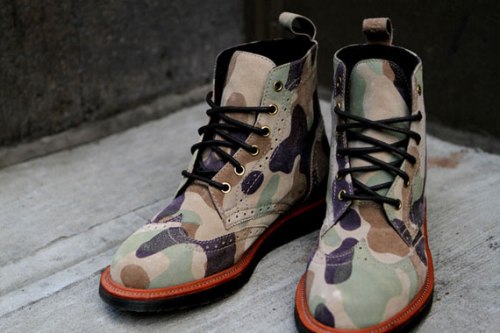
My Doc Martens are a holdover from what my partner Jill lovingly refers to as my “Baby Dyke” years.  They are one of the few extant remnants from this phase, along with memorized song lyrics to many, many Indigo Girls songs and a few very dear friends.

The boots are so objectively ugly—mud brown and clunky—that it must have physically pained my mother to spend money on them the year I asked for and received them for Christmas.  I was not particularly tough, badass, or butch, but those Doc Martens made me feel like I was, a little bit. They were not the norm at my very genteel and preppy all-girls’ school in Memphis, Tennessee, but they weren’t all that noticeably different, either; it’s not like I went after purple patent leather or boots that laced up to the thigh.  My boots were quietly defiant, marking me part of some alternative club the same way that the shoes’ very soles stamped a brand imprint into soft ground.

I don’t know why I saved my Docs; I stopped wearing them a long time ago.  Perhaps they seemed too significant, too sturdy, too potentially utilitarian to get rid of.  Or perhaps I was too nostalgic for those coming out years, my earnest, angsty youth.  But kept them I did, unable to throw them out or give them away each time I packed up my dorm room or apartment closet.


They come in handy the first time I go dove hunting with Jill.  It is early in our relationship, maybe the second year.  We are living together but still exploring each other actively, floating into new corners of experience like kids in bumper cars: meeting parents, learning quirks and proclivities, sharing passions.  For this afternoon, she dresses me in an old pair of her heavy canvas camouflage pants and a soft t-shirt (also camo), but is at a loss with what to do with my feet, for hers are much smaller than mine and I will not fit into any of her old boots.  Suddenly I remember my Doc Martens, long neglected and relegated to the bottom of the closet.

“Perfect,” she says as I lace them up, feet remembering just how much these damn things weigh.  I stand and examine myself in the mirror; it is the first time I have ever worn camo in my life.  I look like some alternate version of myself, still not particularly tough, badass, or butch, but feeling more the part than usual.

In the field, I follow behind Jill, treading my way through knee-high brush, grateful for the secure footing of my clod-hopper boots.  She has a gun slung over one shoulder and a folding stool over the other; I carry my own stool, a small, round cooler filled with water, and my journal.  We set up underneath a modest clump of trees and wait.


It’s important to note that Jill hunts for meat, not trophies; everything she kills we eat.  She grew up inhabiting a world that I only read about in books: Where the Red Fern Grows, My Side of the Mountain, and Rascal, stories where the main characters are self-sufficient children deeply connected to the outdoors.  They, like Jill, know the names of animals and plants, are comfortable with silence, have instinctive skills for survival, and are not afraid of much.

Jill shot her first gun at age five.  Her family grew or hunted pretty much everything they ate, skinning and cleaning and canning and preserving, using all parts of the animals they killed—not because it was romantic, but because they needed to.  Because that’s what you did.  Because it was a sin to let a once-living thing go to waste.


I did not grow up around guns, and the proximity of Jill’s shotgun, though I know the safety is on and she is extraordinarily careful, makes me a little jumpy.  In the yellow-brown field around us, bugs and mockingbirds skitter, backgrounded by blue sky.  Our attention is focused on a small watering hole some twenty-five yards away, the hope being that it will draw some thirsty doves on this hot afternoon.

I do not know what to expect, how I will feel about watching the woman I love kill things.  Though a meat eater myself, I came into our relationship with a bias against hunters, a lazy understanding that the sport was necessarily cruel and thoughtless, when for Jill it is quite the opposite.  She hunts to take an active part in the project of feeding herself, instead of shying away from the reality of the death that comes when one creature eats another.  She hunts because she is not a hypocrite, and she is not willing to be a vegetarian.  She hunts to plug her being into the greater cosmos of living things, the wild, cruel, and wondrous food chain into which we are all born.

“Hunting is the only religion I practice,” she told me when we first met, and so I am out here to see it for myself.

After about an hour of waiting, a pair of grey-brown, ring-necked birds appear on the scene and Jill manages to get them both as they come in to land, one smooth motion of lifting the gun’s stock to her cheek and its end into her shoulder.  The sound from the blasts echoes across the field, scattering more distant birds.  Jill locates the discarded shotgun casings on the ground around us and holds one up for me and instructs me to inhale: the sharp, acrid scent of spent gunpowder fills my nose.  “I love that smell,” she says.

We walk over to retrieve the birds before we lose sight of where they fell, their small eyes glazed over and spots of crimson blooming in their breasts.  I have never held a just-dead thing, so recently alive that it is warm and liquid under the surface.  Death has transformed them, making them more lovely and remarkable than they were in life, a kind of reverse benediction.  Before slipping them into her game bag, Jill puts each bird close to her face and whispers thanks for its life.

“You lived wild and free until you died,” she tells a dove, tracing the distinctive dark black ring around its neck with her finger.  “Not in a cage or a pen.”

At sunset, the hunting is done and Jill lays her six birds on the tailgate of the truck.  With skilled fingers and a pair of hunting shears, she cleans their soft bodies, first plucking their feathers, which float out into the air like soft snow for other birds and field mice to use for their nests and burrows.  Then she clips the heads, feet, wings, and removes the glistening innards, tossing it all out onto the ground as an offering of dinner for the creatures that live nearby.  Finally, what’s left are a naked row of breasts and legs, our dinner.

We cook the ring-necks just a few hours later, their flesh meeting flame on the grill,  eating with our hands, taking their bodies into our own for nourishment and pleasure.


black-white-on-benchNishta Mehra is a writer, middle school English teacher, and enthusiastic home cook who blogs about food and life at www.bluejeangourmet.com.  Her first book, a collection of essays entitled The Pomegranate King, is forthcoming in early 2013.  She lives in a suburb of Houston, Texas with her partner, Jill Carroll, and their four-and-a-half month old son, Shiv.


Leave a comment

Filed under nonfiction november

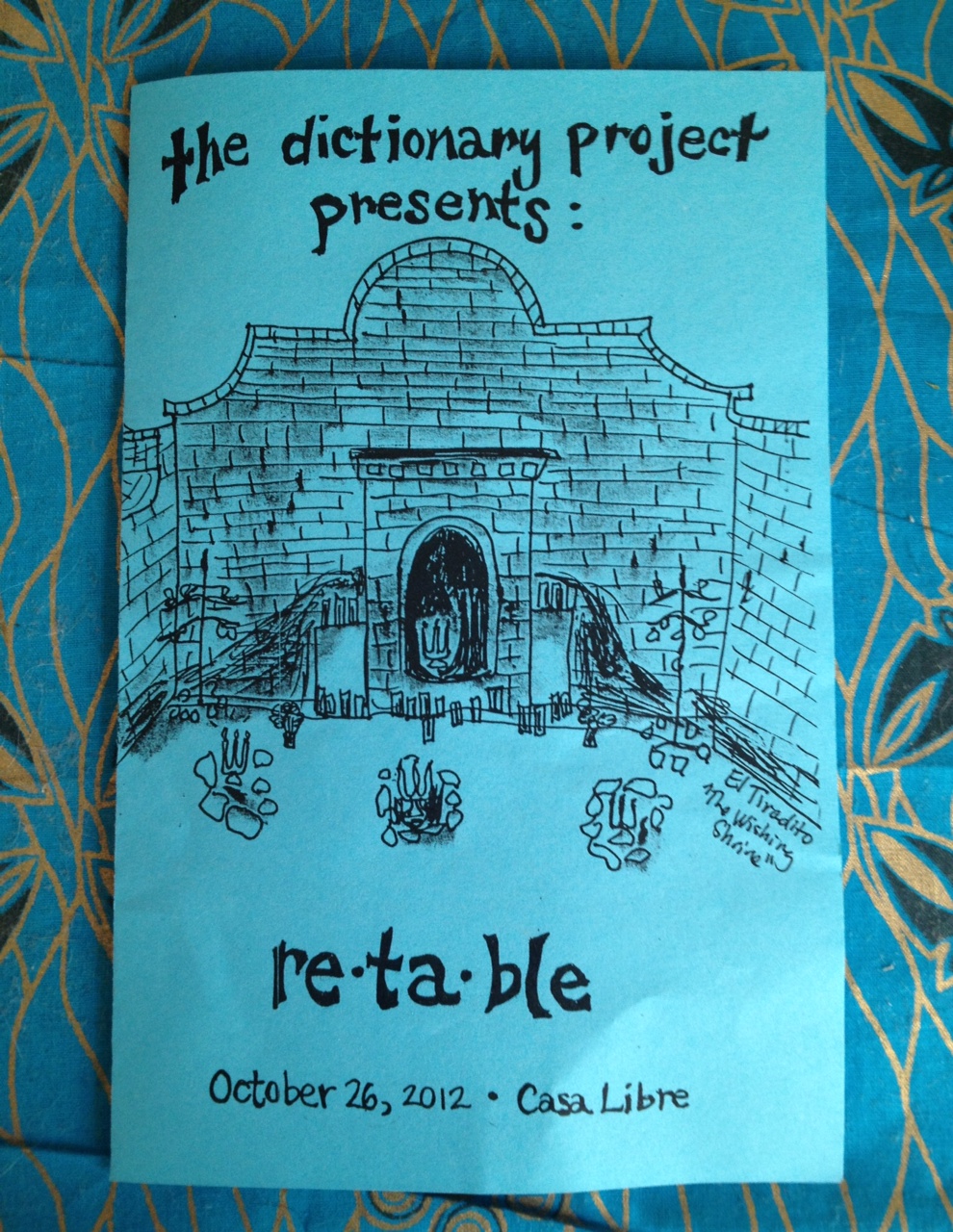
the dictionary project presents: re·ta·ble


On October 26, the dictionary project held our second the dictionary project presents reading featuring Tucson writers writing to the word: re·ta·ble. It was a truly magical, inspired and inspiring evening, hosted at Casa Libre. We constructed an altar in honor of the word, and the readers offerings were poignant, funny, smart, and beautiful. It seems appropriate in this time of harvest and of giving thanks to offer these readings to those of you who could not be with us in person on that evening. Please enjoy these offerings of words and ideas as you consider what people, talismans, gifts are on your own retable.


re·ta·ble  (ˈrē-ˌtā-bəl)  n.  [Fr., contr.  <  *reretable; rere (see REAR) + table (see TABLE)], a raised shelf of ledge above an altar for holding altar lights, flowers, etc.


A million thanks go to Casa Libre Assistant Director Tc Tolbert for recording and uploading these readings so that we can continue to enjoy them.


Leave a comment

Filed under the dictionary project presents