cor·re·spond·ence

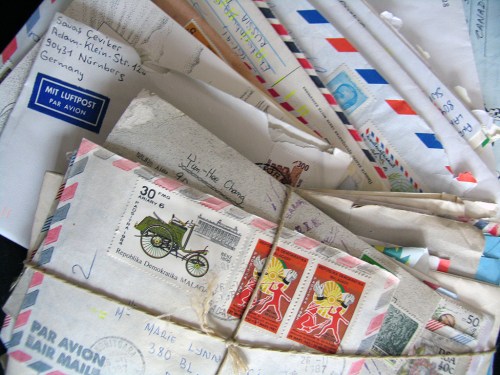
photo by Mary Lynn Richard


cor·re·spond·ence /ˌkôrəˈspändəns/  n.  1. a close similarity, connection, or equivalence. 2.  communication by exchanging letters with someone.


Note: I wrote this post on May 22, 2012 . I set it aside, thinking I would add to it and neglected it it for awhile. Posting it now, in its May form. If you don’t know of The Rumpus or Letters in the Mail, you should check both out (links below)!


What is it about letter writing that allows for such closeness and intimacy?

Last year, The Rumpus started a “Letters in the Mail” program, wherein authors would scribe letters and The Rumpus would send them to subscribers through the mail. I signed up immediately.

And then this past April, they invited subscribers to participate in “Letters to Each Other,” where subscribers would send in a letter (no more than one page, front and back) with a SASE envelope. Then their letters would be sent to six people and they would receive six letters in return.

I received my letter last Thursday, and I cannot tell you how exciting it was to open my mailbox and find that thick envelope.

I think what I love most about letters is their real vulnerability. Letters are not theoretical, they are meant to be a container for one’s thoughts and ideas, a place for truth to be relayed. Even letters between artists that involve philosophy and intellectual spiralings typically also involve a moment of doubt. These are not set in stone, they are inked on paper. In that way they are ephemeral. They are meant to be recordings of a moment. I love this too, their in-the-momentness, their sheerness, their see-through nature.

I wrote my first reply today, and what I was amazed at was not only my ability to but my desire to share intimate details of my life with someone who is an almost complete stranger. Is it the anonymity? Maybe that’s part of it, but we do know each others’ names, at least she will have mine now. I think it is also because she shared intimate details with me, ones that although differing from my experience, I could relate to, and I valued so much that emotional honesty.

Letters are drawings of our names in the sand. They reveal who we are in this precise time of being, a being that is unstable, a self that will change. They are a place that, beyond beautiful prose or constructed narrative or clarity of thought or firm declarations, simply demand honest reflection and an attempt at connection. And we all have the ability to offer that. And isn’t that at the end of the day what we most need from one another? what we most need to offer of ourselves?

Leave a comment

Filed under other words

the dictionary project author interview: lorraine berry

It’s the second Wednesday of June so it’s time for a new author interview at  the dictionary project.  In our author interviews,  guest authors discuss their relationship to words and provide answers to dictionary project words bibliomanced specifically for them.

This week, travel with Lorraine Berry into the woods and across the forest floor, over to an Irish Pub, across the ocean to Sienna, Italy, into the mysteries of Sherlock Holmes and back again!


1. Please share a memory/story/thought in relation to a dictionary/dictionaries:

I’ve had moments of intense love affairs with the English language. When I was younger, I used to read the dictionary and try to memorize new words. As a junior in high school, we were forced, in Honors English, to learn thirty new words a week, and at first, I resented it, but since then, I’ve been so grateful for the practical usage I still get out of those words.

What really lit me on fire about English, however, was taking Latin. I abhorred Latin—the constant charts and tables in order to learn each new word were painful. But what I learned to treasure about Latin was that it made each English word I encountered a puzzle. I found myself wanting to know etymologies. Sometimes, it would be obvious to me because I would recognize the Latin root. But rooting around in the dictionary got me excited about knowing the history of a word: Greek or Latin or Anglo-Saxon? Middle English? Related to what? First used when? All of that word stuff was yummy. It filled up some part of my brain that didn’t know it had been empty.

When I teach, I encourage students to buy themselves the biggest dictionaries they can find, and I especially encourage them to understand where words come from. It’s another way of unlocking the puzzle of our human existence, I think.


2. What is your current favorite word?

I learned a new word just this past weekend. My partner Rob and I were sitting at one of our haunts—one of those faux Irish pubs in a hotel that we like in spite of the décor—because it’s quiet and it has a fireplace. We’ve made a ritual of my bringing essays to grade and him bringing a novel, and we sip Jameson’s as the day slips away.

This past weekend, however, I was between grading spates and had brought a novel of my own to read: Nathan Englander’s The Ministry of Special Cases, and it happened: in the middle of a passage was a word I didn’t recognize: dysthymic. I guessed at its meaning from the context, and cursed the pub for not having a dictionary. (I suppose I could engage my own romanticized vision of the bard here and wonder why someplace that serves Irish spirits does not serve the Irish spirit and keep a fucking dictionary around.) Rob had technology at his fingertips, however, and looked up the word on his iPhone: dysthymia refers to chronic depression, and Englander had referred to his characters as dysthymics.

Jesus, did it seem appropriate. Sometimes, I think my entire thirties (I’m forty-nine now) were spent as the poster child dysthymic. The day we were having Saturday—cold and blustery and gunmetal gray—felt as if April, which had come in with Apollonian glory, had gotten stuck in some northern latitude doldrums—when you know that it should be spring outside, but honestly, a glance through the window leaves you wondering whether it’s November or March.

So, until this damn weather clears up, I’m going with dysthymic as my current favourite word.


3. What, in your opinion, is the most obnoxious/insidious/annoying word?

Has anyone else noticed that we go through cycles of overused, misused words? At one point in my teaching, students couldn’t get through a paragraph without inserting extraneous “basicallys” to their language. Now the word that makes me twitch is literally.

(I should say that, from a political standpoint, the political language of obfuscation and outright lie telling enrages me. But in sticking with the wording of the question, I’m toning down my response from rage to obnoxiousness.)

I’m not sure why the word “literally” has undergone a figurative blooming. It reminds of the way an invasive species can take down an eco-system. Directly across the road from where I live is a small gorge that, in years past, has been full of my favourite summer wildflower: chicory. Chicory is a shade of blue that, depending on the angle of the sun, may appear purple through gray, but mostly stays a shade a tad lighter than cornflowers.

A couple of years ago, wild parsnip (pastinaca sativa) appeared on the scene. The stalks are tall and the flowers resemble a Queen Anne’s Lace, except they’re baby-shit yellow and spiked out so that the flowers appear to be giant hands.

They are more than an eyesore. They contain a photosensitizing chemical that, should you brush the plant with your hands or body then expose your skin to sunlight, will cause burns and blisters. Removing the plant requires the wearing of a hazmat suit.

Notice I didn’t say “literally wearing a hazmat suit.” I’ve become allergic to the word. It is so insidious in my students’ speech that it causes me to involuntarily pull away, as if contact with the word may leave residue on my skin.


 4. Please respond to the following words and definitions, picked exclusively and randomly for you:


dust  (dəst)  n.  [ME.; AS.; akin to ON. dust; IE. base dhus- (<dhewes; see DEER), to fly like dust, dust-colored, etc.; cf. DUN, DUSK],  1.  powdery earth or any powdered matter fine enough to be easily suspended in air.  2.  a cloud of such matter; hense,  3.  confusion; turmoil  4.  earth  5.  mortal remains disintegrated or thought of as disintegrating to earth or dust.  6.  a humble or lowly condition.  7.  anything worthless.  8.  [British], ashes, rubbish, etc.  9.  [Rare], a particle, gold deposits, hence,  12.  [Slang], money.  v.t.  1.  to sprinkle as by brushing, shaking, or wiping (often with off).  v.i.  1.  to remove dust, especially from furniture, floors, etc.  2.  to bathe in dust, said of a bird.  3.  to become dusty

bite the dust, to fall in battle, be defeated.

lick the dust,  1.  to fall in battle; be defeated.  2. to be servile; grovel

  make dust fly,  1. to act energetically.  2.  To move swiftly

shake the dust off of one’s feet, to leave in anger or contempt: Matt. 10:14.

throw dust in (someone’s eyes), to mislead or practice deception on (someone).


I found ashes once.

Human ashes, in a box, that had been washed up from their shallow burial ground by a series of storms. I didn’t open the box; I wanted the body inside to maintain its privacy, but I did make sure that they were reburied properly.

Dust and ashes, it seems to me, are our inevitable form. And while I know ashes are grittier than dust, I imagine myself blown across the universe when I’m dead.


tway·blade  (ˈtwāˌblād),  n.  [archaic tawy, two (ME. twei; see TWAIN; + blade],  1. a variety of orchid with two broad leaves and small, red-veined, yellow flowers.  2.  any of several orchids having two leaves springing from the roots.


I hike in the woods near every day. As far as I know, I’ve never seen twayblade, although I recognize the shape and color. The flower reminds me of Dutchmen’s Breeches, which appear to be a row of pants hanging on a line of washing. A couple of years ago, I encountered a plant that took me days to name. Like twayblade, it had two leaves coming up from the roots, and then two magenta petals with tiny pom-poms on the end of each petal. Its name? Gaywings. Gaywings and twayblades, I think, would make lovely partners on the forest floor.


mark  (mark),  n.  [ME. merke, marke; AS.  mearc, orig., boundary, hence boundary sign, hence sign, etc. (cf. MARCH, boundary); akin to G. mark, boundary, boundary stone, landmark, etc., marke, a token, mark; IE. base *mareg-, seen also in L. margo, an edge, border (cf. MARGIN); basic idea either “extending” or “visible boundary:],  1.  a visible trace or impression on a surface, as a line, dot, spot, stain, scratch, blemish, mar, bruise, dent, etc.; distinctive feature produced by drawing, coloring, stamping, etc.  2.  a sign, symbol, or indication; specially, a) a printed or written sign or stroke: as, punctuation marks. b) a brand, label, seal, or tag put on an article to show the owner, maker, etc.: as trade-mark.  c) a sign or indication of some quality, character, etc.: as, politeness and consideration for others are marks of a good upbringing. d) a letter or figure used in schools, etc. to show quality of work or behavior; grade; rating: as, a mark of B in history. e) a cross or other sign made on a document as a substitute for a signature by a person unable to write.  3.  a standard of quality, proficiency, propriety, etc.: as, this novel doesn’t come up to the mark.  4.  importance; distinction; eminence; as, a man of mark.  5.  impression; influence: as, good teachers leave their mark on their students.  6.  a visible object of known position, serving as a guide or point of reference: as, the tower was a mark for fliers.  7.  a line, dot, notch, etc. used to indicate position, as on a graduated scale.  8.  a) an object aimed at; target. b) an object desired or worked for; end; aim; goal.  9.  an observing; a taking notice; heed.  10.  [Archaic], a) a boundary, border, or borderland; march. b) among Germanic peoples in earlier times, land held or worked in common by a community.  11.  in nautical usage, a) one of the knots, bits of leather, or colored cloth placed at intervals on a sounding line to indicate depths in fathoms. b) the Plimsoll mark.  12.  in sports, a) the starting line of a race. b) the jack in the game of bowls.  v.t.  1.  to put or make a mark or marks on.  2.  to identify or designate by or as by a mark or marks: as, his abilities marked him for success.  3.  to trace, make, or produce by or as by marks; draw, write, etc.  4.  to show or indicate by a mark or marks.  5.  to show plainly; manifest; make clear or perceptible: as, her smile marked her happiness.  6.  to distinguish; set off; characterize: as, great scientific discoveries marked the 19th century.  7.  to observe; note; pay attention to; take notice of; heed: as, mark my words.  8.  to give a grade or grades to; rate: as, the teacher marked the examination papers.  9.  to put price tags on (merchandise).  10.  to keep (score, etc.); record.  v.i.  1.  to make a mark or marks.  2.  to observe; take note.  3.  in games, to keep score.—SYN. see sign.


To mark is to scar. I mark the page with my writing. I mark the earth with my footprint. Life has marked me, left me covered with reminders of growth and grief. I have scars that begin in my scalp and extend to the arch of my foot. If my lover is observant, he’ll note each scar, trace its comma or caret with his breath, his tongue, draw from me its story. I will rise up with each stroke, let him unfold my origami muscles, wail forth my love cry as I launch into flight.


tar·ant·ism  (ˈtarənˌtizəm),  n.  [It., tarantiscmo <  Taranto, Italy: so called because formerly epidemic in the vicinity of Taranto: popularly associated with the tarantula, by whose bite it was said to be caused; cf. TARANTULA, TARENTELLA], a nervous disease characterized by hysteria and a mania for dancing, especially as prevalent in southern Italy during the 16th and 17th centuries; also spelled tarentism.


Siena. 1995. I was on my first overseas research trip, preparing to do an intensive study of Italian and, I hoped, find time to get into the archives and start the initial research for my dissertation.

I had left behind my four-year-old daughter and her father, and as part of my studies, I was living with an elderly, irascible woman who was furious with me for a number of reasons, chief among them being that I didn’t speak any Italian and so wasn’t yet able to communicate with her.

When I had signed up for this particular intensive study, I had requested living with a family. It was what I had done in France in 1984, when, in ten weeks of living with a family with three children, plus attending six hours per day of language instruction, I had returned to the United States completely fluent in French. I had hoped for the same thing in Italy, but it was clear in the first twelve hours after arrival that I had been mismatched with my host family. For one thing, it wasn’t a family. It was just her, and she bullied me. It started when I didn’t finish everything on my dinner plate. She wasn’t the stereotype of the Italian mother who insists to her kids, “eat, eat!” she seemed more like the strega from Hansel and Gretel who wanted me to eat so that she might fatten me up, and eat me, I was convinced.

It didn’t help that I missed my child. I had never spent more than a week separated from her, and as I cried myself to sleep the first of sixty days that I was set to stay, in place of my daughter, I had brought along my old nemesis, panic.

Panic. Which wouldn’t let me sit still. Panic. Which caused me to walk and walk and walk from the outer hilltop where I was staying down into Siena’s ancient walls and to walk and walk without stopping for hours on end. I was afraid that if I sat I would die. If you’ve never suffered from a panic attack, imagine those dreams where you are in the middle of the road, a truck bearing down on you, and you cannot move. Panic, the leavings of our primordial brain, where the fight-of-flight instinct saved us when confronted by saber-toothed tigers and other creatures that wanted to eat us. Panic chased me through the streets of Siena, and kept me walking from dawn until dark.

The old woman would shout at me for having been gone all day, but how to explain to her that I had been bitten by this mania, this hysteria, for which I had no name and no idea how to cure myself of. I was afraid to go to an Italian emergency room for fear that they would lock me away in a psych ward.

And so, one pre-dawn morning, after a sleepless night, I dragged my belongings to a busstop, to the train station, and to the airport at Pisa, where I begged airline officials to let me change my ticket and go home.

I have since returned to Italy, and love it. But I have never forgotten its first bite.


hol·mic (hōlˈmĭk), adj.  of or containing trivalent holmium.

[hol·mi·um (hōl´me-um), n.  a metallic chemical element of the rare-earth group: symbol: Ho; at. wt., 164.94; at. no., 67.]


While it is an adjective that refers to the element holmium, I find that I use such adjectives sparingly in my prose. I once wrote a blog post that compared the reflection that came off sub-zero snow as reminding me of cobalt, I cannot think of a time that I have written something elemental.

But elemental leads me to elementary, and elementary leads me to Holmes. Sherlock Holmes, who, one could argue, has given rise to all manner of Holmic studies.

In high school, I loved chemistry, although I loathed the study of all other sciences. But chemistry was a series of puzzles; it was about balance and about figuring out what happened when you combined two elements to see if, placed together, they might not form something remarkable.

And puzzles. Well, that’s what Holmes solves, right? He begins with a clue and, before you know it, has inferred and deduced, and induced confessions from those he suspects.

So, from now on, perhaps I’ll refer to anything to do with Sherlock Holmes as holmic. Because it’s elemental, my dear Watson.


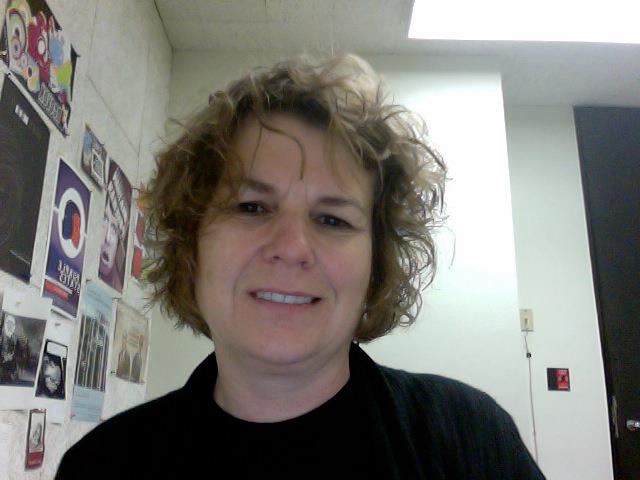
Lorraine Berry was ABD at Cornell when she finally figured out that she didn’t want to be an historian: she wanted to tell stories. Since quitting, she has worked in a number of places—including going back to waitressing—but currently teaches in the Professional Writing Department at SUNY Cortland. Her work can most often be found in Salon.com or at TalkingWriting.com. She lives with her partner, Rob, and is raising two daughters. Her memoir in manuscript, “Word Lovers,” has been optioned for film. When not writing, Lorraine hikes the woods of the Finger Lakes with her two dogs.


Leave a comment

Filed under author interviews

live from the dictionary project presents! part two!

solar eclipse at Gate’s Pass, Tucson, Lisa O’Neill


Today, we have more readers from the dictionary project presents! event at Casa Libre on April 28, 2012.

Annie Guthrie and Samuel Ace read poems they composed for National Poetry Month (napomo) at The Dictionary Project. Elizabeth Frankie Rollins and Rebecca Iosca read flash fiction pieces composed for flash fiction february.  I read on “conduct.” Julia Gordon reads on “New Yorker” and it is a complete and utter tragedy that the video cut out two minutes before she finished because she brought. the. house. down.

Enjoy!


Samuel Ace on “drowsily”:


Elizabeth Frankie Rollins on “schizophrenia”:


Rebecca Iosca on on “schizophrenia”:


Annie Guthrie on “penology”


Lisa O’Neill on “conduct”:


Julia Gordon on “New Yorker”:

Leave a comment

Filed under the dictionary project presents

the dictionary project author interview: nathaniel brodie


At the dictionary project, we have non-traditional author interviews on the second and fourth Wednesdays of the month. In our author interviews, instead of responding to direct questions about their life or work, guest authors discuss their relationship to words and provide answers to dictionary project words bibliomanced specifically for them.

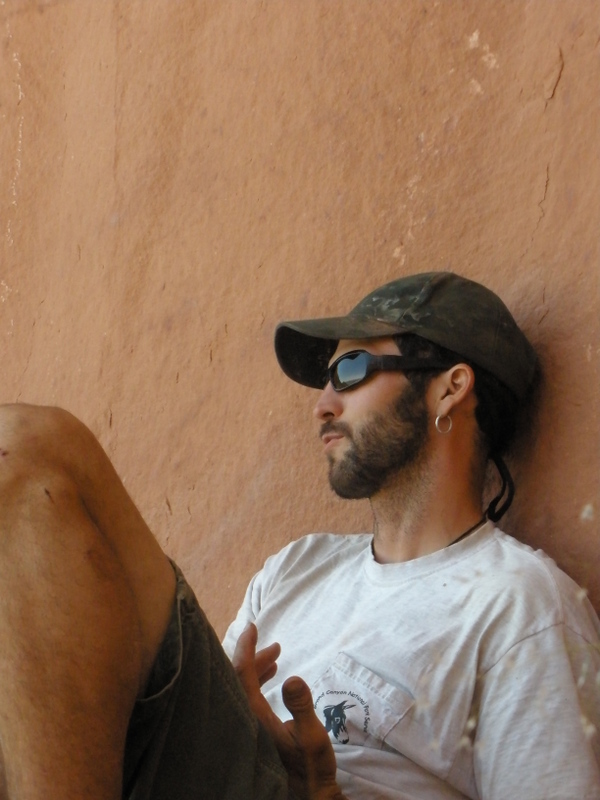
This Wednesday, we feature the words of writer, outdoor enthusiast, soon to be dad, and one-time builder of Grand Canyon trails Nathaniel Brodie. Enjoy!


1.   Please share a memory/story/thought in relation to a dictionary/dictionaries:

The first that springs to mind has to do with a lack of a dictionary: when my wife and I were in the Peace Corps in a small shack in rural Paraguay we whittled away the hours playing Scrabble. But we lacked an English dictionary, so I had no way of calling out my wife on all the words I suspected her of inventing. There’s no way I’d have let her get away with something like “zwyk,” of course, but mostly they resembled actual words (like “sleck” or something), in which case, depending on an complex personal algorithm of belly-satiation, alcohol consumption, and game-board analysis, I’d let her get away with it, but not before adding it to a List of Words To Check Next Time We Get A Dictionary. I can’t remember if I ever got around to truthing that list; I like to think that by then I may have learned enough about life and marriage to know that whatever satisfaction I may have thought I’d have derived from exposing her lexiconic creations would in fact be a tired and petty victory.


2.   What is your current favorite word?

Sylvan. Isn’t that nice?


3.   What, in your opinion, is the most obnoxious/insidious/annoying word?

The one I’ve found particularly irksome recently is “epic.” This has less to do with the word itself—which is a fine word, really—but the way it’s being faddishly and improperly used and abused. Maybe it’s the subculture I find myself in: climbers and kayakers and surfers and the like, but people are constantly describing things as “epic”—things that may have been especially harrowing, or exciting, or in some manner intense, but which to my admittedly curmudgeonly mind do not exactly resemble Gilgameshian acts of heroic valor. Really, though: the existence of two feet of fresh powder does not automatically entail an “epic” day of skiing, especially if the narrative of that day will later be delivered using slang in which the phrase “shredding the gnar-gnar” or “pow-pow” could possibly be employed and understood.


4.   Please respond to the following words and definitions, picked exclusively and randomly for you:


most  (mōst),  adj.  [compar. MORE (môr, mōr)],  [ME. < AS. Mast, maest, used as superl. of micel, big (cf. MUCH); akin to Goth. Maists; for base see MORE],  1.  greatest in amount, quantity, or degree: used as the superlative of much.  2.  greatest in number: used as the superlative of many.  3.  in the greatest number of instances: as, most flame is fleeting.  n.  1.  the greatest amount, quantity, or degree: as, he took most of the credit.  2.  [construed as pl.] a)  the greatest number (of persons or things): as, most of us are going.  b)  the greatest number of persons.  adv.  1.  [compar. MORE], in or to the greatest degree or extent: used with many adjectives and adverbs (regularly with those of three or more syllables) to form the superlative degree: as, most horrible, most quickly.  2.  very (often preceded by a): as, a most beautiful morning.  3.  [for almost], [Colloq.], almost; nearly. 


An ugly word, reeking of selfishness and possessiveness, gluttony and greed. But all is context, I suppose; it depends on the adverb: could be “the most beautiful ____,” which is a bit exclusive, but not all bad. Regardless, I generally regard superlatives as either lazy or simply dull tools of the trade. Yes, we need to be able to say “Kareem Abdul-Jabbar scored the most points in the history of the NBA” (and believe me, I find myself saying that a lot), but there’s not much zest to these type of lines. Same goes for its colloquial use (“Most of the time…”)—just kind of a boring word.  But that’s okay—oftentimes boring is far preferable to flashy. Whatever. Moving on…


 eye·wink·er (ˈī-ˌwiŋkər) n.    1.  an eyelash.  2.  any foreign particle in the eye that causes blinking.


I hate that. Hate the contortions of trying to flush my eye out under the faucet; hate the way the eye becomes bloodshot and bleary; hate the irritating and painful hours of blinking and stifled rubbing. And yet every once in a while it’s good to be reminded of how blessed I am to be of good health; the occasional tweaked back or broken wrist or, yes, “foreign particle” in the eye reminds me of how different and difficult the world could be (and, for billions of people, is). On a sidenote, an “eyewinker” person (n. 3. one who habitually winks, in a conspiratorial manner) can be either creepy or kind. Somewhat to my dismay, I can’t wink.


push  (poosh),  v.t.  [ME. posshen; Early Fr. pousser; OFr. poulser; L. pulsare, to beat, freq. < pellere, pulsum, to beat, drive; cf. PULSE],  1.  to thrust or press against (a thing) so as to move it away.  2.  to move by exerting force in this way.  3.  to thrust, shove, or drive up, down, in, out, forward, etc.  4.  to urge forward or on; impel; press.  5.  to follow up vigorously, as a campaign, claim. etc.  6.  to extend; expand: as, the Genoese pushed their trade to the Far East.  7.  to press hard upon:as, he was pushed for time.  8.  to urge or promote the use, sale, success, etc. of.   v.i.  1.  to press against a thing so as to move it.  2.  to press or thrust forward vigorously.  3.  to put forth great effort.  4.  to advance against opposition.  n.  1.  a pushing; shove, thrust, etc.  2.  a thing to be pushed in order to work a mechanism.  3.  a vigorous effort.  4.  an advance against opposition.  5.  pressure of affairs or of circumstances.  6.  an emergency.  7.  [Colloq.], aggressiveness; enterprise; drive; force.  8.  [Slang], a crowd or clique.
push off, [Colloq.], to set out; depart
push on, to proceed.
SYN.—push implies the exertion of force or pressure by a person or thing in contact with the object to be moved ahead, aside, etc. (to push a baby carriage); shove implies a pushing of something so as to force it to slide along a surface, or it suggests roughness in pushing (shove the box in a corner); to thrust is to push with sudden, often violent force, sometimes so as to penetrate something (he thrust the knife into his victim’s back); propel implies a driving forward by a force that imparts motion (the wind propelled the sailboat).—ANT. Pull, draw.


The ancient Greeks had a lot of things going for them, but I’m particularly thankful for all the time they put into coming up with stories of ingenious punishments for sinners in the land of Hades:  Tantalus and the Danaides and ol’ Sisyphus, who had to push a boulder up a steep hill until, almost at the peak, it rolled over him and down to the bottom, whereupon he had to start over, with the same results, for all of eternity. Man, that’s a good one.


ax·is  (ˈaksis),  n.  [pl. AXES (-sez)], [L., axle, axis]  1.  an imaginary or real straight line on which an object supposedly or actually rotates: as, the axis of a planet.  2.  A straight line around which the parts of a thing, system, etc. are regularly arranged: as, the axis of a picture.  3.  A main line of motion, development, etc.  4.  an alignment between countries, groups, etc. for promoting their purposes: now usually a derogatory term.  5.  in aeronautics, any of three straight lines, the first running through the center of the fuselage length-wise, the second at right angles to this and parallel to the horizontal airfoils, and the third perpendicular to the first two at their point of intersection. 6.  in anatomy, a) the second cervical vertebra.  b) any of several axial parts, especially the spinal column.  7.  in botany, a) the main stem of a plant.  b) the central system of a cluster.  8.  in geometry, a) a straight line through the center of a plane figure or solid, especially one around which the parts are symmetrically arranged. b) a straight line for measurement or reference, as in a graph: see also abscissa, ordinate.  9.  in optics, a) the straight line through the centers of both surfaces of a lens (optic axis).  b)  a straight line from the object of vision to the fovea of the eye (visual axis). Abbreviated ax.


I like the idea of an axis, and for a long time I believed fervently in all the corresponding (and comforting) notions of balance and symmetry, of yin and yang, good and evil, life and death, heaven and hell, synchronicity and rhythm. But not so much anymore—the thorough debunking of the notion of a mechanistic universe has really resonated with me, as have, for reasons I can’t yet put into words but have something to do with mystery and complexity and The Ineffable, theories of chaos and endemic disturbance and unending, dynamic change. Who wants to live in a fixed, clockwork universe? Not me.


mi·ni·um  (ˈminēəm),  n.  [L.; of Iberian origin; cf. Basque arminea],  1.  vermillion (the color)  2.  red oxide of lead, Pb3O4: also called red lead.


Nice: the Vermillion Cliffs in Northern Arizona is one of my favorite landscapes in the world and I had no idea there was such a word to describe the rusty slopes, so thanks, Lisa. (Of course, this also brings me to a familiar writer’s quandary: should I use a word that the vast majority of the population would need a dictionary to understand and which thus puts me at risk of being labeled pretentious? My usual guide is that it depends on the word: in this case “minium” is good, but not that good.) Also: let’s take a moment to admire the “-ium” and lament the American “aluminum,” as opposed to British “aluminium,” this latter case allowing us to etymologically link it to other metallic minerals. But I also like “grey” as opposed to “gray,” and admire the Old-English instances of ending-with-an-e (“centre” instead of “center”), so I’m not exactly a reliable judge.


Nathaniel Brodie lives in Corvallis, Oregon. He writes, and gardens, and posts an occasional blog post about his imminent fatherhood at A Pregnant Husband.

Leave a comment

Filed under Uncategorized

stri·gose


This slideshow requires JavaScript.


stri·gose  (ˈstrīˌgōs),  adj.  [Mod. L. strigosus  <  L.  striga,  a furrow],  1.  in botany, having stiff hairs or bristles, as some leaves.  2.  in zoology, having fine, close-set grooves or streaks. 3. finely grooved or furrowed.


This woman makes nests.
She said: Imagine an impossible book and body as they realize themselves.
She said: my mouth: a living altar space, a living nest.
This woman makes nests out of earth and fills them with words.
She said: I am interested in the muscle memory of the book, the logic stored beneath the sentence.
This woman makes nests that are no longer a part of the book but inseparable from the book.
She said: vessels, chambers, a gathering of something.
She said: Please climb with me into under the sentence.


This woman weaves threads.
She said: I’m working with time, with the moment, with breath, with song, with the thread.
This woman weaves threads through people.
She said: There were no people—everyone was inside. So I was weaving saguaros and lizards.
This woman weaves threads through people and earth and the spaces she moves within.
She said: What is aggressive about a thread lying on the floor?
This woman weaves threads of storysong, songstory into now.
She said: A song a woman sings from hurt is called a pulling…How can I respond except crying in a tone no one cares for?


This woman arranged a courtship.
She said: P and S are pushing at the edge of their relationship.
This woman arranged a courtship, one between the page and the screen.
She said: They share text’s fleshy network.
This woman arranged a courtship, affirming each party in what they had to offer.
She said: Pale, pole, pawl have the same root as page.
This woman arranged a courtship: one of the pair she held up to be seen, the other she sent spinning in motion.


This woman layered a landscape.
She said: So we are all caught hanging: the rope inside us, the tree inside us.
This woman layered a landscape of word and image.
She said: The hearts of my brothers are broken.
This woman layered a landscape in black and white and then blue and green and red.
She said: And you are not the guy but you fit the description. And there is only one guy who is always the guy fitting the description.
This woman layered a landscape, opaque and reflecting.
She said: It was a place to begin to look at what is seen and at perception. It’s deeper than the image and yet it is the image.


These women ask the body.
She said: If a woman in a forest recalls a woman in bed.
These women ask the body to remember, to recall, to reiterate.
She said: If a woman in bed recalls a woman driving.
These women ask the body and the body answers in a curved spine, in sitting upright, in staring out, in.
Shes said:
Are you cooking?
Are you driving?
Are you in the car?
Are you on the phone?
On where writing begins, she said: The jaw. There’s a kind of will in the jaw: it has to do with desire, maybe it has to do with speech and a desire to say something.
She said: It begins in the space in the spine, reflexive knowledge.


Author Note: I wrote this reflection over the course of attending the Poetry Off The Page Symposium at the University of Arizona Poetry Center. The women, in order of appearance, are: Danielle Vogel, Cecilia Vicuña, Amaranth Borsuk, Claudia Rankine, Julie Carr & K.J. Holmes.


1 Comment

Filed under weekly words

live from the dictionary project presents

This slideshow requires JavaScript.


As some of you may know, the dictionary project hosted it’s first live event: the dictionary project presents! at Casa Libre on April 28, 2012.

This week, we’ll be sharing readings from the event. It’s almost like you were there! Or if you were there with us, relive it with us.

(Thanks very much to Casa Libre’s Assistant Director Tc Tolbert for providing the video!)

The first videos are the introduction to the evening as well as the readings that were produced using the word bibliomanced for the event: guava!


gua·va  (ˈgwävə),  n.  [Sp. guayaba  <  native (prob. Arawakan) name in Brazil],  1.  a tropical American tree or shrub bearing a yellowish, pear-shaped, edible fruit.  2.  the fruit, used for jelly, preserves, etc.


Leave a comment

Filed under Uncategorized

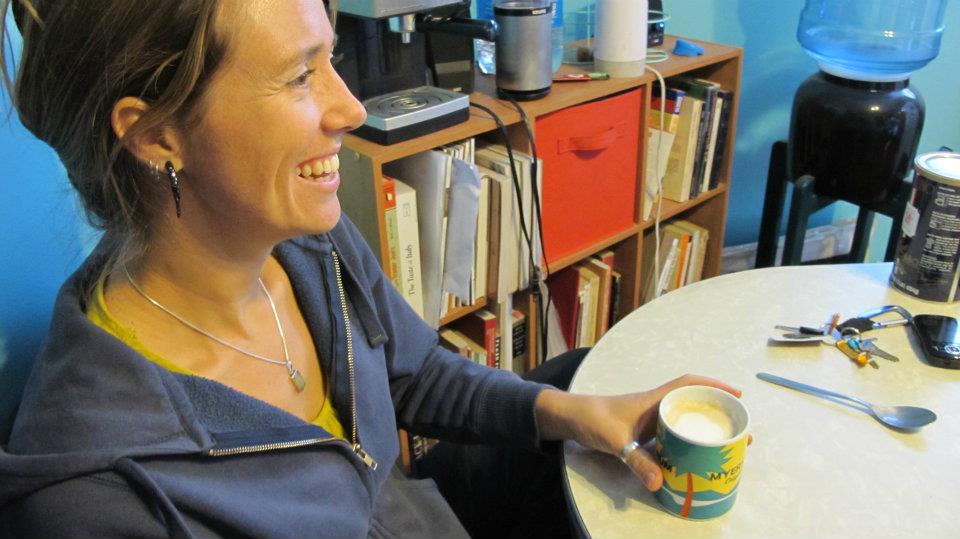
the dictionary project author interview: Arianne Zwartjes


It’s the second Wednesday of the month at the dictionary project, and we have our second non-traditional author interview featuring writer Arianne Zwartjes!

In our author interviews, instead of responding to direct questions about their life or work, guest authors discuss their relationship to words and provide answers to dictionary project words bibliomanced specifically for them.


1. Please share a memory/story/thought in relation to a dictionary/dictionaries:


My grandparents gave me my first dictionary, a brown leatherbound edition which I still have, packed as it is in boxes at the moment. My grandmother’s spidery handwriting stretches across the inside of the cover, for Arianne, so much love, etc etc. I was eight, I think, or nine. I still think of them every time I open it, which I do with fair regularity.


2. What is your current favorite word?

Currently my favorite word is eyesoar, a gross misspelling from a recent work email which, it occurs to me, creates gorgeous new meaning and is actually a way better word than the original they were trying to approximate.


3. What, in your opinion, is the most obnoxious/insidious/annoying word?

Like. Anyone who teaches must feel this way, I imagine.


4. Please respond to the following words and definitions, picked exclusively and randomly for you:


os·ten·ta·tion  \ˌäs-tən-ˈtā-shən\  pretentious or excessive display — ostentatious \shəs\ adj  — ostentatiously  adv


ver·so  \ˈvər-sō\  n, pl   versos :  a left-hand page


draughts  \ˈdräf(t)s\  n, Brit  :  CHECKERS


Far East  the countries of  E Asia & the Malay Archipelago — usually thought to consist of the Asian countries bordering on the Pacific but sometimes including also India, Sri Lanka, Bangledesh, Tibet, & Myanmar — Far Eastern adj


film·o·gra·phy  \filˈmägrəfē\  n,  pl  phies  a list of motion pictures featuring the work of a film figure or a particular topic


leavings: a filmography


aisha is the one who should create any list of films. i am the verso, she the main page. this is an ostentation, a play for words, a desperate bid. tom waits agrees; he says i am striving. to lose at draughts, to misplay, to lose the lines on the road. this is the kind of move i have made recently.  when i traveled in the far east which is only far and only east to us, rooted as we are here in our stretching continent of asphalt and wheat and mountains, i learned the past moves in both directions, forward as well as behind us. when words try to pin that down they fail.


*


the idea of home is suspect. in spike jonze’ film the fall, a horse is winched from the river below a high bridge; it hangs dripping from the sling in a limp arc. a train is frozen on the trestle, a small black and white terrier barks furiously. (home can be person, place, or thing. nouns define us.) this intro is, in my opinion, the best part of the film.


*


i have been to two films recently which stopped midway through, the screen blurring or blacking out, the sound jelling to a halt. J tells me once when that happened to him, his friend seamlessly began verbalizing the soundtrack as he imagined it, and the whole theatre clapped when the scene was done. films that include separations, departures, homes found or homes lost: a river runs through it. lonesome dove. lawn dogs. once upon a time in anatolia. a la mar.


*


Arianne Zwartjes is addicted to the NPR show On Being. She is currently living out of a moving van traveling between Arizona and New Mexico. She will soon be living out of a backpack in the Gila wilderness. Lately she has fallen in love with The Brothers K by Robert James Duncan and with everything and anything by Fanny Howe.

1 Comment

Filed under author interviews

write this word contest


Introducing the dictionary project’s first “write this word” contest!


Writers have from May 1 to June 15, 2012 to write and submit an essay, poem, or fiction piece inspired by the selected dictionary project word.


rules:

Entries must be inspired by the write this word contest word. Judges will look for influence of the word as well as for creativity and innovation. The actual word need not be included in the piece.

Entries should be titled.

Entries must be no more than 1,000 words in length.

Only one entry per person.

Writers previously published on the dictionary project may not submit.

Please include in your email a brief author bio and a sentence telling us how you found out about the dictionary project.

Entries must be submitted in the body of an email to thedictionaryproject@gmail.com by 11:59 p.m. on June 15, 2012.


prizes:


1st Prize:  The write this word contest winner will be awarded $50 and will have hir/his/her piece published on the dictionary project website.


2nd Prize:  The write this word runner-up will be awarded $30 and a pocket dictionary.


3rd Prize:  The write this word third-prize winner will be awarded a year’s subscription to Poets & Writers magazine.


AND THE WORD IS   :


. . . . . . . . . . . . . . . . . . . . .


. . . . . . . . . . . . . . . . . . . . .


. . . . . . . . . . . . . . . . . . . . .


. . . . . . . . . . . . . . . . . . . . .


. . . . . . . . . . . . . . . . . . . . .


. . . . . . . . . . . . . . . . . . . . .


. . . . . . . . . . . . . . . . . . . . .


. . . . . . . . . . . . . . . . . . . . .


. . . . . . . . . . . . . . . . . . . . .


. . . . . . . . . . . . . . . . . . . . .


. . . . . . . . . . . . . . . . . . . . .


. . . . . . . . . . . . . . . . . . . . .


. . . . . . . . . . . . . . . . . . . . .


. . . . . . . . . . . . . . . . . . . . .


. . . . . . . . . . . . . . . . . . . . .


. . . . . . . . . . . . . . . . . . . . .


rip·ple  (ˈripəl),  v.t.  [RIPPLED  (-id), RIPPLING], [Early Mod. Eng.; orig. of stormy, dangerous water; hence prob.  <  rip, v.  -le,  freq. suffix],  1.  to form of have little waves or undulating movements on the surface, as water or grass stirred by a breeze.  2.  to flow with such waves or movements on the surface.  3.  a)  to make a sound like that of rippling water.  b)  to proceed with an effect like that of rippling water: said of sound.  v.t.  1.  to cause to ripple.  2.  to give a wavy or undulating form or appearance to. n.  1.  a small wave or undulation, as on the surface of water.  2.  a movement, appearance, or formation resembling or suggesting this. 3.  a sound like that of rippling water.  4.  a small rapid.  SYN. see wave.


I’ll look forward to seeing how you will write this word!

3 Comments

Filed under contests

so·lo


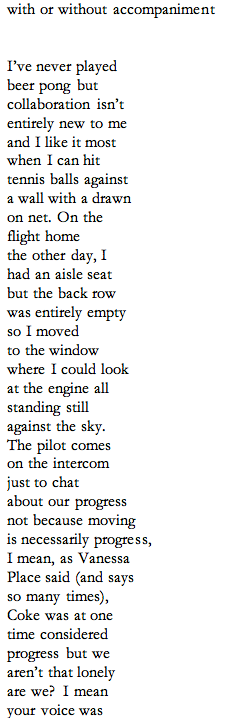
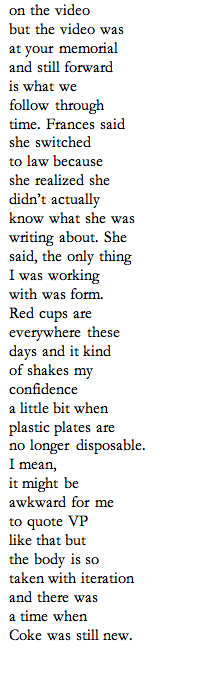
so·lo (ˈsōlō),  n.  [ pl.  SOLOS  (-lōz); rarely SOLI (-lē)], [It.  <  L. solus, alone],  1.  a musical piece or passage to be played or sung by one person, with or without accompaniment.  2.  an airplane flight made by a pilot alone, without any passengers or instructor.  3.  any performance by one person alone.  4.  any card game in which there are no partners.  adj.  1.  arranged for or performed by a single voice or instrument.  2.  performing a solo.  3.  made or done by one person v.i. in aviation, to make a solo flight, especially one’s first.


It’s the last day of April and the last day of National Poetry Month! So today, we have our last word and last post for our first annual na·po·mo. The word is so·lo and the poet is TC Tolbert. Thanks so much for joining us.


TC Tolbert is a genderqueer, feminist poet and teacher committed to social justice.  Co-editor of the forthcoming Anthology of Trans and Genderqueer Poetry (Nightboat Books), TC is the author of two chapbooks, territories of folding (Kore Press) and spirare (Belladonna).  His first book, Gephyromania, is forthcoming from Ahsahta Press.  He is the Assistant Director of Casa Libre en la Solana, Adjunct faculty at University of Arizona and Pima Community College, and founder of Made for Flight.  www.tctolbert.com

Leave a comment

Filed under napomo

prac·ti·cal


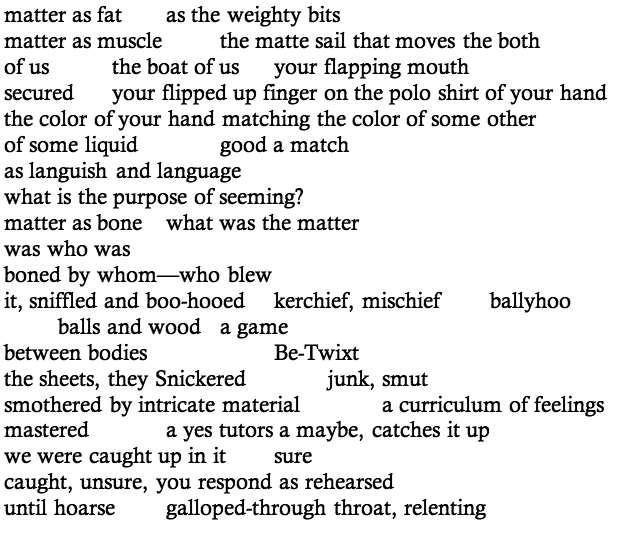
prac·ti·cal  (ˈpraktikəl),  adj.  [obs. Fr. practique, pratique  <  LL. practicus (see PRACTICE) ;  + —al],  1.  of, exhibited in, or obtained through practice or action: as, practical knowledge: opposed ot theoretical, speculative, ideal.  2.  that can be used; workable; useful: as, practical proposals.  3.  designed for use; utilitarian: as, a practical dress.  4.  concerned with the application of knowledge to useful ends, as distinguished from speculation, etc.: as, practical science, a practical mind.  5.  given to or experienced from actual practice: as, a practical farmer.  6.  of, concerned with, or dealing efficiently with everyday activities, work, etc.  7.  that is so in practice, whether or not in theory, intention, law, etc.; virtual.  8.  matter-of-fact.


National Poetry Month is drawing to a close, but we still have a few poems from dictionary project contributors. Enjoy today’s feature, a poem by Kristi Maxwell:


Kristi Maxwell thinks and writes in Tucson, where she also teaches creative writing, literature, and composition around town and serves on the board of POG, a non-profit literary arts organization. Her books include Re– (Ahsahta Press, 2011), Hush Sessions (Saturnalia Books, 2009), and Realm Sixty-four (Ahsahta, 2008).


Leave a comment

Filed under napomo