third

Bones of Magalonyx Jeffersoni, James Akin after a chalk drawing by W.S. Jacobs.


Fittingly, our third post for nonfiction november is for the word third. B.J. Hollars offers his interpretation below. I first became familiar with B.J.’s writing when I wrote a review of his book Thirteen Loops: Race, Violence and the Last Lynching in America. There and here, I appreciate his attentiveness to history, all of history, and the complicated dynamics existing within people in positions of power.


1third  (thərd)  adj :  next after second  —  third or third·ly  adv.


The Third


He was the third, but he was also the first.

The first to press ink to parchment and remind men they were equal.

The first to inform a king across a sea of his irrelevance.

Declarations were made, charges levied, but Thomas Jefferson—seemingly so concerned with the future of a democracy—was concerned also with the mysterious bones unearthed in a Virginian cave.

He was the third, but he was also the first to hold those bones and think: I hold in my hands a monster.

And he was the first to build those bones into a pride of giant lions thundering across the American landscape.

He was the first to designate a room in his White House for bones.

The first to fill the hallways with the corpses of unknown creatures.

I will authorize the Louisiana Purchase, he thought, and then I will return to the bones.

He was the first to fight the French on their theory of degeneracy, which claimed Old World creatures superior to the third-ranked runts born of American soil.

And as a result, he was the first to order the slaughter and transportation of a monstrous moose to prove to the French that America’s beasts were born better.

But.

He was also the first to get it wrong.

The first to dream too hard for too long and make a monster out of a megalonyx.

The first to hold those brittle bones in his hands and think he had a beast.

He did not.

(What he had was a giant sloth).

But Jefferson had dreamed a creature into creation he called “Great-claw,” and though the giant lion did not exist, when Jefferson held those bones in the East Room of the White House, he confused a monster for a miracle.

This from the man who once confused “all men are created equal” with “all white men.”

Who wrote of “unalienable Rights” (but only if you were white).

He was the third to overlook these contradictions.

The third to sound the call for liberty, while fitting shackles to feet and fists.

What he needed, Jefferson knew, was a monster bigger than the one he’d helped create.

A giant lion, he thought, will surely eat this wolf.   

Slavery, Jefferson once claimed, was like holding a wolf by the ear.  And though he held tight to that wolf, he knew not how to release it.

Jefferson also held tight to his giant lion, and though science could not support the stature of the creature, he believed in it all the same.

He believed because he needed to.

Because America needed a giant lion to ensure its dominance.  Because trade routes were at stake, and we could not be not be seen as degenerate.

He was not the first or the second to make a mistake, but the third.  And his mistake was perpetuated by the fourth and the fifth, and on and on until the sixteenth took Jefferson’s declaration as truth and ordered emancipation.

The sixteenth released the wolf’s ear and the wolf killed many people.  Boys in blues and grays poured down hills and soaked into the land as if this, too, was not proof of degeneracy.

The wolf, sometimes, took the form of a gun or a bayonet or dysentery, but mostly it just remained a shadow.

When we speak of the wolf and the giant lion, only one ever existed.

But when America needed a monster, Jefferson held firm—one hand tight on the ear of an impossible wolf, the other on an impossible claw.


B.J. Hollars is the author of two books of nonfiction, Thirteen Loops: Race, Violence and the Last Lynching in America—the 2012 recipient of the Society of Midland Author’s Award—and Opening the Doors: The Desegregation of the University of Alabama and the Fight for Civil Rights in Tuscaloosa forthcoming in 2013. His short story collection, Sightings is forthcoming next year from Indiana University Press. He teaches creative writing at the University of Wisconsin-Eau Claire.


This word and definition was taken from a 2004 copy of the Merriam-Webster Dictionary

1 Comment

Filed under nonfiction november

lump·y

 
We are continuing with nonfiction november here at the dictionary project, and I’m so pleased to share with you today the words of Karinya Funsett-Topping. There is so much to appreciate in Karinya’s writing, but I think what I admire most is the way her wit and humor serve to enhance the poignancy and depth of all that she chooses to write about. Please enjoy her piece on lumpy.


lump·y  (ˈləmpē),  adj.  [LUMPIER, LUMPIEST1.  full of lumps: as, lumpy pudding.  2.  covered with lumps; having an uneven surface.  3.  rough: said of water.  4.  like a lump; heavy; clumsy.


“Losing both of your parents when you were just a child – how was that for you?” –asked, mid pap smear, by a health care professional. 
 
 
The nurse practitioner with frizzy red hair and a last name that sounds like a first name uses both hands to palpate my chest as I stare at the inspirational images tacked up beside the exam table. There’s a woman lacing up tennis shoes, a bald head, lots of pink ribbons, a race number from a marathon. I look at them and think to myself, as I often do, Do not cry. Do not cry.
 
 
“In dense breasts, some lumpiness is to be expected,” she says, fingers still moving in the clockwise motion that all the self-exam guidelines suggest. “Soft lumps are usually fine.”
 
 
I nod. I do that uncomfortable half smile one does when there’s not really anything to smile about.
 
 
“Think about homemade mashed potatoes,” she says. “If you’re checking yourself and you feel something other than a potato lump – like a hard pea that got mixed in there – then that’s when you should worry. That’s when to call us.”
 
 
I saw her a few more times at the university’s campus health center over the course of my undergrad & grad school years. I heard the mashed potato analogy most often, but sometimes she mixed it up: one year I was advised that it was fine if my breasts felt like oatmeal, but I should watch out for the raisins.


I was eight when my mom came home with her breast cancer diagnosis. I might have been seven, or nine: at this point there is no one with a reliable memory left to ask. Whenever it was, she was too young to have her concerns taken seriously, and by the time her illness received a name, it was too late. No longer just dealing with a lump, she tried it all. There was the surgery that removed the offending tissue and replaced it with an implant that caused her almost as much pain as the cancer itself.  (“I’m sorry,” I remember her saying as we left the office after her post-surgery check-up. I had stood in the corner as the doctor unwrapped her; green and yellow bruises and stitches, the incision site still fresh and raw.  “You probably shouldn’t have seen that.”) There were chemotherapy sessions where we sat in a big room with other sick people and half watched hockey games on the television (we hated hockey) and there was the aftermath at home when the basement was the one safe refuge from the sounds of my mother throwing-up in the sink. There were the radiation treatments and technicians in lead aprons and that big built-into-the-floor scale at the nurses station that both intrigued and terrified me (I was not a small child) with the numbers it displayed. There were special diets that came and went, when eating was an option for her at all (a plum upon waking, then nothing else for at least an hour). There were frequent trips in the family station wagon to the local natural health store, which resulted in an entire kitchen cabinet being devoted to shelf after shelf of vitamins, teas, and shark cartilage capsules (contrary to the pop-medicine wisdom of the early 1990s, sharks do, in fact, get cancer).  And finally, there were the doctor-prescribed pills that were burning through our savings account and not doing a damn thing else.
 
 
Sometimes thinking about my parents (my father would succumb to cancer too, a few years after my mother did) is like watching a movie without the sound. The images are vivid. The cinematography is great. The actors are beautiful, even when their hair has fallen out and their costumes hang off their skeletal frames. But there’s no sound, and no director’s commentary available to explain the causes or motivations, or to address the why her? question that will linger on, unanswered, forever.
 
 
The doctors said my mom’s tumor had been in there, growing, for years before there was a noticeable lump; probably even while she was breastfeeding my younger sister. Some days, I look down at my son as he sleepily nurses and silently plea to my chest, please do not betray me.


I am always watching out for raisins.


Karinya Funsett-Topping has been, at various points, a book reviewer, bookseller, arts desk writer for a newspaper, literary journal editor, and chief bedtime story reader. She graduated magna cum laude with a BA in Creative Writing (fiction and nonfiction) in 2005 and an MFA in Creative Nonfiction in May of 2008, both from the University of Arizona. She now works as an editor and lives in Michigan with her husband and two children. She really isn’t always as serious as this piece makes her seem.

Leave a comment

Filed under nonfiction november

the dictionary project author interview: elizabeth crane

Today, the dictionary project hosts an author interview with fiction writer Elizabeth Crane. Enjoy!


1. Please share a memory/story/thought in relation to a dictionary/dictionaries:

When I was in junior high school, my favorite class was Vocabulary. This is not necessarily reflected in, you know, my vocabulary, nevertheless, my best friend and I thought this was the greatest class ever, because we’d learn new words and then have to use them in sentences and paragraphs and I always loved making the silliest possible sentences. “The bombastic misanthrope could not stop talking about the frowzy conquistador’s inability to show up in a decent shirt.” Also, same best friend and I subsequently created our own dictionary called The Betsy Bugs the Bees and Nina the Nerd Random House Dictionary. We each had a copy, and we filled it with slang, words we just liked, and words we made up, like “Feduchee.” We even had Feduchee t-shirts at one point. So, we weren’t in the popular group, but amazingly we weren’t total outcasts either.


2. What is your current favorite word?
I have to choose one??? Jibber jabber. But you have to say it in a 1940s noir movie voice.


3. What is the most obnoxious/insidious/annoying word?

Oh man, so many! Some I’d rather not even say. But lately one I don’t like is ‘ugly.’ I don’t like the sound of it and I don’t like the judgment in the meaning.


4. What word has been your (recent or past) muse?

I’m having a hard time deciding between “Well,” “Anyway” and “So.” I can always get a sentence started with one of those, even if they don’t stay there for the duration. When I was a kid I thought ‘indubitably’ was the greatest-sounding word ever. It still kind of holds up, though it sounds too fake-Britishy coming out of me.


5. Your debut novel We Only Know So Much just came out this year. Were there particular words that you found yourself using often as you wrote?

Some of the characters have a few things that they say regularly: Vivian, the grandmother, likes to follow almost everything she says with “You see.” Gordon likes any three-syllable word, and Priscilla is fond of ‘seriously.’ Otis is obsessed with three jelly beans that his love gave him, and so I repeated the word jelly beans or jelly bellies numerous times, and these words are very pleasant to me. But sometimes I do global searches on certain words that keep coming up so that I don’t sound like a broken record. “Just” is one that just keeps coming up, and just needs to be dialed back.


6. If you had to write your own dictionary entry for the word “story,” what would it say?

Tough one! Story: v. to make something true out of something not true (this makes sense in my head)


7. Please respond to the following words and definitions*, picked exclusively at random for you:


lip (lip), n. [ME. lippe; AS. Lippa; akin to G. lippe ( < LG.) ; IE. base *leb-, prob., what is licked (var. of *lab-, *lebh-, etc., to lick with gusto), prob seen also in L. labium (cf. LABIAL)], 1. either of the two fleshy folds, normally pink or reddish in color, forming the edges of the mouth and important in speech. 2. anything like a lip; specifically, a) the edge of a wound. b) the projecting rim of a pitcher, cup, etc. c) the mouthpiece of a wind instrument. d) the cutting edge of any of certain tools. e) in anatomy, a labium. f) in botany, a labellum. 3. [Slang], impertinent or insolent talk. 4. The position of the lips in playing a wind instrument. v.t. [LIPPED (lipt), LIPPING], 1. to touch with the lips; specifically, a) to kiss. b) to place the lips in the proper position for playing (a wind instrument). 2. in golf, to hit the ball just to the edge of (the cup). adj. 1. merely spoken or superficial; not genuine, sincere, or heartfelt: as, lip service. 2. Formed with a lip or the lips: labial: as, a lip, consonant.


I like definition #3 the best. It makes me think of the Bowery Boys. “Don’t gimme any lip!”


braid (ˈbrād) v.t. [ME. breiden, braiden; AS. Bregdan, to move quickly, jerk, pull, twist, see UPBRAID], 1. to interweave three or more strands of (hair, straw, etc.). 2. to tie up (the hair) in a ribbon or band. 3. to trim or bind with braid. n. 1. a band or strip formed by braiding. 2. a strip of braided hair. 3. a woven band of cloth, tape, ribbon, etc., used to bind or decorate clothing. 4. a ribbon or band for tying up the hair.


I always wish I could wear my hair in one long braid, but because it’s so thick, it gets kind of fat and tends to look like a challah.


sum·mon (ˈsum-ən), v.t. [ME. somonen; OFr. somondre, semondre; L. summonere, to remind privily < sub-, under, secretly + monere, to advise, warn], 1. to call together; order to meet or convene. 2. to order to come or appear; call or send for with authority. 3. to issue a legal summons against. 4. to call upon to act, especially to surrender. 5. to call forth; rouse, gather; collect (often with up): as, summon (up) your strength. —SYN. see call.


This is kind of an awesome word I don’t think about much. But I like the way it sort of speaks to possibility, like we can get whatever it is that we need by just calling it forth.


pro·thon·o·tar·y (prō-ˈthä-nə-ˌter-ē), n. [pl. PROTHONTARIES (-iz)], [ML. protonotarius; LGr. pronotarios < Gr. protos, first + L. notarius: see NOTARY], 1. a chief notary or clerk. 2. in the Roman Catholic Church, one of the seven members of the College of Prothonotaries Apostolic, who record important pontifical events: sometimes held as an honorary title by other ecclesiastics. Also protonotary.


I don’t think I’ve ever heard this word! But suddenly I want to call on the Roman Catholic Church next time I need a document notarized.


dy·ing (ˈdī-iNG), present participle of die. adj. 1. at the point of death; about to die. 2. Drawing to a close; about to end: as, a dying social order. 3. Of or connected with death or dying. n. the act or process of ceasing to live or exist.


What we’re all doing all the time. Sigh.


Elizabeth Crane is the author of the novel We Only Know So Much, and three collections of short stories, When the Messenger is Hot, All this Heavenly Glory, and You Must Be This Happy to Enter. Her work has also been featured in numerous publications and anthologies. She is a recipient of the Chicago Public Library 21st Century Award, and her work has been featured on NPR’s Selected Shorts and adapted for the stage by Chicago’s Steppenwolf Theater company. She teaches in the UCR-Palm Desert low-residency MFA program.


*Definitions taken from Webster’s New World Dictionary of the American Language, copyright 1955.

Leave a comment

Filed under author interviews

broad


Courtesy of Isabella’sArt, Etsy.


For our first guest post of nonfiction november, we are featuring the words of contributor Allie Leach.  Allie takes a zany approach to nonfiction. One of the things I appreciate most about her as both a writer and a human is her willingness to try new things, to ask lots of questions, to seek out those tiny mouseholes where stories reside. Before I met her, she was described to me as this woman who went into college classrooms dressed in a panda suit, you know, to see what happened. Please enjoy her piece on the word broad.
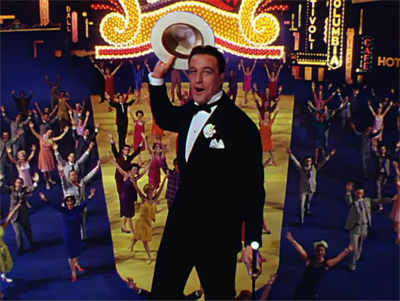


Gene Kelly, “Broadway Melody,” Singin’ in the Rain


broad  (brôd), adj.  [ME. bord; AS. Brad; akin to G. breit],  1.  wide; of large extent from side to side.  2.  having great extent or expanse; spacious.  3. extending about; clear; open: as, broad daylight.  4.  open to the sight; obvious: as, a broad purpose.  5.  strongly marked: said of dialects or accents.  6.  outspoken; unreserved: as, a broad statement; hence, 7.  ribald: as, a broad joke.  8.  all-inclusive; tolerant; liberal: as, he takes a broad view of the matter.  9.  extensive; general: as, in a broad sense that’s true.  10.  main; essential: as, in broad outline.  11.  Spoken with the tongue held flat and low in the mouth and the oral passage wide open, as in father: the current phonetic term is open.  adv.  in a broad manner; widely.  n.  1.  the broad part of anything.  2.  [Slang], a woman or girl: a vulgar term.


Photo by JPinlac, Flickr


Not So Practically Perfect on Broadway


On our first date, about seven years ago in Indiana, my husband and I watched the movie, Mary Poppins. This seems random at first, yes, but we had both grown up with this movie.  At a party about a month before, we were absorbed in one of those great conversations where you realize you have something strange and wonderful in common with another person. And the tie that bound just happened to be, well, Mary Poppins. Still new to each other, we coyly poised ourselves at opposite ends of the couch, and not only watched the movie, but, being the nerdy English majors that we were, dissected the lyrics. If a stranger were eavesdropping, they would’ve thought we were munching on pot brownies.

“This shit’s deep,” remarked Rick. “Think about it: ‘Let’s-go-fly-a-kite.’ The lyrics are so simple and wise. It’s telling us how to find everyday joy in our lives. It’s like…the meaning of life.” I looked at him, mesmerized and in love.

“You wanna go fly a kite?” I suggested.

Four years later, we’re in New York. Rick’s at school at Columbia University, and I’m visiting him from Tucson, where I’m also going to school. We buy tickets to see what else but Mary Poppins on Broadway. Broadway: a word synonymous with the bravado and bigness that is New York City. Full of spectacle and stars and shows. A place I’ve always dreamed of, always in broad, hyperbolic fashion. Located in the heart, the heat of Times Square, I’m surrounded by stampedes, people moving like they’re trying to get somewhere. And aren’t we all? If I panic, if I hesitate for too long, I’ll be stamped by their footprints. And so we dance past each other in a maze-like motion, until we can get through a door. A door that frees us from the ads that look like monster-sized Lite-Brites, each one shouting their show: Mamma Mia! Hair! South Pacific! Wicked! Mary Poppins! And so we escape and slip through the door, hoping for something that’s supercalifragilistic.
 
Rick and I are up in the balcony, holding each other’s hands, being all romantic, and reminiscing about the time we watched our beloved musical for the first time together.

“I kind of thought you were a freak,” I say.

“Why?” he laughs, squeezing my hand.

“Because you kept squealing and hitting the couch after we’d discuss the song lyrics.”

“I wanted to grab you and kiss you really bad,” he admits.
 
Before the show starts, the orchestra begins to play a medley of songs, some of which I recognize, and some of which I don’t. Huh, I think. The curtains rise. The actors sing a string of familiar songs like “Chim-Chim-Cheree” and “The Perfect Nanny.” But even though I know these songs, there’s something lost here. All of the actors have these booming voices that are crisp and clear, but annoyingly and cloyingly loud. What’s so great about the original 1964 movie, starring Julie Andrews and Dick Van Dyke, is that these actors’ voices—even the children who play Jane and Michael Banks—crack and quiver and warble. And because of these nuances, their voices build to create meaningful and moving songs. In this case, singing simple and small, trumps big and broad.

As Act I breezes along, the song “Practically Perfect” jumps out. Wait a minute, I think. Hold the mic-ro-phone. This song isn’t from the movie! And not only is it not from the original beloved movie, my original beloved movie, but this song…it’s…bad. Now, I know that Mary Poppins is a bit of an egomaniac. Yes, in the movie, she does have that amazing, yellow measuring tape that dubs her practically perfect in everyway, but she says this phrase lovingly and with a wink. She doesn’t sing a whole song about why she’s so goddamn perfect. That’s not true to her character; she’s so much more refined than that. Even so, in this new version of the musical, Mary gloats, “I’m practically perfect from head to toe. If I had a fault it would never dare to show. I’m so practically perfect, in every way.” Where’s the humility, the honesty, vulnerability? It’s in our flaws that we’re perfect, and the real Mary Poppins knows this. Heck, she’s dating Bert, who’s a poor but wonderful chimney sweep and street performer. And then she goes on to teach the children about unattainable perfection: “By the time I leave here, you both will be the same. You’ll be practically perfect.” Oh, Lord. Those kids are going to grow up and become two highly dysfunctional adults.
 

“Sister Suffragette,” Mary Poppins


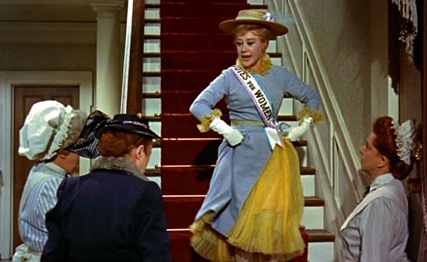
By Act II, it’s not just me who’s an unhappy theatergoer, Rick is visibly peeved, too. We both roll our eyes at each other and shift around in our seats. And we refuse to clap after the songs. This is musical warfare, and we’re on the opposing side. I squint my eyes, trying hard to read the program in the darkness, and realize that the song “Sister Suffragette,” one of my favorites, has been excluded. This song highlights Winifred Banks, Jane and Michael’s crusading and empowered mother. Keep in mind that this musical is set in the early 1900’s, when women were fighting for their right to vote. And this song does a tremendous job expressing the vive and vigor of this time period as Mrs. Banks sings: “Cast off the shackles of yesterday! Shoulder to shoulder into the fray! Our daughters’ daughters will adore us, and they’ll sing in grateful chorus, ‘Well done, Sister Suffragette!’” Not only are these lyrics poetic and well written, they’re incredibly poignant. This song has instead been replaced with the song “Being Mrs. Banks,” with lyrics like: “And now although you’re lost, it’s time that we closed the ranks. I’ll fight for the man who needs freeing. The real you no one is seeing.” Now, I have to cut the songwriters—George Stiles and Anthony Drewe—some slack here. These are some great lyrics, but this is a completely different Mrs. Banks from the previous song. Instead of fighting for women’s rights, she’s fighting for her needy husband.

The lyricists of the original 1964 Mary Poppins were two brothers, Richard and Robert Sherman, born in the 1920s to Russian-Jewish immigrants in New York City. The duo went on to win two Academy Awards for Mary Poppins. The Sherman Brothers also wrote songs for other classic Disney hits, such as The Jungle Book, Chitty Chitty Bang Bang, The Aristocats, Bedknobs and Broomsticks, Charlotte’s Web, and The Many Adventures of Winnie the Pooh. And for their work, they won nine Academy Award nominations, two Grammy Awards, four Grammy Award nominations, and twenty-three gold and platinum albums. In short, these bros had mad skills and major street cred. In all seriousness, though, the lyrics and songs that these two brilliant men created were full of smart, historical references, playful poetics, and touching turns of phrase. I can remember watching the movie, Charlotte’s Web, as a kid, and bawling when, as Charlotte was dying, she sang to Wilbur, “How very special are we. For just a moment to be, part of life’s eternal rhyme,” in the song “Mother Earth and Father Time.” Even now, as an adult, I listen to this song, and it gives me pangs.

Back on Broadway, Mary Poppins, Jane, and Michael head to Mrs. Corry’s sweet shop—yet another departure from the movie—where the lady sells silly words, like “Supercalifragilisticexpialidocious.” After they leave Mrs. Corry’s, they walk through a park and these dancing statues start singing “Jolly Holiday.” Granted, these details were lifted from the original book series “Mary Poppins,” written by an Australian woman named Pamela Lyndon Travers. When she emigrated to England and began writing her series of children’s novels about a magical English nanny named Mary Poppins in 1933, she wrote under the pen name P.L. Travers. Even so, seeing people dressed in tight silver body suits with spray painted faces singing “Jolly Holiday,” is almost as frightening as what’s coming up next in this remake. And what’s more, these awkward scenes replace the wonderful park outing, when the whole gang jumps into one of Bert’s paintings and are charmed by dancing penguins, the horse race, the caramel apples, and the subsequent trip to Bert’s old Uncle Albert’s place. Remember when their laughter suspends them high to the ceilings while they drink tea and sing “I Love to Laugh?”

As the disjointed story continues, Rick and I are confused when, after Mary Poppins leaves the family so that they can bond, a new nanny appears on the scene. This Nanny is Miss Andrews, who was Mr. Bank’s frightening, childhood Nanny, (though Mrs. Banks doesn’t realize this when she hires her). Miss Andrews, this super-evil Nanny, sings a new song called “Temper Temper,” with eerie lyrics like “children who lose their temper will lose everything in the end” and “you will not see your parents for quite some time” and “children who refuse to learn will not return,” a line Miss Andrews repeats three times in a row, in a cackling voice. This song was so freaky that kids were crying in the audience. In fact, it’s recommended on the official Mary Poppins Broadway musical website, that children be at least six to attend a performance, because it can be too scary for the youngins’. This song completely goes against the ethos that is Mary Poppins: joyful, humane, and life affirming.  I’m pretty sure the Sherman brothers wouldn’t approve. Although Julie Andrews, surprisingly, did. She actually praised the cast for their new interpretation when she appeared onstage during the curtain calls after a performance in London in 2005.

The musical ends with the sentimental and cheesy “Anything Can Happen,” which is full of clichés like, “if you reach for the stars all you get are the stars, but we’ve found a whole new spin if you reach for the heavens” and “anything can happen if you let it. Life out there is waiting for you, so go and get it” and “Go and chase your dreams, you won’t regret it.” The song is too general, too broad and abstract. The original movie ended with the song “Let’s Go Fly a Kite,” which, in my mind, was perfect. This song is so simple and concrete. And the act of flying a kite is symbolic to the story. Mr. Banks has finally let loose, has finally decided that life’s too short to be uptight and strict. And so he does something simple and joyful: he takes his kids out and they fly kites. What could be a better, more lasting image than that?

In the hubbub of the finale, Mary Poppins reappears, but this time, she’s flying high across the audience, strings attached, holding her famed, black umbrella. The parents and kids and, well, everyone it seems except for Rick and me, are ooo-ing and ahhh-ing and chanting, “ANYTHING CAN HAPPEN IF YOU LET IT!” The crowd roars with applause as the actors give their bows, and yet Rick and I are in our own, disenchanted world. Our arms are crossed, our fists clenched tight. We will not clap for this, we’ve decided. We leave early, as the actors come out for their final encore, and we trudge like Eeyore down the red, carpeted stairs. We walk through the theater’s corridors and can hear the muffled applause and music fading away. For a moment, New York City seems as quiet as a secret. This sensation, though, only lasts for a moment. As we push the theater doors open, we’re thrown into the rainbow fluorescence of Times Square. It’s dark outside and the scene has shifted. The streets are still crowded with people, but I’m not overwhelmed anymore. I want to be a part of it.


Allie Leach lives in Tucson and works at The University of Arizona Poetry Center. Her work has appeared in South Loop Review, Hot Metal Bridge, Diagram, and Tucson Weekly. When not at work on essays, she’s plotting to become a professional tap dancer and collector of miniatures.


1 Comment

Filed under nonfiction november

sa·bot


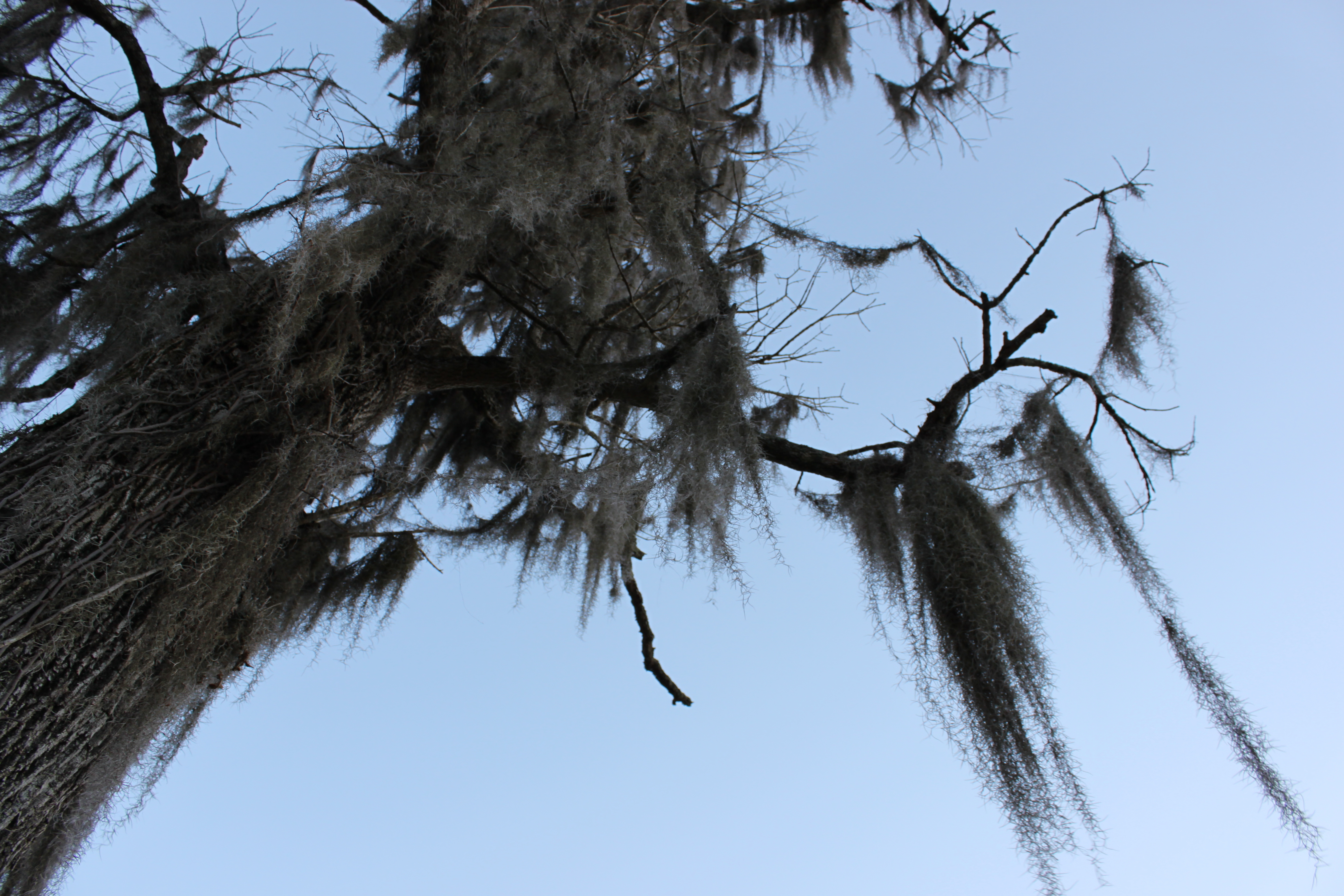
Tree, Lisa O’Neill


sa·bot    (sab-oh)  n.  [Fr.; altered (after bot, a boot)  <  savate, old shoe; via Turk.  <  Ar. sabbat, sandal]  1.  a kind of shoe shaped and hollowed from a single piece of wood, worn by peasants in Europe.  2.  a heavy leather shoe with a wooden sole.  3.  a small sailing dinghy whose hull somewhat resembles a shoe.  4.  in military usage, a wooden disk or soft metalclip fastened to a projectile, formerly used in muzzle-loading canon.
 
 
“Where would I possibly find enough leather
With which to cover the surface of the earth?
But (just) leather on the soles of my shoes
Is equivalent to covering the earth with it”

–Shantideva


The ground was rough. So the girl decided to carve herself some shoes. She was tired of stepping on thorns. She had enough of cuts from tiny pieces of glass. Her toenails were torn. Her arches were sore. Her feet were calloused from walking the stubborn earth.
 
She had tried looking carefully at where she was walking. She had tried looking ahead at where she was going and hoping for the best. She had tried praying for the ground to be other than it was. She had tried laying out a mat which she would pick up and throw in front of her every few steps. All of these were tiresome. None of these worked. So at long last, she decided, though she was no carver, to carve herself some shoes.
 
She went walking to the place where there were many trees and once she arrived there, she considered them keenly. She placed her hand against the bark. She felt the smoothness of their leaves between her fingers. She considered the maple, the mesquite, the magnolia. She sat on the roots of mighty oaks. She pressed her nose to the skin of the cedar. She did this for days, or was it weeks? She smelled the sassafras. She leaned her back against the bark of the elm. She touched the ashes. She tasted the sap of the pine.
 
She wondered which wood would give best, which would mar her feet. She considered what she knew about the rings inside those trees, the color of the wood. She considered the way the wood would sound when it met the earth, in walking or in dancing.
 
She walked to where the water met the trees, she waded, and finally, she settled on something. Cypress.
 
She pulled something sharp from within her coat and she began to saw. She thanked the tree and took her branch with her.
 
The girl found a place on the earth to sit and placed her large branch across her lap. She had never made a pair of shoes before. She had never carved anything besides letters into words, color into walls. She wondered where to begin. Begin with this wood, she heard. Begin with this tool. Begin with this time.
 
So she did. She found the process long, this slow hollowing. The only indicator of time spent was a small curve in the center of the block. And yet there was something satisfying about the sound of her knife cutting into the wood and the sight of curled shavings falling to her feet.
 
She scraped and she notched and she pulled. She worked and as she worked, she sang. These were the songs she had been taught over the years. Her mother had sung them. And her mother’s mother had sung them. They were songs about truth and what it means to sit in the presence of another human being. She became lost in the music and the slow rhythm of scraping and when she came out of her haze, she saw she had cut a hole clean through.
 
So she began again, slowly carving, this time not forgetting where she was. People passed her as she worked, some offered to help her carve, some gave her suggestions. She thanked them, she listened, and then she continued to work. The light turned to dark then to light then to dark again, and still she carved. She noticed the rings in the wood. She noticed the changes in color. She noticed the smell of its skin. She chipped, she chiseled, she cleaved and divided. She etched, she hacked, she hewed. She molded and modeled and patterned and sculpted and shaped. She, at long last, whittled the last bit of excess away.
 
And then she looked at her work. These wooden shoes were not entirely even. They were not exactly smooth. She held one in each hand and considered their weight. She thought about her efforts and why she had begun in the first place. These would not be the most comfortable shoes. They would not be the most attractive. They looked like they had been made by a beginner. And they had. These shoes would not spare her the miles walked in them. They would not spare her the wrong turns. They would not keep her from encountering hard rain or hot sand or a horizon obscured by too much foliage. These shoes would not do this. No shoes ever would. But still, the girl had made these.
 
She slipped on the shoes.
 
She began to walk.


2 Comments

Filed under weekly words

nonfiction november

There Is Nothing Wrong In This Whole World, Installation by Chris Cobb, Photo by Andrea Scher


Hi Dictionary Project People,

I am very pleased to announce that we are adding a new event to our repertoire: nonfiction november.  I tend to write nonfiction essays for the regular weekly words. During November, I wanted to open the doors to other nonfictioneers. All month, we will be featuring short essays inspired by bibliomanced dictionary project words.

While we are on the subject, might I just say that I’ve always been a little unsatisfied by the word “nonfiction” as a descriptor for the genre. A definition in negation. A genre defined by what it is not. I haven’t as of yet found a word or phrase that works to be encompassing of the whole genre, but I’d love to see one. I think what most attracts me to nonfiction as a genre, to write in and to read, is the discovery of all that is true and truly bizarre in our world. I like making connections between seemingly unconnected things. I like listening to people’s stories and thinking about the ways they intersect with art and music and culture, with things I’ve read and things I believe. I like the attempt to get to the heart of the matter. Truth and reflection and beauty are of course present in all genres of writing. Nonfiction, I think offers one thread of connection between the writer and reader: here’s what I see, let’s make sense of it together.  I look forward to sharing with you the nonfiction pieces of writers this month. Stay tuned.

3 Comments

Filed under nonfiction november

re·ta·ble

Amanda Sapir, All Souls Procession 2011. By Lisa O’Neill


Here in Tucson, the air has turned and it is finally beginning to feel like fall. We are also in the season of Dia de los Muertos, the time when the living pay homage to the dead. And so it couldn’t feel more appropriate that for our second the dictionary project presents! reading tonight the word is:


re·ta·ble  (ˈrē-ˌtā-bəl)  n.  [Fr., contr.  <  *reretable; rere (see REAR) + table (see TABLE)], a raised shelf of ledge above an altar for holding altar lights, flowers, etc.


Tonight the readers bringing their offerings, all inspired by the bibliomanced word “retable,” are:


Kimi Eisele,  a Tucson-based multidisciplinary artist who writes, dances, choreographs, teaches and engages the community through art practices and performances. She recently completed her first novel. As the co-director of NEW ARTiculations Dance Theatre, she has directed community-dance projects about such issues as food, water, and public space. She has taught creative writing and movement in schools, communities, and institutions for over a decade.
favorite word right now: ocean
I love the vastness of the actual thing, when I get to see it, which is often only fleetingly.
detested word right now:
I don’t detest many words. and it’s hard to dislike a word for the word’s sake without getting all caught up in what it means. Take “barf” for instance. It’s not a bad word, inherently. But then…don’t you just hearing someone barfing? And then you smell it and then you see the barf. So I guess it’s kind of a great word because it works so well for what it does. Anyway, I’m going to go with “urine.” Because I so hate the smell of it on city walls and sidewalks, especially when the sun’s out. Pee is such a nicer, benign, less smelly word.
 
 
Sarah Kortemeier, who holds an MFA in Creative Writing: Poetry from the University of Arizona. Recently, her work has appeared in Ploughshares, Folio, Sliver of Stone, and Spiral Orb; she has also been a finalist in the annual Gulf Coast and Tennessee Williams Festival Poetry Contests. Sarah is a former journalist, educator, actor, and musician, and has lived and worked in Europe and Asia. She currently serves as a library assistant at the University of Arizona Poetry Center.
Favorite word: creamery
Least favorite word: cunt (I hate this word so much I don’t really want it on the Internet anywhere near my name, but it’s probably better to be honest than to make up something that sounds safer)
 
 
Kristi Maxwell, who eats words. Her books include Re-, Hush Sessions, and Realm Sixty-four.
My favorite word: perhaps
My least favorite: no
 
 
Ted Mcloof, who teaches fiction at the University of Arizona. His fiction has appeared in Bellevue Literary Review, Minnesota Review, Monkeybicycle, Sonora Review, Gertrude, Hobart, and elsewhere. He’s very cool and very handsome and he’d like to buy you a drink.
Favorite word: picayune
Least favorite word: literally
 
 
Kristen E. Nelson, who is the author of Write, Dad (Unthinkable Creatures Press, 2012). She has work forthcoming in Denver Quarterly, and has published work inDrunken Boat, Tarpaulin Sky Journal, Trickhouse, and Everyday Genius, among others. She is a founder and the Executive Director of Casa Libre en la Solana, a non-profit writing center in Tucson, Arizona; a production editor for Tarpaulin Sky Press; and an editor for Trickhouse. She earned her MFA in creative writing from Goddard College and teaches writing.
Favorite Word: “marmalade” for the music in it
Least Favorite Word: “juxtaposition” because of it’s overuse in my undergraduate reading series a million years ago
 
 
Johanna Skibsrud, who is the author of a collection of short fiction, This Will Be Difficult to Explain and Other Stories (Norton 2012), the 2010 Scotiabank Giller Prize winning novel, The Sentimentalists (Norton 2011) and two collections of poetry, Late Nights With Wild Cowboys and I Do Not Think That I Could Love A Human Being (Gaspereau Press, 2008, 2011). Originally from Nova Scotia, Canada, Johanna lives in Tucson, AZ, where she is a postdoctoral fellow at the University of Arizona and is working on a second novel.
Favourite word: and
Least favourite word: but
We will be posting videos and updates after the reading for those of you unable to be with us in person.


1 Comment

Filed under the dictionary project presents

the dictionary project author interview: ander monson

Today, we feature an interview with Ander Monson, author in all genres and known innovator in the world of nonfiction. I think what I appreciate most about Ander’s work is how he brings to the forefront the unexpected and neglected musings that are often relegated to the sidebar, the footnotes, the parentheses. These ideas are investigated, interrogated, violently disassembled and put back together again in surprising, compelling, and sometimes confounding ways.  As he once told me, the essayist’s job is to show the inner workings of the writer’s brain on the page. Enjoy these synapses, these nerve endings.


1. Please share a memory/story/thought in relation to a dictionary/dictionaries:


I’ve collected old dictionaries for years, starting mostly when I lived in Alabama, and happened on a whole pile of them at Alabama’s Thrift Store, now named, instead, America’s Thrift Store. I’d buy them all. I must have had forty. They were all well outdated. I wondered what worth there was in an outdated dictionary. But they had the most lovely images: etchings, woodcuts, weird handmade diagrams of things. I got excited. I kept them for four years, acquiring more, but had to discard most of them when my wife and I moved to Michigan. They weigh a ton. They take up too much space. But first I pillaged them. Now I restrict myself only to specialist dictionaries (medical dictionaries, photography dictionaries, tool-and-die dictionaries, mathematics dictionaries, etc.) and to my OED condensed, 1971, in micro-script. It comes with a magnifying glass.


2. What is your current favorite word?

Library.


3. What is the most obnoxious/insidious/annoying word?

Utilize.


4. What word has been your (recent or past) muse?

I almost never think of words as muses. To me they’re tools—sometimes worlds.


5. Could you talk a little bit about the interaction of words and space in your work? 

Well, that’s a big question. I’ll narrow it down a bit. The piece I wrote for this, Dear Sepulcher, is part of this book project I’m finishing up this fall in which I write short, associative, compressed essays in response to things happened on in libraries: five words (in this case), a passage from a book, a striking image, an snatch of overheard conversation, a human hair, a punch card, homophobic marginalia, a packet of seeds, a due date stamp, just to name a few. Once written, they are originally published back into the book in the library in which I found the originating thing. So they’re words written in response to words I found in any one of a series of particular spaces (libraries, loosely defined), and published back into that space as a communication to a future reader. In this way I’ve been thinking of the library as a medium, a meeting space for brains to find each other. I’m also collecting these short essays as 6×9 cards, unbound, unordered in a box. So in their production I’m thinking about space and language, image and design (as I often do in my work). How language can be a tool of design—or design a tool of language. Either can serve the other, but they work best when they can have a conversation.


6. Please respond to the following words and definitions*, picked exclusively at random for you:


se·pul·cher  (ˈse-pəl-kər),  n.  [ME. & OFr. sepulcre; L. spulcrum < sepelire, to bury],  1.  a vault for burial; grave; tomb.  2.  a place for the safekeeping of relics, as in an altar.  v.t.  to place in a sepulcher; bury.


Al·a·bam·i·an  (ˌæləˈbæmɪən), adj.  of Alabama.  n.  a native or inhabitant of Alabama.


ken·nel  (/ˈkenl),  n.  [ME. kenel, keneil;  OFr.  *kenil; LL. canile < L. canis, a dog],  1.  a doghouse  2.  often pl. a place where dogs are bred or kept.  3.  a pack of dogs  v.t.  [KENNELED or KENNELLED (‘ld), KENNELING or KENNELLING], to place or keep in a kennel.  v.ito live or take shelter in a kennel.


Pa·pe·e·te  (pəˈpētē), n.  a seaport on Tahitia: capital of the Society Islands and French Oceania: pop., 8500.


re·ta·li·ate  (riˈtalēˌāt),  v.i[RETALIATED (-id) RETALIATING], [<L. retaliatus, pp. of retaliare, to require, retaliate < re-, back + talio, punishment in kind < talis, such}, to return like for like; especially to return evil for evil; pay back injury for injury: as, if he is hurt, he will retailiate.  v.t.  to return an injury, wrong, etc. for (an injury, wrong, etc. given); requite in kind.


*Definitions taken from Webster’s New World Dictionary of the American Language, copyright 1955.


Ander Monson is the author of a host of paraphernalia including a decoder wheel, several chapbooks and limited edition letterpress collaborations, a website, and five books, most recently The Available World (poetry, Sarabande, 2010) and Vanishing Point: Not a Memoir (nonfiction, Graywolf, 2010). He lives and teaches in Tucson, Arizona, where he edits the magazine DIAGRAM  and the New Michigan Press.

Leave a comment

Filed under author interviews

sur·ren·der


By Lisa O’Neill. Image of a collaboration of artist Gregory Sale and poet Tc Tolbert at the Phoenix Art Museum (click image for more details)


sur·ren·der (­­­­­­­­­­səˈrendər) v.t.  [OFr. surrender; sur-, upon, up + render, to render],  1. to give up possession of or power over; yield to another on demand or compulsion.  2. to give up claim to; give over or yield, especially voluntarily, as in favor of another.  3. to give up or abandon; as, we surrendered all hope.  4.  to yield or resign (oneself) to an emotion, influence, etc.  5. [Obs.], to give back or in return.  v.i.  to give oneself up to another’s power or control, especially as a prisoner; yield.  n.  [Anglo-Fr.  <  OFr.  surrender  (see the v.);  inf. used as n.],  1. the act of surrendering, yielding, or giving up.  2.  in insurance, the voluntary abandonment of a policy by an insured person in retrun for a cash payment (surrender value), thus freeing the company of liability.

SYN.—surrender commonly implies the giving up of something completely after striving to keep it (to surrender a fort, one’s freedom, etc.); relinquish is the general word implying an abandoning, giving up, or letting go of something held (to relinquish one’s grasp, a claim, etc.); to yield is to concede or give way under pressure (to yield one’s consent); to submit is to give in to authority of superior force (to submit to a conqueror); resign implies a voluntary, formal relinquishment and used reflexively, connotes submission or passive acceptance (to resign an office, to resign oneself to failure).


On Saturday, I heard Amy Goodman speak. I knew she was a brilliant journalist, having read her work and listened to Democracy Now!, but I was taken aback at what a consummate storyteller she is and at her capacity to be a vessel for so many people’s stories. She moved seamlessly in and out of political events, uprisings, movements, historical dates and figures, details of the stories of people she’d met and words they had told her. She talked about the responsibility of journalists (“to go where the silence is and let people speak for themselves”), about what one immigrant fighting for rights said when Goodman asked why there was a butterfly on their sign (“butterflies know no borders; butterflies are free”). She quoted Gandhi: “First they ignore you. Then they laugh at you. Then they fight you. Then you win.”

I think what surprised me most is that in the face of all of the stories of tremendous, often inconceivable, injustice and oppression, she exuded warmth and humor and a presence that spoke to her overall trust in the kindness and goodness of human beings. Was there corruption of power? Absolutely. Were people, all over the world, suffering in unconscionable ways? Without a doubt. Was much of this suffering caused directly by the policies of our country and were we Americans thus accountable to and responsible for much of this injustice? Yes, certainly.

Was this a signal that we should give up? That nothing could be done? That things were fucked up beyond repair and we should retreat into our homes to eat Cheetos and watch reality television for the rest off our lives? A definitive no.

Here’s the thing about surrender, about surrendering. Surrendering is not something that people in positions of power have any authority or control over. The surrendering must come from the person who chooses to submit. Obviously, the stakes are higher for some than others. Some of us enjoy expansive freedom in our day-to-day lives; freedoms we often take for granted and don’t practice gratitude for. Others live each day faced with imminent threats and dangers to their personal safety and that of their loved ones and communities, oppressed in their own countries and homes.

The one thing that steadily continues to amaze and humble me is the resiliency of the human spirit. That even when beared down upon, when suffering, when up against impossible obstacles, human beings consistently stand up and refuse to concede, to resign, to relinquish, to surrender. This is at the heart of our humanness, our ability to take ownership of our bodies, minds, hearts, souls, even if others beat us down, abuse us, tell us we are worthless. There is power in the unwillingness to cower or be made less than. There is strength in taping up wounds and walking even when broken. We may not have control of the conditions around us, but we do have a responsibility to the flickering of light inside.

Goodman took us through uprisings during the Arab Spring and back to the civil rights movement. She reminded the audience of the media’s dismissive and oversimplified take on Rosa Parks (“she was just a tired seamstress”) that doesn’t take into account that she was trained at the Highlander school and held the position of secretary of the local NAACP. Not only was she actively involved in the fight for civil rights for African-Americans, but she was chosen by the movement to take a stand in this way and to pave the way for the entrance of a new as-yet-unknown preacher to help lead the movement.


Goodman conferred some information that was shocking in its irony:

Mitt Romney’s father, George Romney, Jr., when being considered for a presidential run in 1968, warned the Republican party against extremism. He voiced his concerns about and opposition to organizations such as the John Birch Society, a radical right-wing organization that stood in opposition to the civil rights movement. The Koch Brothers’ father Fred Koch was a founding member of the Birch Society. The Koch Brothers have been one of the biggest supporters of Mitt Romney’s campaign.

Because Frederick Douglas was a “difficult” slave, he was sent to Ed Covey, known as a “slave breaker.” The place where Covey lived and enacted his torture on slaves, located in Saint Michael’s, Maryland, was known as Mount Misery. The current owner of Mount Misery? Donald Rumsfeld, the former Secretary of Defense, under whose leadership torture, like that at Abu Ghraib, was conducted. Mount Misery is the site of his vacation home.


I think it is easy to point at the many freedoms we have in our culture and to ignore systemic ills that reveal the ways in which we oppress and are oppressed every day: the United States holding the largest incarceration rate in the world (International Centre for Prison Studies); classism and racism embedded in our criminal justice system; our use of the death penalty and also its continued use even in cases of extreme doubt (as with Troy Davis). Dostoevsky said, “The degree of civilization in a society can be judged by entering its prisons.” And too, I think, by the way in which we choose to acknowledge or not acknowledge how often we tuck people away, out of sight and out of mind.

Goodman spoke of “breaking the sound barrier,” and I think in all the discussion of the economy and the two party candidates batting accusations at one another, the real discourse and debate gets lost. How are we taking care of our citizens? And how are we not? How are we being good citizens of the world? And how are we not? How are we being caretakers of the planet? And how are we not? What are the ways in which our current policies make it impossible for some of our fellow citizens to survive much less thrive?

Here’s another thing about surrendering. Not surrendering becomes easier when we see ourselves as part of a community with others. The greatest myth of our individual-focused U.S. society is that we don’t need one another, that it is okay to take care of “me and mine” and not care about “you and yours,” that we can fill our lives with objects to substitute for intimacy with other human beings, that life is about personal success and that this success is measured by how we appear on the outside and how much money we have in the bank.

This is a myth that pains us because, in our deepest selves, we know it is a lie. We see everyday in countless ways the impact we have on one another. We are interdependent and to propagate the idea within ourselves and our culture that we are not leads to suffering and disillusion, confusion and blame.

From community comes strength and connection, something we all need. When I was in high school, I had a teacher who had adopted a severely mentally and physically disabled child. She and her husband were told by doctors after they adopted him that this infant, now their child, had been within hours of dying. Not because he didn’t have adequate food, but because he, unlike the other babies, had not been regularly held. He was dying from lack of human touch.

The desire to connect with others is at our very core—no matter our political affiliations, no matter the distinctions in our religious or ethical views.

But you know what is required to be a part of community? The vulnerability of being who we really are and speaking from that place, the willingness to have difficult and uncomfortable conversations about how we got to where we are and about the problems that need solutions, the bravery to not turn away when we see someone suffering because it makes us feel dissonance, because we know that in different circumstances that could be us.

Goodman’s new book, written with fellow producer Denis Moynihan, is called The Silenced Majority. The title speaks to the idea that most Americans, even despite differences in opinion, have compassion at their core. They want opportunities to be available not only for themselves but for their fellow citizens. But when the rhetoric is too narrow, too many stories get left out. And it is only through hearing each others’ stories that we learn to understand one another and then act from that space of understanding. Goodman relayed the story of when a joint targeting committee made of staff from The Manhattan Project and the United States Air Force sent suggestions of potential nuclear bomb sites in Japan to Secretary of War Henry Stimson. On the list were Kokura, Hiroshima, Niigata, and Kyoto. Stimson told them to remove Kyoto, not only from the nuclear list but from the list of targets for conventional bombing as well. Why? Because he and his wife had visited Kyoto and they appreciated the beauty and history of the city and enjoyed the people they met there. Through this personal connection, the town of Kyoto was saved. Nagasaki was added in its place.

Amy Goodman said it is movements that make this country great.

And what are movements? Just people. People who have decided to commit themselves to a collective vision that says: we can do better than this. People who, despite the odds and obstacles that face them, do the work anyway. People who, leaning on the strength and knowledge of one another, do not surrender.

5 Comments

Filed under weekly words

the dictionary project author interview: kate durbin


Today, I’m thrilled to share with you an author interview with writer, performer, and transmedia artist Kate Durbin. Kate’s work brilliantly engages with pop culture, celebrity culture, teen girl culture, fashion, and media.  I first became aware of her through her Women as Objects project and Gaga Stigmata, an online arts and criticism journal about Lady Gaga of which she is founding editor.

All glitter and turquoise and bite and wit. Enjoy!


1. Please share a memory/story/thought in relation to a dictionary/dictionaries:

A few years back one of my students showed me the brilliant Urban Dictionary, an online collection of slang. The website was created by a freshman in college and the dictionary’s very first entry was a definition of “the man.” Today’s Sept. 19, 2012 entry is “penis game”: “This is a game that needs a minimum of 2 players. It can be played anywhere from the workplace to school. It starts when one player says penis ! The other player must say penis ! but louder than the first person. It goes on until one player quits or can’t get louder than the other.”

I think it’s appropriate that kids are collecting the language that expresses our cultural moment, although were Shakespeare alive today he’d likely be adding words to the Urban Dictionary too.


2. What is your current favorite word?

Chiffon. The shhh of air in my mouth when I say chiffon is like the very lightness of the material. I heart the luxurious language of fabric: duchess satin, sequined slipper silk, crushed velvet, crinoline, chantilly lace, chenille, moss crepe, sparkle organza, taffeta, liquid lame, tender buttons!


3. What, in your opinion, is the most obnoxious/insidious/annoying word?

Hipster. I feel that term has become an acceptable way to dismiss someone who you perceive to be a threat to your own coolness. Oddly, though, the people who complain about hipsters the most often seem to resemble the criteria for the term itself. But that’s beside the point, as there is no such thing as a hipster.


4. What word has been your (recent or past) muse?

iPrincess


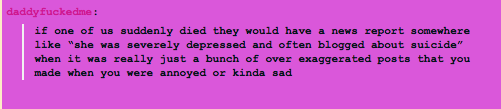
5. Could you talk a bit about the language of youth culture, particularly teenage girls? I’m thinking specifically about your “Women as Objects” project, which collages images from different teen girls’ tumblr blogs. How does language function here? in their world? in your integration of their language? In the land of the Internet?

For Women as Objects (www.womenasobjects.tumblr.com) I not only curate images but text posts as well from teenage girls—so it is both a visual and text-based project. Some of the images have text on them, too.

I think language functions in the online teenage girl’s world as a means of radical self-expression, as tumblr is a place where they can express themselves more liberally than in their IRL existence. At the same time, language functions also as a hook for attention, and so that means they are competing with one another by creating increasingly abject or pop culturally savvy text posts. They create their own language, a sort of iPrincess language of the internet. It’s equal parts computer keyboard and Cher from Clueless.

The way I’ve integrated the girls’ language most directly is in the video art pieces I’ve done, where I’ve taken a collection of the girls’ text posts and conversations with one another and performed those texts directly, in costume, as tumblr girls in bathroom settings. By taking their texts out of context of the Internet, which is a space where the larger culture is sick of seeing girls spill their guts, makes the girls’ humor, vulnerability, abjection, cleverness, body awareness, and pop cultural savvy more apparently brilliant, glittering, pleasurable and important.


6. If you were to write a dictionary definition for Lady Gaga, what would it say?

Lady Gaga: woman having proprietary rights or authority especially as a feudal superior : woman receiving the homage or devotion of a knight or lover : dame : infatuated : virgin mary : usually used with Our : doting : woman of superior social position : crazy : woman of refinement and gentle manners : foolish :woman, female : often used in a courteous reference : marked by wild enthusiasm : show the lady to a seat : or usually in the plural in address : ladies and gentlemen : wife : girlfriend, mistress : any of various titled women in Great Britain : used as the customary title of a marchioness, countess, viscountess, or baroness or the wife of a knight, baronet, member of the peerage, or one having the courtesy title of lord and used as a courtesy title for the daughter of a duke, marquess, or earl : I can’t understand how anyone could be so gaga over golf : woman who is a member of an order of knighthood : he thinks that most artists are at least a little bit gaga : origin French, from gaga fool : of imitative origin : First Known Use 1917


7. Please respond to the following words and definitions*, picked exclusively at random for you:


2up  \əp\  adj   1 :  risen above the horizon <the sun is ~>  2 :  being out of bed (~ by 6 o’clock)  3 : relatively high <prices are ~>  4 :  RAISED, LIFTED <windows are ~>  5 :  BUILT, CONSTRUCTED <the house is ~>  6 :  grown above a surface <the corn is ~>  7 :  moving, inclining, or directed upward  8 :  marked by agitation, excitement, or activity  9 :  READY; esp: highly prepared  10 :  going on: taking place <find out what is ~>  11 :  EXPIRED, ENDED <the time is ~>  12 :  extensively aware or informed <~ on the news>  13 :  being ahead or in advance of an opponent <one hole ~ in a match>  14 :  presented for or being under consideration <~ for promotion>  15 :  charged before a court <~ for robbery>


block·ade  \bläˈkād\  n : the isolation of a place usu. By troops or ships — block·ade vb  — block·ade·er n


2sluice  \slo͞os\  vb    sluiced; sluic·ing  1 :  to draw off through a sluice   2 :  to wash with running water: FLUSH


a·sep·tic  \ āˈseptik\   adj free or freed from disease-causing germs


re·par·a·tive   \ri-ˈpa-rə-tiv\    adj   1 :  of, relating to, or effecting repairs  2 :  serving to make amends


(All images taken from tumblr)

*Definitions taken from The Merriam-Webster Dictionary, New Edition, copyright 2004.


Kate Durbin is a Los Angeles-based writer, performer, and transmedia artist. She is author of The Ravenous Audience (Akashic Books) and E! Entertainment Diamond Edition (Insert/Blanc Press, forthcoming). She has also written five chapbooks, including, most recently, FASHIONWHORE and Kept Women. Her projects have been featured in Spex, Huffington Post, The New Yorker, Salon.com, Denver Quarterly, AOL, Poets and Writers, TMobile’s Your Digital Daily, Poets.org, VLAK, Lana Turner: A Journal of Poetry and Opinion, Black Warrior Review, berfrois, Drunken Boat, NPR, Bookslut, 1913, LIT, and Yale’s The American Scholar, among others. She is founding editor of Gaga Stigmata, an online arts and criticism journal about Lady Gaga, which will be published as a book from Zg Press in 2013.


Leave a comment

Filed under author interviews