Tag Archives: dictionary

as·ta·tine

as·ta·tine  (ˈastəˌtēn),  n.  [ < Gr. Astatos, ustable; + ine], an unstable chemical element formed from bismuth when it is bombarded by alpha particles; symbol. At; at. wt., 211 (?); at. no., .85 (formerly designated as alabamine).
 
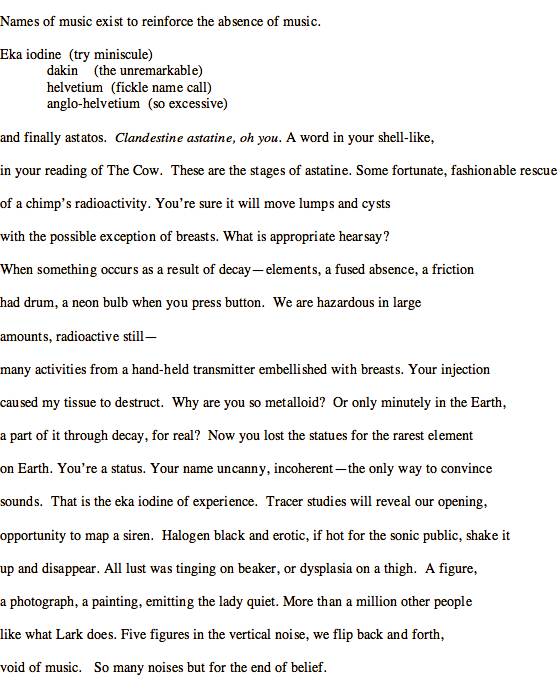
It’s the second word of na·po·mo at the dictionary project. Enjoy the writing of poet Meagan Lehr!

 
AS·TA·TINE


Meagan Lehr’s work can be found at Arch Literary Journal, and Mary: A Journal of New Writing. She currently teaches writing at The University of Arizona, and is managing editor for The Destroyer, an online publication of art, text, and the public rant. Her book Men in Correspondence is forthcoming from Jackleg Press.

Leave a comment

Filed under napomo

stag·ing

by Clay Connally


stag·ing (ˈstājiNG),  n.   1.   a temporary structure used for support; scaffolding.   2.   the business of operating stagecoaches.   3.   travel by stagecoach.   4.   the act or process of presenting a play on the stage.
 
 
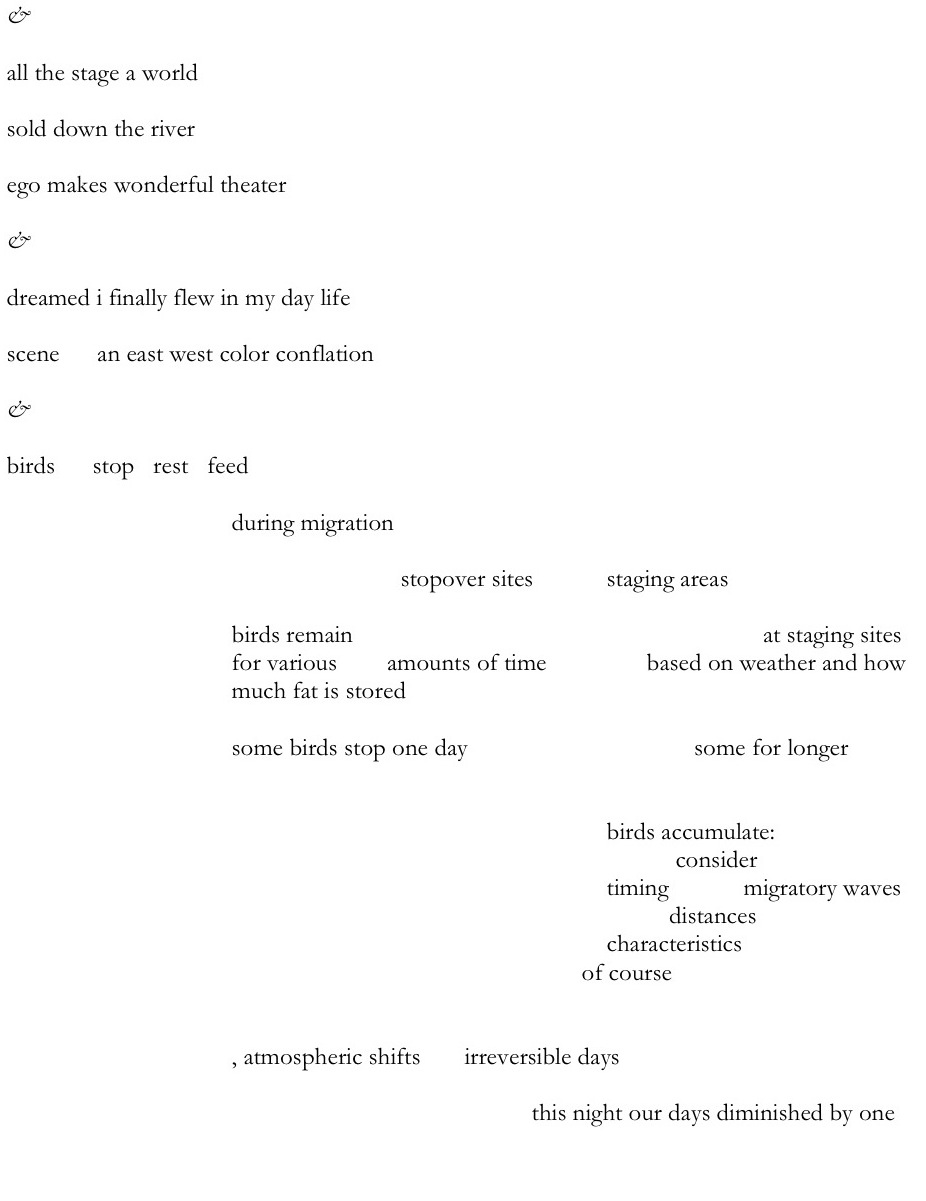
The first word for napomo! at the dictionary project is stag·ing. And our first poet is the wonderful Deborah Poe. Enjoy:


Notes: Cornell Ornithology Lab’s Bird Migration Teacher’s Resource Guide, prepared by Carolyn Sedgewick; Mark Twain for “a cradle on wheels;” Kerry Scanlan, Vicki Piaskowski, Michelle Jacobi and Steve Mahler, Zoological Society of Milwaukee for “Bird Migration Facts;” Mečislovas Žalakevičius for “Global Environmental Change and Vulnerability of Ecosystems: From Local to Regional to Global Scales;” Selah Saterstrom for “Beautiful women are haunted houses,The Pink Institution (Coffee House Press 2004); Zen Evening Gata for the last line.


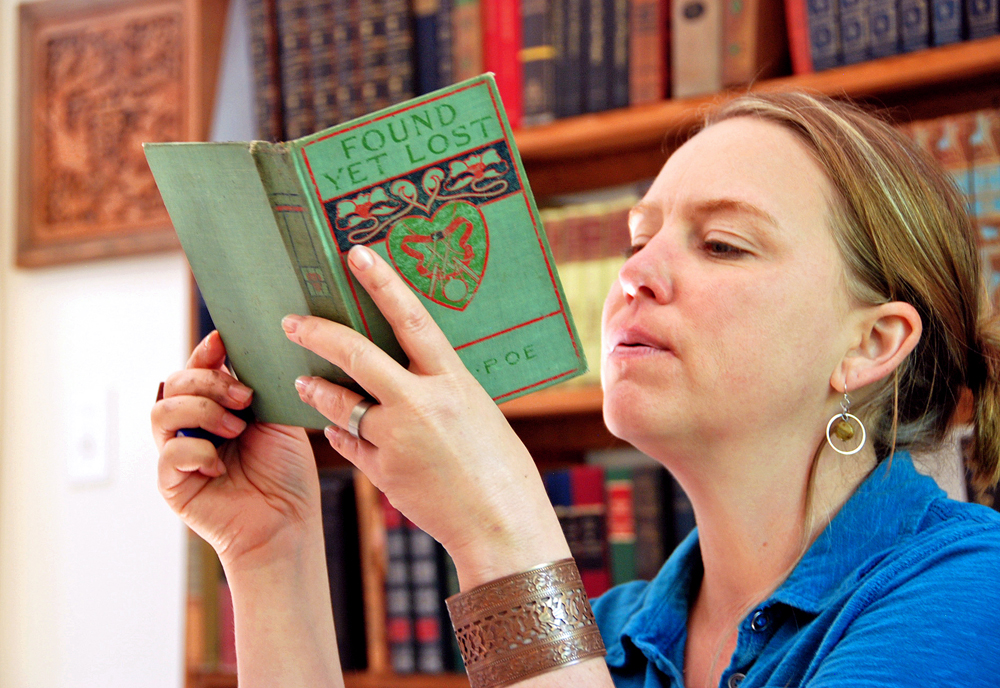
Deborah Poe is author of the poetry collections Elements (Stockport Flats Press 2010), Our Parenthetical Ontology (CustomWords 2008), and “the last will be stone, too,” as well as a novella in verse, “Hélène” (Furniture Press 2012). Her poetry is forthcoming or has recently appeared in Shampoo, Denver Quarterly, Yew Journal, Mantis, Horse Less Review, Bone Bouquet, PEEP/SHOW, and Open Letters Monthly. Please visit deborahpoe.com for more information. (Photo by Elizabeth Bryant)

1 Comment

Filed under napomo

na·po·mo


April is National Poetry Month, and to celebrate, the dictionary project is hosting its first na·po·mo! Each Tuesday and Friday during the month of April, we will feature poems inspired by dictionary project words authored by visiting poets. Stay tuned!


And to whet your appetite, I leave you with “Diving into the Wreck” by Adrienne Rich:


First having read the book of myths,
and loaded the camera,
and checked the edge of the knife-blade,
I put on
the body-armor of black rubber
the absurd flippers
the grave and awkward mask.
I am having to do this
not like Cousteau with his
assiduous team
aboard the sun-flooded schooner
but here alone.

There is a ladder.
The ladder is always there
hanging innocently
close to the side of the schooner.
We know what it is for,
we who have used it.
Otherwise
it is a piece of maritime floss
some sundry equipment.

I go down.
Rung after rung and still
the oxygen immerses me
the blue light
the clear atoms
of our human air.
I go down.
My flippers cripple me,
I crawl like an insect down the ladder
and there is no one
to tell me when the ocean
will begin.

First the air is blue and then
it is bluer and then green and then
black I am blacking out and yet
my mask is powerful
it pumps my blood with power
the sea is another story
the sea is not a question of power
I have to learn alone
to turn my body without force
in the deep element.

And now: it is easy to forget
what I came for
among so many who have always
lived here
swaying their crenellated fans
between the reefs
and besides
you breathe differently down here.

I came to explore the wreck.
The words are purposes.
The words are maps.
I came to see the damage that was done
and the treasures that prevail.
I stroke the beam of my lamp
slowly along the flank
of something more permanent
than fish or weed

the thing I came for:
the wreck and not the story of the wreck
the thing itself and not the myth
the drowned face always staring
toward the sun
the evidence of damage
worn by salt and sway into this threadbare beauty
the ribs of the disaster
curving their assertion
among the tentative haunters.

This is the place.
And I am here, the mermaid whose dark hair
streams black, the merman in his armored body.
We circle silently
about the wreck
we dive into the hold.
I am she: I am he

whose drowned face sleeps with open eyes
whose breasts still bear the stress
whose silver, copper, vermeil cargo lies
obscurely inside barrels
half-wedged and left to rot
we are the half-destroyed instruments
that once held to a course
the water-eaten log
the fouled compass

We are, I am, you are
by cowardice or courage
the one who find our way
back to this scene
carrying a knife, a camera
a book of myths
in which
our names do not appear.

Leave a comment

Filed under napomo

con·vex·o-con·cave 


con·vex·o-con·cave (kuhn-vek-soh-kon-keyv), adj.  1. having one convex side and one concave side.  2. in optics, designating a lens whose convex face has a greater degree of curvature than its concave face, so that the lens is thickest in the middle.

Writer Rae Pilarski concludes this  flash fiction february with her flash fiction piece on con·vex·o-con·cave. Thanks to all our writers and all you readers for participating. Keep posted for more happenings here at the dictionary project.


He remembers his daughter when she was young. She looked like her mother then, so serious. When she came home with her first spider, big as the fist it was clenched in, legs sticking out between pink fingers, she brought it to him like an offering, setting it on the dirty knee of his jeans. As she got older, she spent her small weekly allowance on Mason jars in which to place her growing collection.  He built shelves to house them and helped her poke holes in the lids after she opened her finger with a paring knife. He remembers she hadn’t cried, just watched the drops of blood bloom at her feet. He is still amazed at how smoothly the phrase subesophageal ganglion passed through her preadolescent lips. When she was about ten, he told her about ants and magnifying glasses. He had described the way ants smell as they burn under the concentrated spot of sunlight. She had run away from him then, slamming the door to her bedroom behind her hard enough to set the jars along the wall rattling. He wonders now if he should have detected a pattern much earlier.

(Here he thinks about the first boy she brought home at fifteen, who eyed her as if already masturbating to her memory. Should he have known then?)

What he had always found most interesting about his daughter’s spiders was the fact that most were somehow able to spin their webs in their new habitats, unhindered by the smooth curve of the glass. One in particular spent most of its time clinging to the underside of the lid so that he had to turn the jar over in order to catch a glimpse of it. After his daughter left a second time, he had shaken that jar until the spider dropped to the bottom, its long legs curling into itself.

He can only remember his daughter when she was young. He falls into his easy chair. He opens another beer. He turns on the news. He searches for her mother’s face.


Rae Pilarski currently lives in downtown Tucson and attends the University of Arizona.

Leave a comment

Filed under flash fiction february

en·force


en·force (enˈfôrs), v.t.  [ENFORCED, ENFORCING], [ME, enforcen;  OFr. enforcer, enforcier; LL. Infortiare < L. in, in + fortis, strong], 1. to give force to; urge: as, he enforced his argument by analogies. 2. to force; compel. 3. to impose by force as, don’t enforce your will on the child. 4. to compel observance (of a law, etc.).

For enforce, the third word of flash fiction february, we have guest flash fiction pieces by writers Beth Alvarado and Julia Gordon (respectively). Read on and enjoy.


And maybe you were told not to raise your voice, as in don’t raise your voice to me, young lady. You were sitting in the classroom looking out the basement window.  You could see the shoes and pants and bare legs of others walking by on their way to lunch.  You could smell them sneaking cigarettes and the smoke smelled a little like grilled cheese sandwiches and made you hungry.  Don’t tell me you wrote this yourself, and she handed you the sheet of notebook paper with an F circled in red at the top.  Her fingernails were also red.  And maybe you thought red, the color of shame, as in the Scarlet Letter, you supposed, that made sense, but it wasn’t your shame. You crumpled up the piece of paper with the red F and then left it behind in the wastebasket.  You walked out of the room.  There, you thought, keep it, the evidence of your own small mind.

Maybe later you were told you didn’t have a voice, as in this writing is too feminine, too flowery, it will never have any power. You were sitting in his small office in the university, again in a basement.  You were wearing a yellow dress, you were barefoot because it was the 1970’s, and he was smoking, his fingers stained with nicotine, which is another kind of yellow. There is, you thought, no evidence, and so you went home and wrote about yellow, which is when you remembered fear:  the older neighbor boy:  the round aluminum trailer.  You were six, then, when he tried to undress you and fear flooded up from your gut into your mind, making you lightheaded.  But what you remember most is rising up out of your body and speaking, the slap of the trailer door as you left that place behind.

Much later, when you were a mother, you wanted your daughter’s voice to rise up out of her body.  When she was an infant and you held her over your shoulder, walking her up and down the hall, your bare feet on the cold tile floor, her body warm and damp from sleep, you sang to her and she sang back, a breathy humming in your ear. When she was in kindergarten, you bought her a red dress with tiny yellow giraffes; she wore it with her brother’s old cowboy boots.  She put too many barrettes in her hair.  When strangers talked to her, she hid behind you.  She is shy, you explained, but it seemed wrong, as if to blame her for their transgression, and so you learned to say what felt more true: she has been taught not to speak to strangers.  Still, you wanted her to find her own voice, you did, and so when she grew up, as daughters do, and wanted to kiss boys and to talk back to you, you had to listen, just listen, even when the words were knocking around in your own chest and catching in your throat.


Beth Alvarado’s Anthropologies, A Family Memoir, is part of the Sightline Series in Literary Nonfiction from the University of Iowa Press (2011).  Her story collection, Not a Matter of Love, won the Many Voices Prize, which honors work that has “a strong sense of place and speaks to our troubled times with empathy and aesthetic courage.”  Other recent work has appeared in Nimrod, Sonora Review, and Western Humanities Review. She is the fiction editor of Cutthroat: A Journal of the Arts and teaches at the University of Arizona.


Hug, Hug


Once, Lara had the most awkward hug in the world.  Other people have had awkward hugs.  You have had awkward hugs.  Surely Lara’s awkward hug wasn’t the most awkward hug in the world.  But it was.  Lara’s hug was with Kevin, who found the hug to be uncomfortable too, even if he didn’t think, at the time, that it was the most awkward hug in the world (which it was). Later he would realize it was, but he would not wonder why.  It was just one of those things.  Many things were just one of those things.

Lara wondered why.  Lara wondered how, of all the hugs in the world, did she manage to have the most awkward one? Lara thought and thought about that hug. She wondered if it was because the hug was on the corner, and there were people watching, but Lara had had lots of corner-hugs and none of them were the most awkward hug in the world – except her corner hug with Kevin. She wondered if it was because Kevin’s elbow had touched the side of her breast at the start of the hug, but Lara had had that happen many times before, ever since she got breasts, and none of those breast-touch hugs were the most awkward hug in the world – except her breast-touch hug with Kevin.  She wondered if it was because she had a belly full of food, but that wasn’t it, either.

It was not the most awkward hug because she had two drinks.

It was not because it was 2 o’clock in the afternoon.

It was not because it did not end in a kiss.

It was not because it was Wednesday.

It was not because her hat was ugly.

It was not because her thumbs ached.

Lara started to wonder if it was the most awkward hug in the world because of a person in the hug. Lara started to wonder if it was because Kevin was in the hug.  Lara thought that might be it.  She started to wonder why that would be. Kevin was the man who said “sit, sit,” and Lara sat. Kevin was the man who said “write, write,” and Lara wrote.  Kevin was the man who said “drink, drink,” and Lara drank. Kevin was the man who said “suck, suck” and Lara sucked. Kevin was the man who said “snort, snort” and Lara snorted. Kevin was the man who said “cry, cry” and Lara cried.  But Lara was the one who said “hug, hug.” And that was why.


Julia R. Gordon is a writer with over ten years of experience in the non-profit sector as well as a background in government and political media, fundraising, and message development. Since 1998 she has worked as a writing consultant; currently Julia works at the University of Arizona and Raise the Bar LLC, and serves on the Board of Directors for Casa Libre en la Solana, a Tucson, AZ-based literary arts organization. She also writes for The Skein, an online blog she created to explore politics, government, society, and interpersonal relationships through language and the written word. Julia was born and raised in downstate New York, and made her home in Brooklyn for a decade, prior to relocating to Tucson in 2009.  She is a graduate of Cornell University.

Leave a comment

Filed under flash fiction february

schiz·o·phre·ni·a

cells in dish replicate schizophrenic brain


schiz·o·phre·ni·a (skitsəˈfrēnēə), n. [Mod. L. < schizo- + Gr. Phren, the mind] a mental disorder characterized by indifference, withdrawal, hallucinations, and delusions of persecution and omnipotence, often with unimpaired intelligence: a more inclusive term than demtnia praecox, avoiding the implications of age and deterioration.

For the second word this flash fiction february, we are honored to have pieces authored by two writers: Elizabeth Frankie Rollins (first) and Rebecca Iosca (second).



(In French, “aliéné” Means Mad)

Eloise couldn’t say.  The teachers asked.  The classrooms felt immense.  The teachers and the students seemed like giants moving around her.  In her French class, Eloise stared at a worksheet in front of her and the accents on the words looked like eyebrows.  She couldn’t read one French word, although she knew she used to be able to read some of them.  Now they looked like simple black marks.  She could barely fit the French words the teacher spoke into her head.  They were too big.  She wanted to put her hands over her ears, but she didn’t.  This would make them ask her more questions.

She didn’t want to think about it.

At lunch, she received her tray of macaroni, red jello square, and paper milk container, but she couldn’t remember where she usually sat.  She chose a table with girls.  As soon as she sat, as soon as they began ignoring her, she remembered that this wasn’t her usual table.  She’d only been gone a couple of weeks, but couldn’t remember things.  Even the air felt too big.  It hurt her ears.

There had been a lot of screaming.  But no, she didn’t want to think about it.

In science, they stood over plastic tubes and looked at liquids.  Her paper, where she was supposed to fill in the blanks with numbers, remained blank.  She didn’t even look at other students’ papers to fill hers in.  She stood at the table and stared at what they did, but she couldn’t put anything in the white blanks on her paper.

There had been a lot of messes. She hadn’t cleaned them up.  No one had.  Everything got sticky.

The Vice Principal came to check on her in the homeroom at the end of the day.  The Vice Principal’s first name was Barbara.  Eloise read this on the nametag, but she couldn’t pay attention to the last name.  Barbara the Vice Principal crouched in front of Eloise and spoke.  Her breath smelled like coffee and bologna.  Eloise was sick of breath.

There had been a lot of strong breath: whiskey breath, wine breath, stale breath, weeping breath, smoking breath, screaming breath.

Barbara the Vice Principal said something about Eloise’s mother.   Eloise stared at her.  She felt the air swallow her up, as if she was shrinking, as if her head was folding down on itself.  She stared at Barbara the Vice Principal, who said, “I can understand if you aren’t ready to talk about your mother yet, but I want you to know if you want to talk about it with me, any time, you can.”

There had been a lot of talk about things Eloise didn’t understand.  Real estate, avocado growers, pantyhose, poisoned water, why people should learn French, why no one should have telephones, what good girls did, who was a really great singer, and people out to get you.

When Barbara the Vice Principal asked, “Eloise, are you listening?”  Eloise couldn’t say.

The dinner table at the Gershens was set with plastic tablemats picturing strawberries with legs.  Folded paper napkins sat on the mats, and forks and knives on top of the napkins.  It was only Eloise and Mr. Gershen and Mrs. Gershen at the table.  They didn’t have children. There was meatloaf and orange macaroni and cheese and a very big piece of broccoli on Eloise’s plate. Eloise ate some of everything. She knew that you had to plan meatloaf.  You had to cook it in the oven.  She knew it wasn’t easy, she knew that cooking wasn’t easy.  She understood that some things weren’t easy and you shouldn’t ask for them.  But she hadn’t asked for this and she liked it.

There had been food, but usually it was “craving” food.  Craving food came in greasy paper wrappers or sticky sweet cellophane.  In cardboard boxes or styrofoam bowls.  If you didn’t eat it fast, you weren’t really craving it, and you shouldn’t take it from the people who were craving it.

There had been a lot of smoking and the ashtrays got really full and spilled onto the table or counter.  There were a lot of ashes on the floor, too, from cigarettes being waved around.  Eloise washed her feet sometimes, when they turned black on the bottoms.

There had been crying and apologies and yelling and then the longest silence.  It was the longest silence that sent Eloise to the neighbors and then the police came, and an ambulance, and Eloise had not even gotten to say “good morning,” or “good bye” and now she was living at the Gershens and she’d gone back to school as if nothing had happened but everything had happened and she hadn’t even said “good bye” and now she had to go to French class where nothing made any sense at all, though everyone else pretended like it did.

Eloise took the clean dishtowel with smiling kettles and teacups and wiped the plates that Mrs. Gershen handed her.  She wiped them dry, around and around and around.  Mrs. Gershen took them from her and placed them neatly in the cabinet.  Click. Click.

Mrs. Gershen turned and looked down at her and said that there had been a call from the hospital where they were keeping her mother for observation, but Eloise had not even said “good morning” or “good bye,” so she stared hard at the framed needlepoint on the wall which said Gershen in fancy letters, circled by mice and cheese and mustard pots.   The mustard pots were white with red stripes around the rims.  She nodded when Mrs. Gershen stopped talking and handed back the kettle towel.

When Mrs. Gershen asked, “Eloise, we all want to help you, you know that, don’t you?”  Eloise couldn’t say.


Elizabeth Frankie Rollins has published work in Conjunctions, Green Mountains Review, Trickhouse, The New England Review, and The Cincinnati Review, among others.  An excerpt from her novel, Origin, will soon appear in Drunken Boat. Author of The Sin Eater, Corvid Press, she’s previously received a New Jersey Prose Fellowship and a Special Mention in the Pushcart Prize Anthology. She teaches writing at Pima Community College and the University of Arizona Poetry Center.  Installments of Origin and short fiction can be found here:  www.madamekaramazov.com
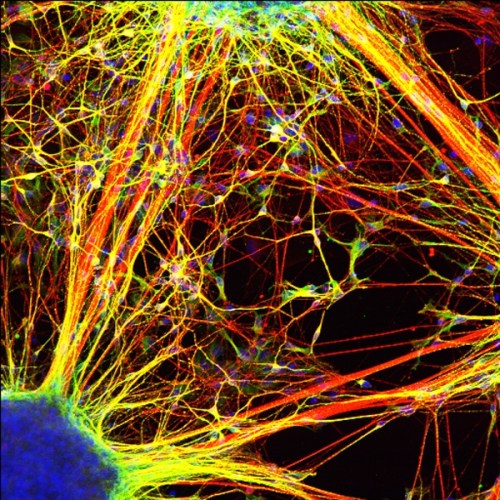


cells in dish replicate schizophrenic brain


Rosemary, in LA I became you. Some memory of the way you rode the bus away from home, from your father really, who scared you so badly you hid under the table. The first time they thought something was wrong it wasn’t because you were scared (they both knew he could be scary even though they never admitted it to you), but because you were meowing, quietly at first and then with more feeling, crouched under the table.  You were twelve. Did he tell you then to become an actress because you were being so dramatic?  I don’t know if he ever hit you, but I know you tried to snap a woman’s neck once and almost succeeded.  You walked like you were still 300 pounds, but you’d lost weight and all of your teeth.  Or maybe it’s more true to say that when you’d lost most of them, the rest were pulled. It was the only service covered by your dental plan by then.

No wonder you were angry.  The side effects of how you had to live would be enough to make me angry, but to think directly of the main axes of truth in your life. Or if not truth, some version of mundane reality.  Locked up in a building that smelled of far-gone yesterdays and surrounded by paint shades too dark to catch the little northwestern light that landed in your room.  The one chair out on the smoke-porch that was the only one you understood. You got in fights about it because nobody could understand you having a chair that was the only one you understood. Your mother sent you things you might need at logical intervals, but there were no cards, no little gifts, no Christmas presents even though you still counted down the days gleefully every year. What you called “giving birth,” the rest of the world called “having an accident in the middle of the night.” Your baby, then, a yellow stain that no one wanted to manage.  In the morning after so many of my arrivals, plastic gloves, biohazard bags, and a trip to the laundry room. But not after you told me her name. It was usually the same each time: “little glow.” Years later, I learn of the Spanish phrase “to give a light” for birth, and I think of the landscapes you won’t ever see.

By the time you were 18, you’d hopped a bus to Hollywood, but your chart said nothing else.  You spoke of acting, and I can imagine a time when catching a break in Hollywood seemed plausible or at least possible.  I would have believed you were a model. In your face, a deep beauty and in your movements an unswerving confidence.  But you told me you were on that cruise the year before I met you, when you had already lost your teeth, already lost so much more than your teeth.  You looked so happy recounting the places you’d visited, and I wondered then about whether it wasn’t something of a blessing to remember a history that is not your own. A kind of imagination-in-reverse function. If your days are spent smoking cigarettes until your fingers yellow and finding your only real comfort is a stuffed horse who sits on your narrow bed in your narrow, urine-soaked room, how obliging of your mind to take you on a cruise, show you the beauty of the world, reflect your beauty to you in the eyes of off-stage admirers? How obliging of your mind to give you a baby every morning instead of a mess to clean up and the knowledge that your body is past being able to carry one.

I was not in Hollywood, but in LA I saw trees like prehistoric towers lining the streets and watched a film in 3-D about Pina Bausch.  In the theater I became you, for a moment, seeing the world in front of me in blurry multiple, edge over edge, until I put on glasses that made the multiplicity three-dimensional and single. I want to say singular, and it was that too.  I felt, suddenly, your frustration at trying to explain that the world is round and alive and moving quickly toward you when everyone else could see only blurry flatness taken for the extent of what was there to be seen. It’s a wonder you never gave up trying to explain what was there for you, in stereo, in stereoscopic 3-D, as we unfocused our vision, trying to make the world as we knew it more clear or at least contiguous.  And who would have believed you anyway, if you’d somehow managed to fashion paper spectacles with blue and red lenses, and shouted triumphantly that finally we might see your reality?  You probably would have been written up, the glasses discarded as a quaint craft project or some other artifact of delusion.

When people say “schizophrenic,” so often what is heard is “split,” “broken,” or “out of touch with reality.” Your diagnosis was based on the concept of emotions split from thought, but who can say what emotions are called for anyway, or who is more colonized by perplexing delusions than anyone else?  And who is to say what of reality there is to touch, and what edges, what whole planes in fact, we might be missing in our smug perceptions?  Can empiricism explain the way you spoke of my father, but never my mother, except to say, at times, that you were my mother?  Can scientific inquiry measure the chances that of all the names you could have taken on once you were sent away to the state hospital, you chose my mother’s and called for me like I was your daughter?


Rebecca Iosca feels grateful to have become friends with Lisa, the resident logophile of The Dictionary Project, through the University of Arizona’s MFA program, and has worked with a number of amazing people who happen to be diagnosed with schizophrenia.
Leave a comment

Filed under flash fiction february

as·sim·i·late


as·sim·i·late (əˈsiməˌlāt), v.t. [ASSIMILATED (-id), ASSIMILATING], [<L. assimilatus, pp. of assimilare < ad-, to + similare, to make similar to < similes, like],  1. to take up and make part of itself or oneself; absorb and incorporate; digest: as, the body assimilates food.  2. to incorporate or liken.  3. to make life or alike; cause to resemble (with to): as, assimilate the final sound of a prefix to the initial sound of a word.  v.i.  1. to become like or alike.  2. to become absorbed and incorporated: as, minority groups often assimilate  by intermarriage.

For our first week of flash fiction february, the dictionary project  features a flash fiction piece by writer Timothy C. Dyke. Enjoy!


After the Spooging

How much latitude are you going to give me? How specific do you need me to get when it comes to describing the mechanics of the fantastical elements? This is a surreal adventure. How completely must I convince you of the viability of this story’s reality? A part of Tennessee Williams comes to me as spiritual entity.

At one point this was going to be a nostalgia narrative about A Streetcar Named Desire. I’m 51 years old, and thirteen of my crucial lifetime experiences have involved A Streetcar Named Desire. Quick example: Two days before he beat me up in the basement of New England boarding school, Jamie Chesterson told our AP English teacher that Blanche Dubois was a slut.

Consider that I have been intending to write an A Streetcar Named Desire narrative for a couple of decades now. Do you believe in the collective unconscious? Can you imagine other writers who have been inspired by A Streetcar Named Desire? We all have heard this expression: “I just want to put this out there.”  So imagine that enough people put their Tennessee Williams intentions “out there.” Where exactly would that be? I’m just going to go ahead and say that The Figurative Penis of Tennessee Williams stays, for the time being, in my hard-drive.

Please don’t think I am trying to be off-putting. This could really happen. A collective intention to create a story inspired by Tennessee Williams manifests as some certain kind of writing energy. In the National Hockey League, when a team wins the championship, each member of that team gets to spend personal, one-on-one time with the Stanley Cup. The trophy itself goes on the road right after the playoffs. A guy in Alberta might drive the ceremonial vessel around for a day in the back of his Durango. I think the Stanley Cup has its own personal assistant. Imagine that this is also how it works for the part of Tennessee Williams that manifests as a certain kind of writing energy. Imagine that those who have earned the energy, share the energy.

I really wanted to acquire the figurative heart or the figurative brain of Tennessee Williams, just for a day, but I got his penis. I saw it in my hard-drive. At first I thought it was this thing I downloaded at night, but this obscene and virtual entity was witty, and it wore a hat. The Figurative Penis of Tennessee Williams spooged all over some documents on my desktop. I had been working on a story about a baseball player who loses his ability to see other men naked without weeping. The Figurative Penis of Tennessee Williams loved this story. Literally. After the spooging, the story rebirthed itself as something darker. The baseball player marries his psychologist who sends him to Mexico for an exotic series of therapies. The baseball player falls in love with a donkey cart driver who loves him back. The two men have sex on top of a bed of scorpions. They die. The jilted psychologist drinks bourbon, masturbates, and then drives off a cliff. My story is so much better now.

The Figurative Penis of Tennessee Williams wants to know what happens outside my hard drive in the world I call “real life.” I tell him not much. He doesn’t seem to believe me.  The Figurative Penis of Tennessee Williams asks me to write a story about The Figurative Penis of Tennessee Williams. He commands me to write the scene where he escapes my hard drive and goes rogue. I finish the narrative: “After the Spooging.”

The Figurative Penis of Tennessee Williams hitches a ride with some graduate students to New Orleans for Jazz Fest. He ditches the grad students to cruise the French Quarter, then the Garden District, Elysian Fields. The Figurative Penis of Tennessee Williams has not been to New Orleans for such a long time. Things have changed after all these years. The Figurative Penis of Tennessee Williams feels like an outsider, a stranger in a strange land. It takes him forever to find a good cigarillo. Eventually he discovers communities to probe. He introduces himself as Dick from Tennessee. He manages to assimilate.


This slideshow requires JavaScript.


Timothy C. Dyke has published fiction in Santa Monica Review in 2008 and 2011. He was chosen as a semi-finalist for the Sentence Book Award for his manuscript of prose poems, Only Stories About Skin in 2011. His story “No Look Back” appears in Don’t Look Now: “Hawaiian Legends Made New,” a 2011 anthology, published by Watermark Books of Honolulu. A text/image collaboration with Noah Saterstrom, “Mound and Minds are Bumps,” will appear in The Spirit of Black Mountain College, a book project published by Lorimer Press in 2012. He has work forthcoming in Drunken Boat and Kugelmass. He currently lives in Tucson where he is writing a novel and pursuing an MFA degree in fiction writing at the University of Arizona.

1 Comment

Filed under flash fiction february

flash


1flash \flash\  v 1: to break forth in or like a sudden flame  2: to appear or pass suddenly or with great speed  3: to send out in or as if in flashes <~ a message>  4: to make a sudden display (as of brilliance or feeling)  5: to gleam or glow intermittently  6: to fill by a sudden rush of water  7: to expose to view very briefly <~ a badge>  Synonyms GLANCE, GLINT, SPARKLE, TWINKLE —  flash·er


2flash n 1: a sudden burst of light  2: a movement of a flag or light in signaling  3: a sudden and brilliant burst (as of wit)  4: a brief time  5: SHOW, DISPLAY; esp: ostentation display  6: one that attracts notice; esp:  an outstanding athlete  7: GLIMPSE, LOOK  8: a first brief news report  9: FLASHLIGHT  10: a device for producing a brief and very bright flash of light for taking photographs  11: a quick-spreading flame or momentary intense outburst of radiant heat


3flash adj:  of sudden origin and short duration <a ~ fire> <a ~ flood>


4flash adv: by very brief exposure to an intense agent (as heat or cold) < ~ fry> < ~ freeze>


Welcome to flash fiction february 2012! All month long, the dictionary project will be featuring flash fiction contributions from guest writers. Like all weekly posts, these short pieces, all 1,000 words or less, will emerge from and be inspired by the word of the week (which I choose each week at random by closing my eyes and flipping through a dictionary). Keep tuning in and enjoy!


Leave a comment

Filed under flash fiction february

flo·rid·i·ty

Opulence


flo·rid·i·ty (ˈflȯr-əd-ə-tē)  n. the state or quality of being florid

flo·rid (ˈflȯr-əd) adj. [L. floridus, flowery < flos, floris, a flower],  1. Rosy; ruddy; highly colored; said of the complexion.  2.  Highly decorated; gaudy; showy; ornate; as, a florid passage in music, etc.  3.  [Rare], decorated with flowers; flowery. –SYN. See rosy.


Peacock


Where is the line between gorgeous and gaudy? Between taste and ostentation?

When I think of floridity, these questions come to mind and also: the irresponsible use of color; writers who aren’t afraid to use flourishes; embroidery on bodices and pillows and handkerchiefs; flowery accents in music, the lilt of a trumpet carried over the beat of a handdrum; dark ink curling around elbows and forearms, beneath clavicles; cheeks flushed from flirting; brocaded curtains; balconies, ornate with iron plumage.


New Orleans Balcony, by David Paul Ohmer


When I was seventeen, I visited Versailles for the first time and witnessed it in all its floridity—everything lacquered with gold, everything in undulating waves and crevasses, cherubs everywhere, gilted glory. In my body, I experienced the feeling of it being too much and then the quiet relief of the garden—which, even if precisely manicured, provided, in its lush greenness, a respite. Somewhere to stand that felt closer to where my body comes from, my mother’s body, and where it will end up, underneath the earth.


Hall of Mirrors, Versailles by Stephane Feugere


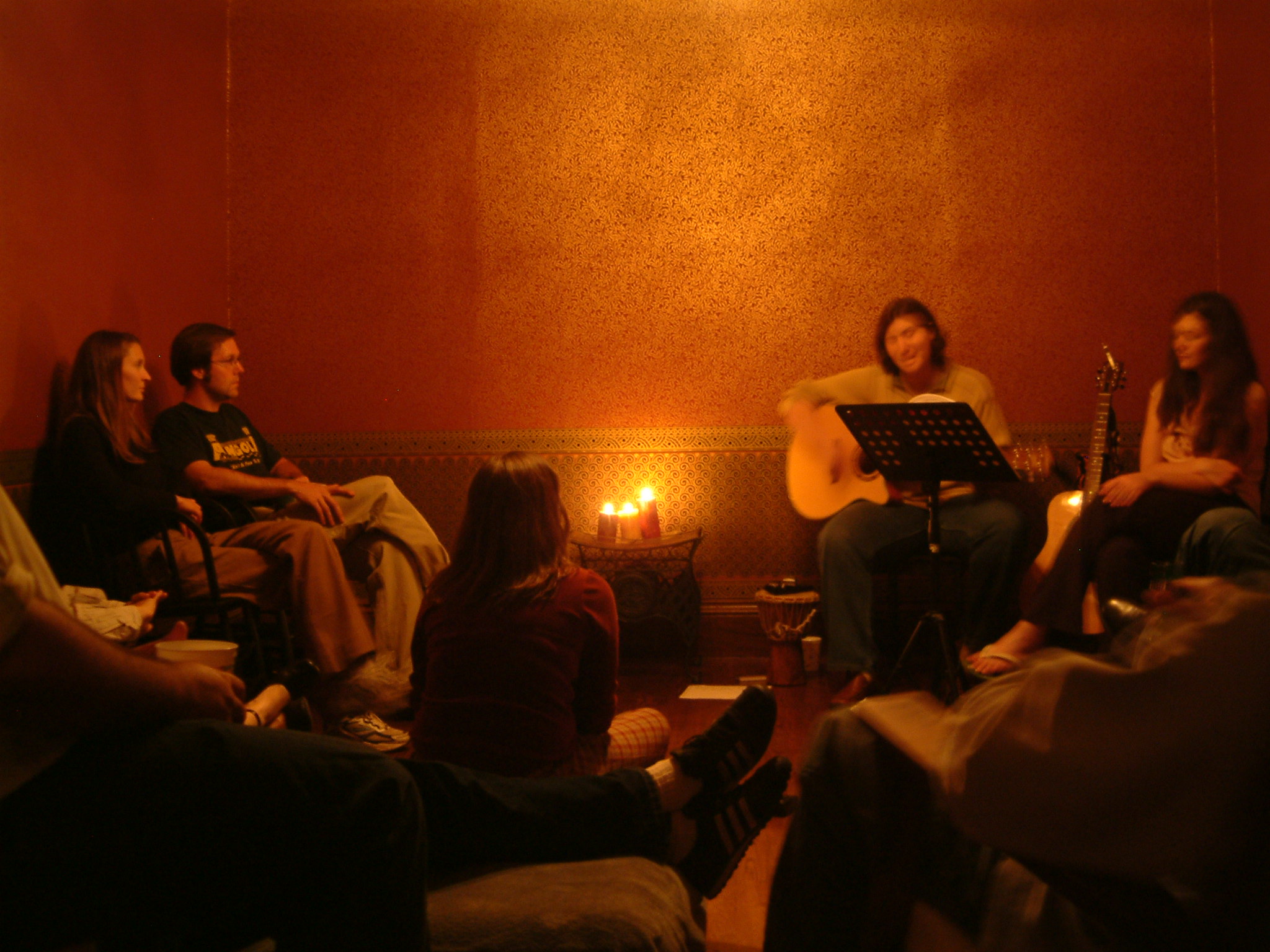
When I first moved to San Francisco, I stayed in the apartment of a friend. The walls of the living room and one of the bedrooms were covered in ornate wallpaper, dark maroon and dark green etched over with a pattern of intertwined gold leaves and vines. At night, when the fire was lit, small strokes of light illuminated the golden pattern before it was reclaimed by shadow. The paper contained both darkness and light. And yet, when I had the opportunity to move into one of the rooms with that paper, I could not do it. To be there part of the time was acceptable but to sleep with this richness, that was too much. When a room with plain green walls opened up, I moved in.


McAllister, San Francisco, CA 2005


Florid sounds like floral—floral was big in the early nineties when I was in junior high. Babydoll dresses, rufflely shirts, ultra-feminine pinks and corals. Lipstick that looked like the little Avon samples my grandma kept in her drawer—tubes the perfect size for my fingers. As a child, I felt so grown-up, with the addition of this color.


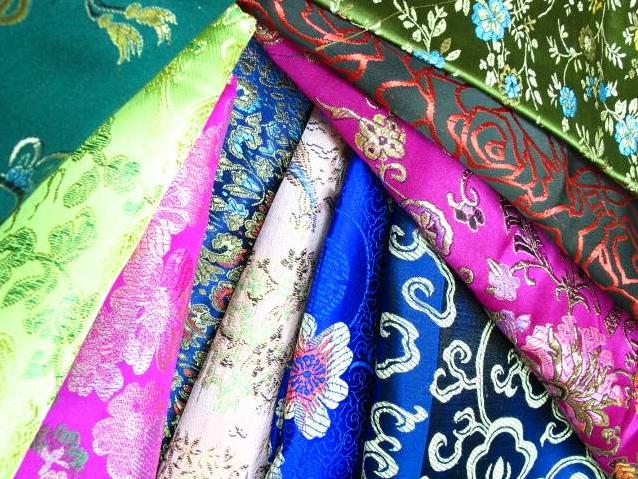
Brocade


Floridity: a matter of personal taste and aesthetics. But also a communal decision because at different eras in different locales, different levels of floridity were prized. The Puritans weren’t so much into the gaud, but the Baroqueans were. It seems some floridity comes from the desire to decorate, to make things beyond beautiful. And other aspects of floridity seem to stem from not being satisfied with life as it is, with things as they are. As if the addition of a bustle or a bow could help in any more than a superficial way. But it can, on some level, can’t it?


Gilded


I love adornment. I am a fan of earrings and scarves and brooches. I like stripes and polka dots and dark colors etched over in silver and gold leaf. Really our world is our canvas, parts of it have already been colored in and on and other parts are ready for our own definitions and markings. We are both the made and the makers. The adorned and those who adorn. We fasten, we draw, we gather, all in the hopes that we can make something that will somehow mean something to us and to those around us.

In her essay “Beauty Laid Bare: Aesthetics in the Ordinary,” bell hooks writes: “…among the traditional Southern black folks I grew up around there was a shared belief in the idea that beautiful things, objects that could be considered luxurious, that were expensive and difficult to own, were necessary for the spirit. The more downtrodden and unfortunate the circumstance, the more ‘beauty’ was needed to uplift, to offer a vision of hope, to transform.”

We all need beautiful things. What things we consider beautiful will be different for each of us. For me, I have begun to appreciate beauty in the small things I used to consider ordinary: the shape of my spoon, the way light shines through the colored glass of a candle holder, the new turquoise curtains that cover my windows. And also the floridity that can happen in just one person’s visage and how many looks—the tip of a laugh, the bathed eyes and soft brow of someone moved, the focus held in the corners of a mouth—can be contained in just one face.


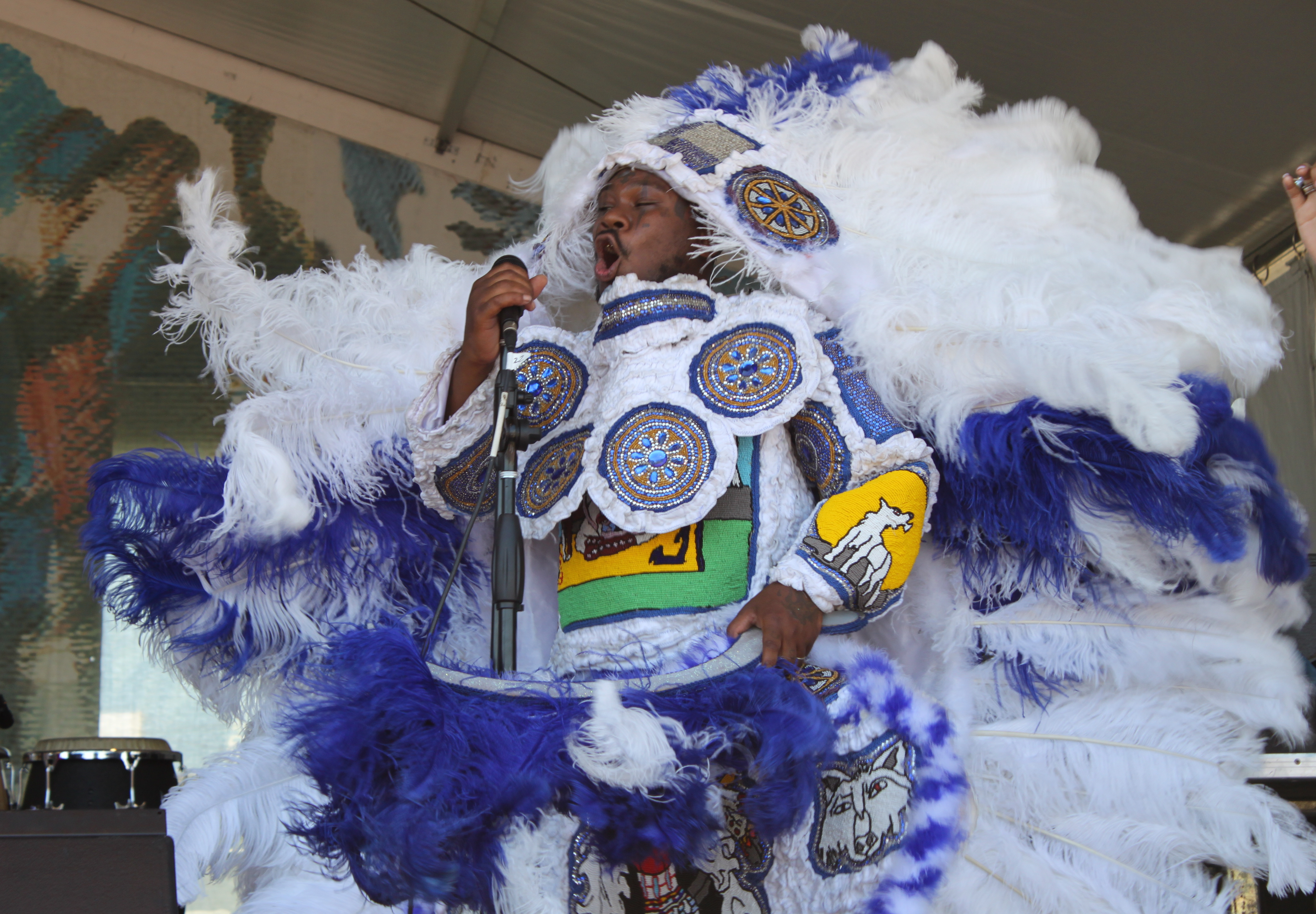
Mardi Gras Indian, New Orleans, 2011 by Lisa O'Neill

Leave a comment

Filed under weekly words

gen·er·al·i·ty


gen·er·al·i·ty (jenəˈralitē), n. [pl. GENERALITIES (-tiz)], [Fr. généralités; LL. generalitas < L. generalis], 1.  the condition or quality of being general, or applicable to all  2.  a general, or nonspecific statement, expression, idea, principle, etc.: as, he spoke in generalities 3.  The bulk; main body; majority; mass.


I cannot tell you how appropriate this word is for me at this moment, as I read my freshmen students’ first composition essays of their college careers. In class, I told them that one thing they should not do is begin their essay with any of the following statements or anything resembling these: “Since the beginning of time, man has known…”, “Everyone in the world knows that…”, “All human beings have the same quality that allows them to…”, “Webster’s defines language as….” For many of them, their knee-jerk reaction is to write with this broad scope. They have been taught to begin with the general and move towards the specific so often, they write these sort of statements that are non-statements, words that don’t express anything because of their lack of specificity.

I don’t say these things to give them a hard time. I’m quite sure that I began papers like this way back when. Part of it has to do with the way we Americans are often taught to write and think in high school, where learning is a process of memorization and receiving information rather than a process of inquiry and engagement, and part of it has to do with not trusting the specificity of our own voices and our own experiences. Writing about others is way less vulnerable than writing about ourselves. What could we possibly have to say about ourselves that someone else would care about? Maybe I’ll just quote Mark Twain instead.

When we speak in generalities, we have the cushion of a group to protect us. “We human beings are flawed” is much easier than saying “I am flawed.” “Growing up can be scary” is easier to say than “I am scared.” There is something comforting in “since the beginning of time”, even if it is inaccurate, because we can rest in the assurance that others before us had similar struggles; it makes us feel as if we are not alone. The problem here is that generalities allow us to forget that these groups, these communities were and are all made up of many individual specific people with their own specific stories. The Civil Rights Movement was a movement made up of individual people, each with their own relationship to disobedience, to putting themselves in harm’s way, to wanting to look out for the rights but also the wellbeing of their families. Hurricane Katrina didn’t just happen to “the city of New Orleans.” It happened to the Greater New Orleans area, a community made up of two million individual people, each with their own unique story to tell, with their own sorrows and yearnings and struggles.

As someone who writes nonfiction, I am often engaged in the debate about memoir. Some argue that only people with lives deserving should write memoirs. My questions to them is:  Who then is to decide whose life is worthy and whose isn’t? I certainly couldn’t make that decision. I have been just as amazed and moved by stories by “ordinary” people than famous or celebrated ones. There have been times when I’ve found myself completely unengaged by a celebrated author’s work and in contrast completely riveted by the thoughtfulness and words of an undergraduate’s essay. For me, it is all about the resonance and skill of the storytelling, not about the outlandishness of the life lived.

Furthermore, that question itself comes out of an ideology that rings false for me. Because I believe all of our lives are worthy of examination and discovery. We each have unique stories to offer, unique things to say, and I think of how lacking our collective story would be if any of the authors whose work I have read had thought that their voice wasn’t deserving of an audience. That would be a devastating loss. What if James Baldwin decided there had been enough writing done about race and racism, about complicated relationships with father figures? What if Charlotte Perkins Gilman listened to her husband and doctors who told her that her writings was unnatural and problematic, that she needed to stop, instead of continue, for her own health and wellbeing?

We are not selfish in our desire to tell our own stories. We are generous. This desire to tell stories is a sign that we are attempting to engage with each other. We are trying to understand ourselves. We are trying to relate. And you may say, well, that’s a generality; people write for many different reasons. And you would be correct. But I also believe there is something innate in us. We make sense of our lives through story.

While there are things we all share, the “applicable to all” statement is really very limiting and, I think, untrue, especially since we are only able to speak in generalities because of the thinking, researching, recording and writing of individual people who decided to ask questions about why we human beings, specifically and as a group, are the way we are.

And it is only in the effort and process of understanding ourselves, our own desires and motivations, that we have any hope of understanding others. Why do we think the way we think? What makes us lash out in anger or be moved to tears? Why is one conversation like sinking into a soft easychair while another leaves us with itchy skin? I may not know exactly who you are, but the more I read individual stories, the more capacity I have to listen and to really hear you. And only when I am honest with myself and only when I do the work of parsing through my own story do I start to have the ability to understand yours.

3 Comments

Filed under weekly words