Tag Archives: dictionary

the dictionary project author interview: lorraine berry

It’s the second Wednesday of June so it’s time for a new author interview at  the dictionary project.  In our author interviews,  guest authors discuss their relationship to words and provide answers to dictionary project words bibliomanced specifically for them.

This week, travel with Lorraine Berry into the woods and across the forest floor, over to an Irish Pub, across the ocean to Sienna, Italy, into the mysteries of Sherlock Holmes and back again!


1. Please share a memory/story/thought in relation to a dictionary/dictionaries:

I’ve had moments of intense love affairs with the English language. When I was younger, I used to read the dictionary and try to memorize new words. As a junior in high school, we were forced, in Honors English, to learn thirty new words a week, and at first, I resented it, but since then, I’ve been so grateful for the practical usage I still get out of those words.

What really lit me on fire about English, however, was taking Latin. I abhorred Latin—the constant charts and tables in order to learn each new word were painful. But what I learned to treasure about Latin was that it made each English word I encountered a puzzle. I found myself wanting to know etymologies. Sometimes, it would be obvious to me because I would recognize the Latin root. But rooting around in the dictionary got me excited about knowing the history of a word: Greek or Latin or Anglo-Saxon? Middle English? Related to what? First used when? All of that word stuff was yummy. It filled up some part of my brain that didn’t know it had been empty.

When I teach, I encourage students to buy themselves the biggest dictionaries they can find, and I especially encourage them to understand where words come from. It’s another way of unlocking the puzzle of our human existence, I think.


2. What is your current favorite word?

I learned a new word just this past weekend. My partner Rob and I were sitting at one of our haunts—one of those faux Irish pubs in a hotel that we like in spite of the décor—because it’s quiet and it has a fireplace. We’ve made a ritual of my bringing essays to grade and him bringing a novel, and we sip Jameson’s as the day slips away.

This past weekend, however, I was between grading spates and had brought a novel of my own to read: Nathan Englander’s The Ministry of Special Cases, and it happened: in the middle of a passage was a word I didn’t recognize: dysthymic. I guessed at its meaning from the context, and cursed the pub for not having a dictionary. (I suppose I could engage my own romanticized vision of the bard here and wonder why someplace that serves Irish spirits does not serve the Irish spirit and keep a fucking dictionary around.) Rob had technology at his fingertips, however, and looked up the word on his iPhone: dysthymia refers to chronic depression, and Englander had referred to his characters as dysthymics.

Jesus, did it seem appropriate. Sometimes, I think my entire thirties (I’m forty-nine now) were spent as the poster child dysthymic. The day we were having Saturday—cold and blustery and gunmetal gray—felt as if April, which had come in with Apollonian glory, had gotten stuck in some northern latitude doldrums—when you know that it should be spring outside, but honestly, a glance through the window leaves you wondering whether it’s November or March.

So, until this damn weather clears up, I’m going with dysthymic as my current favourite word.


3. What, in your opinion, is the most obnoxious/insidious/annoying word?

Has anyone else noticed that we go through cycles of overused, misused words? At one point in my teaching, students couldn’t get through a paragraph without inserting extraneous “basicallys” to their language. Now the word that makes me twitch is literally.

(I should say that, from a political standpoint, the political language of obfuscation and outright lie telling enrages me. But in sticking with the wording of the question, I’m toning down my response from rage to obnoxiousness.)

I’m not sure why the word “literally” has undergone a figurative blooming. It reminds of the way an invasive species can take down an eco-system. Directly across the road from where I live is a small gorge that, in years past, has been full of my favourite summer wildflower: chicory. Chicory is a shade of blue that, depending on the angle of the sun, may appear purple through gray, but mostly stays a shade a tad lighter than cornflowers.

A couple of years ago, wild parsnip (pastinaca sativa) appeared on the scene. The stalks are tall and the flowers resemble a Queen Anne’s Lace, except they’re baby-shit yellow and spiked out so that the flowers appear to be giant hands.

They are more than an eyesore. They contain a photosensitizing chemical that, should you brush the plant with your hands or body then expose your skin to sunlight, will cause burns and blisters. Removing the plant requires the wearing of a hazmat suit.

Notice I didn’t say “literally wearing a hazmat suit.” I’ve become allergic to the word. It is so insidious in my students’ speech that it causes me to involuntarily pull away, as if contact with the word may leave residue on my skin.


 4. Please respond to the following words and definitions, picked exclusively and randomly for you:


dust  (dəst)  n.  [ME.; AS.; akin to ON. dust; IE. base dhus- (<dhewes; see DEER), to fly like dust, dust-colored, etc.; cf. DUN, DUSK],  1.  powdery earth or any powdered matter fine enough to be easily suspended in air.  2.  a cloud of such matter; hense,  3.  confusion; turmoil  4.  earth  5.  mortal remains disintegrated or thought of as disintegrating to earth or dust.  6.  a humble or lowly condition.  7.  anything worthless.  8.  [British], ashes, rubbish, etc.  9.  [Rare], a particle, gold deposits, hence,  12.  [Slang], money.  v.t.  1.  to sprinkle as by brushing, shaking, or wiping (often with off).  v.i.  1.  to remove dust, especially from furniture, floors, etc.  2.  to bathe in dust, said of a bird.  3.  to become dusty

bite the dust, to fall in battle, be defeated.

lick the dust,  1.  to fall in battle; be defeated.  2. to be servile; grovel

  make dust fly,  1. to act energetically.  2.  To move swiftly

shake the dust off of one’s feet, to leave in anger or contempt: Matt. 10:14.

throw dust in (someone’s eyes), to mislead or practice deception on (someone).


I found ashes once.

Human ashes, in a box, that had been washed up from their shallow burial ground by a series of storms. I didn’t open the box; I wanted the body inside to maintain its privacy, but I did make sure that they were reburied properly.

Dust and ashes, it seems to me, are our inevitable form. And while I know ashes are grittier than dust, I imagine myself blown across the universe when I’m dead.


tway·blade  (ˈtwāˌblād),  n.  [archaic tawy, two (ME. twei; see TWAIN; + blade],  1. a variety of orchid with two broad leaves and small, red-veined, yellow flowers.  2.  any of several orchids having two leaves springing from the roots.


I hike in the woods near every day. As far as I know, I’ve never seen twayblade, although I recognize the shape and color. The flower reminds me of Dutchmen’s Breeches, which appear to be a row of pants hanging on a line of washing. A couple of years ago, I encountered a plant that took me days to name. Like twayblade, it had two leaves coming up from the roots, and then two magenta petals with tiny pom-poms on the end of each petal. Its name? Gaywings. Gaywings and twayblades, I think, would make lovely partners on the forest floor.


mark  (mark),  n.  [ME. merke, marke; AS.  mearc, orig., boundary, hence boundary sign, hence sign, etc. (cf. MARCH, boundary); akin to G. mark, boundary, boundary stone, landmark, etc., marke, a token, mark; IE. base *mareg-, seen also in L. margo, an edge, border (cf. MARGIN); basic idea either “extending” or “visible boundary:],  1.  a visible trace or impression on a surface, as a line, dot, spot, stain, scratch, blemish, mar, bruise, dent, etc.; distinctive feature produced by drawing, coloring, stamping, etc.  2.  a sign, symbol, or indication; specially, a) a printed or written sign or stroke: as, punctuation marks. b) a brand, label, seal, or tag put on an article to show the owner, maker, etc.: as trade-mark.  c) a sign or indication of some quality, character, etc.: as, politeness and consideration for others are marks of a good upbringing. d) a letter or figure used in schools, etc. to show quality of work or behavior; grade; rating: as, a mark of B in history. e) a cross or other sign made on a document as a substitute for a signature by a person unable to write.  3.  a standard of quality, proficiency, propriety, etc.: as, this novel doesn’t come up to the mark.  4.  importance; distinction; eminence; as, a man of mark.  5.  impression; influence: as, good teachers leave their mark on their students.  6.  a visible object of known position, serving as a guide or point of reference: as, the tower was a mark for fliers.  7.  a line, dot, notch, etc. used to indicate position, as on a graduated scale.  8.  a) an object aimed at; target. b) an object desired or worked for; end; aim; goal.  9.  an observing; a taking notice; heed.  10.  [Archaic], a) a boundary, border, or borderland; march. b) among Germanic peoples in earlier times, land held or worked in common by a community.  11.  in nautical usage, a) one of the knots, bits of leather, or colored cloth placed at intervals on a sounding line to indicate depths in fathoms. b) the Plimsoll mark.  12.  in sports, a) the starting line of a race. b) the jack in the game of bowls.  v.t.  1.  to put or make a mark or marks on.  2.  to identify or designate by or as by a mark or marks: as, his abilities marked him for success.  3.  to trace, make, or produce by or as by marks; draw, write, etc.  4.  to show or indicate by a mark or marks.  5.  to show plainly; manifest; make clear or perceptible: as, her smile marked her happiness.  6.  to distinguish; set off; characterize: as, great scientific discoveries marked the 19th century.  7.  to observe; note; pay attention to; take notice of; heed: as, mark my words.  8.  to give a grade or grades to; rate: as, the teacher marked the examination papers.  9.  to put price tags on (merchandise).  10.  to keep (score, etc.); record.  v.i.  1.  to make a mark or marks.  2.  to observe; take note.  3.  in games, to keep score.—SYN. see sign.


To mark is to scar. I mark the page with my writing. I mark the earth with my footprint. Life has marked me, left me covered with reminders of growth and grief. I have scars that begin in my scalp and extend to the arch of my foot. If my lover is observant, he’ll note each scar, trace its comma or caret with his breath, his tongue, draw from me its story. I will rise up with each stroke, let him unfold my origami muscles, wail forth my love cry as I launch into flight.


tar·ant·ism  (ˈtarənˌtizəm),  n.  [It., tarantiscmo <  Taranto, Italy: so called because formerly epidemic in the vicinity of Taranto: popularly associated with the tarantula, by whose bite it was said to be caused; cf. TARANTULA, TARENTELLA], a nervous disease characterized by hysteria and a mania for dancing, especially as prevalent in southern Italy during the 16th and 17th centuries; also spelled tarentism.


Siena. 1995. I was on my first overseas research trip, preparing to do an intensive study of Italian and, I hoped, find time to get into the archives and start the initial research for my dissertation.

I had left behind my four-year-old daughter and her father, and as part of my studies, I was living with an elderly, irascible woman who was furious with me for a number of reasons, chief among them being that I didn’t speak any Italian and so wasn’t yet able to communicate with her.

When I had signed up for this particular intensive study, I had requested living with a family. It was what I had done in France in 1984, when, in ten weeks of living with a family with three children, plus attending six hours per day of language instruction, I had returned to the United States completely fluent in French. I had hoped for the same thing in Italy, but it was clear in the first twelve hours after arrival that I had been mismatched with my host family. For one thing, it wasn’t a family. It was just her, and she bullied me. It started when I didn’t finish everything on my dinner plate. She wasn’t the stereotype of the Italian mother who insists to her kids, “eat, eat!” she seemed more like the strega from Hansel and Gretel who wanted me to eat so that she might fatten me up, and eat me, I was convinced.

It didn’t help that I missed my child. I had never spent more than a week separated from her, and as I cried myself to sleep the first of sixty days that I was set to stay, in place of my daughter, I had brought along my old nemesis, panic.

Panic. Which wouldn’t let me sit still. Panic. Which caused me to walk and walk and walk from the outer hilltop where I was staying down into Siena’s ancient walls and to walk and walk without stopping for hours on end. I was afraid that if I sat I would die. If you’ve never suffered from a panic attack, imagine those dreams where you are in the middle of the road, a truck bearing down on you, and you cannot move. Panic, the leavings of our primordial brain, where the fight-of-flight instinct saved us when confronted by saber-toothed tigers and other creatures that wanted to eat us. Panic chased me through the streets of Siena, and kept me walking from dawn until dark.

The old woman would shout at me for having been gone all day, but how to explain to her that I had been bitten by this mania, this hysteria, for which I had no name and no idea how to cure myself of. I was afraid to go to an Italian emergency room for fear that they would lock me away in a psych ward.

And so, one pre-dawn morning, after a sleepless night, I dragged my belongings to a busstop, to the train station, and to the airport at Pisa, where I begged airline officials to let me change my ticket and go home.

I have since returned to Italy, and love it. But I have never forgotten its first bite.


hol·mic (hōlˈmĭk), adj.  of or containing trivalent holmium.

[hol·mi·um (hōl´me-um), n.  a metallic chemical element of the rare-earth group: symbol: Ho; at. wt., 164.94; at. no., 67.]


While it is an adjective that refers to the element holmium, I find that I use such adjectives sparingly in my prose. I once wrote a blog post that compared the reflection that came off sub-zero snow as reminding me of cobalt, I cannot think of a time that I have written something elemental.

But elemental leads me to elementary, and elementary leads me to Holmes. Sherlock Holmes, who, one could argue, has given rise to all manner of Holmic studies.

In high school, I loved chemistry, although I loathed the study of all other sciences. But chemistry was a series of puzzles; it was about balance and about figuring out what happened when you combined two elements to see if, placed together, they might not form something remarkable.

And puzzles. Well, that’s what Holmes solves, right? He begins with a clue and, before you know it, has inferred and deduced, and induced confessions from those he suspects.

So, from now on, perhaps I’ll refer to anything to do with Sherlock Holmes as holmic. Because it’s elemental, my dear Watson.


Lorraine Berry was ABD at Cornell when she finally figured out that she didn’t want to be an historian: she wanted to tell stories. Since quitting, she has worked in a number of places—including going back to waitressing—but currently teaches in the Professional Writing Department at SUNY Cortland. Her work can most often be found in Salon.com or at TalkingWriting.com. She lives with her partner, Rob, and is raising two daughters. Her memoir in manuscript, “Word Lovers,” has been optioned for film. When not writing, Lorraine hikes the woods of the Finger Lakes with her two dogs.


Leave a comment

Filed under author interviews

the dictionary project author interview: Arianne Zwartjes


It’s the second Wednesday of the month at the dictionary project, and we have our second non-traditional author interview featuring writer Arianne Zwartjes!

In our author interviews, instead of responding to direct questions about their life or work, guest authors discuss their relationship to words and provide answers to dictionary project words bibliomanced specifically for them.


1. Please share a memory/story/thought in relation to a dictionary/dictionaries:


My grandparents gave me my first dictionary, a brown leatherbound edition which I still have, packed as it is in boxes at the moment. My grandmother’s spidery handwriting stretches across the inside of the cover, for Arianne, so much love, etc etc. I was eight, I think, or nine. I still think of them every time I open it, which I do with fair regularity.


2. What is your current favorite word?

Currently my favorite word is eyesoar, a gross misspelling from a recent work email which, it occurs to me, creates gorgeous new meaning and is actually a way better word than the original they were trying to approximate.


3. What, in your opinion, is the most obnoxious/insidious/annoying word?

Like. Anyone who teaches must feel this way, I imagine.


4. Please respond to the following words and definitions, picked exclusively and randomly for you:


os·ten·ta·tion  \ˌäs-tən-ˈtā-shən\  pretentious or excessive display — ostentatious \shəs\ adj  — ostentatiously  adv


ver·so  \ˈvər-sō\  n, pl   versos :  a left-hand page


draughts  \ˈdräf(t)s\  n, Brit  :  CHECKERS


Far East  the countries of  E Asia & the Malay Archipelago — usually thought to consist of the Asian countries bordering on the Pacific but sometimes including also India, Sri Lanka, Bangledesh, Tibet, & Myanmar — Far Eastern adj


film·o·gra·phy  \filˈmägrəfē\  n,  pl  phies  a list of motion pictures featuring the work of a film figure or a particular topic


leavings: a filmography


aisha is the one who should create any list of films. i am the verso, she the main page. this is an ostentation, a play for words, a desperate bid. tom waits agrees; he says i am striving. to lose at draughts, to misplay, to lose the lines on the road. this is the kind of move i have made recently.  when i traveled in the far east which is only far and only east to us, rooted as we are here in our stretching continent of asphalt and wheat and mountains, i learned the past moves in both directions, forward as well as behind us. when words try to pin that down they fail.


*


the idea of home is suspect. in spike jonze’ film the fall, a horse is winched from the river below a high bridge; it hangs dripping from the sling in a limp arc. a train is frozen on the trestle, a small black and white terrier barks furiously. (home can be person, place, or thing. nouns define us.) this intro is, in my opinion, the best part of the film.


*


i have been to two films recently which stopped midway through, the screen blurring or blacking out, the sound jelling to a halt. J tells me once when that happened to him, his friend seamlessly began verbalizing the soundtrack as he imagined it, and the whole theatre clapped when the scene was done. films that include separations, departures, homes found or homes lost: a river runs through it. lonesome dove. lawn dogs. once upon a time in anatolia. a la mar.


*


Arianne Zwartjes is addicted to the NPR show On Being. She is currently living out of a moving van traveling between Arizona and New Mexico. She will soon be living out of a backpack in the Gila wilderness. Lately she has fallen in love with The Brothers K by Robert James Duncan and with everything and anything by Fanny Howe.

1 Comment

Filed under author interviews

write this word contest


Introducing the dictionary project’s first “write this word” contest!


Writers have from May 1 to June 15, 2012 to write and submit an essay, poem, or fiction piece inspired by the selected dictionary project word.


rules:

Entries must be inspired by the write this word contest word. Judges will look for influence of the word as well as for creativity and innovation. The actual word need not be included in the piece.

Entries should be titled.

Entries must be no more than 1,000 words in length.

Only one entry per person.

Writers previously published on the dictionary project may not submit.

Please include in your email a brief author bio and a sentence telling us how you found out about the dictionary project.

Entries must be submitted in the body of an email to thedictionaryproject@gmail.com by 11:59 p.m. on June 15, 2012.


prizes:


1st Prize:  The write this word contest winner will be awarded $50 and will have hir/his/her piece published on the dictionary project website.


2nd Prize:  The write this word runner-up will be awarded $30 and a pocket dictionary.


3rd Prize:  The write this word third-prize winner will be awarded a year’s subscription to Poets & Writers magazine.


AND THE WORD IS   :


. . . . . . . . . . . . . . . . . . . . .


. . . . . . . . . . . . . . . . . . . . .


. . . . . . . . . . . . . . . . . . . . .


. . . . . . . . . . . . . . . . . . . . .


. . . . . . . . . . . . . . . . . . . . .


. . . . . . . . . . . . . . . . . . . . .


. . . . . . . . . . . . . . . . . . . . .


. . . . . . . . . . . . . . . . . . . . .


. . . . . . . . . . . . . . . . . . . . .


. . . . . . . . . . . . . . . . . . . . .


. . . . . . . . . . . . . . . . . . . . .


. . . . . . . . . . . . . . . . . . . . .


. . . . . . . . . . . . . . . . . . . . .


. . . . . . . . . . . . . . . . . . . . .


. . . . . . . . . . . . . . . . . . . . .


. . . . . . . . . . . . . . . . . . . . .


rip·ple  (ˈripəl),  v.t.  [RIPPLED  (-id), RIPPLING], [Early Mod. Eng.; orig. of stormy, dangerous water; hence prob.  <  rip, v.  -le,  freq. suffix],  1.  to form of have little waves or undulating movements on the surface, as water or grass stirred by a breeze.  2.  to flow with such waves or movements on the surface.  3.  a)  to make a sound like that of rippling water.  b)  to proceed with an effect like that of rippling water: said of sound.  v.t.  1.  to cause to ripple.  2.  to give a wavy or undulating form or appearance to. n.  1.  a small wave or undulation, as on the surface of water.  2.  a movement, appearance, or formation resembling or suggesting this. 3.  a sound like that of rippling water.  4.  a small rapid.  SYN. see wave.


I’ll look forward to seeing how you will write this word!

3 Comments

Filed under contests

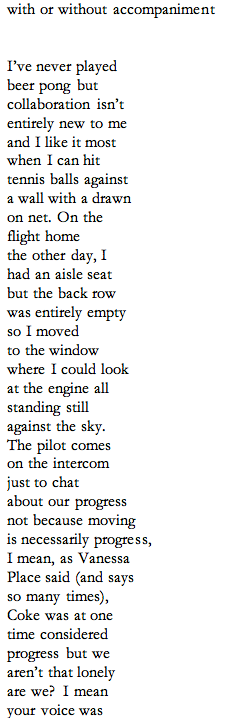
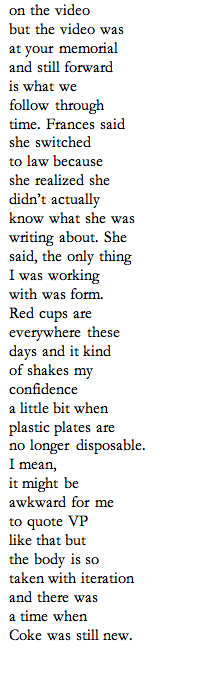
so·lo


so·lo (ˈsōlō),  n.  [ pl.  SOLOS  (-lōz); rarely SOLI (-lē)], [It.  <  L. solus, alone],  1.  a musical piece or passage to be played or sung by one person, with or without accompaniment.  2.  an airplane flight made by a pilot alone, without any passengers or instructor.  3.  any performance by one person alone.  4.  any card game in which there are no partners.  adj.  1.  arranged for or performed by a single voice or instrument.  2.  performing a solo.  3.  made or done by one person v.i. in aviation, to make a solo flight, especially one’s first.


It’s the last day of April and the last day of National Poetry Month! So today, we have our last word and last post for our first annual na·po·mo. The word is so·lo and the poet is TC Tolbert. Thanks so much for joining us.


TC Tolbert is a genderqueer, feminist poet and teacher committed to social justice.  Co-editor of the forthcoming Anthology of Trans and Genderqueer Poetry (Nightboat Books), TC is the author of two chapbooks, territories of folding (Kore Press) and spirare (Belladonna).  His first book, Gephyromania, is forthcoming from Ahsahta Press.  He is the Assistant Director of Casa Libre en la Solana, Adjunct faculty at University of Arizona and Pima Community College, and founder of Made for Flight.  www.tctolbert.com

Leave a comment

Filed under napomo

prac·ti·cal


prac·ti·cal  (ˈpraktikəl),  adj.  [obs. Fr. practique, pratique  <  LL. practicus (see PRACTICE) ;  + —al],  1.  of, exhibited in, or obtained through practice or action: as, practical knowledge: opposed ot theoretical, speculative, ideal.  2.  that can be used; workable; useful: as, practical proposals.  3.  designed for use; utilitarian: as, a practical dress.  4.  concerned with the application of knowledge to useful ends, as distinguished from speculation, etc.: as, practical science, a practical mind.  5.  given to or experienced from actual practice: as, a practical farmer.  6.  of, concerned with, or dealing efficiently with everyday activities, work, etc.  7.  that is so in practice, whether or not in theory, intention, law, etc.; virtual.  8.  matter-of-fact.


National Poetry Month is drawing to a close, but we still have a few poems from dictionary project contributors. Enjoy today’s feature, a poem by Kristi Maxwell:


Kristi Maxwell thinks and writes in Tucson, where she also teaches creative writing, literature, and composition around town and serves on the board of POG, a non-profit literary arts organization. Her books include Re– (Ahsahta Press, 2011), Hush Sessions (Saturnalia Books, 2009), and Realm Sixty-four (Ahsahta, 2008).


Leave a comment

Filed under napomo

the dictionary project author interview: Nicole Sheets

Welcome to a new addition here at the dictionary project: author interviews!

The second and fourth Wednesday of each month, we will feature non-traditional author interviews, where instead of responding to direct questions about their life or work, guest authors will discuss their relationship to words and attempt to provide answers to dictionary project words bibliomanced specifically for them.

We are so pleased to announce our first featured author is Nicole Sheets!


1.   Please share a memory/story/thought in relation to a dictionary/dictionaries:


When I first started graduate school, one gentleman caller mailed me a two volume compact Oxford English Dictionary, the kind with a magnifying glass in the little drawer. I discovered a Friday night game: split a bottle of red wine and the OED with a friend, and look up words as they pop into your head. Sometimes you need to swap volumes with your friend if she has the letters you need.

My OED has moved hundreds of miles with me. It sits on my floor next to one of my bookshelves, largely ignored by my cats, often commented on by dinner guests.


2.   What is your current favorite word?

“Buoyant.” I’ve been feeling pretty up lately, like an unsinkable Cheerio. In my memory of the commercial, those Os bounce to the bottom of the cereal bowl and back, through a cascade of milk.

Also, I recently learned “arctophile” when I clicked on a link at dictionary.com ( I confess that I often use an online dictionary in my office rather than the hardback Random House College Dictionary because I’m in a hurry). Isn’t it great that there’s a word for a lover and collector of teddy bears?


3.   What, in your opinion, is the most obnoxious/insidious/annoying word?

I’m cheating here because I asked some students to think about this question after reading Mary Oliver’s A Poetry Handbook. One student included “microwave” in her list, and that hit home with me. I dislike microwave’s nasal “r” that bunches up in my nose. My grandmother Hazel refers to her microwave as a “radar range,” which is a far superior name.

When I hear “microwave,” I also think of the microwave in the lunch room at my school. It’s not really a lunch room but more like an open kitchenette next to an alcove that thinks of itself as a lounge. Students and faculty microwave users are rather neighborly minded. Even so, the microwave deflates the meal experience. When you pop open the door and insert your single serve pyrex dish of last night’s stir fry, you see the ring of grease or splotches of overspill on the glass turntable and the sweat on the inside of the microwave door. On your hand you feel the moist breath from someone’s Lean Cuisine.


4.    Please respond to the following words and definitions, picked exclusively and randomly for you:


un·faith·ful  \ˌənˈfāTHfəl\ adj  1  :  not observant of vows, allegiance or duty: DISLOYAL  INACCURATE, UNTRUSTWORTHY < a ~ copy of a    document >


Last year I tried being an engaged lady. John proposed, and I thought about the proposal for three weeks. And then I called him late one afternoon to tell him I would marry him after all. I had just finished a short run on the Centennial Trail. I thought it would be romantic to say yes by a waterfall. But the rush of water was so loud that we couldn’t hear each other, so instead I said yes in the parking lot of a nearby fish restaurant. I felt buoyant. It was a feeling that lasted about three weeks.

We broke off the engagement well before the vows. Now I have a ring the man doesn’t want back (“It isn’t really the kind of thing you recycle,” he said) and a white, unworn, fitted, lace confection bagged up and hanging in the back of my closet.


-less  \ləs\  adj suffix  1 :  destitute of : not having < childless >   2  :  unable to be acted on or to act (in a specified way) dauntless


I recently turned 35, and I’ve been thinking a lot about childlessness. Last fall, I visited friends in Moscow, Idaho, who have three lovely daughters. Frankie, the three-year-old, asked “Do you have kids?”

“No,” I said. “Why?”

“Because your car has so many doors.”

“Count your blessings,” one of my favorite sing-songy hymns instructs. And I do. The number is high. I can make up many verses. Even so, I feel the –less of my childlessness. I’m not yet hopeless. I’m far from fearless.


ex li·bris  \eks-ˈlē-brəs, -ˌbrēs\  [L]  :  from the books of  —  used on bookplates 


At the Huntington Mall, a habitat of my youth, I spent more time looking at stationery than at books at a bookstore. I would spend at least a couple of hours at the mall every Thursday with Hazel, my grandmother, after she picked me up from my piano lesson. We’d have dinner at the food court or at Morrison’s Cafeteria and be back at her house in time for The Cosby Show. In that era, there were two bookstores in the mall, Waldenbooks and Coles. Coles’ logo and storefront were yellow, and the white floor glared at the fluorescent overhead lights. I browsed the day-by-day calendars and fingered the tassel fringe of the circular racks of laminated bookmarks and bookplates with ex libris printed in scratchy calligraphy.


2branch  \ˈbranch\  vb  1 :  to develop branches  2 :  DIVERGE  3 :  to extend activities: <the business is ~ing out>


On the wall of my grandparents’ kitchen hung a small wooden tree. Its outline was rounded, cartoonish. The texture of the tree was green with small pale dots, and each member of the family had their name printed on an orange, wooden button. Nana and Grandaddy rested in the top branches. My dad, mom, and me down the right edge, and my dad’s sister, my uncle, and my cousins Melissa and Allison took up a fuller bough because there were more of them. Allison’s button was a slightly different shade of orange, suggesting that the tree was a gift before Allie was born. This was a few years before my brother was born and even more years before Allie died the summer after high school graduation.

The living orange buttons haven’t been together since Nana’s funeral. My remaining cousin branched out, got married, had two kids. The family branches stretch so far apart, we might as well be in separate trees. There’s no neat break from an axe’s clean tooth. Just a rot, slow and silent.


poor \ˈpür, ˈpȯr\  adj   1 :  lacking material possessions <~ people>  2 :  less than adequate : MEAGER <a ~ crop>  3 :  arousing pity <you ~ thing>  4 :  inferior in quality or value  5 :  UNPRODUCTIVE, BARREN <~ soil>  6 :  fairly unsatisfactory <~ prospects>; also : UNFAVORABLE <~ opinion> — poor·ly adv


I accidentally misquoted the Bible in a fellowship application, but, reader, I still got the money. When I was a kid, I memorized Bible verses for church all the time, inscribing them on my heart etc. For this fellowship, I was thinking about the word inheritance, and I rewrote the Bible so that it’s the poor who inherit the earth (in fact, it’s the meek. Consolation: “Blessed are the poor in spirit, for theirs is the kingdom of heaven”). I was so sure in my rewrite that I didn’t even look it up to see if I was correct. I guess the fellowship committee liked my version, too.

I’m surprised when Mother Teresa, who lived among the poorest of the poor in Calcutta, expressed compassion for the West. When she accepted her Nobel Peace Prize in 1979, Mother Teresa remarked that in her visit to a nursing home, the residents had material comforts but no one to visit them. Loneliness, lack of love, these are real poverty, Mother Teresa insisted. “I want you to find the poor here, right in your own home first,” she said, “And begin love there.”


 Nicole Sheets teaches and writes in Spokane, Washington. Her work has recently appeared or is forthcoming in Image, Hotel Amerika, Cream City Review, and DIAGRAM. As WanderChic, Nicole blogs about travel and style for Wanderlust & Lipstick. She can be reached by email at nsheets@whitworth.edu.

3 Comments

Filed under author interviews

pe·nol·o·gy


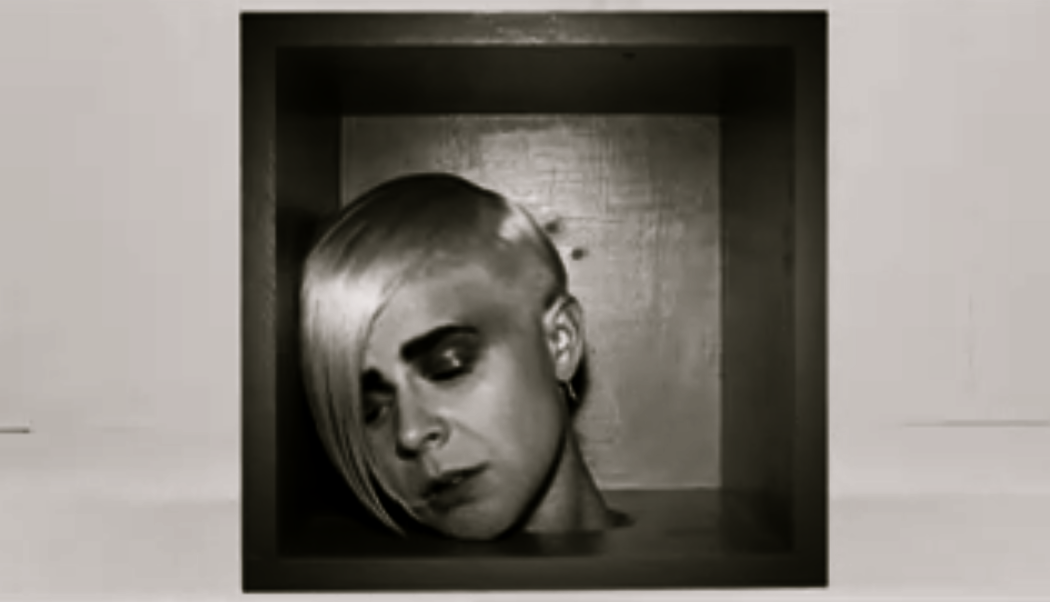
Robyn, from "Handle Me"


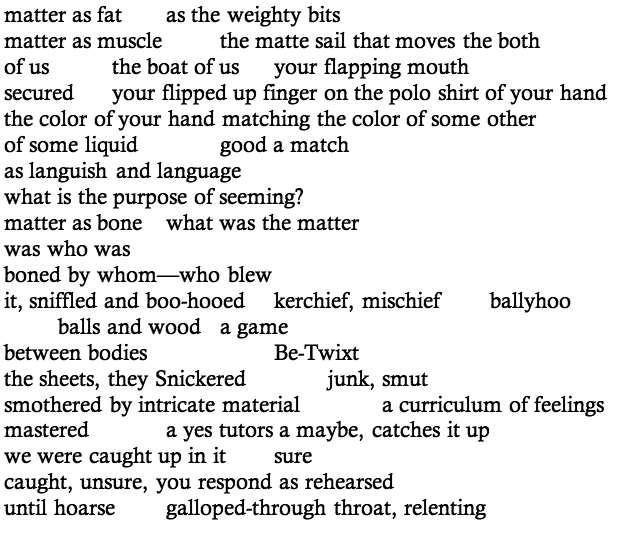
pe·nol·o·gy  /pēˈnäləjē/  n. the study of the punishment of crime and of prison management.  mid 19th cent.: from Latin poena ‘penalty’ + -LOGY. –pe·nol·o·gi·cal  /pē-nə-ˈlä-ji-kəl/ adj. pe·nol·o·gist /jist/  n.


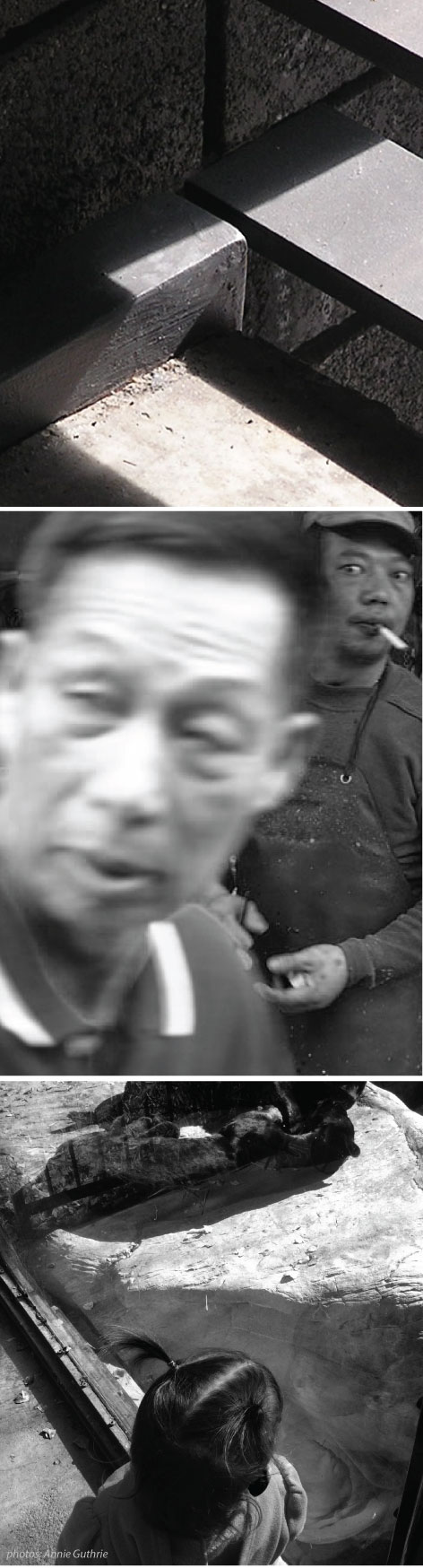
Writer Annie Guthrie joins us for our first annual na·po·mo. Enjoy her poem and photos:


*

make a box
a social judicial legislative executive box
a thought box
what kind of time does it keep
bodybox time  you feel
yes what did the mothers do
I always study yourself
you are the box. make you the box box fist
im going to punch me first
im going to wall my own wall with a wallbox!
make it box make it do
what kind of keeping does it do
heritage box lineage box legacy box
are you the archon who traces
my fistbox punches ?
yes attention is valuable
is studying humane
that’s why you can’t find it?
it is hoped
navigational way points fix whatbox
your ownself atbox
fear it keeper it do keep
trespassing the natural
I have I have not I had I had not I do have I do not have
I do I did I was I were I were not I am I am not
I where I am I where I am not I am not where
whatbox stay right there where you arebox
I can still put my hands in my pocket
it’s no longer in your hands
wouldn’t you wear gloves for that
yes


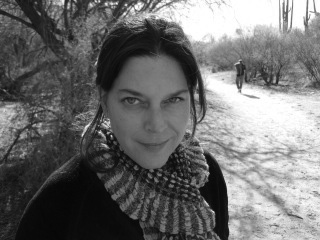
Annie Guthrie is a writer and jeweler living in Tucson. She works and teaches at the UA Poetry Center. She has work published in Tarpaulin Sky, Ploughshares, Fairy Tale Review, HNGMAN, The Destroyer, RealPoetik, Everyday Genius, Omniverse, The Volta, Spial Orb and more.

Leave a comment

Filed under napomo

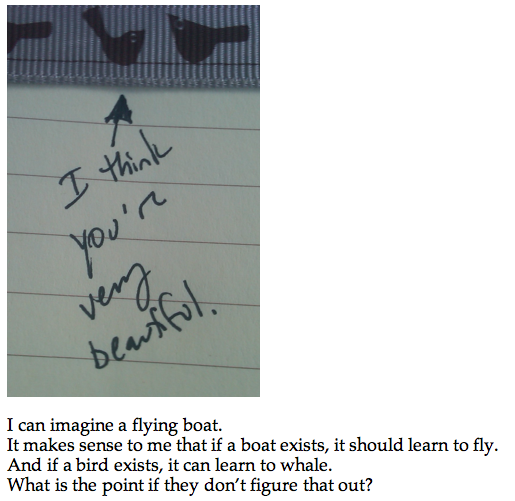
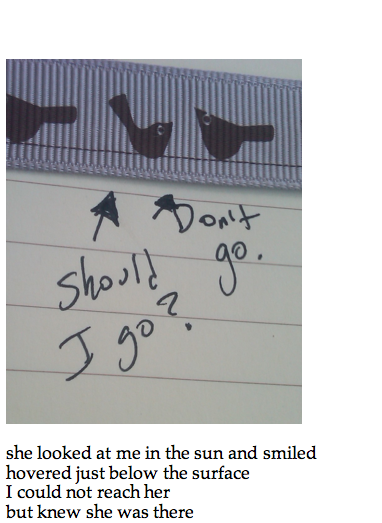
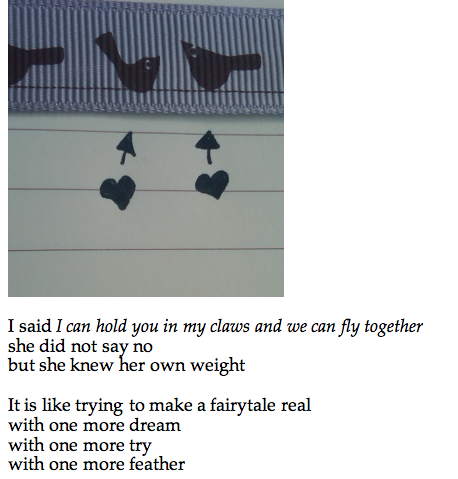
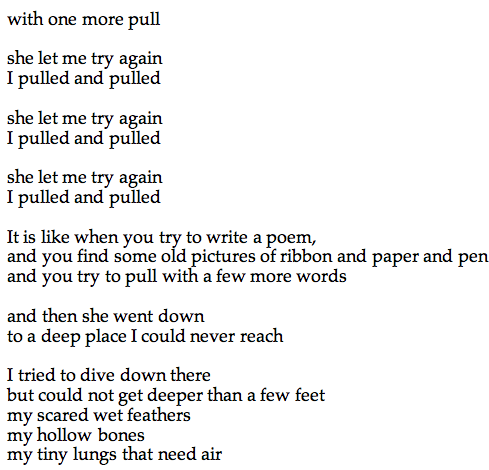
fly·ing boat


fly·ing boat, an airplane with a hull that permits it to land on and take off from water: see TYPES OF AIRPLANE, p. 32


For the second time in two weeks and in the history of  the dictionary project, when I closed my eyes and ran my finger through the pages of the dictionary, I landed on an image. This time, the image was of a flying boat, a vessel made for both air and water, from a page covered in illustrations of airplanes. Enjoy Kristen Nelson’s text & image poem for the next installment of na·po·mo.


Kristen E. Nelson is the author of Write, Dad (Unthinkable Creatures Press, 2012). Her recent work can be found in Tarpaulin Sky, Trickhouse, Cranky Literary Journal, In Posse Review, Dinosaur Bees, Everyday Genius, GlitterTongue, and Spiral Orb. She is a founder and the Executive Director of Casa Libre en la Solana; an editor/curator for Trickhouse; a production editor for Tarpaulin Sky Press; and a writing teacher. She earned her MFA in creative writing from Goddard College.

Photo credit: Sarah Dalby


2 Comments

Filed under napomo

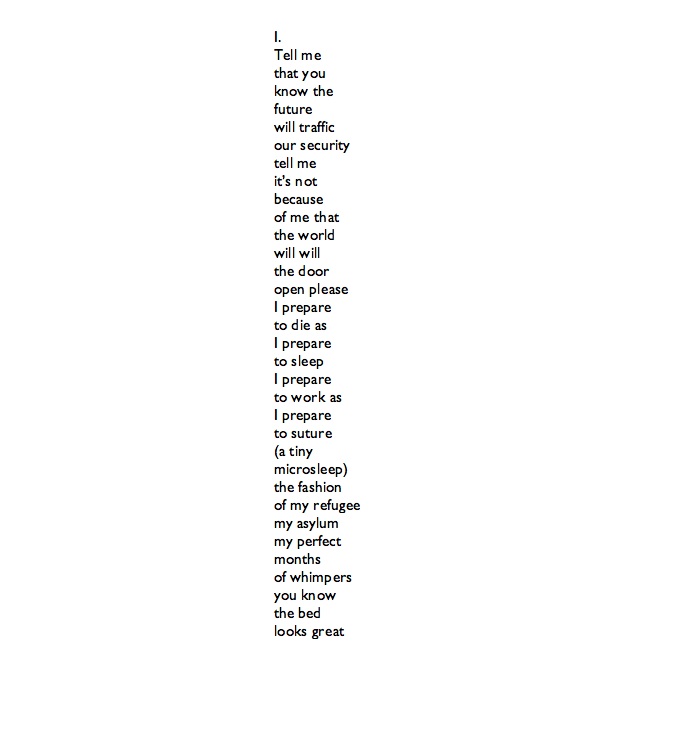
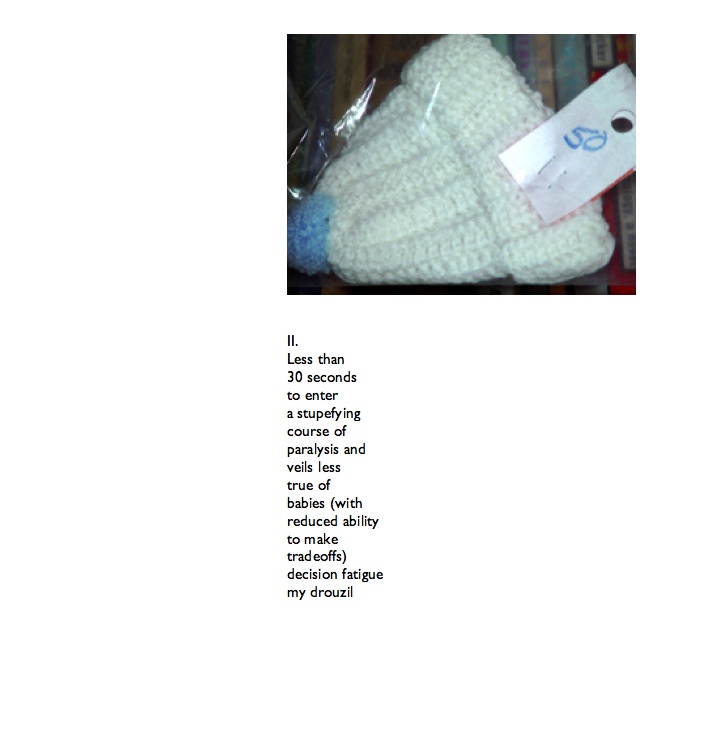
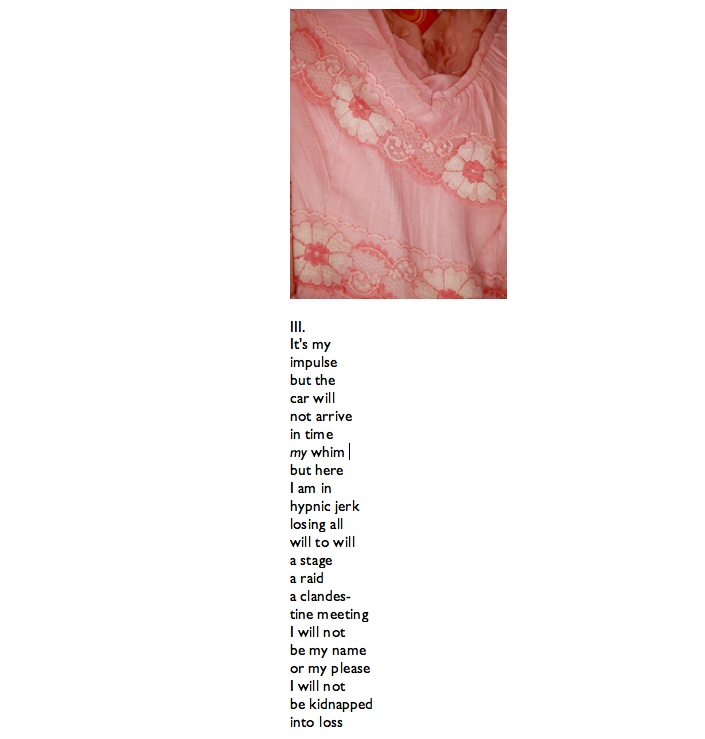
drows·i·ly


drows·i·ly  (drou’z’l-i)  adv.  in a drowsy manner, sleepily

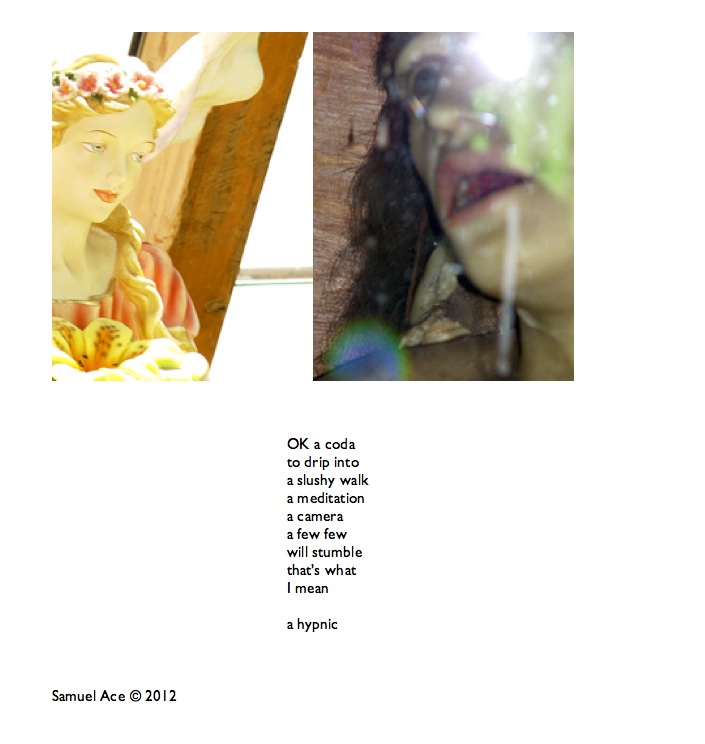
Samuel Ace joins us with his rendition of drows·i·ly for na·po·mo at the dictionary project. Enjoy the dreamscape, the space in between.


Samuel Ace is the author of three collections of poetry: Normal Sex (Firebrand Books), Home in three days. Don’t wash., a hybrid project of poetry, video and photography (Hard Press), and most recently Stealth, co-authored with Maureen Seaton (Chax Press). He is a recipient of a New York Foundation for the Arts grant, two-time finalist for a Lambda Literary Award in Poetry, winner of the Astraea Lesbian Writer’s Fund Prize in Poetry, The Katherine Anne Porter Prize for Fiction and the Firecracker Alternative Book Award in Poetry. His work has been widely anthologized and has appeared in or is forthcoming from, Ploughshares, Eoagh, Spiral Orb, Nimrod, The Prose Poem: an International Journal, Kenyon Review, van Gogh’s Ear, 3:am, and others. He lives in Tucson, AZ and Truth or Consequences, NM.


In their jammies (clockwise from top left): Trudy, Pete, and Don from Mad Men; Lana Turner; The Von Trapp Family; and Models from 1957 (photo by Nina Leen)

Leave a comment

Filed under napomo

con·stel·la·tion


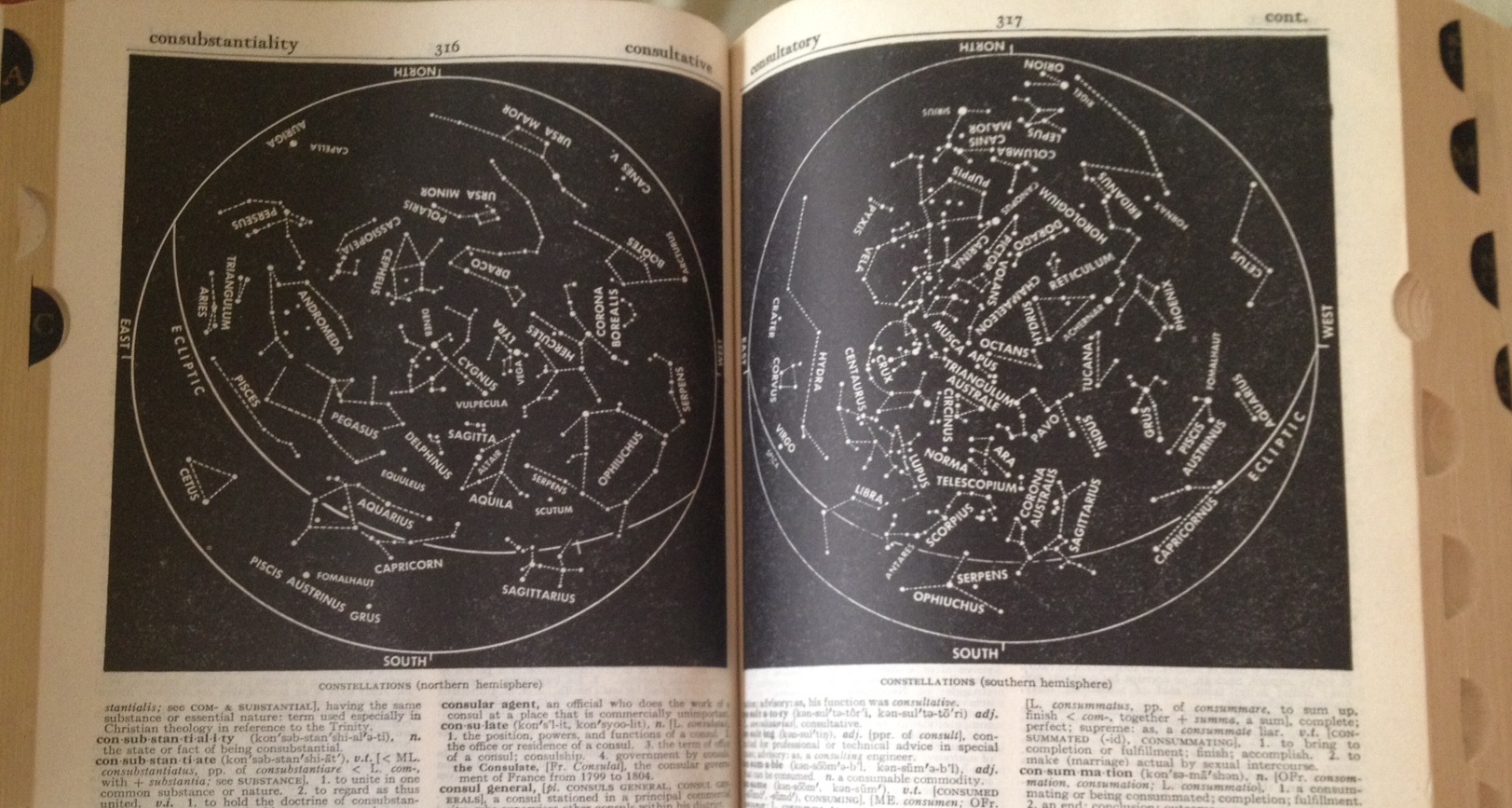
con·stel·la·tion  (känstəˈlāSHən),  n.  [ME. & OFr.  constellacion;  LL.  constellatio < constellatus, set with stars < L. com-, with + pp. of stellare, to shine < stella, a star; see STELLAR]  1.  a number of fixed stars arbitrarily considered as a group, usually named after some mythological being that they supposedly resemble in outline: see charts on following pages.  2.  the part of the heavens occupied by such a group.  3.  any brilliant cluster or gathering: as, a constellation of beautiful women.  4.  in astrology, a) the grouping of the planets at any particular time, especially at a person’s birth. b) one’s disposition or fate as supposedly influenced by such a grouping.  5.  in psychology, a group of related thoughts regarded as clustered about one central idea.

Editor’s note: For the first time in the dictionary project history, when closing my eyes and flipping through the dictionary, I landed on an image instead of a word. An image of the constellations in the sky. Closest to Libra, in case you are curious. The word for this post is con·stel·la·tion as a result.

For the third word of na·po·mo at the dictionary project, Lauren Eggert-Crowe joins us, contemplating the cosmos.


Lauren Eggert-Crowe was born and raised in rural Pensylvania. After a four year stint in the magical fairyland of Santa Cruz, where she lived so close to the ocean she could hear sea lions from her bedroom window, she relocated to Los Angeles to work as a freelance writer. She has written for The Rumpus, L.A. Review of Books, The Murky Fringe, and Blue Jean Gourmet. Her poetry has been published in several journals, including Puerto Del Sol, So To Speak, DIAGRAM, Terrain.org, Water-Stone Review, Eleven Eleven, and We Are So Happy To Know Something. Her first chapbook, The Exhibit, is forthcoming from Hyacinth Girl Press in January 2013. She is also the author of the literary feminist ‘zine, Galatea’s Pants. She holds an English degree from the Robert E. Cook Honors College at Indiana University of Pennsylvania, and an MFA in Creative Writing from The University of Arizona.

Leave a comment

Filed under napomo