Tag Archives: dictionary

re·cline

re·cline \ri-ˈklīn\ transitive verb : to cause or permit to incline backwards

intransitive verb 1. to lean or incline backwards 2. repose, lie

Origin: Middle English, from Anglo-French or Latin; Anglo-French recliner, from Latin reclinare, from re- + clinare to bend. First Known Use: 15th century

(from Merriam-Webster.com)

The Lazyboy was a sort of garish orange threaded through with white. Susan picked at the worn section on the left arm, as if she could do no further harm to this eyesore of a chair that had no business existing in the first place. She could tell it was annoying her therapist, her picking not the chair itself, which he had apparently chosen after all. He had just asked her what she presumed was a pivotal question in her “therapeutic process” and he had a look of expectation on his face, although he was trying to hide it. This was the moment, she imagined, when she was supposed to have an epiphany. No, wait, it was called an epiphany in novels. In therapy, it was called… What the hell was it called again? Well, anyway, she was supposed to be overcome with emotion. She was about to disclose something major, something life-changing, something she had never realized until this exact moment. Maybe she would cry, a river or perhaps a single dramatic tear. A tear which she would let slide down the length of her cheek without wiping it away, feeling the poignancy of the moment grow as it slid and slid and then dropped below, leaving a mark on her cotton t-shirt.

But the truth was, she didn’t feel a damn thing. Hours and hours of therapy, hundreds of dollars and she had arrived at the moment when she was supposed to finally come to some sort of realization, perhaps provide herself with some restitution for years of self-harm and self-doubt. She almost felt bad for her therapist, who sat there calmly waiting for her to speak. He had worked hard to get her here and for what? For her to feel nothing at all? Perhaps she could fake it. Make some shit up. Babble about her subconscious desires. But no. This, she imagined, was one of the few things in life impossible to fake. You cannot feign knowledge about something if you have no idea what that something is supposed to be.

She looked down at the arm of the chair and realized what she had done. There was a large oval area on the chair’s arm that now resembled the bald spot on a mangy dog. Through one sliver at the side, you could even begin to see the metal rod inside the chair.

“Oh my God, I’m so sorry,” she said, only it came out muddled and muted.

“What was that?” her therapist asked.

“I said I’m so sorry. I wasn’t paying attention. I ruined your chair. I’ll pay for it.”

He dismissed the idea with a wave of his hand. “It’s not a problem, Susan. I’ve been meaning to re-cover or replace that chair for months. Really, you helped me out.”

“But shit, I just, I mean, I can’t believe I did this without noticing.”

“Really, it’s fine. If I was worried, I would’ve said something or asked you to stop.”

She could tell by the calmness of his eyes that he was telling the truth, but she couldn’t let it go.

“How much do you think a new chair costs? I can add it to my check for today. Really, I’d feel better.”

“Why do you feel it is necessary to compensate me for the chair when I’ve told you that it’s not important? Do you not believe that I’m telling you the truth?”

“No, I do believe you.”

“Then what it is it?” he asked.

“I messed it up, okay? I messed it up and I can make it right. This, this I can fix. I can fix this stupid fucking chair that is the ugliest goddamn thing I have ever seen. And it’s something that shouldn’t even be fixed because it’s that worthless. But I have the power to fix it and I know I can. So will you let me fix the fucking chair?”

She suddenly felt like she was going to vomit. She could feel the sensation of fullness in her belly and knew that the accompanying nausea would soon be followed by a warming of her esophagus as everything rose. But just as she felt it coming, she instead began to sob. Her whole body shook, convulsing in a way she had never experienced before. She did not fight it. She didn’t try to make herself stop. She put her head in her hands and she felt the water teem. Her nose was running but she didn’t reach for the tissues. She wanted to feel like the mess that she was. Oh right, she thought, it’s called a breakthrough.

1 Comment

Filed under weekly words

under sail

under sail, from my dictionary

under sail, sailing, with sails set.

SAILS ON A FULL-RIGGED SHIP

1. flying jib; 2. jib; 3. fore-topmost staysail; 4. foresail; 5. lower fore-topsail; 6. upper fore-topsail; 7. fore-top-gallant sail;  8. foreroyal;  9. fore-skysail;  10. lower studding sail;  11. fore-topmost studding sail;  12. fore-topgallant studding sail;  13. foreroyal studding sail;  14. main staysail;  15. main-topmast staysail;  16. main-topgallant staysail;  17. main-royal staysail;  18. mainsail;  19. lower main topsail;  20. upper main topsail;  21. main-topgallant sail;  22. main royal; 23. main skysail;  24. main-topmast studding sail;  25. main-topgallant studding sail;  26. main-royal studding sail;  27. mizzen staysail;  28. mizzen-topmast staysail;  29. mizzen-topgallant staysail;  30. mizzen-royal staysail; 31. mizzen topsail; 32. lower mizzen topsail;  33. upper mizzen topsail; 34. mizzen-topgallant sail;  35. mizzen royal; 36. mizzen skysail; 37. spanker

1. flying, we 2. left 3. them, headed to sea 4. without 5. without manuals 6. we’ll learn to survey 7. the water, the wind 8. with no map 9. we, map-less               10. lower our demands 11. low, we go in cabin 12. foreswear the compass, foreswear 13. those running rigging lines 14. we will steer 15. using other tools  16. mid-wives of this vessel 17. mid-breath, we assist  18. with limbs  19. used as wood rutters 20. with balance, from scales 21. we climb, to check sails 22. main royal 23. we tighten 24. that which needs tightening 25. and we loosen just to see 26. what billows, what flies out 27. we need staysails 28. we need this, to stay, sail 29. and to hoist, to work, to move 30. to handle, steer, manage          31. beneath shape sheets 32. needing only to spread 33. and to catch and deflect 34. this full air, this strong wind  35. no, we are not 36. prepared, only             37. steady.

Leave a comment

Filed under weekly words

jad·ed

jad·ed (jā-dəd),  adj. [pp. of jade, v.I],  1. Tired; worn-out; wearied.  2. Dulled or satiated, as from overuse.

The interesting thing about language is how just one letter can create a seismic-size shift in meaning. For example, jaded is a word that means disillusioned, worn down, made dull, apathetic or cynical. One form of the word “jade” is also a verb signifying these sentiments. But the noun version of jade is of course, a gem, a green natural stone that in Chinese culture is revered for the qualities it signifies.

When I think of certain aspects of my life lately, I think of the grooves that form in wood after wheels have run over the same patch over and over again. My creative life feels as if it has stalled. I have moved to a new house and although it is beginning to feel like home, there is more I want to do to personalize my space and make it my own. After some difficult experiences over the past few months, including the break-ins I wrote about here on the blog, I don’t feel like I have the energy or inventiveness to jump the track.

So, I reordered a Feng Shui book I owned years ago in the hopes of at least manifesting what I want in my life in my personal space. Maybe by being intentional about the qi (pronounced chee) in my house, I thought, I would find some insights into what to work on now. Feng Shui literally translates to “wind-water”. Feng Shui, for those unfamiliar, is an ancient Chinese practice in aesthetics that is based in the idea that the energy in your home can be enhanced by the ordering of your home and the placement of the items within it. With intention, you can enhance areas of your life. Your space is divided into baguas, or zones. There are nine baguas: prosperity, fame & reputation, relationships & love, family, health, creativity & children, skills & knowledge, career, and helpful people & travel.

Jade Plant, photo by Matt Baume

For each, there are associated colors, elements and shapes that can be used to enhance the area. By enhancing the qi in your space, you enhance the qi in your life.

I think there is something to this stirring of energy. It makes logical sense to me that the way in which our home is structured would affect our internal structures. I think most readily of clutter. When clutter infests our homes, it also takes up space in our lives. Instead of taking the time needed to do some clearing, we live with the knowledge that there are bills to be paid, paintings to be hung, dishes to be attended to. And those items and the knowledge of them takes up psychic space that could be better used focusing on more important matters. If we neglect the spaces we live in, that neglect can wear us out.

The first year I lived in San Francisco, my room was painted a fluorescent green color. This green was a compromise with the prior resident, who agreed to paint over his one royal blue accent wall with this green. “I was envisioning the colors of the earth when I painted,” he told me. “Uh huh,” I responded. It was hideous.

I intended to paint over it immediately, but little did I know that I was entering one of the most difficult periods in my life. I had a hard time functioning much less considering things like decorating or qi (maybe I should have). So through that difficult time, the fluorescence remained. When I was starting to come out of it and began to reconsider how to organize my space to restore balance and wellbeing in my life, I finally went to the hardware store down the street and bought some paint.

I don’t remember the chip name, but I picked a sagey, jade-toned green. Green has always been one of my favorite colors. I remembered that it was said to be a calming color, fitting for a bedroom. I just needed a shade that suited me.

Chinese Jade

In Chinese culture, jade symbolizes beauty, nobility, perfection, constancy, power, and immortality. There is a Chinese saying that states: “God has a value; jade is invaluable.”  Stones have been found in the country that date back to 5,000 B.C. Whomever wears jade is believed to be protected from misfortune (Could it be said that in wearing jade, this person is “jaded”?)

Chinese Jade

I wonder what attracts me to this shade of green. The color is pleasant to me. It reminds me of Louisiana, of the color of leaves when lit by the sun.

I know for sure that it wasn’t repainting my walls that made me reconnect with important parts of myself that had been neglected. I do know that when it was time to paint, I felt a sense of urgency about it. I went from waiting a year to take care of it to feeling like I needed to paint immediately. So, I bought the paint and brushes, moved all my furniture to the center of the room, draped the floor and the furniture with dropcloths, and began to cover the walls with a new color.

When I was done, my arms were covered in specks of jade that would take a week to finally come off. I found them funny, these stubborn bits of paint. While I tried my best to scrub them off, I also took a kind of pleasure in the testament to small changes I was making in my life.

I know for sure that painting my walls didn’t change my life. But I also know for sure paying attention to my environment was a step in taking care of myself and my needs. I was paying attention to all the spaces I lived and moved and breathed in, the spaces without and within.

My room in the Western Addition, San Francisco


Leave a comment

Filed under weekly words

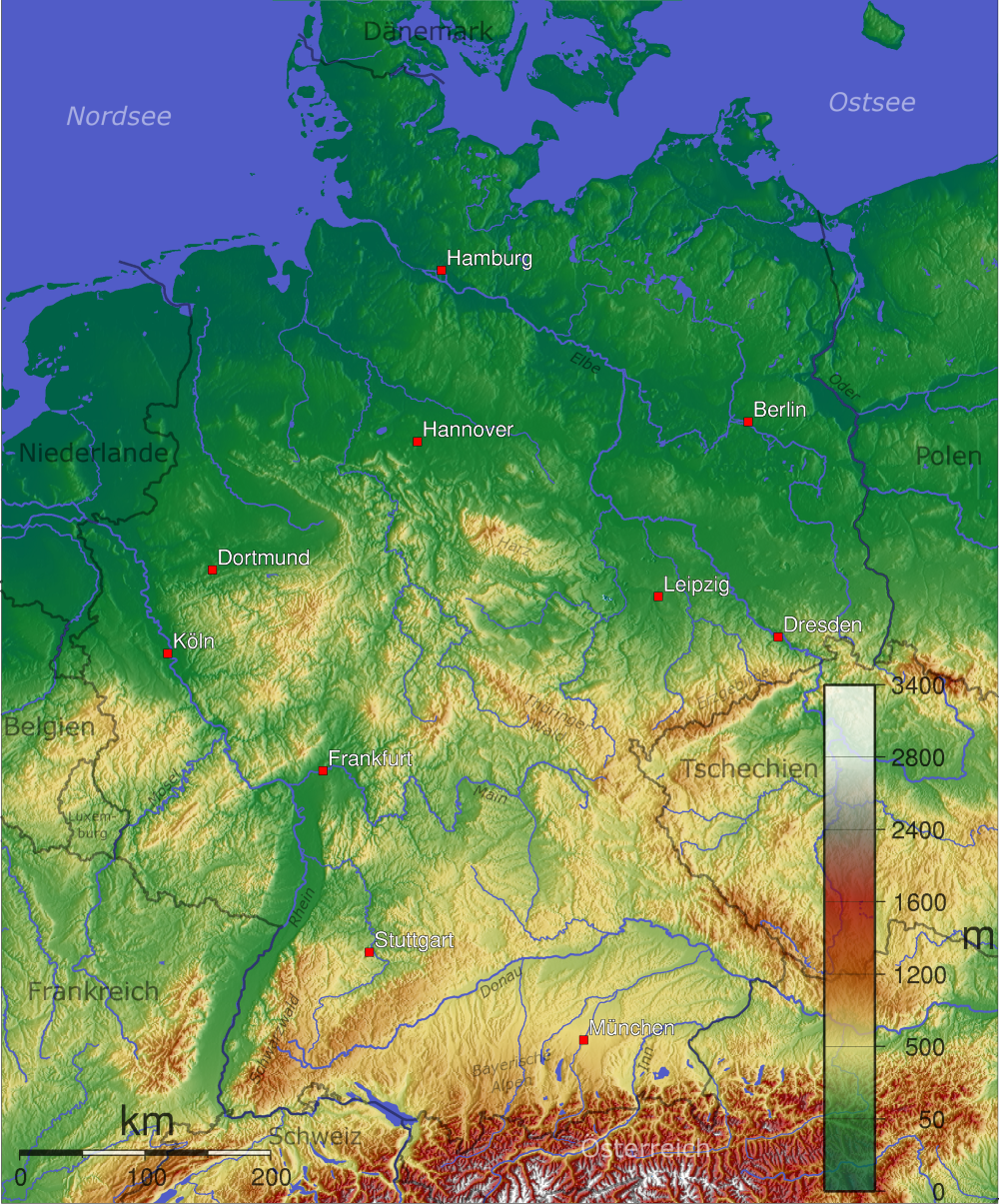
Germany

Germany* (jûr m -n ), n. a country in north central Europe, on the North and Baltic Seas; area, 182,471 sq. mi.; pop., 65,899,000 (1946): in 1945, Germany was divided into four zones of occupation, administered respectively by France, Great Britain, the Soviet Union, and the United States, in 1949, the United States, British, and French zones were constituted as (the Federal Republic of) West Germany and the Soviet zone was constituted as the East German Democratic Republic (East Germany): capitals, Bonn (West Germany), Berlin (East Germany): German name, Deutshland: abbreviated Ger., G.
*reminder that the dictionary I typically pick from is from 1955

What is it that defines a place? Its borders? The way it is placed in our collective memory, in our history books? How is that a place comes to conjure certain emotions? What about the way in which people use the land? What about the personalities, values and passions of the people that live there? How do these people’s way of life embed the place with meaning? The study of geography fascinates me because of all these questions. When people move thousands of miles from their native land, why do they often choose places with similar topographic features or climate? How do their bodies or souls gravitate there? How do they know where to go—to the place that feels most like where they come from, the home they left behind? And how does what humans do in a given space define it permanently?

Although my last name is Irish and my mother’s side is mostly Acadian French, a good chunk of my ancestry is German. And I remember when I found this out not wanting this to be the case. I had learned about the Holocaust and was horrified by the stories I read, the black and white photos I saw. I remembered the image that Elie Wiesel wrote of in Night that described babies being thrown up in the air and speared by German soldiers bayonets. And I wanted to not be from there, from the place that produced ethnic genocide, suffering, death, pain. I wanted to not be associated with or related to people who were able to participate in the mass slaughter, in a very methodical and personal way, of millions of people solely because of the God they worshipped and the way their features were shaped.

In knowing that my ancestors came from there, even if it was long before the Holocaust, it somehow made them and me complicit or related to these unimaginable actions, this behavior so divorced from the human capacity for compassion, understanding, kindness. So I found pride in my Irish roots, my Cajun roots, and I ignored my German ones.

And I wonder how we untether a place from its history. We can’t, I guess. And we shouldn’t. But what if a place only becomes about the painful parts of its history? I grew up in the South, in Louisiana—a place lush with cypress and magnolia trees, with humidity, with music streaming out of bars and out of the bells of brass instruments. This is also a place with long ugly celloid scars from the scourge of slavery and the racism that followed (and continues to follow) long after the Civil War was over. And yet it is my home. There are so many things about my home that I am proud of. I see that it is not one thing or the other, not evil or good, not about suffering nor about the overcoming of it. This place, as with all places, is defined by it all.

I also don’t know how to reconcile the fact that the suffering of a place and its peoples also shapes and informs the important and positive cultural identification of that place. Before Katrina, New Orleans was 65 percent African-American, and it is the spirit, music, family and cultural values of the African-American community that is the foundation of the streets we walk on back home. Without this community, New Orleans is not New Orleans. And this community is there because their ancestors were brought over to be slaves to white colonizers.

Germany is not just the Holocaust, but the scars are there. And the scars are visible not only to Germans but to me and the rest of the world. When I went to Germany on a high school trip to Europe, we went to two places. We walked around the cobblestones streets of Munich, where we visited the Hofbräuhaus and watched the Glockenspiel tell the hour in the evening. And yet all the time, I was thinking of the next place we were to visit: Dachau. It was raining and cold when we visited Dachau. We walked around and saw the empty plots, with wooden borders to show where the camps had been. We saw one of the brick ovens (a reconstructed one? A remaining one? I don’t remember now).

At some point, I distanced myself from the crowd and went with my umbrella to stand off alone taking in the scene. I remember thinking: This is where the Jews were persecuted. This is where they stood in rain and cold like this except with threadbare clothing and shaven heads. And I wanted more than anything to cry. But I couldn’t cry. The truth was that I could not feel their pain. How could I? I had never had to experience the sort of suffering they had undergone. So all I could do was stand there and try to understand.

I have had a hard time writing this post because whenever I thought of Germany, these thoughts came to my mind. And I thought, is that all there is to write about? I guess that’s not what matters because this is what, I suppose, I needed to write about. That my Grandma’s name is Rothermich. That my great grandfather’s name was Hupfer. And that it is problematic to come from a place—from multiple places—in which human beings were impossibly cruel to other human beings.

The key to understanding a place, I suppose, resides in the ability to not only read or understand but absorb the feeling of it all as much as possible. To see the broken down barns as well as the stately mansions, the dead trees and the ones that bear fruit. I guess it is about never forgetting the human-created sorrow that will never be absent from the place and yet to not allow that feeling of sadness to be the only feeling. To know a place, in my mind, is to know that it is a space in which both hurt and healing can occur. What happens in that space, all of it, should never be forgotten. And our responsibility to that place is to try to tip the scales, to be better to each other than future generations were and to repeat their kindness but not their cruelty.

Leave a comment

Filed under weekly words

in·gra·ti·a·tor·y

in·gra·ti·a·tor·y* /in-ˈgrā-sh(ē-)ə-ˌtȯr-ē/ a. tending to ingratiate, ingratiating

in·gra·ti·ate /in-ˈgrā-shē-ˌāt/ v. [f. L in gratiam into favour + -ATE, after It. Ingratiare, ingraziare.}  1. v. refl. Get oneself into favour; gain grace or favour (with); make oneself agreeable to). 2. v.t. Bring (a person or thing) into favour (with someone); make (a person or thing) agreeable (to).  3. v.i. Gain grace or favour (with)

When I was twenty-three and living back home in New Orleans, I began working for a community center that offered a coffeehouse with pastries and coffee a couple of times a week for homeless men. This was the first time I had real conversations with people who were living without a home, instead of encounters in passing on the street. Through them and through Unity for the Homeless, I learned more about what they were facing, where they came from, why it was near impossible for many of them to hold down a steady job and residence.

I also learned about the different places around town that provided services for homeless men and women, and I learned the different expectations that came with those places. At more than one place, the men and women who sought shelter and food were given it only after they attended a spiritual service, for whatever denomination was there. They were emphatically told they were sinners and to repent. And it was only after sitting through this condemnation. “Sermon for your sandwich,” the guys told me. Many would rather go hungry than go there.

In my experience, people who are homeless, who are addicted, who have committed crimes, who have estranged themselves from their families—hell, people, like me, who have messed up in anyway, have the knowledge that they have messed up. They don’t need a reminder of the ways in which they are flawed or the damage they have done. Most often, they need the hope that healing is possible. If all you have known is brokenness in your life, how are you to even begin to believe that wholeness is something that can be achieved? No wonder your behavior is to continue to break, to break with, to behave in ways that shatter your self or connection to other people.

And to begin to heal oneself, one’s primary concern cannot be the needs or desires of others.

This is not only because one needs to take care of oneself, but because one needs to be real about who one is while making oneself whole. People need to know that they, as they are, are worthy of rich, fulfilled lives, and they don’t have to act a way they are not, believe something they do not believe, or ingratiate themselves to others to do so.

When I was in my mid-twenties, I continued working with homeless and low income people in San Francisco, for St. Anthony Foundation, a Franciscan based organization in San Francisco’s Tenderloin neighborhood. The reason I was attracted to the organization was largely due to its mission statement. Part of this statement was that every human being is worthy of dignity and respect just by being.

I don’t mean, by this post, to undermine the reality that people make awful mistakes and cause wounds that are sometimes so difficult to heal. But I do think it is important for us to remember that all of us have the capacity to make mistakes, to fuck up in ways we would never think possible. And because we all have that capacity within us, we also have the responsibility to offer grace to those are hurting whenever we can, not because they can do something for us but because they need it and we are in the position to give that grace.

*I am house-sitting right now so this word was not selected from one of my home dictionaries but from this one:

The Newer Shorter Oxford English Dictionary (Thumb Index Edition), Volume A-M 1993

1 Comment

Filed under weekly words

man·ner

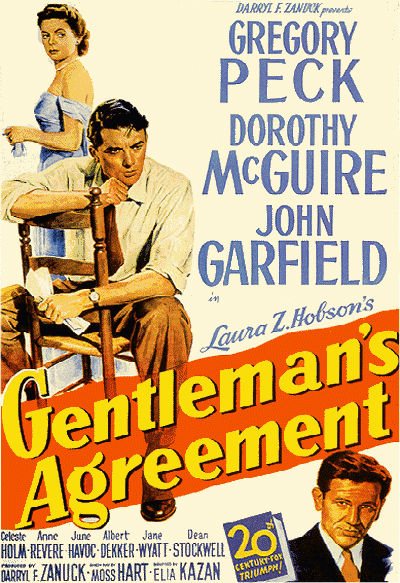
Film Poster for Gentleman's Agreement, 1947

man·ner [man er] n. [<L manus, a hand] 1. a way of doing something; mode of procedure 2. a way, esp. a usual way, of acting 3. [pl.] a) ways of social behavior / bad manners b) polite ways of social behavior / to learn manners/ 4. Kind; sort.

The first thing that pops into my head when I think of the word “manner” is the concept of “minding your manners,” attending to the guidelines we are given as a child. Usually this involves gentility, how we treat other people and how we present ourselves. It is about character, about respect for self and others. These ways of doing something were created to provide structure in our society and our communities. But oftentimes, manners are used synonymously with the idea of good moral behavior and this is not always the case. I think of it being good manners for the host family to sit at one table while the servants ate in the kitchen. I think of outdated rules like not wearing white after Labor Day or women wearing girdles and pantyhose, which once implied—and in some places still do—good manners and an acceptable way of dressing.

The second thing that I think of when I think of “manner” is those people who have a distinctive way of being. I think of old Hollywood celebrities who were recognizable not only for their appearance, but for the characteristics of their demeanor. Celebrities like Katherine Hepburn, Cary Grant, Rita Hayworth, Gene Kelly, and Gregory Peck.

I have been thinking about Gregory Peck often lately. I saw Roman Holiday when I was younger, but I don’t think I saw To Kill a Mockingbird until I was in my mid-twenties. Unlike many people, I wasn’t assigned the book in high school. I read it when I was twenty-one or twenty-two and I was struck by the book’s poignancy and universality. Although I had not grown up in the same time as Scout, I had grown up in the South very aware of class and racial differences around me. I had grown up with a very keen desire to understand injustice, which I saw seemingly everywhere around me. I identified with Scout and revered her father Atticus Finch as an upstanding citizen and moral voice amidst a community ruled by lunacy and fear.

I didn’t see the movie until years later. I was living in San Francisco at the time and had visited my local independent video store. I picked up To Kill a Mockbird then. I was again moved by the story, now told through film, and by the way each character works through their own relationship to the trial of Tom Robinson, a black man accused of raping a white woman in a rural Southern community. I was particularly moved by Peck’s performance as Atticus. I watched the special features, which included a documentary about Peck’s life.

Atticus Finch (Gregory Peck) and Tom Robinson (Brock Peters) in court

Here, I thought, was a man with a unique manner. It was he who had pushed for the production of To Kill a Mockingbird after having read the book. He devoted himself to films whose stories also held a greater social importance. I remember watching the documentary and feeling a real affection for him. This feeling was renewed when, that same year, I saw the film again on the big screen of San Francisco’s Castro Theatre. The screening included a question and answer period with Mary Badham, the actress who had played Scout as a child. She described Peck as having been very much a father figure to her. He was so similar in real life to the character he played in the film, she said.

To Kill a Mockingbird Poster, 1962

Recently, I watched the film The Gentlemen’s Agreement, which stars Peck. Dennis Hopper had just died and I decided I wanted to watch Rebel without a Cause, his first film in which he played a minor role. While browsing the Classics Section at Casa Video, I picked up The Gentlemen’s Agreement, read the back, and decided to rent it. The film is about a newspaper reporter Phillip Skylar Green who is asked to write a feature on anti-Semitism. He is searching for an angle for his story and arrives at pretending he himself is Jewish for a given period of time. No one is to know except his boss, his mother, and his fiancé, who he has just recently met. As the story unfolds, his interpersonal relationships are challenged by this choice to pretend to be Jewish. His fiancé doesn’t understand why he needs it to be a secret amongst her family. His son is threatened at school. His Jewish friend Dave even advises him against it. He is used to discrimination because he has been Jewish his whole live, but he fears that Skylar will not be able to handle it in one concentrated time period.

The film asks large questions of the viewer and challenges the viewer by the subtlety with which the characters come to realizations. The effect of prejudices like anti-Semitism, is revealed through interpersonal relationships, where the impact is felt in real life, and there are no true villains only complicated people. The film also makes a strong statement about people who are good-hearted and thoughtful but who remain silent or apathetic.

Another thing that makes this film so remarkable is its context. The film was released in 1947, just after World War II, just after anti-Semitism so strong it resulted in the genocide of over six million Jews in Europe. When Elia Kazan (who himself is a complicated character as he testified in 1952 in front of the House Un-American Activities Committee and named eight Hollywood associates who were former members of the Communist Party) decided to make the film, several Jewish studio heads told him not to make it. One said it would be “like stirring up a hornets’ nest.” That conversation ended up being worked in as a scene with the newspaper’s editorial board and its dissenting voice against the “anti-Semitism” story.

Skylar Green is a character who has manners but who is unwilling to abide by social constructs without critical thinking. He embodies a persecuted group in order to challenge certain social norms and to understand better where anti-Semitism is rooted and what impact it has on individuals. And yet, it is not Skylar who ends up being the hero, but his friend Dave, who in a strong speech talks about the eventual impact of being silent while others are mischaracterized, mistreated, and oppressed.

The actor who played Dave, John Garfield, was an actor who was a headlining leading man at the time, and he took a supporting role in the film because he so believed so strongly in the worth of the project.

The film’s title itself refers to a unspoken agreement that allows and endorses discrimination. At one point, Skylar Green goes to a hotel that he has reserved for his honeymoon and asks point-blank if they allow people who practice Judaism to stay there. The manager comes out and asks in a nuanced way if that is a hypothetical question or not. Eventually, he is asked to leave.

I think of today’s celebrities who get more attention for their outrageous, scandalous and often disgraceful behavior instead of getting revered for who they are. They become caricatures of how not to behave instead of models of how to be. And oftentimes, their loud lives are more recognizable than their body of work. I am grateful to actors like Peck who were more concerned with the impact they made with their work than with being famous and who picked their roles carefully, choosing the stories that were worthy, that asked questions and that ultimately modeled a way of being and asked viewers to question the way they themselves moved in the world.

1 Comment

Filed under weekly words

sal·e·ra·tus


Bonneville Salt Flats


Today, we have a guest post from writer and friend of the project, Julie Lauterbach-Colby*:

sal·e·ra·tus (sal’e’ra’tes), n. [Mod. L. sal aeraius, aerated salt], sodium (or sometimes potassium) bicarbonate; baking soda, as used in cooking.

A space opens to provide context—topographic lines separating what runs away (what I have run from). Almost as soon as we crossed the Californian border into Nevada we start to see the dried salt flats. What used to be lakes, appear as opening voids on the altas. Points, here. An exact location rendered gone. Those first explorers into the open lands: the badlands, wastelands. Where the earth has dried and cracked, opened up from sudden change, sudden pressure (the constant ebb of flow of life, of family units), chasms of depth and darkness. How deep is each cut (of the earth)? Around the outer rims, white powder still visible. Traces of. Portraits of. The past. Water marks: where seawater dug its way gently into the sides of the land. With each receding, circular line: a closing in upon itself. Earth’s vacuum effect. From a bird’s eye view, cartographers map each concentric shape wider, farther apart from the last. On a map, what we have is an inverse mountain, a valley that appears to create a wide vortex but which, from the ground, appears nothing but flat for miles and miles and miles.


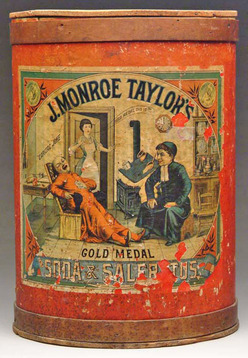
saleratus cannister


The cake, too: flat and even when I peek into the oven to check its progress. Sudden change, sudden pressure: my mother, a lesson. Set on the counter to cool, the soft center closes in upon itself. Baking soda, saleratus powder, likes heat and time to converge with the flour. What I have is (What appears from my bird’s eye view.) cartographic crater.

My family, driving the winding Californian coast each summer, past Carmel and Monterey out to the coast where we dug for abandoned shells and overturned abalone. On the edge, where saltwater plunges itself into porous rock, what remains? Collected in shallow pools, sun-evaporated during low tide, this white powder. Remains of after collected on the tip of one’s finger.

Ground up and put next to each other, sodium chloride (sea salt) and sodium bicarbonate (baking soda) look almost identical. (As in the saying, Like mother, like daughter.) But we must think back to the tracing of one’s concentric circles: each enclosed within the other (Do we interpret those inner rungs, those that, on a map, appear to be digging themselves into a hole?) but standing on the edge one sees that no: what we have is (       ).


*Julie Lauterbach-Colby is a writer, teacher and artist living in Tucson. She is currently working on a project that incorporates cartography, mathematical equations and cadavers, and owns her own editing business called Chicken Scratch Editing.

1 Comment

Filed under weekly words

belle

belle (bel) n. [Fr., fem. of beau; see beau],  1. A very attractive woman or girl.  2. The most attractive or most popular woman or girl of a certain place or on a given occasion: as, the belle of the ball.

Rue McClanahan as Blanche Devereaux

This is one of those uncharacteristic times when I choose a word to ruminate on in addition to the word of the week. And this word is “belle.”

In the last month and a half, we have lost two iconic actresses who created iconic characters: Dixie Carter as Julia Sugarbaker and Rue McClanahan as Blanche Devereaux.

I have been uncharacteristically sad about these celebrity deaths. I have always loved Designing Women. As an avid fan of The Golden Girls, I grieved the loss of both Bea Arthur and Estelle Getty this past year. However, there

Dixie Carter as Julia Sugarbaker

was something different about the loss of Rue.

Let me offer some context. I was born and raised in New Orleans, Louisiana—in a place where, despite modern times, I learned that women were supposed to dress, act, and behave in certain ways. I wore tights as a little girl and at about age eleven switched to pantyhose (even in summer, in Louisiana). My mother never let me leave the house without something being pressed. I learned to have pride in my appearance, in the way I dressed and the way I conducted myself.

I learned that there was no white after Labor Day. I learned about pearls and handkerchiefs and linen and seersucker. I learned the importance of presenting oneself in a certain way. I also learned that women were to be smart (but not too smart), interesting (but not too interesting).

I was fortunate enough to be raised by progressive parents, who encouraged me to do whatever I wanted to, who believed I could do anything a boy could do. They encouraged me to follow my dreams and to pursue whatever held my interest. However, despite their support, I always had a feeling that I might have to sacrifice one part of myself for the other. I would have to cover up my femininity in order to be strong. I would have to pretend to be passive to maintain my girl-ness.

I watched The Golden Girls and Designing Women during formative years in my life. The first time I remember watching The Golden Girls was when I went to my grandmother’s house after school in junior high. It was a hard time for me. My parents were separated, which had come to me as a total shock. I was at a new school for the first time, and for the first time, I was in class with boys. I felt like I didn’t fit in and had no chance of being popular. I have always loved these two shows, but it wasn’t until the stunning sadness at the loss of these two women that I have begun to understand why.

I realize now that in Julia and in Blanche, I found role models of what it means to be a real Southern belle. Not a Scarlet O’Hara or a Blanche DuBois, but a belle for modern times. A belle who is self-defined instead of defined by men’s expectations of her.

These were woman who were attractive and not just because of what they looked like. These were women who were smart and educated. They had family lives and professional lives. They had quick wits and were quick to use them. They were classy, well-dressed and gorgeous. They had beautiful, intimate friendships and sometimes challenging but fulfilling romantic relationships. They had grown into themselves and were responsible for that growing.

And they were older. Rue McClanahan once said of The Golden Girls: “that when people mature, they add layers.” And the show was a revelation of that fact, a fact that women need to hear. Because I think there is still an idea in our culture, which is much too rampant, especially in the South. That being that women are to be respected because of their beauty and when they are older, they become washed-up, objects to be forgotten about or thrown away. The show proved that women become even more assured and knowledgeable and interesting with every year that passes. Women become more beautiful with more life experiences and lessons learned, with more laugh lines and wrinkles.

The shows themselves had substance, unlike most shows today, and were not afraid to tackle controversial issues, like HIV/AIDS and racism. Because the writing was so good and the acting was so strong, these issues worked seamlessly into the dialogue and action of episodes. And one of the commonalities between them was a strong feminist thread. In their episodes, Designing Women and The Golden Girls dealt with: abusive relationships, domestic violence, sexism and sexual harassment, violence towards women and self-defense courses, expectations for women’s beauty, and sex and sexuality.

These shows weren’t produced as Public Service Announcements but as powerful dramatic and comedic programming that revealed real characters working through and struggling with these realities in their day to day lives. And so, when I was young, I learned vicariously what it meant to stand up for myself, and how I should be treated, with respect and love.

I want to use these women to redefine the conception of Southern belles. The thing about real Southern belles is that they don’t restrict themselves. At the same time, and in the moment they sashay their hips, they are feminine and strong, they are classy and kitschy, they are sweet and what some may call bitchy. They are bold with their own ideas and receptive to others’. They are sexy and innocent. They are the ultimate hostesses and vulnerable to making mistakes. They refuse to be defined as one thing or another. They can be both and all.

I learned from these women that it was okay to be myself, that it was fullness and contradiction that makes women beautiful. I learned to accept all my qualities as valuable. Some might call Julia a bitch because she spoke her mind. Some might call Blanche a slut because she took charge of her own sexuality. I call them strong Southern women who I was lucky to see as an impressionable little girl. I will always be grateful to Dixie and to Rue for creating such lovely and lovable complicated women who became role models of how to be it all, how to have it all, and most of all: how to be myself.

3 Comments

Filed under other words

bat·tle

Francisco José de Goya, Y no hay remedio (And there's no help for it), 1810-1820 Plate No. 15 from Los Desastres de la Guerra, etching on paper

bat·tle (bat´’l),  n. [ME. & OFr.  Bataile; L.  battalia, battualia, exercises of gladiators and soldiers in fighting and fencing  <  battuere; see BATTER (to beat)],  1. a fight, especially a large-scale engagement, between armed forces on land, at sea, or in the air.  2. armed fighting; combat or war.  3. any fight or fighting; conflict.  v.t. & v.i. [BATTLED (-‘ld), BATTLING], to fight.  give (or do) battle, to engage in battle; fight.

When I was a senior in college, I took a class on “Catholic Social Thought.” We went through the different teachings the Church had about equality and justice and we ended the semester with the idea of peace and of just war. I remember vividly a day when we were talking about war and the need to step in with things that got out of hand. Dr. Barbieri, the instructor of the course, was very good about exposing us to charged issues and the different sides and then getting out of the way to let us hammer it out on our own. On that day, an outspoken senior, who was on ROTC, sitting far down the conference table from me talked about how war was justified in many cases. He said that war had happened since the beginning of time and that man’s natural tendency was towards war, was towards fighting as a way to resolve issues.

Although I was an outgoing person, I hesitated to speak in that class. I was worried I would say something wrong, and the absence of a set way of thinking from the professor meant I had to decide for myself. What if I decided the “wrong” thing. But that day, I disagreed with him. I opened my mouth, not knowing exactly what I was going to say, and I told him that I didn’t believe men and women’s natural tendencies were towards violence but towards compassion. I said that I didn’t think war was ever justified.

He brought in World War II. How were we not to fight in that instance? And I surprised myself in that moment in saying that I didn’t know the answer to that, but that neither did any of us. Did I believe that the Nazis needed to be stopped? Yes, absolutely. But how could we know we could not have been stopped in another way if it hadn’t have been through war? History had already played out and we were living with the reality of what had occurred. But none of us knew what would have happened if the war hadn’t occurred. Could the mess of Nazi Germany have been conquered in a way absent of violence and war? Maybe not. I certainly didn’t know the answer. But neither did he.

The definitions listed above are all literal battles. They refer to physical battles, to violence that involves bodies. But the newer Webster’s dictionary also refers to battles as “an extended controversy.” A controversy has been brewing in the state where I reside, Arizona. The controversy is in regards to HB1070, a bill that passed on Friday, April 23. Jan Brewer signed into law a bill that mandates police officers to pull over anyone that they have “reasonable suspicion” may be in the country illegally.

Native American Dancers at May Day Rally, Tucson, May 1, 2010

We are a proud nation and we often forget the legacy of our forefathers, that our foundation was built upon genocide and slavery. We feel so proud of our citizenship that we forget that unless we are Native American, our ancestors were once citizens of another country. And many of them didn’t come over here with any legal papers on hand. They came on boats for a better life. Mexicans often come by car or on foot. The difference is that we have decided that we want our country to ourselves. That “they” are too much.

It is in these kind of battles that I think it is important to bridge the divide between those on different sides. It doesn’t help for us to yell at one another. It doesn’t help for us to categorize each other as “those people.”

My mother’s first language was Cajun French. When she and her classmates began kindergarten, they were forbidden from speaking French. Many of them didn’t know any English but they were expected to communicate nonetheless. As punishment, six-year-olds were made to kneel on dry rice in the corner or write “I will not speak French in school” hundreds of times on the blackboard. The ensuing result for my mother is that she didn’t teach me French and until ten years ago when it was required by her job, she barely spoke it herself.

I genuinely believe that much of the problem white citizens have with Mexicans immigrating here is not because they take jobs away or because they don’t come here legally. I believe many Americans of European heritage feel threatened by the Mexican culture, which has a rich language and deeply rooted traditions. I believe that White Americans have suffered a great loss and are still grieving for it.

We came here from our European countries in search of a new land and a place where we could be ourselves, to practice our own religion and our own traditions. And the truth is that America has not always supported this. Many of our ancestors abandoned their traditions to become American and we don’t like seeing other people have their cake and eat it too. We didn’t have that chance. Why should they? They should because no one should have to abandon their cultural traditions when they go to another country. Our culture is embedded in us. The places we come from, the people who love us are within us and that doesn’t change when we change physical locales.

This country was founded on the tragedy of one culture dominating another, but does that mean we should continue in this very dangerous path? It seems that now White Americans want immigrants from other traditions to give up what we had to, to sacrifice their cultural roots to be part of this country. But just because we had to go through this suffering doesn’t mean we should continue this cycle.

It seems to me that beyond this being a political battle or even a cultural battle, this law and many other anti-immigrant laws are about the internal battles within all of us. What do we need to do to find our own identity so that we don’t feel threatened by others? What can we do to appreciate our country as a place that is full of people of all different ancestral roots, people who come from rich, cultural traditions? Can we learn from what has been lost before we ask others to sacrifice who they are and where they come from? What can we personally do to reclaim our own traditions so that we can make ourselves whole again?

Leave a comment

Filed under weekly words

myth·i·cize

I guess "Perfection" does have a zipcode. Perfection, North Carolina. Photo by Wessel Kok

myth·i·cize (mith´i-siz´),  v.t. [MYTHICIZED  (-sizd´),  MYTHICIZING], to make into, or explain as, a myth.

&

myth (mith),  n. [LL. mythos; Gr. mythos, a word, speech, story, legend],  1. a traditional story of unknown authorship, ostensibly with a historical basis, but serving usually to explain some phenomenon of nature, the origin of man, or the customs, institutions, religious rites, etc. of a people: myths usually involve the exploits of gods and heroes: cf. legend.  2. such stories collectively; mythology.  3. any fictitious story.  4. any imaginary person or thing spoken of as though existing.

I think it is almost impossible for us to not buy into certain cultural myths. The myth of what is beautiful. The myth that “truth” has one clear-cut meaning. And, of course, the myth of perfection. Much of the time—and much of that time without awareness of it—I live under the myth that I have to be perfect. Somewhere in my head is a stubborn part of me that believes that if I do not take the right steps, if I don’t have every aspect of my life in order, if I do not appear to be always together, the world—or at least my personal world—will crumble.

This is not a new myth in my life. I went to nationals in speech and debate my senior year of high school with an original oratory entitled “The Art of Perfectionism.” Using advertising, psychology, and personal narrative, I crafted a speech, a cautionary tale of shorts, that documented the dangers of trying to be perfect all the time, the dangers of believing that perfection was even possible. When I was a child, I was anchored in doing things right. I tried to be the model child and my desire to please others and to be perceived as strong and smart and creative has continued in my adult self.

I know this myth of perfection is inherently flawed, impossible and ultimately undesirable, and yet I tend to apply that knowledge to everyone but me. Why is it that I am able to be so generous when it comes to other people and their slip-ups and simultaneously be so hard on myself?

I think of a quote from Anne Lamott’s book Bird by Bird. She writes: “I think perfectionism is based on the obsessive belief that if you run carefully enough, hitting each stepping-stone just right, you won’t have to die. The truth is that you will die anyway and that alot of people who aren’t even looking at their feet are going to do a whole lot better than you, and have a lot more fun while they’re doing it.”

Beyond not having fun, the problem with buying into the myth of perfection is that it is just that: a myth. It is a story, a legend, a fiction. I am not perfect. No matter how hard I try to juggle all the balls in my day-to-day life, I always end up dropping one. And this week, I was reminded in very visceral and difficult ways that I am not perfect and that I have to let go of the myth and embrace the reality.

Scenario #1 or “The Scenario In Which I Beat The Crap Out Of Myself”

Wednesday. 9:30 a.m. I have just crawled out of bed and am going to get food to feed my dog. It’s April 14, the day before tax day. I have not started my taxes. I have opened my computer to tackle this task, but first I have to feed the dog. I am not quite awake yet as I have not yet made the coffee. On the way into the kitchen, I open a high kitchen cabinet and get out some napkins to blow my nose (as I have been stopped up from allergy season). Leaving the door open, I get my dog some food and put it in a bowl. On any other day, I would have looked up as I exited the kitchen, avoiding the open cabinet by stepping to the right. Or perhaps as I passed it, I would close the cabinet with my free hand, laughing at my absentmindedness. But this is not any other day. This is the day when, with Maggie’s bowl in hand, I walk directly into the cabinet, my forehead hitting the sharp metal clasp that is meant to close the cabinet. I keel over to the floor in pain, still trying to process what just happened. Maggie runs around me, fixated on her food dish, and I yell at her, “Mama’s hurt. How can you be worried about food right now?”

At first, I think I just hit my head really hard, but when I put my hand to my forehead, I feel the blood before I see it. Running into the bathroom, I pull my bangs backed and look at my forehead and see a vertical red line where the skin had broken open. Too deep to be a scratch. Too surface for the emergency room. I grab a soda out of the freezer and put it to my head with a Kleenex to catch the blood. I call my mom and dad to ask for advice. They tell me to check it out. I call some friends, but I only get voicemails.

I decide to go to urgent care. Sitting there, all I can do is chastise myself. Why hadn’t I been more careful? Why hadn’t I closed the cabinet? Why hadn’t I watched where I was going? Why was I such a klutz? I wondered whether I had messed up my face forever. I wondered whether I needed stitches. About a half an hour into my stay, my friend E called. She was just getting done with class and got my message. She was coming to meet me there. I wonder what would have happened if she would have asked what I needed.


What can I do?

Oh, it’s okay, I’m just here waiting.

or

I’ll be okay by myself.

or

Well, really, if you don’t mind too much. I mean, it would be kinda cool to have company.

It is so hard to ask for help.

She comes and the doctor puts a strip on the wound to help the skin close. He says I am young and the laceration doesn’t look bad. I still don’t know how it will heal. I don’t know if there will be a mark. I hope there won’t be, or that it will be slight if there is one, but I don’t know. And I have to accept myself regardless. I too have to accept that I am capable of great things and also of accidents, of fuck-ups, of times when I bleed and cry. And I can’t see myself reflected only in the flaw of my bumping into the cabinet or the potential flaw of the wound. I am not my flaws alone.

Scenario #2 or “The Scenario in Which I Run On Empty…Literally”

Friday. 7 p.m. Because of the difficult emotionality of the past few days, I have decided to treat myself to some Dairy Queen. I noticed the other day that I was running low on gas but I forgot about it. I put it on a list of things to do later. On the way back from the DQ, driving down a four-lane street near the university, I think about whether I should stop at the Circle K for gas on the way home. That would probably be a good idea. Then, just a block away from the Circle K, I feel the car begin to shake. The needles are pulsing up and down. The car is sputtering. Please, I think to myself, I only have a block to go. Please, please let me make it to the gas station.

But I don’t make it. I stall in the middle of the street. I put my hazards on and just sit there, beginning to panic. Headlights of other cars brighten as they swerve around me, no doubt pissed that I am in their way. What am I going to do? I can’t move the car by myself. I step out of the car.

I see two college kids walking down the sidewalk.

“Hey, I’m out of gas. Y’all think you could help me out?”

They shrug and tell me “sure.” I don’t know what to do, I tell them. This has never happened to me.

“Put it in neutral.”

We begin to push. With them in the back and I by the driver’s side, I turn the wheel to keep us moving straight. Then another girl and guy come up and ask if we need help.

“You had almost made it,” the girl said, smiling at me.

More quickly than I would have thought possible, the five of us push car to the station. They didn’t needed to help me, but they had. There was something reassuring in that.

I thank them and offer them slushies, offer them a drink, anything. But they wave off my offer, heading back down the street in direction they were headed before.

I fill the tank up all the way, telling myself I will not let it come that close again. Before the light went on, I will fill the tank up. I get in the car, still feeling grateful for help in a bad situation.

In the car, I turn the key. The engine turns over for a minute, then nothing. I try again. Again. I call my mom, on the verge of tears.

“I ruined the engine. I ran out of gas and then filled it up. Now the car won’t start. I ruined the engine.”

“You can’t ruin the engine for being out of gas. Oil, yes. Water, yes. Not gas. Let it fill up the pipes. Wait five minute and try again.”

I wait and the car did start. I move slowly back home.

Two scenarios in which I messed up and had to suffer the consequences. Two scenarios in which I was humbled. And two scenarios in which I had to ask for help. The thing about letting go of the dream of perfection is that we also have to admit that we cannot do everything ourselves. Let me remove the plural pronoun: I cannot do everything by myself. We, and I, need other people. I spend many of my days under the illusion that I have crafted for myself that I can handle all I need to handle on my own. And I am reminded almost every day that this is another fallacy. I cannot handle everything on my own. There is, however, one some trick to getting others to help you… you have to ask for help. My friend E wasn’t going to telepathically sense that I needed her to sit with me in the urgent care office. The students walking may have responded, may have realized I needed help, but they also might have easily walked on by. What I had to do in both of these situations is admit, not only to myself but to other people, that I needed help, that I was not perfect, that I was in a dilemma that I could not get out of on my own.

Mythology and legend often depicts the feats of heroes as we humans attempt to understand the planet we live on and the nature of the human spirit. These stories are useful in some ways. They are creative and exuberant. They depict both the beauty and the imperfections of gods as a way to help us understand our own beautiful and imperfect natures. And these stories, just like the people they feature, are limited. We can mythicize as long as we also understand that myths are only one part of a longer, much more complicated story.

[full disclosure: I considered chucking this whole post and rewriting it because it doesn’t feel totally done and because some of the material here makes me vulnerable. But in the interest of what this post discusses (dispelling the myth of perfection, accepting that I am not perfect), I’m letting the post stand. Thank you for accepting it as is]
1 Comment

Filed under weekly words