Tag Archives: dictionary project

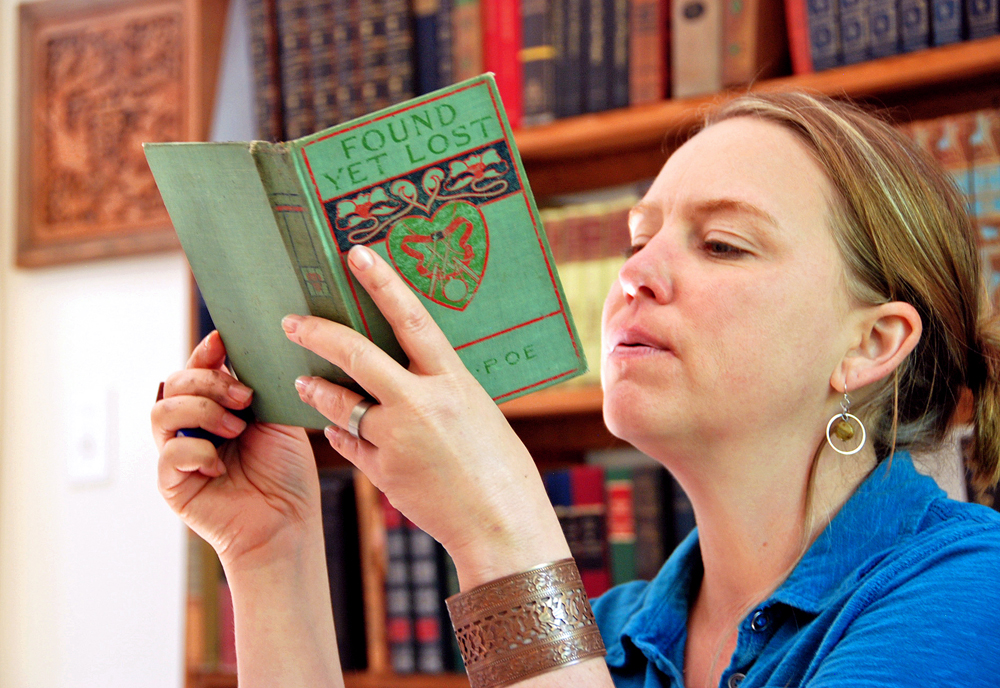
cor·re·spond·ence

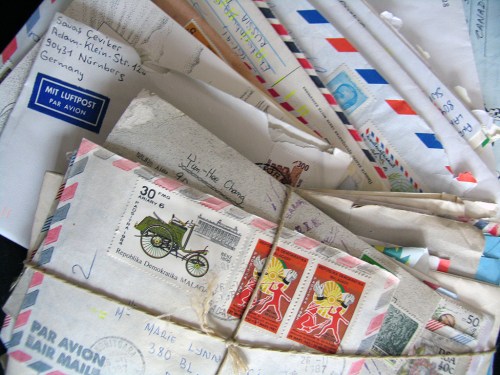
photo by Mary Lynn Richard


cor·re·spond·ence /ˌkôrəˈspändəns/  n.  1. a close similarity, connection, or equivalence. 2.  communication by exchanging letters with someone.


Note: I wrote this post on May 22, 2012 . I set it aside, thinking I would add to it and neglected it it for awhile. Posting it now, in its May form. If you don’t know of The Rumpus or Letters in the Mail, you should check both out (links below)!


What is it about letter writing that allows for such closeness and intimacy?

Last year, The Rumpus started a “Letters in the Mail” program, wherein authors would scribe letters and The Rumpus would send them to subscribers through the mail. I signed up immediately.

And then this past April, they invited subscribers to participate in “Letters to Each Other,” where subscribers would send in a letter (no more than one page, front and back) with a SASE envelope. Then their letters would be sent to six people and they would receive six letters in return.

I received my letter last Thursday, and I cannot tell you how exciting it was to open my mailbox and find that thick envelope.

I think what I love most about letters is their real vulnerability. Letters are not theoretical, they are meant to be a container for one’s thoughts and ideas, a place for truth to be relayed. Even letters between artists that involve philosophy and intellectual spiralings typically also involve a moment of doubt. These are not set in stone, they are inked on paper. In that way they are ephemeral. They are meant to be recordings of a moment. I love this too, their in-the-momentness, their sheerness, their see-through nature.

I wrote my first reply today, and what I was amazed at was not only my ability to but my desire to share intimate details of my life with someone who is an almost complete stranger. Is it the anonymity? Maybe that’s part of it, but we do know each others’ names, at least she will have mine now. I think it is also because she shared intimate details with me, ones that although differing from my experience, I could relate to, and I valued so much that emotional honesty.

Letters are drawings of our names in the sand. They reveal who we are in this precise time of being, a being that is unstable, a self that will change. They are a place that, beyond beautiful prose or constructed narrative or clarity of thought or firm declarations, simply demand honest reflection and an attempt at connection. And we all have the ability to offer that. And isn’t that at the end of the day what we most need from one another? what we most need to offer of ourselves?

Leave a comment

Filed under other words

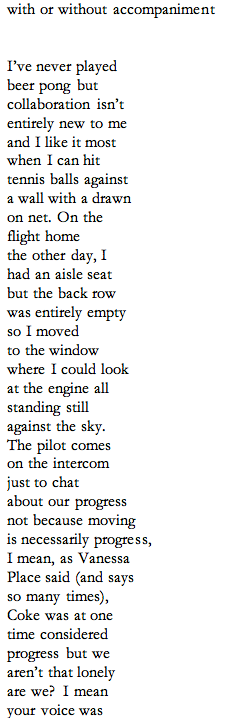
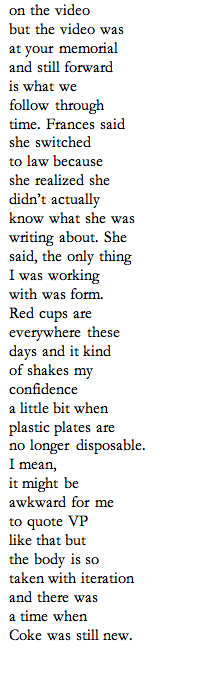
so·lo


so·lo (ˈsōlō),  n.  [ pl.  SOLOS  (-lōz); rarely SOLI (-lē)], [It.  <  L. solus, alone],  1.  a musical piece or passage to be played or sung by one person, with or without accompaniment.  2.  an airplane flight made by a pilot alone, without any passengers or instructor.  3.  any performance by one person alone.  4.  any card game in which there are no partners.  adj.  1.  arranged for or performed by a single voice or instrument.  2.  performing a solo.  3.  made or done by one person v.i. in aviation, to make a solo flight, especially one’s first.


It’s the last day of April and the last day of National Poetry Month! So today, we have our last word and last post for our first annual na·po·mo. The word is so·lo and the poet is TC Tolbert. Thanks so much for joining us.


TC Tolbert is a genderqueer, feminist poet and teacher committed to social justice.  Co-editor of the forthcoming Anthology of Trans and Genderqueer Poetry (Nightboat Books), TC is the author of two chapbooks, territories of folding (Kore Press) and spirare (Belladonna).  His first book, Gephyromania, is forthcoming from Ahsahta Press.  He is the Assistant Director of Casa Libre en la Solana, Adjunct faculty at University of Arizona and Pima Community College, and founder of Made for Flight.  www.tctolbert.com

Leave a comment

Filed under napomo

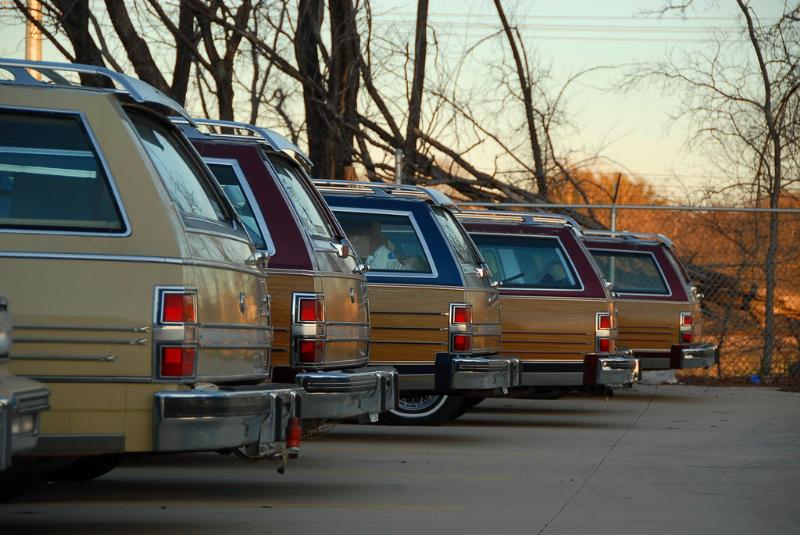
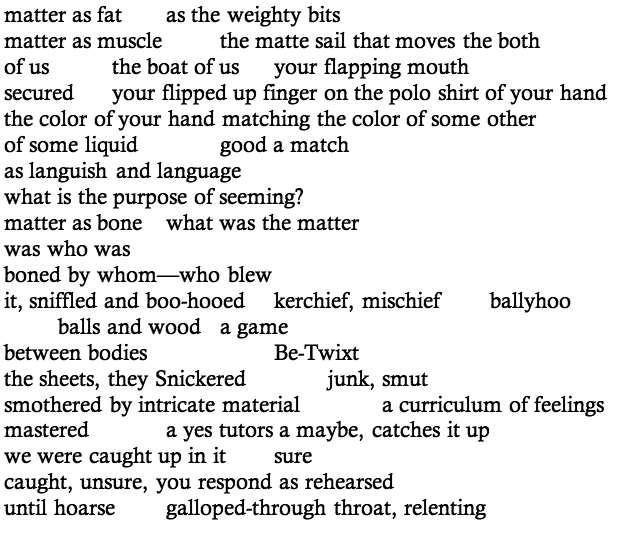
prac·ti·cal


prac·ti·cal  (ˈpraktikəl),  adj.  [obs. Fr. practique, pratique  <  LL. practicus (see PRACTICE) ;  + —al],  1.  of, exhibited in, or obtained through practice or action: as, practical knowledge: opposed ot theoretical, speculative, ideal.  2.  that can be used; workable; useful: as, practical proposals.  3.  designed for use; utilitarian: as, a practical dress.  4.  concerned with the application of knowledge to useful ends, as distinguished from speculation, etc.: as, practical science, a practical mind.  5.  given to or experienced from actual practice: as, a practical farmer.  6.  of, concerned with, or dealing efficiently with everyday activities, work, etc.  7.  that is so in practice, whether or not in theory, intention, law, etc.; virtual.  8.  matter-of-fact.


National Poetry Month is drawing to a close, but we still have a few poems from dictionary project contributors. Enjoy today’s feature, a poem by Kristi Maxwell:


Kristi Maxwell thinks and writes in Tucson, where she also teaches creative writing, literature, and composition around town and serves on the board of POG, a non-profit literary arts organization. Her books include Re– (Ahsahta Press, 2011), Hush Sessions (Saturnalia Books, 2009), and Realm Sixty-four (Ahsahta, 2008).


Leave a comment

Filed under napomo

the dictionary project author interview: Nicole Sheets

Welcome to a new addition here at the dictionary project: author interviews!

The second and fourth Wednesday of each month, we will feature non-traditional author interviews, where instead of responding to direct questions about their life or work, guest authors will discuss their relationship to words and attempt to provide answers to dictionary project words bibliomanced specifically for them.

We are so pleased to announce our first featured author is Nicole Sheets!
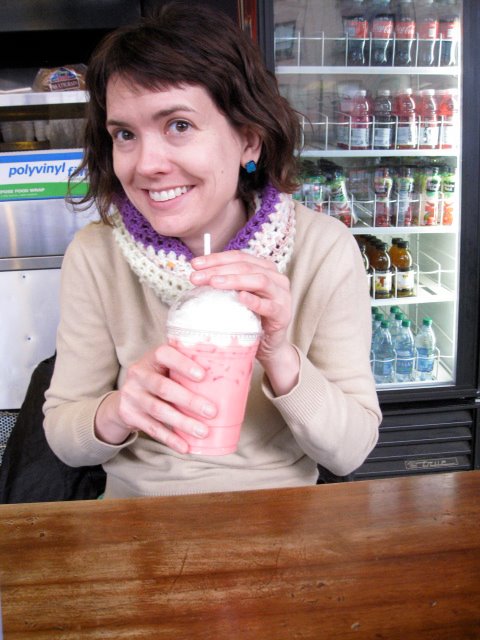


1.   Please share a memory/story/thought in relation to a dictionary/dictionaries:


When I first started graduate school, one gentleman caller mailed me a two volume compact Oxford English Dictionary, the kind with a magnifying glass in the little drawer. I discovered a Friday night game: split a bottle of red wine and the OED with a friend, and look up words as they pop into your head. Sometimes you need to swap volumes with your friend if she has the letters you need.

My OED has moved hundreds of miles with me. It sits on my floor next to one of my bookshelves, largely ignored by my cats, often commented on by dinner guests.


2.   What is your current favorite word?

“Buoyant.” I’ve been feeling pretty up lately, like an unsinkable Cheerio. In my memory of the commercial, those Os bounce to the bottom of the cereal bowl and back, through a cascade of milk.

Also, I recently learned “arctophile” when I clicked on a link at dictionary.com ( I confess that I often use an online dictionary in my office rather than the hardback Random House College Dictionary because I’m in a hurry). Isn’t it great that there’s a word for a lover and collector of teddy bears?


3.   What, in your opinion, is the most obnoxious/insidious/annoying word?

I’m cheating here because I asked some students to think about this question after reading Mary Oliver’s A Poetry Handbook. One student included “microwave” in her list, and that hit home with me. I dislike microwave’s nasal “r” that bunches up in my nose. My grandmother Hazel refers to her microwave as a “radar range,” which is a far superior name.

When I hear “microwave,” I also think of the microwave in the lunch room at my school. It’s not really a lunch room but more like an open kitchenette next to an alcove that thinks of itself as a lounge. Students and faculty microwave users are rather neighborly minded. Even so, the microwave deflates the meal experience. When you pop open the door and insert your single serve pyrex dish of last night’s stir fry, you see the ring of grease or splotches of overspill on the glass turntable and the sweat on the inside of the microwave door. On your hand you feel the moist breath from someone’s Lean Cuisine.


4.    Please respond to the following words and definitions, picked exclusively and randomly for you:


un·faith·ful  \ˌənˈfāTHfəl\ adj  1  :  not observant of vows, allegiance or duty: DISLOYAL  INACCURATE, UNTRUSTWORTHY < a ~ copy of a    document >


Last year I tried being an engaged lady. John proposed, and I thought about the proposal for three weeks. And then I called him late one afternoon to tell him I would marry him after all. I had just finished a short run on the Centennial Trail. I thought it would be romantic to say yes by a waterfall. But the rush of water was so loud that we couldn’t hear each other, so instead I said yes in the parking lot of a nearby fish restaurant. I felt buoyant. It was a feeling that lasted about three weeks.

We broke off the engagement well before the vows. Now I have a ring the man doesn’t want back (“It isn’t really the kind of thing you recycle,” he said) and a white, unworn, fitted, lace confection bagged up and hanging in the back of my closet.


-less  \ləs\  adj suffix  1 :  destitute of : not having < childless >   2  :  unable to be acted on or to act (in a specified way) dauntless


I recently turned 35, and I’ve been thinking a lot about childlessness. Last fall, I visited friends in Moscow, Idaho, who have three lovely daughters. Frankie, the three-year-old, asked “Do you have kids?”

“No,” I said. “Why?”

“Because your car has so many doors.”

“Count your blessings,” one of my favorite sing-songy hymns instructs. And I do. The number is high. I can make up many verses. Even so, I feel the –less of my childlessness. I’m not yet hopeless. I’m far from fearless.


ex li·bris  \eks-ˈlē-brəs, -ˌbrēs\  [L]  :  from the books of  —  used on bookplates 


At the Huntington Mall, a habitat of my youth, I spent more time looking at stationery than at books at a bookstore. I would spend at least a couple of hours at the mall every Thursday with Hazel, my grandmother, after she picked me up from my piano lesson. We’d have dinner at the food court or at Morrison’s Cafeteria and be back at her house in time for The Cosby Show. In that era, there were two bookstores in the mall, Waldenbooks and Coles. Coles’ logo and storefront were yellow, and the white floor glared at the fluorescent overhead lights. I browsed the day-by-day calendars and fingered the tassel fringe of the circular racks of laminated bookmarks and bookplates with ex libris printed in scratchy calligraphy.


2branch  \ˈbranch\  vb  1 :  to develop branches  2 :  DIVERGE  3 :  to extend activities: <the business is ~ing out>


On the wall of my grandparents’ kitchen hung a small wooden tree. Its outline was rounded, cartoonish. The texture of the tree was green with small pale dots, and each member of the family had their name printed on an orange, wooden button. Nana and Grandaddy rested in the top branches. My dad, mom, and me down the right edge, and my dad’s sister, my uncle, and my cousins Melissa and Allison took up a fuller bough because there were more of them. Allison’s button was a slightly different shade of orange, suggesting that the tree was a gift before Allie was born. This was a few years before my brother was born and even more years before Allie died the summer after high school graduation.

The living orange buttons haven’t been together since Nana’s funeral. My remaining cousin branched out, got married, had two kids. The family branches stretch so far apart, we might as well be in separate trees. There’s no neat break from an axe’s clean tooth. Just a rot, slow and silent.


poor \ˈpür, ˈpȯr\  adj   1 :  lacking material possessions <~ people>  2 :  less than adequate : MEAGER <a ~ crop>  3 :  arousing pity <you ~ thing>  4 :  inferior in quality or value  5 :  UNPRODUCTIVE, BARREN <~ soil>  6 :  fairly unsatisfactory <~ prospects>; also : UNFAVORABLE <~ opinion> — poor·ly adv


I accidentally misquoted the Bible in a fellowship application, but, reader, I still got the money. When I was a kid, I memorized Bible verses for church all the time, inscribing them on my heart etc. For this fellowship, I was thinking about the word inheritance, and I rewrote the Bible so that it’s the poor who inherit the earth (in fact, it’s the meek. Consolation: “Blessed are the poor in spirit, for theirs is the kingdom of heaven”). I was so sure in my rewrite that I didn’t even look it up to see if I was correct. I guess the fellowship committee liked my version, too.

I’m surprised when Mother Teresa, who lived among the poorest of the poor in Calcutta, expressed compassion for the West. When she accepted her Nobel Peace Prize in 1979, Mother Teresa remarked that in her visit to a nursing home, the residents had material comforts but no one to visit them. Loneliness, lack of love, these are real poverty, Mother Teresa insisted. “I want you to find the poor here, right in your own home first,” she said, “And begin love there.”


 Nicole Sheets teaches and writes in Spokane, Washington. Her work has recently appeared or is forthcoming in Image, Hotel Amerika, Cream City Review, and DIAGRAM. As WanderChic, Nicole blogs about travel and style for Wanderlust & Lipstick. She can be reached by email at nsheets@whitworth.edu.
3 Comments

Filed under author interviews

pe·nol·o·gy


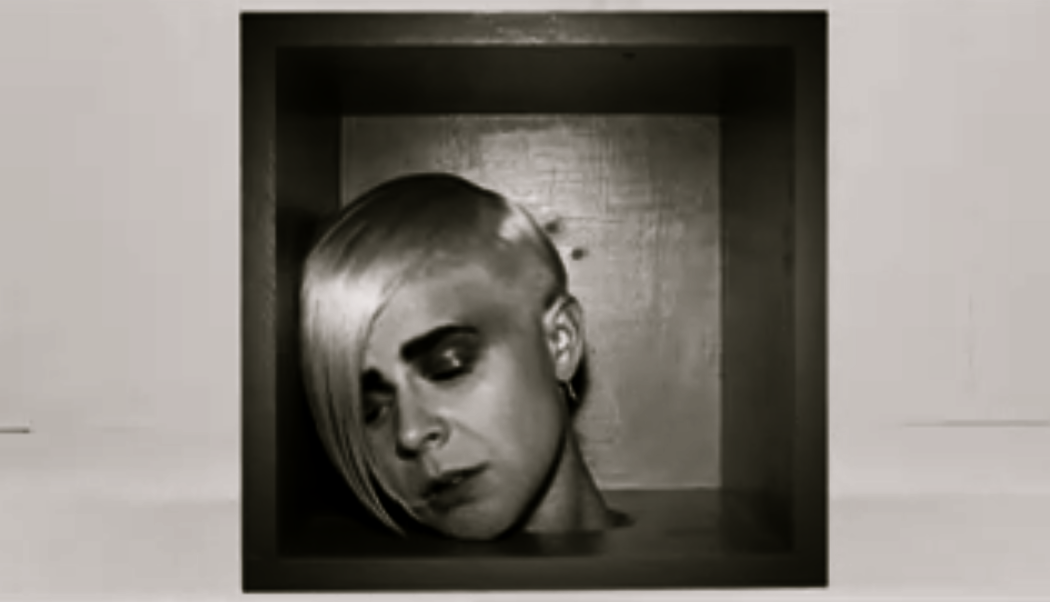
Robyn, from "Handle Me"


pe·nol·o·gy  /pēˈnäləjē/  n. the study of the punishment of crime and of prison management.  mid 19th cent.: from Latin poena ‘penalty’ + -LOGY. –pe·nol·o·gi·cal  /pē-nə-ˈlä-ji-kəl/ adj. pe·nol·o·gist /jist/  n.


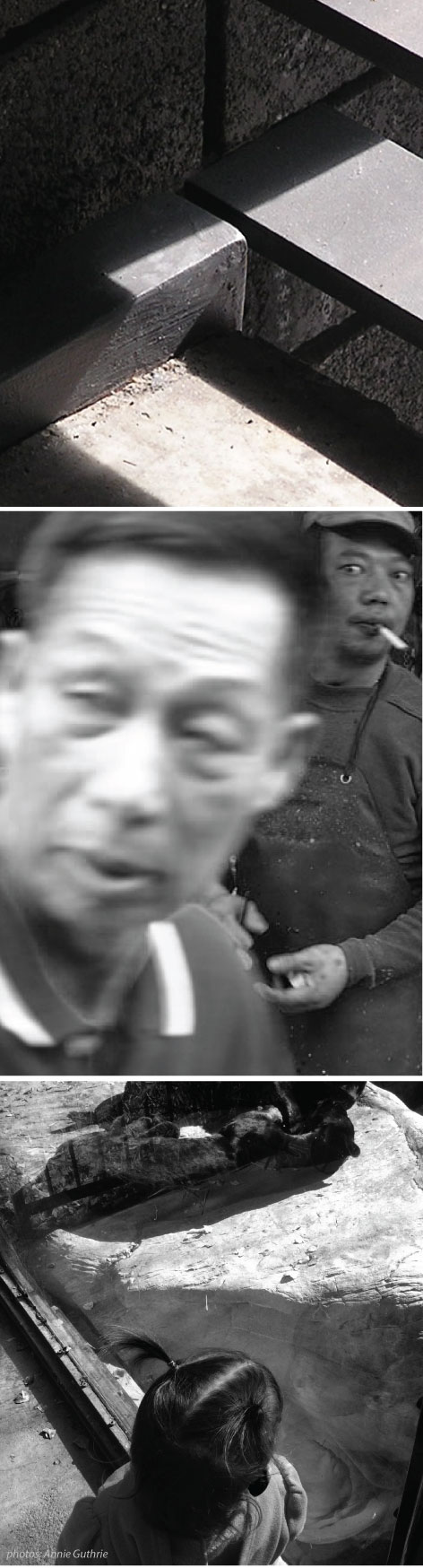
Writer Annie Guthrie joins us for our first annual na·po·mo. Enjoy her poem and photos:


*

make a box
a social judicial legislative executive box
a thought box
what kind of time does it keep
bodybox time  you feel
yes what did the mothers do
I always study yourself
you are the box. make you the box box fist
im going to punch me first
im going to wall my own wall with a wallbox!
make it box make it do
what kind of keeping does it do
heritage box lineage box legacy box
are you the archon who traces
my fistbox punches ?
yes attention is valuable
is studying humane
that’s why you can’t find it?
it is hoped
navigational way points fix whatbox
your ownself atbox
fear it keeper it do keep
trespassing the natural
I have I have not I had I had not I do have I do not have
I do I did I was I were I were not I am I am not
I where I am I where I am not I am not where
whatbox stay right there where you arebox
I can still put my hands in my pocket
it’s no longer in your hands
wouldn’t you wear gloves for that
yes


Annie Guthrie is a writer and jeweler living in Tucson. She works and teaches at the UA Poetry Center. She has work published in Tarpaulin Sky, Ploughshares, Fairy Tale Review, HNGMAN, The Destroyer, RealPoetik, Everyday Genius, Omniverse, The Volta, Spial Orb and more.

Leave a comment

Filed under napomo

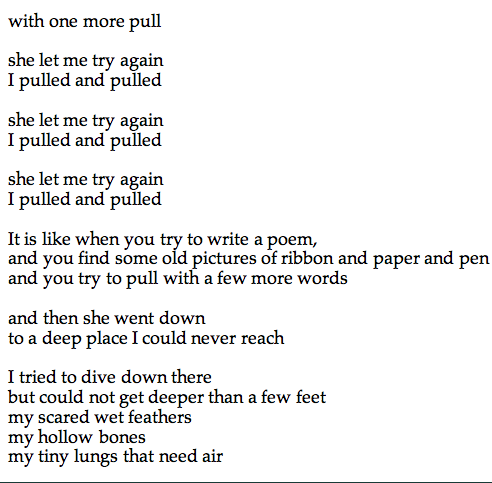
fly·ing boat


fly·ing boat, an airplane with a hull that permits it to land on and take off from water: see TYPES OF AIRPLANE, p. 32


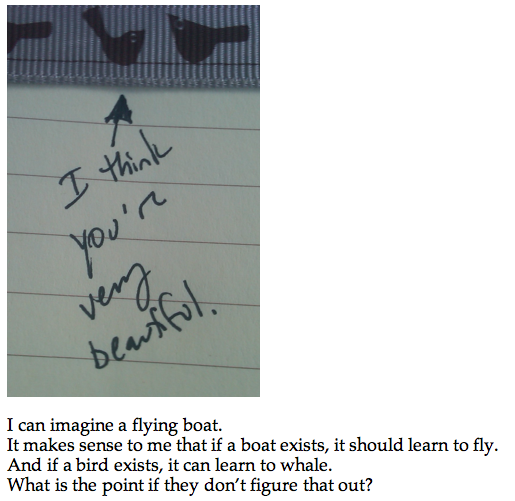
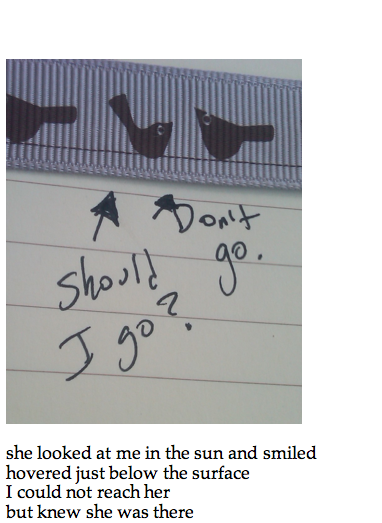
For the second time in two weeks and in the history of  the dictionary project, when I closed my eyes and ran my finger through the pages of the dictionary, I landed on an image. This time, the image was of a flying boat, a vessel made for both air and water, from a page covered in illustrations of airplanes. Enjoy Kristen Nelson’s text & image poem for the next installment of na·po·mo.


Kristen E. Nelson is the author of Write, Dad (Unthinkable Creatures Press, 2012). Her recent work can be found in Tarpaulin Sky, Trickhouse, Cranky Literary Journal, In Posse Review, Dinosaur Bees, Everyday Genius, GlitterTongue, and Spiral Orb. She is a founder and the Executive Director of Casa Libre en la Solana; an editor/curator for Trickhouse; a production editor for Tarpaulin Sky Press; and a writing teacher. She earned her MFA in creative writing from Goddard College.

Photo credit: Sarah Dalby


2 Comments

Filed under napomo

drows·i·ly


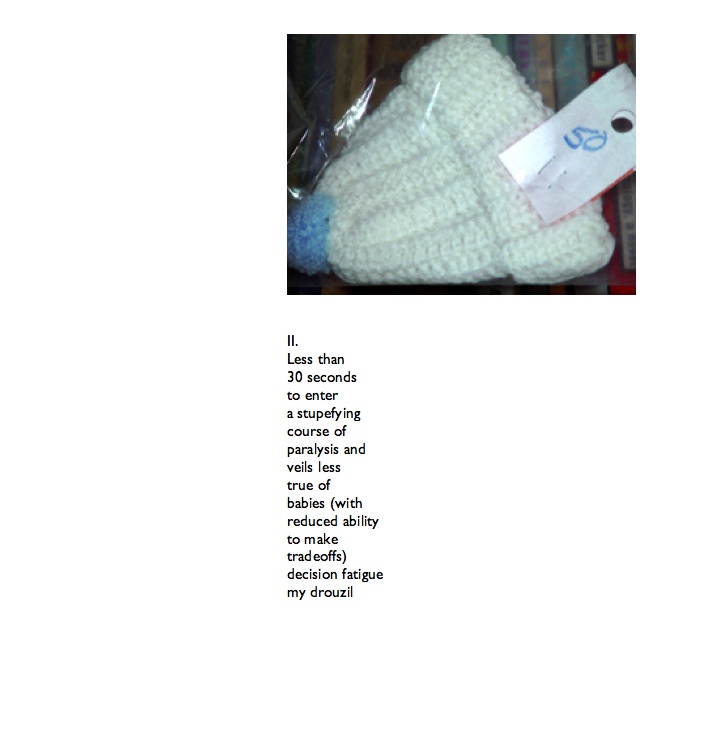
drows·i·ly  (drou’z’l-i)  adv.  in a drowsy manner, sleepily

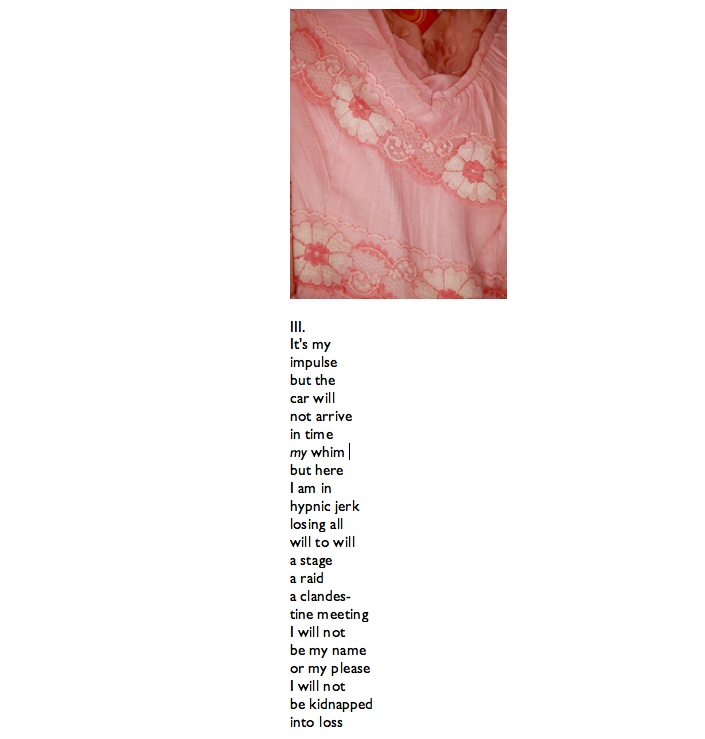
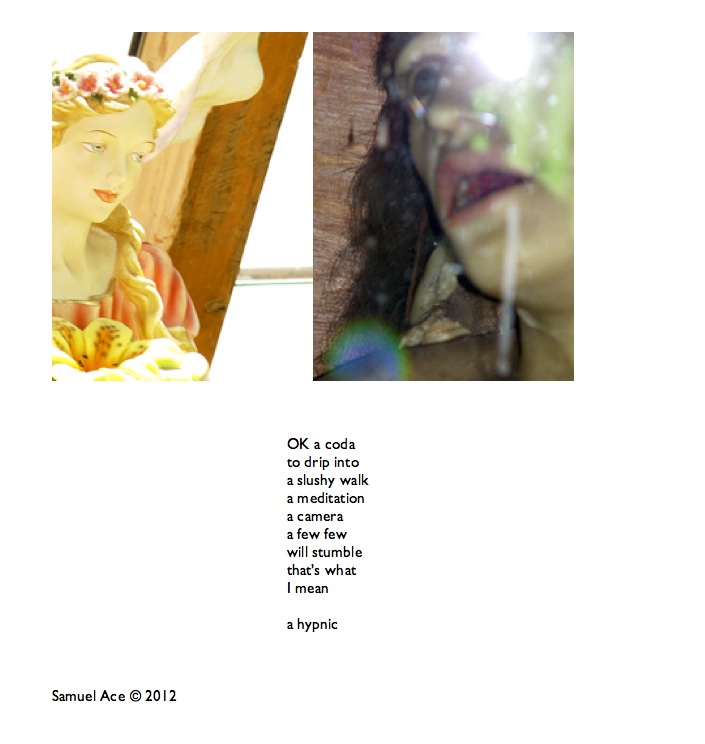
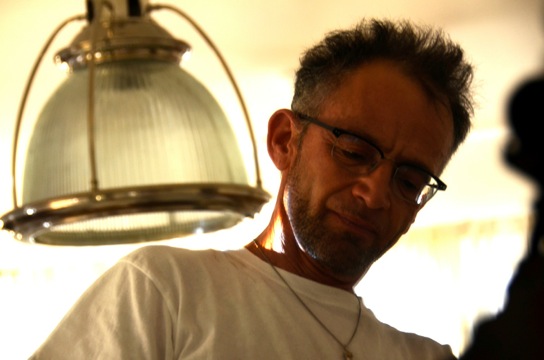
Samuel Ace joins us with his rendition of drows·i·ly for na·po·mo at the dictionary project. Enjoy the dreamscape, the space in between.


Samuel Ace is the author of three collections of poetry: Normal Sex (Firebrand Books), Home in three days. Don’t wash., a hybrid project of poetry, video and photography (Hard Press), and most recently Stealth, co-authored with Maureen Seaton (Chax Press). He is a recipient of a New York Foundation for the Arts grant, two-time finalist for a Lambda Literary Award in Poetry, winner of the Astraea Lesbian Writer’s Fund Prize in Poetry, The Katherine Anne Porter Prize for Fiction and the Firecracker Alternative Book Award in Poetry. His work has been widely anthologized and has appeared in or is forthcoming from, Ploughshares, Eoagh, Spiral Orb, Nimrod, The Prose Poem: an International Journal, Kenyon Review, van Gogh’s Ear, 3:am, and others. He lives in Tucson, AZ and Truth or Consequences, NM.


In their jammies (clockwise from top left): Trudy, Pete, and Don from Mad Men; Lana Turner; The Von Trapp Family; and Models from 1957 (photo by Nina Leen)

Leave a comment

Filed under napomo

con·stel·la·tion


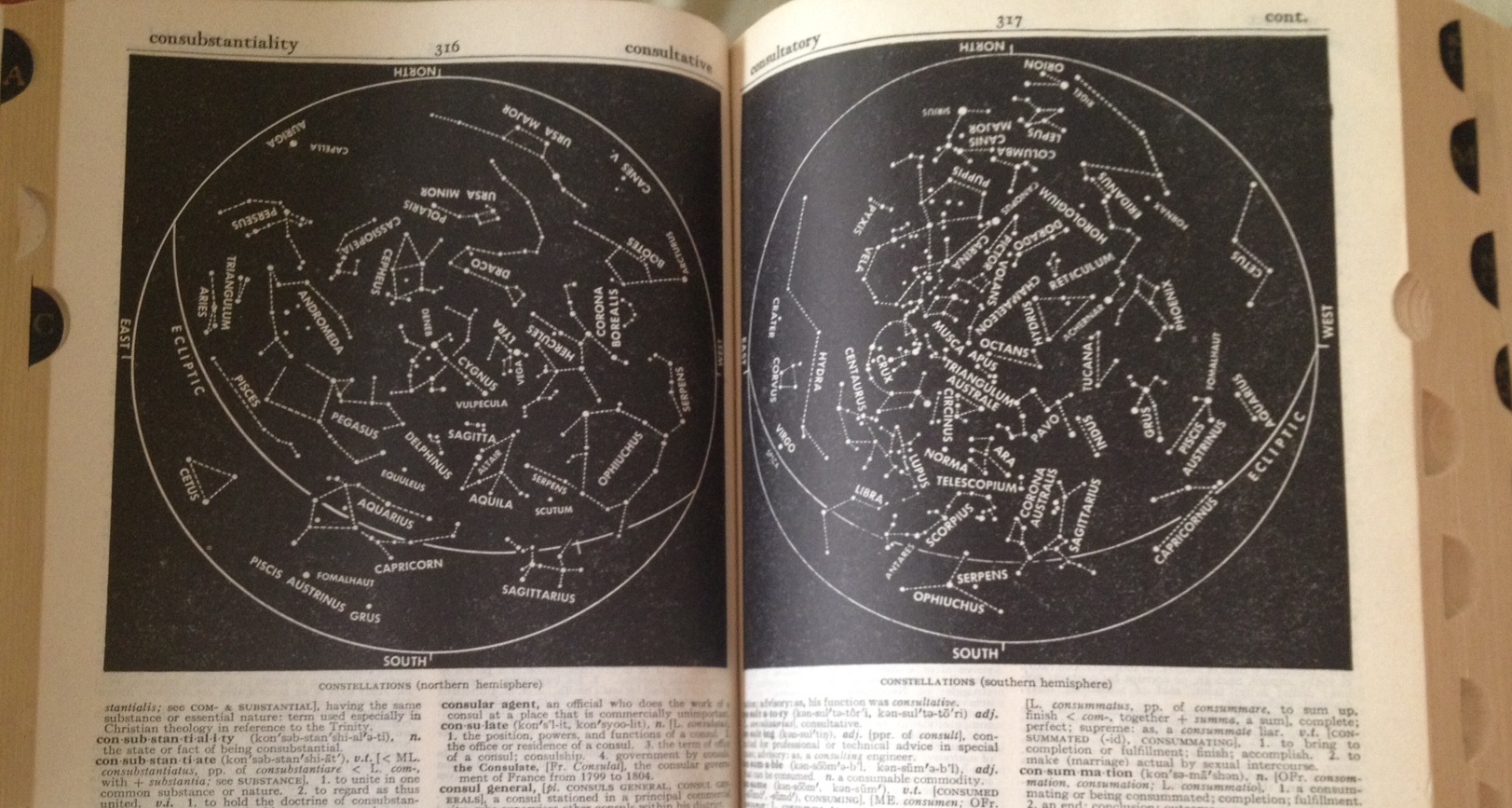
con·stel·la·tion  (känstəˈlāSHən),  n.  [ME. & OFr.  constellacion;  LL.  constellatio < constellatus, set with stars < L. com-, with + pp. of stellare, to shine < stella, a star; see STELLAR]  1.  a number of fixed stars arbitrarily considered as a group, usually named after some mythological being that they supposedly resemble in outline: see charts on following pages.  2.  the part of the heavens occupied by such a group.  3.  any brilliant cluster or gathering: as, a constellation of beautiful women.  4.  in astrology, a) the grouping of the planets at any particular time, especially at a person’s birth. b) one’s disposition or fate as supposedly influenced by such a grouping.  5.  in psychology, a group of related thoughts regarded as clustered about one central idea.

Editor’s note: For the first time in the dictionary project history, when closing my eyes and flipping through the dictionary, I landed on an image instead of a word. An image of the constellations in the sky. Closest to Libra, in case you are curious. The word for this post is con·stel·la·tion as a result.

For the third word of na·po·mo at the dictionary project, Lauren Eggert-Crowe joins us, contemplating the cosmos.


Lauren Eggert-Crowe was born and raised in rural Pensylvania. After a four year stint in the magical fairyland of Santa Cruz, where she lived so close to the ocean she could hear sea lions from her bedroom window, she relocated to Los Angeles to work as a freelance writer. She has written for The Rumpus, L.A. Review of Books, The Murky Fringe, and Blue Jean Gourmet. Her poetry has been published in several journals, including Puerto Del Sol, So To Speak, DIAGRAM, Terrain.org, Water-Stone Review, Eleven Eleven, and We Are So Happy To Know Something. Her first chapbook, The Exhibit, is forthcoming from Hyacinth Girl Press in January 2013. She is also the author of the literary feminist ‘zine, Galatea’s Pants. She holds an English degree from the Robert E. Cook Honors College at Indiana University of Pennsylvania, and an MFA in Creative Writing from The University of Arizona.

Leave a comment

Filed under napomo

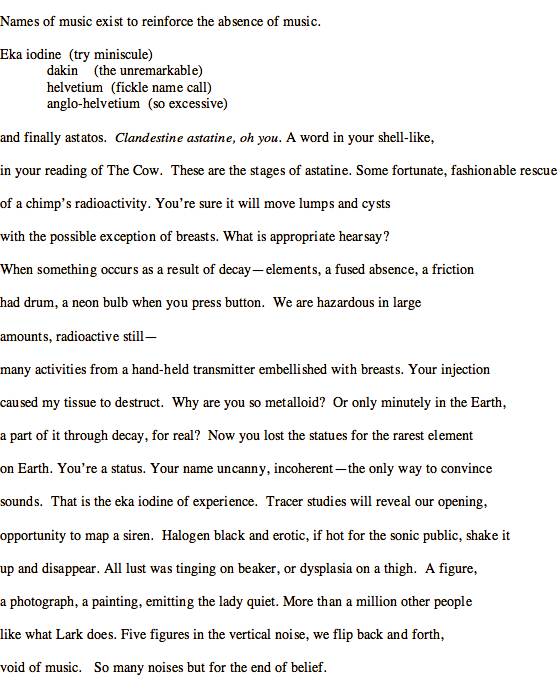
as·ta·tine

as·ta·tine  (ˈastəˌtēn),  n.  [ < Gr. Astatos, ustable; + ine], an unstable chemical element formed from bismuth when it is bombarded by alpha particles; symbol. At; at. wt., 211 (?); at. no., .85 (formerly designated as alabamine).
 
It’s the second word of na·po·mo at the dictionary project. Enjoy the writing of poet Meagan Lehr!

 
AS·TA·TINE


Meagan Lehr’s work can be found at Arch Literary Journal, and Mary: A Journal of New Writing. She currently teaches writing at The University of Arizona, and is managing editor for The Destroyer, an online publication of art, text, and the public rant. Her book Men in Correspondence is forthcoming from Jackleg Press.

Leave a comment

Filed under napomo

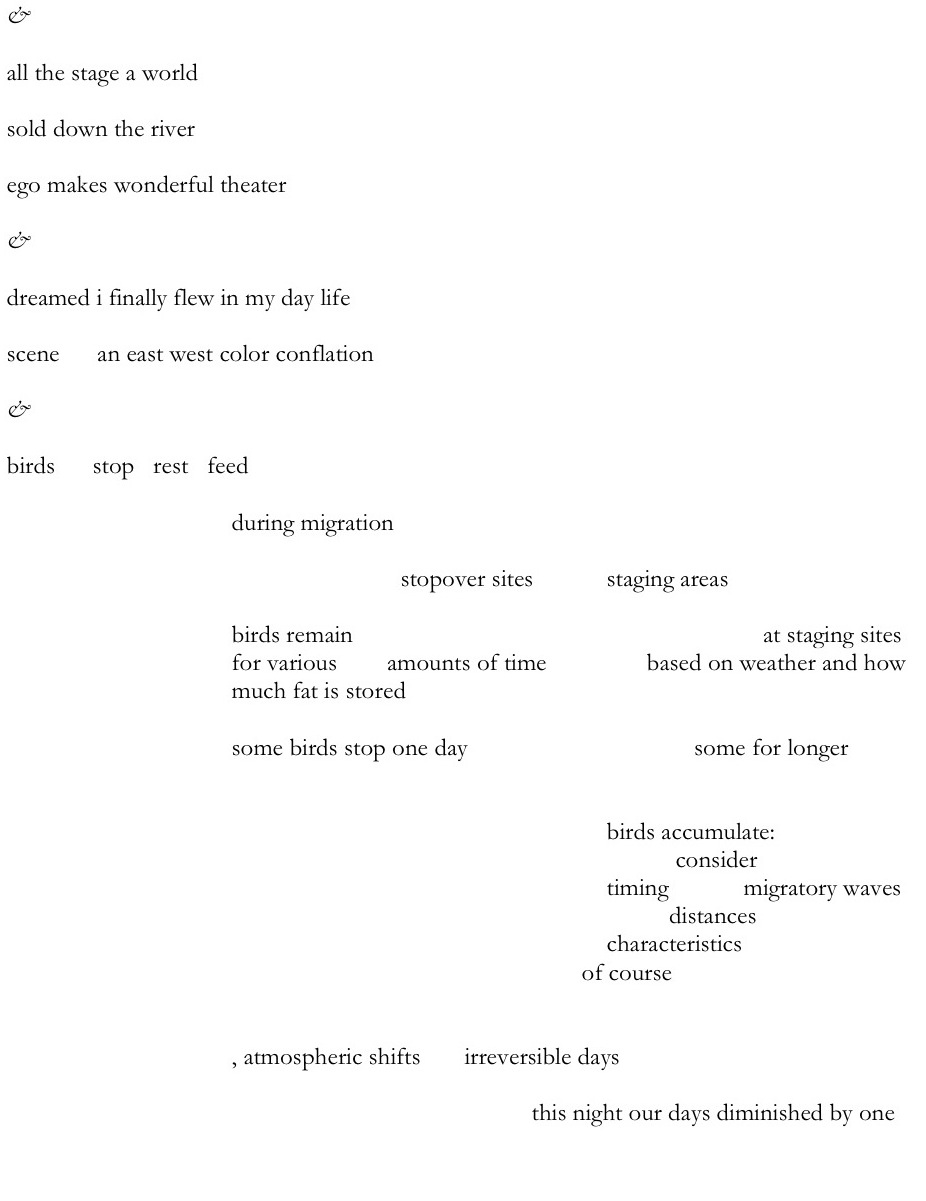
stag·ing

by Clay Connally


stag·ing (ˈstājiNG),  n.   1.   a temporary structure used for support; scaffolding.   2.   the business of operating stagecoaches.   3.   travel by stagecoach.   4.   the act or process of presenting a play on the stage.
 
 
The first word for napomo! at the dictionary project is stag·ing. And our first poet is the wonderful Deborah Poe. Enjoy:


Notes: Cornell Ornithology Lab’s Bird Migration Teacher’s Resource Guide, prepared by Carolyn Sedgewick; Mark Twain for “a cradle on wheels;” Kerry Scanlan, Vicki Piaskowski, Michelle Jacobi and Steve Mahler, Zoological Society of Milwaukee for “Bird Migration Facts;” Mečislovas Žalakevičius for “Global Environmental Change and Vulnerability of Ecosystems: From Local to Regional to Global Scales;” Selah Saterstrom for “Beautiful women are haunted houses,The Pink Institution (Coffee House Press 2004); Zen Evening Gata for the last line.


Deborah Poe is author of the poetry collections Elements (Stockport Flats Press 2010), Our Parenthetical Ontology (CustomWords 2008), and “the last will be stone, too,” as well as a novella in verse, “Hélène” (Furniture Press 2012). Her poetry is forthcoming or has recently appeared in Shampoo, Denver Quarterly, Yew Journal, Mantis, Horse Less Review, Bone Bouquet, PEEP/SHOW, and Open Letters Monthly. Please visit deborahpoe.com for more information. (Photo by Elizabeth Bryant)

1 Comment

Filed under napomo