en·force


en·force (enˈfôrs), v.t.  [ENFORCED, ENFORCING], [ME, enforcen;  OFr. enforcer, enforcier; LL. Infortiare < L. in, in + fortis, strong], 1. to give force to; urge: as, he enforced his argument by analogies. 2. to force; compel. 3. to impose by force as, don’t enforce your will on the child. 4. to compel observance (of a law, etc.).

For enforce, the third word of flash fiction february, we have guest flash fiction pieces by writers Beth Alvarado and Julia Gordon (respectively). Read on and enjoy.


And maybe you were told not to raise your voice, as in don’t raise your voice to me, young lady. You were sitting in the classroom looking out the basement window.  You could see the shoes and pants and bare legs of others walking by on their way to lunch.  You could smell them sneaking cigarettes and the smoke smelled a little like grilled cheese sandwiches and made you hungry.  Don’t tell me you wrote this yourself, and she handed you the sheet of notebook paper with an F circled in red at the top.  Her fingernails were also red.  And maybe you thought red, the color of shame, as in the Scarlet Letter, you supposed, that made sense, but it wasn’t your shame. You crumpled up the piece of paper with the red F and then left it behind in the wastebasket.  You walked out of the room.  There, you thought, keep it, the evidence of your own small mind.

Maybe later you were told you didn’t have a voice, as in this writing is too feminine, too flowery, it will never have any power. You were sitting in his small office in the university, again in a basement.  You were wearing a yellow dress, you were barefoot because it was the 1970’s, and he was smoking, his fingers stained with nicotine, which is another kind of yellow. There is, you thought, no evidence, and so you went home and wrote about yellow, which is when you remembered fear:  the older neighbor boy:  the round aluminum trailer.  You were six, then, when he tried to undress you and fear flooded up from your gut into your mind, making you lightheaded.  But what you remember most is rising up out of your body and speaking, the slap of the trailer door as you left that place behind.

Much later, when you were a mother, you wanted your daughter’s voice to rise up out of her body.  When she was an infant and you held her over your shoulder, walking her up and down the hall, your bare feet on the cold tile floor, her body warm and damp from sleep, you sang to her and she sang back, a breathy humming in your ear. When she was in kindergarten, you bought her a red dress with tiny yellow giraffes; she wore it with her brother’s old cowboy boots.  She put too many barrettes in her hair.  When strangers talked to her, she hid behind you.  She is shy, you explained, but it seemed wrong, as if to blame her for their transgression, and so you learned to say what felt more true: she has been taught not to speak to strangers.  Still, you wanted her to find her own voice, you did, and so when she grew up, as daughters do, and wanted to kiss boys and to talk back to you, you had to listen, just listen, even when the words were knocking around in your own chest and catching in your throat.


Beth Alvarado’s Anthropologies, A Family Memoir, is part of the Sightline Series in Literary Nonfiction from the University of Iowa Press (2011).  Her story collection, Not a Matter of Love, won the Many Voices Prize, which honors work that has “a strong sense of place and speaks to our troubled times with empathy and aesthetic courage.”  Other recent work has appeared in Nimrod, Sonora Review, and Western Humanities Review. She is the fiction editor of Cutthroat: A Journal of the Arts and teaches at the University of Arizona.


Hug, Hug


Once, Lara had the most awkward hug in the world.  Other people have had awkward hugs.  You have had awkward hugs.  Surely Lara’s awkward hug wasn’t the most awkward hug in the world.  But it was.  Lara’s hug was with Kevin, who found the hug to be uncomfortable too, even if he didn’t think, at the time, that it was the most awkward hug in the world (which it was). Later he would realize it was, but he would not wonder why.  It was just one of those things.  Many things were just one of those things.

Lara wondered why.  Lara wondered how, of all the hugs in the world, did she manage to have the most awkward one? Lara thought and thought about that hug. She wondered if it was because the hug was on the corner, and there were people watching, but Lara had had lots of corner-hugs and none of them were the most awkward hug in the world – except her corner hug with Kevin. She wondered if it was because Kevin’s elbow had touched the side of her breast at the start of the hug, but Lara had had that happen many times before, ever since she got breasts, and none of those breast-touch hugs were the most awkward hug in the world – except her breast-touch hug with Kevin.  She wondered if it was because she had a belly full of food, but that wasn’t it, either.

It was not the most awkward hug because she had two drinks.

It was not because it was 2 o’clock in the afternoon.

It was not because it did not end in a kiss.

It was not because it was Wednesday.

It was not because her hat was ugly.

It was not because her thumbs ached.

Lara started to wonder if it was the most awkward hug in the world because of a person in the hug. Lara started to wonder if it was because Kevin was in the hug.  Lara thought that might be it.  She started to wonder why that would be. Kevin was the man who said “sit, sit,” and Lara sat. Kevin was the man who said “write, write,” and Lara wrote.  Kevin was the man who said “drink, drink,” and Lara drank. Kevin was the man who said “suck, suck” and Lara sucked. Kevin was the man who said “snort, snort” and Lara snorted. Kevin was the man who said “cry, cry” and Lara cried.  But Lara was the one who said “hug, hug.” And that was why.


Julia R. Gordon is a writer with over ten years of experience in the non-profit sector as well as a background in government and political media, fundraising, and message development. Since 1998 she has worked as a writing consultant; currently Julia works at the University of Arizona and Raise the Bar LLC, and serves on the Board of Directors for Casa Libre en la Solana, a Tucson, AZ-based literary arts organization. She also writes for The Skein, an online blog she created to explore politics, government, society, and interpersonal relationships through language and the written word. Julia was born and raised in downstate New York, and made her home in Brooklyn for a decade, prior to relocating to Tucson in 2009.  She is a graduate of Cornell University.

Leave a comment

Filed under flash fiction february

schiz·o·phre·ni·a

cells in dish replicate schizophrenic brain


schiz·o·phre·ni·a (skitsəˈfrēnēə), n. [Mod. L. < schizo- + Gr. Phren, the mind] a mental disorder characterized by indifference, withdrawal, hallucinations, and delusions of persecution and omnipotence, often with unimpaired intelligence: a more inclusive term than demtnia praecox, avoiding the implications of age and deterioration.

For the second word this flash fiction february, we are honored to have pieces authored by two writers: Elizabeth Frankie Rollins (first) and Rebecca Iosca (second).


(In French, “aliéné” Means Mad)

Eloise couldn’t say.  The teachers asked.  The classrooms felt immense.  The teachers and the students seemed like giants moving around her.  In her French class, Eloise stared at a worksheet in front of her and the accents on the words looked like eyebrows.  She couldn’t read one French word, although she knew she used to be able to read some of them.  Now they looked like simple black marks.  She could barely fit the French words the teacher spoke into her head.  They were too big.  She wanted to put her hands over her ears, but she didn’t.  This would make them ask her more questions.

She didn’t want to think about it.

At lunch, she received her tray of macaroni, red jello square, and paper milk container, but she couldn’t remember where she usually sat.  She chose a table with girls.  As soon as she sat, as soon as they began ignoring her, she remembered that this wasn’t her usual table.  She’d only been gone a couple of weeks, but couldn’t remember things.  Even the air felt too big.  It hurt her ears.

There had been a lot of screaming.  But no, she didn’t want to think about it.

In science, they stood over plastic tubes and looked at liquids.  Her paper, where she was supposed to fill in the blanks with numbers, remained blank.  She didn’t even look at other students’ papers to fill hers in.  She stood at the table and stared at what they did, but she couldn’t put anything in the white blanks on her paper.

There had been a lot of messes. She hadn’t cleaned them up.  No one had.  Everything got sticky.

The Vice Principal came to check on her in the homeroom at the end of the day.  The Vice Principal’s first name was Barbara.  Eloise read this on the nametag, but she couldn’t pay attention to the last name.  Barbara the Vice Principal crouched in front of Eloise and spoke.  Her breath smelled like coffee and bologna.  Eloise was sick of breath.

There had been a lot of strong breath: whiskey breath, wine breath, stale breath, weeping breath, smoking breath, screaming breath.

Barbara the Vice Principal said something about Eloise’s mother.   Eloise stared at her.  She felt the air swallow her up, as if she was shrinking, as if her head was folding down on itself.  She stared at Barbara the Vice Principal, who said, “I can understand if you aren’t ready to talk about your mother yet, but I want you to know if you want to talk about it with me, any time, you can.”

There had been a lot of talk about things Eloise didn’t understand.  Real estate, avocado growers, pantyhose, poisoned water, why people should learn French, why no one should have telephones, what good girls did, who was a really great singer, and people out to get you.

When Barbara the Vice Principal asked, “Eloise, are you listening?”  Eloise couldn’t say.

The dinner table at the Gershens was set with plastic tablemats picturing strawberries with legs.  Folded paper napkins sat on the mats, and forks and knives on top of the napkins.  It was only Eloise and Mr. Gershen and Mrs. Gershen at the table.  They didn’t have children. There was meatloaf and orange macaroni and cheese and a very big piece of broccoli on Eloise’s plate. Eloise ate some of everything. She knew that you had to plan meatloaf.  You had to cook it in the oven.  She knew it wasn’t easy, she knew that cooking wasn’t easy.  She understood that some things weren’t easy and you shouldn’t ask for them.  But she hadn’t asked for this and she liked it.

There had been food, but usually it was “craving” food.  Craving food came in greasy paper wrappers or sticky sweet cellophane.  In cardboard boxes or styrofoam bowls.  If you didn’t eat it fast, you weren’t really craving it, and you shouldn’t take it from the people who were craving it.

There had been a lot of smoking and the ashtrays got really full and spilled onto the table or counter.  There were a lot of ashes on the floor, too, from cigarettes being waved around.  Eloise washed her feet sometimes, when they turned black on the bottoms.

There had been crying and apologies and yelling and then the longest silence.  It was the longest silence that sent Eloise to the neighbors and then the police came, and an ambulance, and Eloise had not even gotten to say “good morning,” or “good bye” and now she was living at the Gershens and she’d gone back to school as if nothing had happened but everything had happened and she hadn’t even said “good bye” and now she had to go to French class where nothing made any sense at all, though everyone else pretended like it did.

Eloise took the clean dishtowel with smiling kettles and teacups and wiped the plates that Mrs. Gershen handed her.  She wiped them dry, around and around and around.  Mrs. Gershen took them from her and placed them neatly in the cabinet.  Click. Click.

Mrs. Gershen turned and looked down at her and said that there had been a call from the hospital where they were keeping her mother for observation, but Eloise had not even said “good morning” or “good bye,” so she stared hard at the framed needlepoint on the wall which said Gershen in fancy letters, circled by mice and cheese and mustard pots.   The mustard pots were white with red stripes around the rims.  She nodded when Mrs. Gershen stopped talking and handed back the kettle towel.

When Mrs. Gershen asked, “Eloise, we all want to help you, you know that, don’t you?”  Eloise couldn’t say.


Elizabeth Frankie Rollins has published work in Conjunctions, Green Mountains Review, Trickhouse, The New England Review, and The Cincinnati Review, among others.  An excerpt from her novel, Origin, will soon appear in Drunken Boat. Author of The Sin Eater, Corvid Press, she’s previously received a New Jersey Prose Fellowship and a Special Mention in the Pushcart Prize Anthology. She teaches writing at Pima Community College and the University of Arizona Poetry Center.  Installments of Origin and short fiction can be found here:  www.madamekaramazov.com


cells in dish replicate schizophrenic brain


Rosemary, in LA I became you. Some memory of the way you rode the bus away from home, from your father really, who scared you so badly you hid under the table. The first time they thought something was wrong it wasn’t because you were scared (they both knew he could be scary even though they never admitted it to you), but because you were meowing, quietly at first and then with more feeling, crouched under the table.  You were twelve. Did he tell you then to become an actress because you were being so dramatic?  I don’t know if he ever hit you, but I know you tried to snap a woman’s neck once and almost succeeded.  You walked like you were still 300 pounds, but you’d lost weight and all of your teeth.  Or maybe it’s more true to say that when you’d lost most of them, the rest were pulled. It was the only service covered by your dental plan by then.

No wonder you were angry.  The side effects of how you had to live would be enough to make me angry, but to think directly of the main axes of truth in your life. Or if not truth, some version of mundane reality.  Locked up in a building that smelled of far-gone yesterdays and surrounded by paint shades too dark to catch the little northwestern light that landed in your room.  The one chair out on the smoke-porch that was the only one you understood. You got in fights about it because nobody could understand you having a chair that was the only one you understood. Your mother sent you things you might need at logical intervals, but there were no cards, no little gifts, no Christmas presents even though you still counted down the days gleefully every year. What you called “giving birth,” the rest of the world called “having an accident in the middle of the night.” Your baby, then, a yellow stain that no one wanted to manage.  In the morning after so many of my arrivals, plastic gloves, biohazard bags, and a trip to the laundry room. But not after you told me her name. It was usually the same each time: “little glow.” Years later, I learn of the Spanish phrase “to give a light” for birth, and I think of the landscapes you won’t ever see.

By the time you were 18, you’d hopped a bus to Hollywood, but your chart said nothing else.  You spoke of acting, and I can imagine a time when catching a break in Hollywood seemed plausible or at least possible.  I would have believed you were a model. In your face, a deep beauty and in your movements an unswerving confidence.  But you told me you were on that cruise the year before I met you, when you had already lost your teeth, already lost so much more than your teeth.  You looked so happy recounting the places you’d visited, and I wondered then about whether it wasn’t something of a blessing to remember a history that is not your own. A kind of imagination-in-reverse function. If your days are spent smoking cigarettes until your fingers yellow and finding your only real comfort is a stuffed horse who sits on your narrow bed in your narrow, urine-soaked room, how obliging of your mind to take you on a cruise, show you the beauty of the world, reflect your beauty to you in the eyes of off-stage admirers? How obliging of your mind to give you a baby every morning instead of a mess to clean up and the knowledge that your body is past being able to carry one.

I was not in Hollywood, but in LA I saw trees like prehistoric towers lining the streets and watched a film in 3-D about Pina Bausch.  In the theater I became you, for a moment, seeing the world in front of me in blurry multiple, edge over edge, until I put on glasses that made the multiplicity three-dimensional and single. I want to say singular, and it was that too.  I felt, suddenly, your frustration at trying to explain that the world is round and alive and moving quickly toward you when everyone else could see only blurry flatness taken for the extent of what was there to be seen. It’s a wonder you never gave up trying to explain what was there for you, in stereo, in stereoscopic 3-D, as we unfocused our vision, trying to make the world as we knew it more clear or at least contiguous.  And who would have believed you anyway, if you’d somehow managed to fashion paper spectacles with blue and red lenses, and shouted triumphantly that finally we might see your reality?  You probably would have been written up, the glasses discarded as a quaint craft project or some other artifact of delusion.

When people say “schizophrenic,” so often what is heard is “split,” “broken,” or “out of touch with reality.” Your diagnosis was based on the concept of emotions split from thought, but who can say what emotions are called for anyway, or who is more colonized by perplexing delusions than anyone else?  And who is to say what of reality there is to touch, and what edges, what whole planes in fact, we might be missing in our smug perceptions?  Can empiricism explain the way you spoke of my father, but never my mother, except to say, at times, that you were my mother?  Can scientific inquiry measure the chances that of all the names you could have taken on once you were sent away to the state hospital, you chose my mother’s and called for me like I was your daughter?


Rebecca Iosca feels grateful to have become friends with Lisa, the resident logophile of The Dictionary Project, through the University of Arizona’s MFA program, and has worked with a number of amazing people who happen to be diagnosed with schizophrenia.

Leave a comment

Filed under flash fiction february

sug·ar


1sug·ar     noun     \ˈSHo͝ogər\

1: a : a sweet crystallizable material that consists wholly or essentially of sucrose, is colorless or white when pure tending to brown when less refined, is obtained commercially from sugarcane or sugar beet and less extensively from sorghum, maples, and palms, and is important as a source of dietary carbohydrate and as a sweetener and preservative of other foods b : any of various water-soluble compounds that vary widely in sweetness, include the monosaccharides and oligosaccharides, and typically are optically active

2 : a unit (as a spoonful, cube, or lump) of sugar

3: a sugar bowl


2sugar     verb     sug·ared     sug·ar·ing

transitive verb

1: to make palatable or attractive : sweeten <a story sugared with romance>

2: to sprinkle or mix with sugar

intransitive verb

1: to form or be converted into sugar

2: to become granular

3: to make maple syrup or maple sugar


I found Sugar at a time in my life when I was mourning severed connections, reflecting deeply on myself and my life and my choices and experiencing raw loneliness. My life was by no means in shambles, but I still was struggling with boundless uncertainties and deep self-doubt.

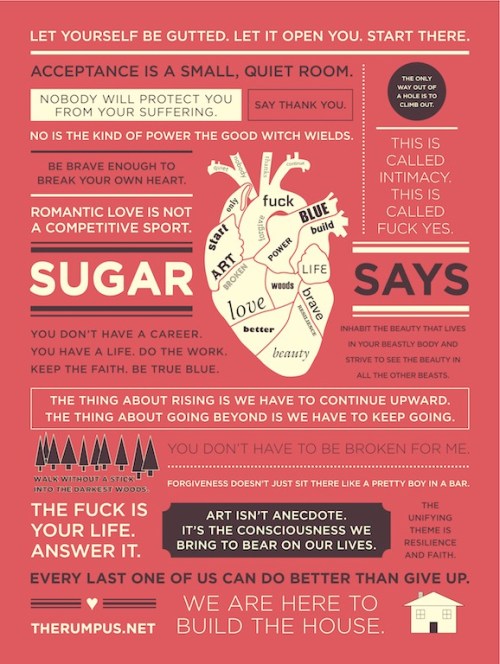
An advice columnist for The Rumpus, Sugar’s columns are exactly the opposite of what repels me from other columns. They are not didactic. They do not pretend to solve someone’s complicated problem or deep question in one neatly wrapped up answer. They are not formal or impersonal. They do not have an imbalanced or hierarchical relationship between advice seeker and advice giver. There is no air of superiority.

Instead, Sugar is a cartographer of the heart; she reaches into the map of her personal history, pulling out threads of her journeys and struggles and celebrations and weaving them through readers’ questions. Here, she says, look at this. And this. And this. In authentically crafting stories that navigate their way to an answer of sorts, she offers words that resonate with all readers, no matter whether they have been in the same situation as the advice seeker or not.

It isn’t that Sugar is telling us things that we don’t already know. Sugar taps into the deep register, the inaudible murmur resting below the words being said and she echoes back this thrumming in the truths she tells and the way she tells them: with honesty, with compassion, with love. Often those writing in don’t only need to address the current situation in need of attention and healing but the deep wounds that lie beneath it. And these wounds—of not feeling worthy or of being ashamed or of being scared to love or to be vulnerable or take risks because of our past hurts—these are ones we can all relate to.

Tonight, Sugar is having a coming out party in San Francisco, to tell the world who she really is. But as she said in one of her columns, we already know who she is: “…I quickly realized that telling stories about my life was often the only way I knew how to communicate the complexity of my advice. Your story spilled into mine and then I spilled it back into you, with hopes that we’d all find ourselves somewhere in the big story that belongs to all of us in a place we made up called Sugarland, where you know me already, even though you don’t know me at all.”


Researcher and storyteller Brene Brown has a brilliant TED talk about vulnerability. One of the things she discusses is that there is only one major difference between whole-hearted people, those who live with their whole heart, and those who don’t, and that is that whole-hearted people view vulnerability as a necessary part of life. And they see that vulnerability involves risk (to say “I love you” first, to do something they’ve never done before, to ask for help) and they choose to be vulnerable anyway. Sugar’s columns are built with vulnerability and they encourage this sort of way of being and living in her readers.

I brought Sugar’s columns into my freshman composition classroom this past fall to show them examples of how to use personal narrative to make a strong and clear point. We read one of her columns aloud and discussed how she went about telling her story and for what effect. Then, students had to answer one of her letter writers using their own personal experience. They talked about loss and grief and insecurities. Their words spilled over with hope and fear and love and disappointment. And when they were finished writing, one of my students asked: Can we see her answer? What did Sugar say?

I never know how students will respond to lesson plans and had hopes for this one. But it was about something more than craft or pedagogical goals: I wanted to expose them to the rhetoric of love. One of the things I love most about Sugar is that she writes her column because the letters she receives need to be read and these stories need to be told. We all need tending to. And in reading and in responding, she has created and held a space for us, where we all can feel less alone, where we all belong, where we have the opportunity to be whole-hearted people, together.


Leave a comment

Filed under other words

as·sim·i·late


as·sim·i·late (əˈsiməˌlāt), v.t. [ASSIMILATED (-id), ASSIMILATING], [<L. assimilatus, pp. of assimilare < ad-, to + similare, to make similar to < similes, like],  1. to take up and make part of itself or oneself; absorb and incorporate; digest: as, the body assimilates food.  2. to incorporate or liken.  3. to make life or alike; cause to resemble (with to): as, assimilate the final sound of a prefix to the initial sound of a word.  v.i.  1. to become like or alike.  2. to become absorbed and incorporated: as, minority groups often assimilate  by intermarriage.

For our first week of flash fiction february, the dictionary project  features a flash fiction piece by writer Timothy C. Dyke. Enjoy!


After the Spooging

How much latitude are you going to give me? How specific do you need me to get when it comes to describing the mechanics of the fantastical elements? This is a surreal adventure. How completely must I convince you of the viability of this story’s reality? A part of Tennessee Williams comes to me as spiritual entity.

At one point this was going to be a nostalgia narrative about A Streetcar Named Desire. I’m 51 years old, and thirteen of my crucial lifetime experiences have involved A Streetcar Named Desire. Quick example: Two days before he beat me up in the basement of New England boarding school, Jamie Chesterson told our AP English teacher that Blanche Dubois was a slut.

Consider that I have been intending to write an A Streetcar Named Desire narrative for a couple of decades now. Do you believe in the collective unconscious? Can you imagine other writers who have been inspired by A Streetcar Named Desire? We all have heard this expression: “I just want to put this out there.”  So imagine that enough people put their Tennessee Williams intentions “out there.” Where exactly would that be? I’m just going to go ahead and say that The Figurative Penis of Tennessee Williams stays, for the time being, in my hard-drive.

Please don’t think I am trying to be off-putting. This could really happen. A collective intention to create a story inspired by Tennessee Williams manifests as some certain kind of writing energy. In the National Hockey League, when a team wins the championship, each member of that team gets to spend personal, one-on-one time with the Stanley Cup. The trophy itself goes on the road right after the playoffs. A guy in Alberta might drive the ceremonial vessel around for a day in the back of his Durango. I think the Stanley Cup has its own personal assistant. Imagine that this is also how it works for the part of Tennessee Williams that manifests as a certain kind of writing energy. Imagine that those who have earned the energy, share the energy.

I really wanted to acquire the figurative heart or the figurative brain of Tennessee Williams, just for a day, but I got his penis. I saw it in my hard-drive. At first I thought it was this thing I downloaded at night, but this obscene and virtual entity was witty, and it wore a hat. The Figurative Penis of Tennessee Williams spooged all over some documents on my desktop. I had been working on a story about a baseball player who loses his ability to see other men naked without weeping. The Figurative Penis of Tennessee Williams loved this story. Literally. After the spooging, the story rebirthed itself as something darker. The baseball player marries his psychologist who sends him to Mexico for an exotic series of therapies. The baseball player falls in love with a donkey cart driver who loves him back. The two men have sex on top of a bed of scorpions. They die. The jilted psychologist drinks bourbon, masturbates, and then drives off a cliff. My story is so much better now.

The Figurative Penis of Tennessee Williams wants to know what happens outside my hard drive in the world I call “real life.” I tell him not much. He doesn’t seem to believe me.  The Figurative Penis of Tennessee Williams asks me to write a story about The Figurative Penis of Tennessee Williams. He commands me to write the scene where he escapes my hard drive and goes rogue. I finish the narrative: “After the Spooging.”

The Figurative Penis of Tennessee Williams hitches a ride with some graduate students to New Orleans for Jazz Fest. He ditches the grad students to cruise the French Quarter, then the Garden District, Elysian Fields. The Figurative Penis of Tennessee Williams has not been to New Orleans for such a long time. Things have changed after all these years. The Figurative Penis of Tennessee Williams feels like an outsider, a stranger in a strange land. It takes him forever to find a good cigarillo. Eventually he discovers communities to probe. He introduces himself as Dick from Tennessee. He manages to assimilate.


This slideshow requires JavaScript.


Timothy C. Dyke has published fiction in Santa Monica Review in 2008 and 2011. He was chosen as a semi-finalist for the Sentence Book Award for his manuscript of prose poems, Only Stories About Skin in 2011. His story “No Look Back” appears in Don’t Look Now: “Hawaiian Legends Made New,” a 2011 anthology, published by Watermark Books of Honolulu. A text/image collaboration with Noah Saterstrom, “Mound and Minds are Bumps,” will appear in The Spirit of Black Mountain College, a book project published by Lorimer Press in 2012. He has work forthcoming in Drunken Boat and Kugelmass. He currently lives in Tucson where he is writing a novel and pursuing an MFA degree in fiction writing at the University of Arizona.

1 Comment

Filed under flash fiction february

flash


1flash \flash\  v 1: to break forth in or like a sudden flame  2: to appear or pass suddenly or with great speed  3: to send out in or as if in flashes <~ a message>  4: to make a sudden display (as of brilliance or feeling)  5: to gleam or glow intermittently  6: to fill by a sudden rush of water  7: to expose to view very briefly <~ a badge>  Synonyms GLANCE, GLINT, SPARKLE, TWINKLE —  flash·er


2flash n 1: a sudden burst of light  2: a movement of a flag or light in signaling  3: a sudden and brilliant burst (as of wit)  4: a brief time  5: SHOW, DISPLAY; esp: ostentation display  6: one that attracts notice; esp:  an outstanding athlete  7: GLIMPSE, LOOK  8: a first brief news report  9: FLASHLIGHT  10: a device for producing a brief and very bright flash of light for taking photographs  11: a quick-spreading flame or momentary intense outburst of radiant heat


3flash adj:  of sudden origin and short duration <a ~ fire> <a ~ flood>


4flash adv: by very brief exposure to an intense agent (as heat or cold) < ~ fry> < ~ freeze>


Welcome to flash fiction february 2012! All month long, the dictionary project will be featuring flash fiction contributions from guest writers. Like all weekly posts, these short pieces, all 1,000 words or less, will emerge from and be inspired by the word of the week (which I choose each week at random by closing my eyes and flipping through a dictionary). Keep tuning in and enjoy!


Leave a comment

Filed under flash fiction february

Ni·cae·a

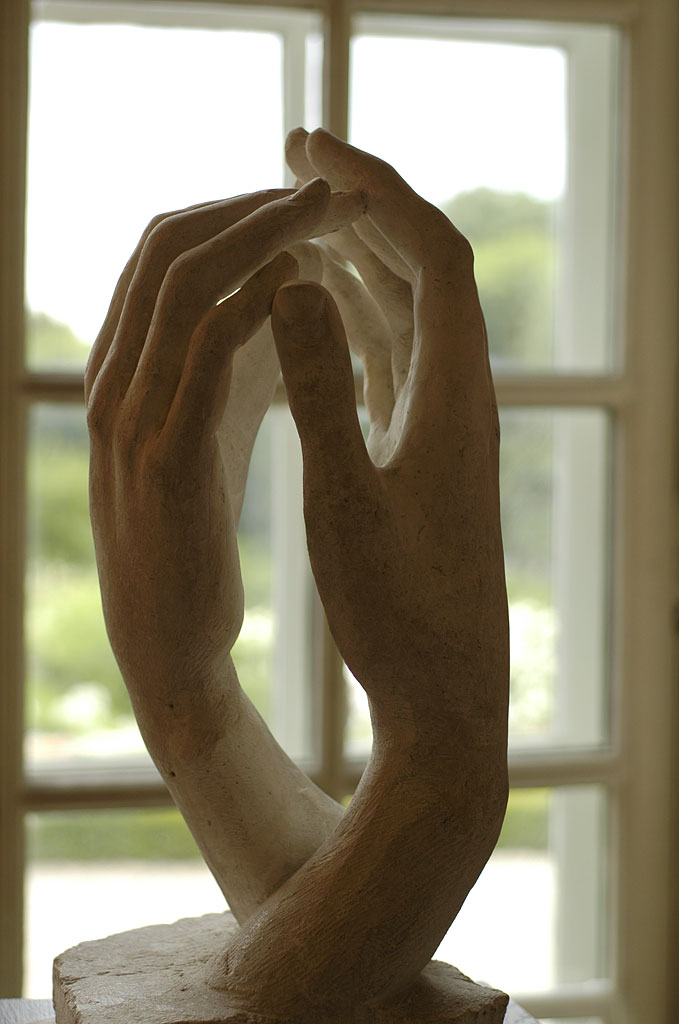
Rodin's "Cathedral" (David Udvardy)


Ni·cae·a (nīˈsēə)  n.  1.  an ancient city in Bithynia, near the Sea of Marmara: at an important church council held here in 325 AD, the Nicene Creed was formulated: English Name, Nice  2.  Nice (city in France): the ancient name.


Some thoughts on Nicaea:


1. I stopped going to mass for good when I could no longer say the words of “The Nicene Creed” without feeling anger and revulsion rise up in my body. While other Catholic prayers ceded my sacredness, this one felt the most visceral: one God, the Father, the almighty; one Lord, Jesus Christ, the only Son of God; the Holy Spirit, the Lord, the giver of life, who proceeds from the Father and the Son. With the Father and the Son, he is worshiped and glorified. Even the holy spirit, the most ethereal of the trinity, was male. Where was I to find myself in this paradigm? God made me in “his image”? I cannot name the number of times I recited the creed over the years (hundreds? thousands?); having gone to Catholic school kindergarten through college, mass was not only a part of my family life but my school life and my education. I was only three years old, at the ordination of a friend of my parents when I saw the line of men in cassocks drifting up the aisle and asked my father where the women were (His answer: I don’t know, Lisa). But it was in high school that I began to clearly see my absence from the representation of the sacred in Catholic prayers. And I felt the reasoning given for this as what they were: excuses. If the prayers were written a long time ago and by men and that’s why the patriarchal language existed, then we needed to rewrite the prayers, to change the language to make it real for our culture and all the people in our church. If it was that way because that’s the way it had always been, then it was time for change.

The First Council of Nicea, where The Nicene Creed was written and adopted, was the first ecumenical council of the Catholic Church. The conference was called to reach consensus on questions of the church’s body, to work towards unification. Agenda items: 1. Clarification of the relationship between God the Father and Jesus: are the Father and Son one in divine purpose or also in being? (i.e. the beginnings of the Trinity; Jesus is “begotten, not made”) 2. Deciding the date to celebrate Easter 3. Discussion of the Meletian schism (an early breakaway sect) 4. The validity of baptism by heretics (Paulian heretics denied that Christ was divine and thus not part of the holy trinity; baptisms conducted by subscribers to Paulianism were deemed invalid) 5. The status of the lapsed in persecution under Licinius (the persecution of Christians had just ended with the February 313 Edict of Milan by Emperors Constantine and Licinius)

Primarily, the council was gathered to discuss and reach agreement on the deity or non-deity of Jesus. It is interesting to note that among early Christians, there was division about whether he was God or was sent by God; was he a prophet or divine himself?

All of these specific questions bore me now. Jesus was an amazing teacher (whose most central teachings on love and peace are now largely ignored or passed over by those who claim to know him), as was the Buddha and Mohammed. All the terminology and details of the Catholic Church that I once desired to know or felt privileged when I knew and “understood” feel unimportant to me now. It seems to me that so much of Christianity and Catholicism and many world religions come from a defensive platform. Our way! our God! is right, is the best, and here are all the reasons why. Laws and rules and prayers that are based on this defensive and reactive standpoint are a waste of time to me. The Dalai Lama says: My religion is kindness. I can get behind that: a religion where compassion and love towards another is the rule, where we can meet each other with genuine attempts at understanding, where it is in the way we live—not what temple we visit—that we show our faith. And where the divine resides within each one of us.


2. The first time I played the “Ha Ha” Game was on a beach in Nice, France. This was not the sort of beach I was used to: beige, covered in tiny grains. There were black and gray rocks, big ones that covered the earth near the water. Stones and gravel. I was there on spring break, from Rome where I was studying. My friends and I, close although we’d not known each other long, laid on the rocks, one head on another’s belly, and when the inevitable first laugh came, the movement and sound cascaded down the row. The inevitability caused by others’ laughter, the luxury of silliness when one is supposed to be, finally and always, an adult. Other moments I remember from that trip: Nice just a few weeks before Carnival, the busyness of preparations but no clear signs; buckets of irises, of carnations—red, purple, pink, white—cascading out of buckets at the flower market; a hostel painted all in white; my all purpose wool green sweater with flecks of white; the French version of American diner breakfast; a bus ride to see Rodin’s This Kiss, something that was maybe the most tender and erotic art I had ever seen, and large hands rising up to form a sort of temple: Cathedral.


Leave a comment

Filed under weekly words

plot


1plot \`plat\ n.  1 :  a small area of ground  2 :  a ground plan (as of an area)  3 :  the main story (as of a book or movie)  4 :  a secret scheme : INTRIGUE


I have been going by the house for years now, every time I am home for a visit. It was just a shell of where we lived but I felt compelled to visit every time I was back in New Orleans in the years following Katrina. A few months ago, my mom sent me an email to tell me that the house had been razed. It’s just river sand now, she wrote. She said she picked up three pieces of brick (one for her, one for my dad, one for me), a small piece of wood, a small piece of latticework—the traces that were left behind. She said she wanted to lie in the sand and make a sand angel, to place her body on the earth itself, but a truck drove up so she just pretended.

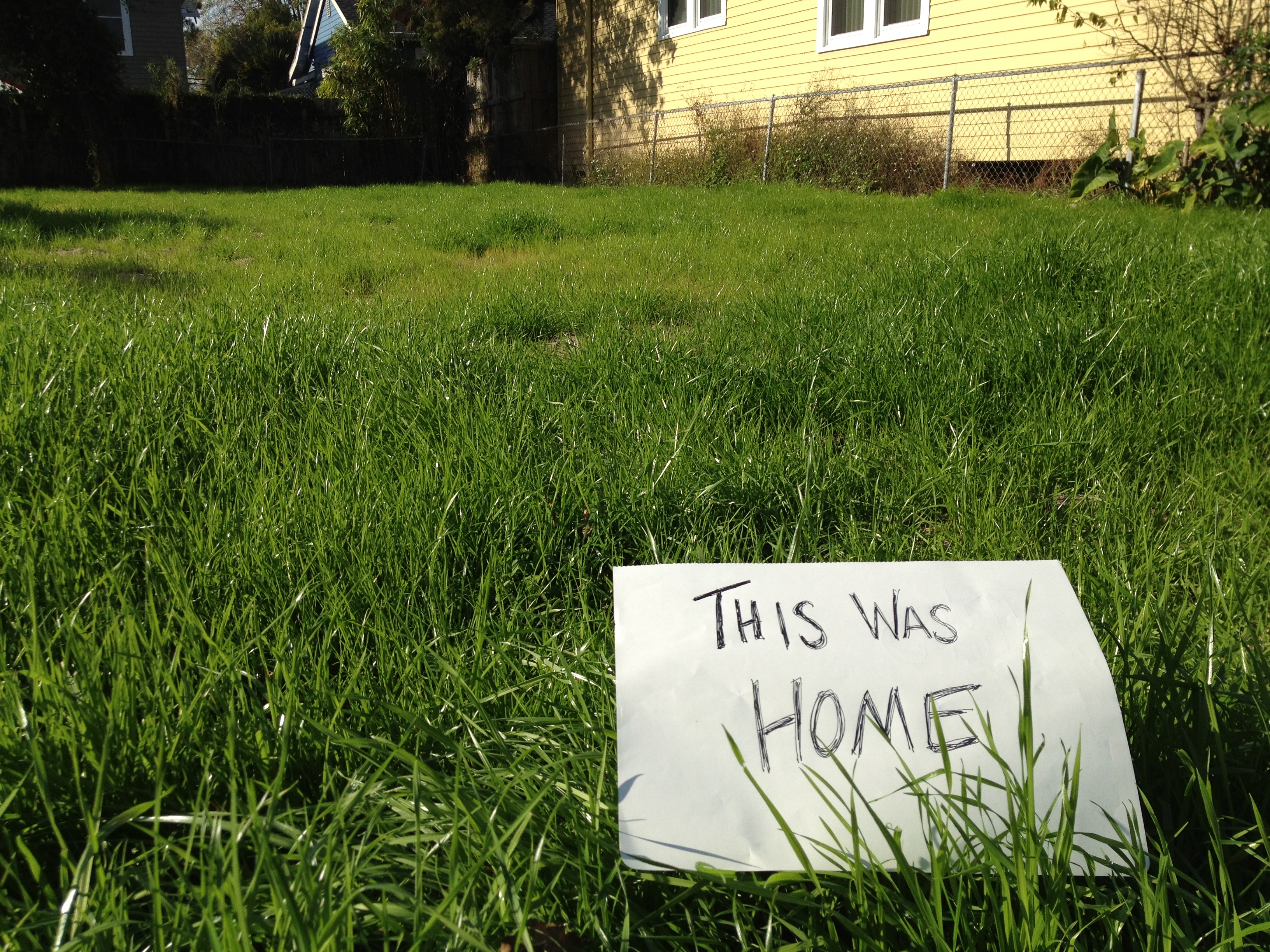
I knew, then, what to expect when I went by 3324 Vincennes Place, and yet, I was surprised all the same. I was taken aback by the shock of green grass usurping the plot. I had expected river sand, but since my mom visited, there had been time for old seeds to sprout up. To fill this hole, this gap, this absent space.

I thought: how odd to witness so clearly an absent place that is so full, this place that occupies so much space in my in my memory. The lot looks enormous without our house on it (hadn’t my mom mentioned that in her email as well?). Just one small block of green. It was hard to imagine all those rooms, all that our house contained.

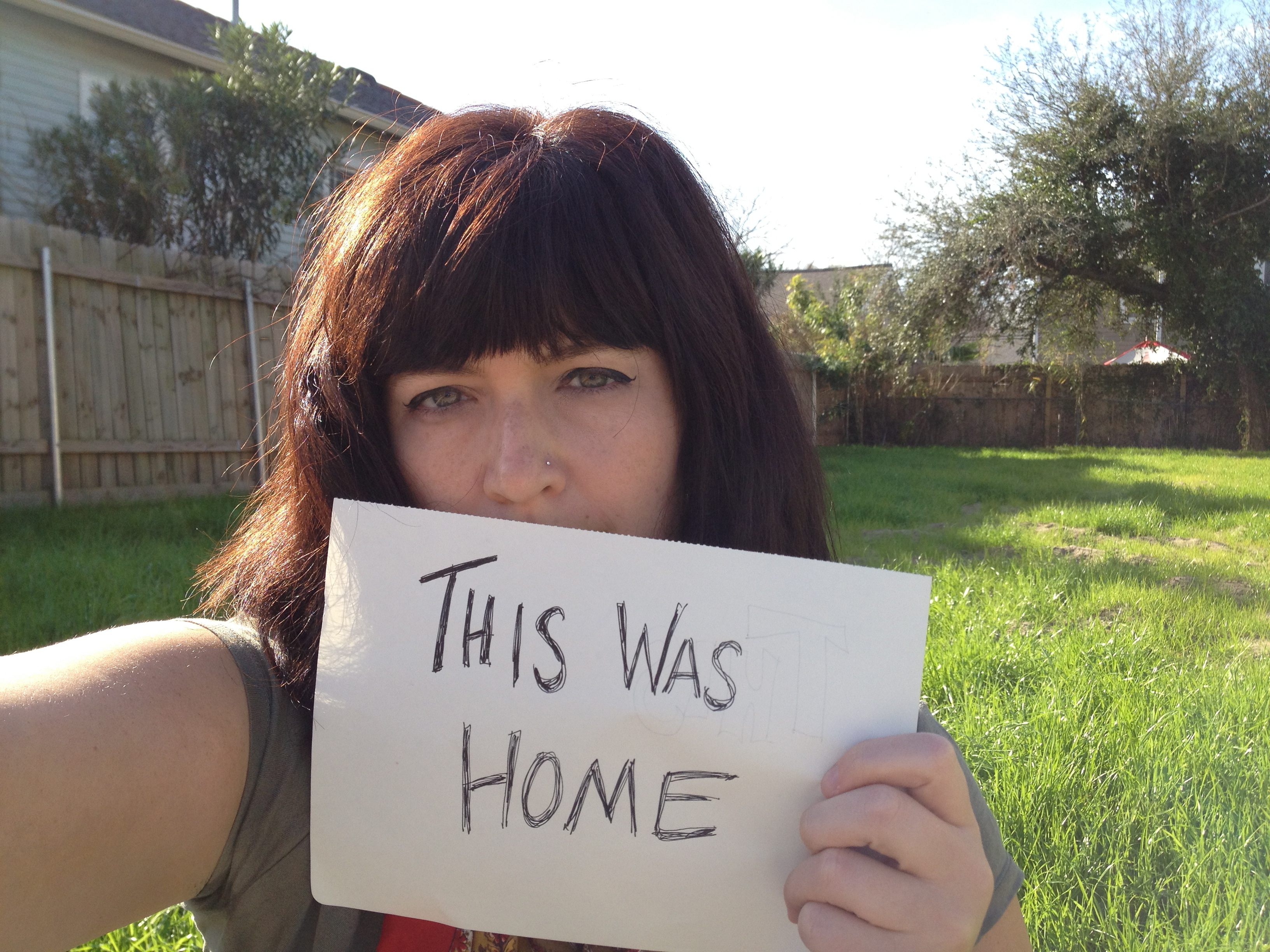
I pulled out my journal and tore out a perforated page. On it I wrote: THIS WAS HOME. This (space). Was (past tense of “to be,” as in is no longer). Home (a place where families are born, where dreams are dreamed, where mornings break and evenings are put to bed). I took pictures of the sign resting in the grass in front of the plot. I took portraits of myself with my arm extended, holding the sign. I walked around the perimeter and traced the word HOME with my finger in the river sand. Then I took a stray stick and signed my name in the corner of the plot before tucking the stick in the back pocket of my jeans. Three trees stood as sentries at the back of the land and then there was just the span of grass and sand and the neighboring fences on either side.


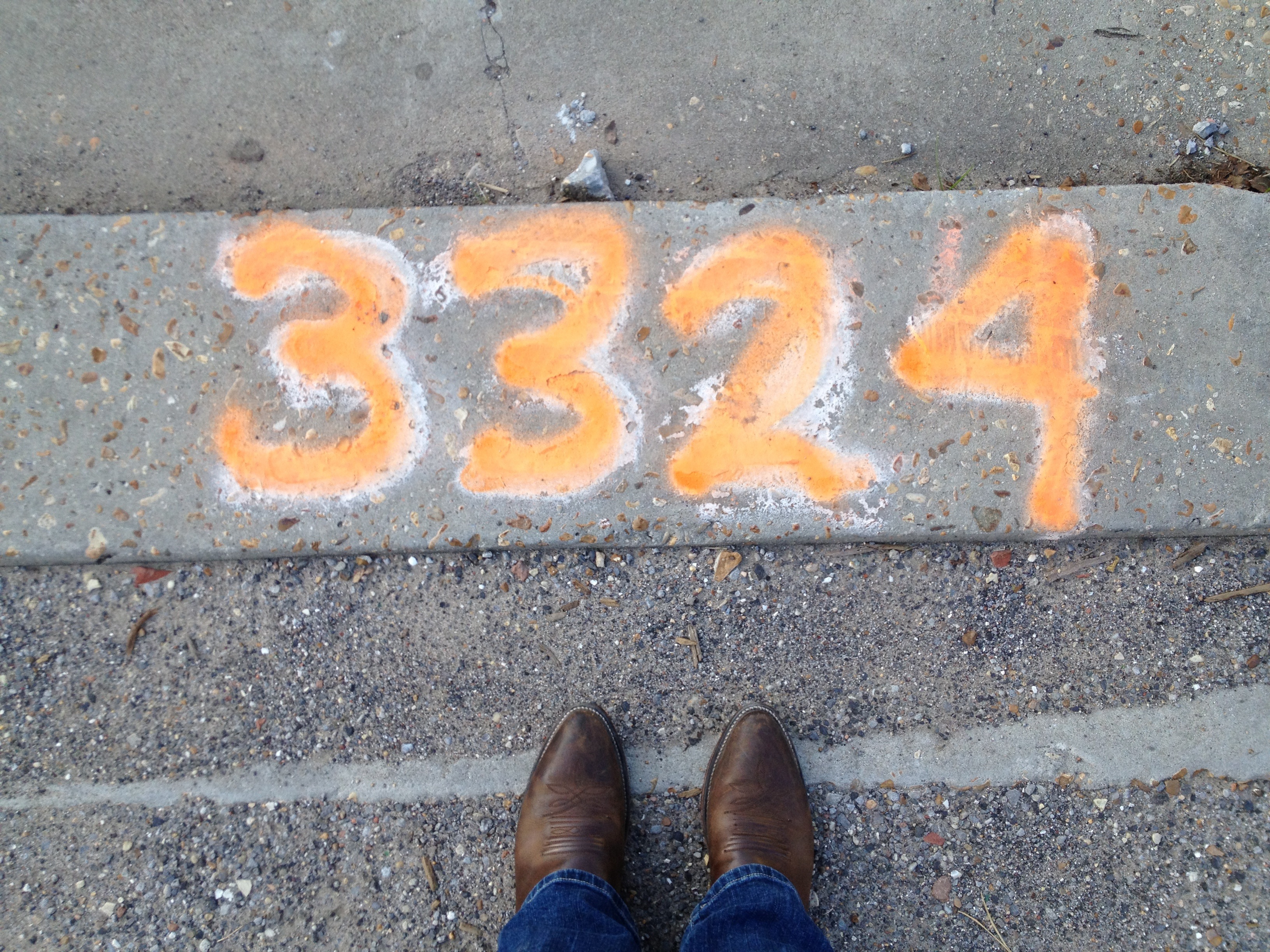
The sidewalk had 3324 spray-painted in orange, over a version painted in white. This now marks the address since there is no longer a house to mark the space. Addresses are random numbers and letters we assign to places to make them ours, to make them home, to tell people where to find us. While I was sitting in the car across from the plot where our house was, a mail carrier, mail in one hand and a bag crossing her body, walked by the empty lot on her route.

I scanned my body. I felt tears behind the lids of my eyes—held, not held back. There was a sort of soft gnawing in my belly. I didn’t feel sad really but rather vaguely numbed out.

This was a place I had been saying goodbye to for years. A place I came to visit as one does a deceased family member in a cemetery, over and over again. Our home died to us and now the traces of it, save a long thin piece of wood with blue paint that I found and took, are gone as well.

And although this moment felt like it should be the natural point of closure, the final goodbye, I couldn’t imagine stopping my visits: even if there was a new house there, even if there was a new family in it. In the movie version of my life, we might end here as the protagonist bids farewell to her childhood memories and her childhood home and steps off into her very bright future. Maybe there would even be a flash-forward to her home-to-be, complete with husband in the doorframe and children eating breakfast at the kitchen table. So why do I feel its not over for me and this land?

It’s not a compulsion, this desire to visit. It’s more like coming to sit in silence with an old friend. There’s a kind of peace that comes from being there—from remembering what was and seeing what is real now. I can sit with all the fond memories and the painful loss of this place. It feels real. It feels authentic—this mix of beauty and joy with grief and sorrow. This house taught me how to live life and bear it all: how to grow, how to be nurtured and to nurture, how to love and also how to unexpectedly and without warning, let it all go. To say goodbye. To unhand expectations of what the space you rest your life in looks like.


I feel I owe this land so much—the place I was born into, where I took my first steps and read and wrote my first words, where I learned how to embrace and be enclosed in the arms of somebody who loved me. I learned to cry, to mourn and to go on, still and always, with the movement of life. I learned about the richness that lies in details—in the shape of a sill, in nicks, slants, the flaws we perceive as such or the ones we find charming. I learned how to observe and how to write those observations down.

It occurred to me as I sat across the street from my childhood home that while I thought I had been coming back to grieve and let go, I was also coming back to honor and pay tribute to the home that held the space for me to become who I am, to the sacred spot where my mom, dad and I became a family. I realized I have continued to come back, all these months, all these years later, because I am so deeply grateful.


2 Comments

Filed under other words

eye open·er

eye open·er (ˈī-ˌōp-nər, -ˌō-pə-) n.  1.  something that causes the eyes to open in astonishment or realization, as a piece of news, discovery, etc.  2. [Slang] an alcoholic drink, especially one taken early in the day.


Beyoncé & Who Run(s) The World


Although I’ve always loved Beyoncé as an artist, more recently I have come to deeply appreciate her and love the way she makes me consider questions about aesthetics and pop culture, about myself and the world I live in and move through. Part of this has come from examining and analyzing her videos. I brought “Countdown” into my freshman composition class so we could look at the video’s aesthetics—choreography, costumes, styling, settings—and how they was greatly influenced by others and in parts taken wholecloth from Belgian Choreographer Anne Teresa De Keersmaeker. In doing so, we talked about the context of her as a pop diva, about the history of music videos (hers and others), about issues of ethics and recycling vs. plagiarizing. A few weeks ago, my friend Meg introduced me to her song and video “Who Run The World (Girls).”

On a first watch, I was taken by the choreography, strong and dynamic, by Beyoncé’s holding the leashes of hyenas in a desert, by her hair taking on a light shade of blonde and the sometimes “whitening” of her that happens either with or without her permission. Meg told me how Beyoncé had seen videos of the two men from Mozambican kwaito dance group Tofo Tofo who choreographed part of the video and dance alongside her. She told her people she had to work with them. The body movements and the drumbeats are instantly recognizable as stemming from African dance. They are powerful, they showcase the fluid and sharp movement of bodies to strong rhythms. I showed “Who Run the World” to another friend Amanda, and she was struck by the end of the video, when, after a song about girls ruling the world, Beyoncé leads her army of women—clad in bright flowing dresses, combat boots and garter belts—up to uniformed riot policemen and leads her army in a salute to them. “Whoa, that is something,” she said, and went on to talk about that moment as a sort of insight into these women as powerful not only in the way they execute force but in how they choose to vocalize or not vocalize, how they choose to be assertive and how they choose to, at least seemingly, submit.

For me, this video is a striking commentary about women as powerful beings. About how women are sources of both sensuality and real power and the proposal that these don’t have to be mutually exclusive. Women use their wiles not just as manipulation of power but because this sensuality—in their bodies, their souls, their nature—is a part of who they are at their foundation.

This is in strong contrast to other representations of how women are portrayed as using their sexuality and sensuality. Oftentimes, women in film and media are shown using their sensuality as a form of trickery or a last ditch effort to save them. (These examples also often do an injustice to straight men, portraying them as oversimplified beings, oversexed dolts who can’t tell their wristwatch from their crotch.) If she is in a bind, a Charlie’s Angel could strut out in a bikini to distract a villain. Or Liv Tyler and Alicia Silverstone in the Aerosmith video “Crazy” can make eyes at the convenience store clerk to shoplift as much loot as they want. Or maybe when about to be raped by a man, a woman will use her sensuality to convince him she has changed her mind to buy a few seconds until she can grab the glass vase from the shelf and break it over his head. In these examples, a woman’s sensuality is a source of power but also a source of shame and guilt because she is using it in situations that allow her (and it) to be demeaned by others; her sexuality is the only thing she can use to help her because her smarts, her skills, her knowledge are nonexistent or not enough. She is objectified: her sensuality is reduced to being her only power instead of a deeply rooted part of who she is as a whole being—and that whole being, her real source of power.

This is not true in “Who Rule The World.” One of my favorite moments of brilliance in the video begins at time marker 2:20. In a close-up of Beyoncé, she sings the words “You will do anything for me” as she makes seductive facial expressions, looking away from the camera. Then, as she sings “Who Rule the World?”, she looks directly into the camera with soft eyes and smiles sweetly, a sort of “cover of Cosmopolitan” smile. But immediately after, she scrunches her face into a strong, aggressive expression and shouts: “Girls!” For me, it’s not about Beyoncé being coy and taking advantage of her unsuspecting male viewer. It’s about her knowing that her power rests in both her sweetness expressed in the question and in the strength and power delivered in the answer.


In the video, the women dancers wear military jackets strung over bras. They wear official army caps with metal stars. Later, some of them, including Beyoncé, wear brightly-colored flowing dresses with long slits up the sides; others don camisoles, underwear and long flowing capes. The dancers wear garters and stockings and black combat boots. At moments their underwear shows, but instead of this being a kind of seduction, it is a kind of powerful revealing. Because of the capes and slits in the dresses, the viewers can see the strength and power of these women’s bodies, and through them, the strength and power of women’s bodies in general. And in showcasing the strength of their hips and thighs, in both the costuming and the choreography, we remember that there has been, since forever really, a masculining of what power looks like: in human bodies and in the world. It looks like war. It looks like dominance. It looks like carved pecks and abdomens. It looks like giant sculpted Popeye arms. This video is saying: power looks like the line of muscle definition in a woman’s thighs, it looks like the delicate swoop of an arched back, it looks like the ability to dance with both subtle and sharp movement, hip sways and shoulder snaps. It is beautiful and it is strong.


As a woman raised in the South to understand that women are supposed to look and behave a certain way, I have not always been able to connect with or honor all that I am as a woman: my sensitivity and my power (and the power that comes from my sensitivity), my soft curves and my strong legs (and the strength that comes from having both soft and sturdy parts of my body). And it is really refreshing to have a perspective that is not an either/or, that does not ask me to sacrifice one for the other. Because fuck that. I don’t have to and I don’t want to. And not in some sort of I am Woman, Hear me Roar way. More that I am woman and I can roar if I want to. I can also whisper. I can dance and I can run. I can compromise and I can be unyielding. More that I am a woman and all that this encompasses. And that to be a woman, to be me, is to be beautiful and valuable and strong. I run this mother—


2 Comments

Filed under weekly words

car·a·van (more gypsies)

Elephant Girl


car·a·van (ˈkarəˌvan), n. [Fr. caravone; OFr. karouan; Per. karwan, caravan],  1.  a company of travelers, especially of merchants or pilgrims traveling together for safety, as through a desert  2. a number of vehicles traveling together.  3. a large covered vehicle for passengers, circus animals, gypsies, etc.; van.  

We’re rounding out our week of caravaning (see previous two posts). Today, another joins the caravan.


Jesus Wagon


This doesn’t make a ton of sense, but when I think of a caravan, I think of Jesus.  An image lingers from the novel Quarantine by Jim Crace. The story begins as a caravan of travelers and merchants winds through the desert. A man in the group is dying. For a few days the caravan stops to allow the man to recover, but when his conditions worsen, the decision is made to leave him behind. The man’s wife is required by custom and consensus to stay with him. She has no choice, and even though the man has been a terrible and abusive mate for her, she has to leave the caravan and wait for him to die.  As the story progresses, she meets Jesus who is spending his 40 days and 40 nights alone in the desert.  That’s pretty much where my association with Jesus and caravans comes from.  Am I right in perceiving a kind of utilitarian underpinning in the philosophy of caravans?  At what point do caravans look after the individual, and at what point do the members of a caravan abandon their burdensome colleague so that the majority of the group can continue on the journey? Jim Crace’s novel Quarantine is no religious text, but it tells a good story, and it sets up two modes with regards to coping with life. There’s the Jesus paradigm and the nomad paradigm. There’s the character alone in the desert, and there’s the wagon full of passers-by. Which one am I? Am I one of the men in the caravan, or am I one of the men who watches the caravan go past?

—Timothy Dyke


Leave a comment

Filed under weekly words

car·a·van (a new string of wagons)


Caravan 3 by Noah Saterstrom, with words by Julia Gordon


car·a·van (ˈkarəˌvan), n. [Fr. caravone; OFr. karouan; Per. karwan, caravan],  1.  a company of travelers, especially of merchants or pilgrims traveling together for safety, as through a desert  2. a number of vehicles traveling together.  3. a large covered vehicle for passengers, circus animals, gypsies, etc.; van.  (see previous post)


Caravan 1 by Noah Saterstrom, with words by Amanda Sapir


Sometimes I get lost

and then I am grateful

for noises in the dark

 —Kristen Nelson


Caravan 2 by Noah Saterstrom, with words by Frankie Rollins


Leave a comment

Filed under weekly words