Category Archives: weekly words

di·u·ret·ic

di·u·ret·ic /dī’ə-rĕt’ĭk/ adj. : tending to increase urine flow—diuretic n.

[NOTE: Okay, seriously, dictionary gods?!?!?! Last week, “reins” and now “diuretic?” These last two words were really the first ones that I have felt pretty stumped by. I mean, what does one really care to write about “urine flow.” I can answer for myself, nothing, nothing at all. But rules are rules. This was the word I landed on this week. I could try to fool y’all and say I landed on the word just below it, which was “diurnal”: daily; of, relating to, occurring, or active in the daytime. That would be pretty easy to write from. But that wouldn’t be honest. But no matter the word, I will not subject you to talk about my own bathroom habits. So please don’t be concerned about that.]

This is maybe going to sound silly or too big of an analogy to make here, and you have every right to think that and to stop reading. But I think sometimes about bodily functions, our response to these functions and what they have to say about the ways in which we move through life. For example, I think about the sensation of having to go to the bathroom when the situation becomes urgent. It requires your entire focus. You can’t imagine a more uncomfortable feeling. You are going to explode. You are literally going to die.

And then the moment you go, you feel that instantaneous relief. It is hard to conjure or even imagine the feeling of hopelessness and anxiety that existed a mere thirty seconds before.

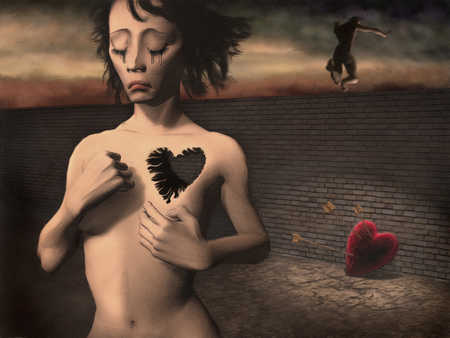
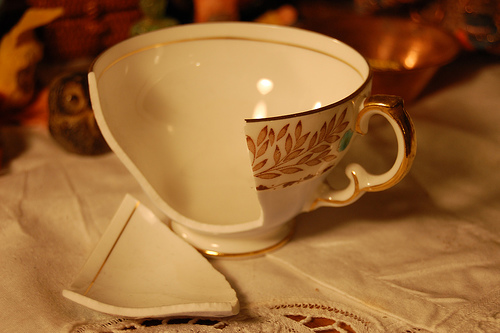
I feel that way about life sometimes. This is especially true because right now I am in the midst of one of those “gotta go” moments. I can’t even begin to explain the amount of brokenness I have experienced and witnessed in the last few months (and even more so in the last few weeks)—broken relationships, broken engines, broken windows, broken words, broken trust. Everywhere, everything is broken and I’m not sure what to do. It feels silly and naïve to just pick up the pieces: almost like, what is the point when something else is bound to break again? Why not just live in the battered shell? Why not just abide in the wreckage?

And it is hard for me, in the midst of these experiences, to have any comfort in the idea that relief will come. When? For how long before something else happens? For how long must I endure this feeling of powerlessness or the deep desirous need for relief whose arrival I cannot predict? I don’t know. And I don’t have a ribbon with which to tie up this post or answer these questions. These feelings are very real and palpable to me.

I am someone who believes in redemption and repair, and yet in this very moment, all of this feels so far away from reality. The only thing that gets me through moments like are the little things that are not broken. The phone call of a friend to check in. The offer of a safe place to stay or a car to drive. A compassionate embrace.

And these little gestures, these moments of connectivity do not do away with the brokenness. The pieces are too small to fill the cracks. But they do help clot the bleeding. They do hold back the dam from bursting further. They stop the cool air from rushing in.

Someone once told me that a religious leader was talking about the beauty of a broken heart. It had to be broken open, he said, so that more love could pour in, could pour out. I have definitely experienced moments of brokenness in my life that led to more fullness and beauty than I could have ever imagined. But that didn’t make the breaking nor the putting back together any easier. That didn’t make me know that relief would someday come. Maybe there is something about the intensity of these moments, their never-ending quality and the feeling that we might not make it through them, that makes us truly love the act of letting go.

1 Comment

Filed under weekly words

reins

reins (rānz) n. pl. [ME. Reines; OFr. Reins; L. renes, pl. of ren, kidney], [Archaic], 1. the kidneys, region of the kidneys, or loins 2. the loins as the seat of the emotions and affections; hence 3. the emotions and affections.

In using a dictionary from 1955, there is always the possibility of coming up with words that are now defunct or seldom used. However, for this week, I came upon a word that I was familiar with but whose listed definition is no longer associated with the word.

After searches on multiple online dictionary sites, I was unsuccessful in finding this dictionary definition anywhere. Everywhere reins involved horses and the strap used to make them yield. It was about the act of restraint, of pulling back. But a search with reins and the word kidney revealed that the word in this context was used often biblically:

Psalms 16:7 My reins also instruct me in the night.
Proverbs 23:16 My reins shall rejoice.
Psalms 7:9 God trieth the hearts and reins.
Isaiah 11:5 Faithfulness the girdle of his reins.
Job 16:13 He cleaveth my reins asunder.

In ancient Hebrew tradition, the kidney was of equal value to the heart. According to Dr. Giovanni Maio at the University of Lübeck’s Institute for the History of Medicine and Science in Germany, the kidneys were where the deepest emotions and passions resided. Kidneys were representative of the secret inner world all humans have and were a metaphor for deep reflection. Kidneys were also referenced as both a place of great strength and also one of great vulnerability.

It is compelling then that the definition of reins that we use currently relates to and tempers the older one. Reins are something that facilitate control: of a horse, of a passion, of our innermost desires. Instead of, as it was, the organ that produces those desires themselves.

In traditional Chinese medicine, the kidney is responsible for growth and maturation as well as for reproduction. So, when the kidney is malfunctioning or imbalanced, the person suffering can emotionally manifest this by feeling fearful or isolated or insecure.

I guess it makes sense too that kidneys were seen as the site of passions because when kidneys are working properly, they regulate the body, keeping it balanced. They filter the system and get rid of waste. And when they don’t, there is build up. The rest of the body suffers. These are passions that need to be honored for their power and also controlled.

1 Comment

Filed under weekly words

port⋅ance, v2


port⋅ance (pôr/t’ns), n. [Early Mod. Eng. < porter, to bear, carry; cf. –ANCE], [Archaic], conduct; bearing; carriage; demeanor

This post by the fabulous Drew Krewer


:::::::::::::::::::::::::::::::::::::::::       :::::::::::    ::::::::::::::    : : :     :

From Kindergarten until I left my small, rural school in Georgia as a Junior, the same man took my yearbook photograph every year.  He had a stuffed frog named, appropriately, “Mr. Froggy.”  For all the kids who didn’t want to smile, Mr. Froggy hopped out of his frog cave to be animated by a wide-faced, mustached Mr. Photographer.

I didn’t want to smile.  At least in the way he wanted me to smile.  To him, smiling meant teeth, and I really didn’t want teeth in my pictures.  When it came my turn, I would give a slight, tight-lipped smile, and out would come Mr. Froggy.  The photographer would switch on his goofy frog voice––personable, perhaps child-friendly on the surface, but beneath it there was this impatience, this sense that I was the one cattle who wouldn’t listen to his herding call.  Finally, he would take the picture anyway, teeth or no teeth.  I think over my school career I alternated between the tooth and non-tooth yearbook photos, depending on how annoyed I was with the frog voice that year.

This scenario has continued to happen throughout my life––why the long face?  Cheer up.  Give me a little smile.

Just because I don’t walk around with a continual, pep-rally grin on my face does not mean that I’m sad.  In fact, I’m content 80% of the time.  Well, maybe 70%.

But why are people, even strangers, so concerned about it anyway?  Maybe that’s what the song “It’s My Party and I’ll Cry if I Want To” is really about:  the freedom to come off as sad or as happy as one damn well pleases.  Maybe a happy demeanor became expected with the rise of consumerism, salesmanship, and retail; the expectation that if one looks happy enough, talks friendly enough, stands upright enough, that the customer will feel happy and perfect, too.

Stop frowning.  You’re invading everyone’s HAPPYSPACE!

But I’m not frowning.  I’m content.

One day, I was driving back home with a friend, and she asked me about the word “content.”  I had always had a positive relationship with the word “content.”  But my friend said, “Content means that things are routine, normal, and satisfactory.  Happiness is so much more than that.”

So, maybe people just aren’t content with being content anymore.  The world can never be too Technicolor.  A world flash-flooded with routine yet vibrant compliments.  A world where Mr. Froggy hops out at unsuspecting, content strangers, convincing them that no matter how wide their smiles may be, they’ll never be wide enough.


*Drew Krewer’s work has appeared in Trickhouse, Poor Claudia, Pequod, and Quick FictionArs Warholica, a chapbook of poetry, was recently published by Spork Press.  He holds an M.F.A. from University of Arizona, where he received the Academy of American Poets prize.  He runs the multimedia culture site mars poetica.

Leave a comment

Filed under weekly words

port⋅ance, v1

As I mentioned in my last post, this week I will be featuring posts by guest contributors who are offering their own insights and observations on the first word ever randomly selected for the dictionary project:

port⋅ance (pôr/t’ns), n. [Early Mod. Eng. < porter, to bear, carry; cf. –ANCE], [Archaic], conduct; bearing; carriage; demeanor

This first post is from Julie Lauterbach-Colby*.

“Lines Appearing, Distant Points”

We study the line. From point A to point B we have the closest distance. Draw a footpath, map out a solid trail of breadcrumbs. Denote journey and begin.

Intersection of lines, latitude and longitude, a knitting, a stitch. Sense of security; single location of one self in space. I say one, because, can we ever possess our whole selves in any given moment? Denote a journey, a beginning.

We are all familiar with the history of the GPS (I wasn’t). Devloped by the military to deliver an exact point, an exact location. We are talking precision here: the most authoritative mode of travel, point A to point B and nothing else, nothing outside. Similar to (and at the same time, nothing like) medieval road maps.

Matthew Paris, an English monk from the 1200s, was famous for them. He made the maps in likeness to Roman army parchment maps: thin strips, the maps only showing road and important places along that journey. Most often, these journeys were spiritual: how to travel from London to Jerusalem for a holy pilgrimage.

(How to, with accompanying pictures for each: Start in London [A]; cross the English Channel [B]; through France [C, where the whole country was drawn as a single castle with three spires]; into Italy [D]; across the sea [E]; onward to the holy land [J, with a few undeciphered points in-between].)

Notes in the margin of the parchment scaled distance, how long it would take one to travel between destinations. Roads were straight—study the line: from point A to point B we have the closet distance. Nothing exists outside the frame, no chance for wandering minds, no detail for lay of the land. These maps were about getting. About time-management, efficiency. Exactness, with a clear sense of exclusion. As in, “Shoulders back, chin up.” Presentation of one self and oneself. (I cannot seem to stress this enough.)

It was from a fear of its exactness that military personnel insisted that the GPS technology remain hidden from the world citizen. In 199__ the Clinton administration “unscrambled” the codes and put the GPS on the public’s radar.

Take a GPS and map out a ten-mile radius from where you are (your house, your car, your supermarket, your post office, your church) and follow that breadcrumb trail from each direction: go N, NE, E; SE, S, SW; W, NW. Upon arrival, turn 360° and take in the view.

You’re going to this one spot, and it’s a dictated spot. Once you get there, infinite possibilities. The first sea cartographers used x to mark not treasure but danger. Define trespassing: there are a million ways in which I lie.

*Julie Lauterbach-Colby is a writer, teacher and artist living in Tucson. She is currently working on a project that incorporates cartography, mathematical equations and cadavers, and owns her own editing business called Chicken Scratch Editing.

Leave a comment

Filed under weekly words

wa·ter ta·ble

wa·ter ta·ble  n. :  the upper limit of the portion of the ground wholly saturated with water.

“The water table is the level at which the groundwater pressure is equal to atmospheric pressure. It may be conveniently visualized as the ‘surface’ of the groundwater in a given vicinity. It usually coincides approximately with the ‘phreatic surface’, but can be many feet above it. As water infiltrates through pore spaces in the soil, it first passes through the zone of aeration, where the soil is unsaturated. At increasing depths water fills in more spaces, until the zone of saturation is reached. The relatively horizontal plane atop this zone constitutes the water table.” –from wikipedia

I find it interesting that my finger landed on a page filled with words about water—waterway, water wheel, water wings—because water is what I desire almost constantly lately. I live in the desert so am unaccustomed in my daily life to seeing water anywhere else besides a drinking glass, the sink spout or the occasional swimming pool.

My thumb landed on two words: water strider and water table. As I discuss in the rules, in the event of such a situation, I get to pick. And I’m picking water table. I invite you to write your own posts about water strider in the comments section, if you so desire (wa·ter  stri·der  n. : any of various long-legged bugs that move about swiftly on the surface of water).

* * *

Water and I have a complicated relationship. I was born in July and regardless of how much astrology is or is not true, I feel a strong pull to water. Before Tucson, I have always lived in places that were anchored to large bodies of water—New Orleans, Washington, D.C., Rome, San Francisco. When I lived in New Orleans, I would often bike to a park alongside the Mississippi called The Fly. Especially on difficult days, I found looking out at the waves of the Mississippi, seeing the river curve around the bend and keep going, very reassuring. Here was this thing that just kept flowing. It’s sheer size was a comfort to me. No matter what was going on with me, the river would always be there, and I found a certain peace in that thought.

When the levees broke following Hurricane Katrina, the water rose through the streets of New Orleans and filled my childhood home with five feet of water. The water seeped into cabinets, into the mattresses and box springs. The water soaked the curtains. The water bled the photos in albums on my bookshelf. The water took indiscriminately and it took almost everything.

When my parents and I returned to the house a month after the storm, when we were finally let back into the city, we sorted through our saturated belongings. We held each other after we saw the watermark on the wallpaper and the smattering of mold on the sheetrock.

Then, I wasn’t thinking about water’s ability to provide sustenance. About its beauty or largeness. I was heartbroken. Water had ruined everything.

In the months to come, I would assess and reassess all my family and I had lost. I would remember books and journals and photo albums that had been in the room. Each time I remembered something new, I felt the grief afresh. A memory gone. I also grieved for the items I would never remember, for the ruined photographs that would have reminded me of past experiences, experiences I might not ever recall again on my own.

Then slowly, my parents began to rebuild their lives. I began to see changes, even if small ones, in the city and its progress. I began to worry less about lost items I could no longer hold in my hands.

Earlier this week, my house was broken into. The window was pried open and the burglars, likely teenagers looking for some quick cash, took some jewelry of sentimental value to me and my digital camera. They didn’t take my guitar or my computer or backup drive or other things I would have felt lost without. My house had been broken into, and I felt the  violation of my space. But my dog was safe and so was I.

And surprisingly, I didn’t feel outraged. I wasn’t panicked. I felt a bit less safe but not totally shaken. The robbers had taken some things that belonged to me, but they hadn’t taken anything I could not live without. And while I was sad at the loss of these things, I didn’t feel hostile. They were taking these things to fill a need they had: for money, for drugs, for something to maybe make them feel better about themselves and their own trials.

And I had the sense, even just a short time after I discovered the house in disorder and my things missing, that I would be okay. And I somehow knew that my previous losses had prepared me for this moment, had prepared me to handle it with grace.

We are taught in our culture to value objects. We are what we own. We need things that are pretty, and once we have these things, we need things that are even prettier. But I found that losing these things, even ones that had been given by loved ones, did not shake my sense of self. I still had the people who gave these objects to me in my life. And I was okay. In caring too much about objects, we become bound to them. I think we give those objects too much power over us. And ultimately, when these possessions break or are lost or stolen, we are the ones who choose to decide how to let their absence affect us.

This month will be five years since the storm, and while I still believe it should have never happened–the city of New Orleans and its people drowned and it was completely unnecessary, the city and its citizens were abandoned (and continue to be) when help was (and is) so desperately needed—the time hasn’t passed without me learning something really important: I am capable of handling loss, of dealing with heartbreaking grief and of coming out on the other side.

I still think sometimes about what is lost in the storm, and it is with a sense of sadness. But my sadness now is measured. All this was lost and I still stand. My parents still stand. We made it through this experience, fortunate to have our lives and each other. And it turns out that the funny thing about memories is that you keep making them. New ones are created to fill the spaces of the ones that are missing. We keep living. We keep remembering. And the water cannot take that away.

2 Comments

Filed under weekly words

de·form

Painting by Jay Koelzer

de·form \di-´form\ vb. 1. DISFIGURE, DE-FACE 2. To make or become misshapen or changed in shape.

*Today, we have a guest post by writer and friend to The Dictionary Project, Jenna Orzel.

When Lisa asked me to be a guest writer on this wonderful blog, I was honored and excited. When she told me the word she had chosen at random for me, I felt a little overwrought. Just the word deform makes me a little uncomfortable. I immediately think of two movies: Mask and The Elephant Man, two 1980-something films based on true stories. Both tell the story of the fear we as people have on appearances and how despite a deformity, both characters turn out to be articulate, kind and intelligent men. The men portrayed in each film are set in very different times and settings, but the meaning at the end is basically the same.

Cacophobia is the fear of ugliness. There are many reasons why people are impacted by this phobia but the biggest reason that stands out to me is: perhaps individuals simply watched the reactions of others and began to imitate their negative and fearful response. I think all of us to some degree fear something unseemly. We make fun of and assume that if it doesn’t look pretty then there is obviously something wrong with either a person or a situation. Our mothers or guardians or teachers have taught us all to not judge a book by its cover. Yet, I think it’s difficult to not be somewhat afraid, at least at first, when faced with someone or something that doesn’t appear to what we as a society view as normal.

I got a text message a few months ago from a friend of mine that said, “OMG, I just saw that guy with no face again!” I don’t think my friend suffers from the fear of ugliness, but it is shocking when you encounter a deformity. I have definitely been overcome by seeing some sort of disfigurement.

One particular story that I have was during my senior year of high school when I needed two electives to graduate. It was an easy year school-wise. In addition to senior English, I took jewelry making for the third year in a row and an aerobics class for a physical education credit. In the locker room we had to undress and change into a P.E. uniform. Most of the girls in that class were younger than me and I didn’t know anyone in it. I went to a very large high school where the majority of the student body and staff were Mormon. Me not being raised Mormon, I was already kind of an outcast and had few friends.

On the first day of this aerobics class, I had gotten to the locker room early and was relieved to find no one was there yet. I quickly undressed and changed into my uniform and read my book to pass the time until the class started. Soon chatty girls started to flood the locker room to get changed. From another row, I heard a couple of girls squeal and yell, “Go find another locker, freak!” A girl clearly fighting tears back rounded the corner to come into my row. She walked up to me and asked if the locker next to mine was taken.

“Nope, it’s all yours,” I replied.

She opened the locker and very sheepishly started to take her shirt off. I averted my eyes but could see something in my peripheral vision, something odd. I looked up at her for a glance and saw that she had a third breast growing full and plump out of her side, under her armpit. The nipple was erect and I could tell was slightly larger than her other two naturally-placed breasts. I quickly looked away, not knowing if what I just saw was real. Before I could even process the thought of, was that a boob?, other girls in the row of lockers were pointing, whispering and laughing. I looked up at her and she was facing her locker with her head down, now tying the waist strings on her shorts and she had a few tears streaming down her face. I stood up and told the girls laughing to shut the fuck up. Swearing at this school was a big no no. Mormon teenage ears hearing the word fuck was like a gunshot of silence. I loved this power. They all looked at me as the blasphemous young girl I was and trailed off into the gym. I waited, retrieved some Kleenex I had in my backpack and asked this girl what her name was.

“Carrie” she said, taking a tissue. “Carrie with an ie not a y. Thank you by the way, but you shouldn’t say the f word.”

Over the semester, I befriended Carrie. I spoke with the gym teacher about speaking with Carrie’s teachers to let her out five minutes early to be able to come to the locker room to change for class while it was empty. She was always waiting for me by my locker and we always stood together in class and walked in and out of the gym together. I learned that Carrie was also Mormon and her family, being so religious, believed that God made her this way and refused corrective surgery. She being so young also believed this notion. She was not a pretty girl whatsoever. Her hair was stringy and always looked dirty. She had bad acne, smelled of mothballs and her teeth were jagged and yellow. When she was younger, she was hit by a car and the injuries to her legs made her ankles look almost bell-bottom-like and she had large flat feet. She walked with a limp and, to top it all off, she had a fucking third boob.

I learned that she was gifted and could literally be a human calculator. She was a sophomore and surpassed my level of intelligence by far. Yet, the girls were vultures, tearing her apart at every chance they got. It was awful. I used the words “fuck off” and “fuck you” and “stop being so fucking cruel” a lot during the last semester of high school. On the last day of class, she walked me to my car. She told me she would come to graduation and clap for me when she heard my name. I thanked her and she hugged me hard. I immediately burst into tears. I was surprised that this was my reaction to saying goodbye and I felt embarrassed by it. I felt afraid and sad that she had to come to this depraved place for another two years and I told her that. She told me that nobody liked me either and I got through it and that she would be fine. “Plus,” she added, “I’m a lot smarter than…(with a pause and a low whisper), all those stupid fucks.”

I can only imagine what she has been through with her deformity over the years. I need to try to remember that when I’m having a bad hair day or when I don’t like the way my ass looks in a pair of jeans. Finding beauty in someone should be a lot easier than it is. Carrie taught me that and I won’t ever forget her. I hope she is kicking ass and taking names.

Be kind to one another, even when it’s eerie and intimidating. The beauty you find may surprise you.

————————

Jenna Orzel resides in Tucson, Arizona with her partner, Amber. After living in the Pacific Northwest for over ten years, she found herself back in the desert to be close to her family. She provides chefs with often unusual ingredients to sustain Tucson’s pallet for her day job. Jenna has a passion for good food, her family, her close friends, and finding humor in the odd experiences she often encounters. She writes about these experiences and has a collection of true short stories from her life titled, In Case of Emergency.

Leave a comment

Filed under weekly words

clench

clench (klench), v.t. [ME. Clenchen; AS. –clencan (in beclencan), lit., to make cling, caus. Of AS, clingan (cf. CLING); akin to OHG, klenken, to bie, bind & G. klinke, door latch; IE. Base *gleng(h) <  *gel- ; see CLIMB-]  1. to clinch, as a nail.  2. to bring together tightly; close firmly, as the teeth or fist.  3. to grip tightly   n. 1. a firm grip.  2. a device that clenches.

I tend to hold on tight. Whether that be to people, to possessions, to places that are important to me. I sometimes misinterpret this closeness, this tightness, for connectivity. If I can only hold on tight enough to these things or people, I won’t lose them. If I grasp hard enough, what I have created around me will remain stable and secure. And it is in this holding, this clenching, that I am most prone to lose the things and people that are important to me.

The same thing that happens in my mind and heart sometimes is also reflected in my body. I carry around knots and tension in my shoulders that I seldom release. When I am doing healthy things for my body, like going to yoga, the tension dissipates and my body feels more at peace. I feel healthier and more in touch with my own feelings about what is happening around me. But with this kind of fluidity comes openness and vulnerability.

Clenching is often used in reference to anger: clenching teeth, clenching hands. When I think of the word clench, I get images of fists with knuckles turning white or teeth held tight in a grimace. But I think the act of clenching is less about anger than it is about fear. When we are in situations where we feel unprotected, where we feel the potential—real or imagined—to be harmed, we clench. We try to bring ourselves in as tightly as possible to arm ourselves from what we fear.

As much as I think that we need to protect ourselves, I wonder how much clenching we do that is completely unnecessary and that actually dramatically limits our experience. If we are always closed off, our hands balled up, we have no way to receive the good things that are presented to us. Then, we have a choice. We can unclench in that moment and trust or we can stay clenched. We can let go and present ourselves unarmed, or we can remain armed and stuck exactly where we are.

Within the past week, two of my friends gave birth. One of my closest friends gave birth to her first child in a pool of water, surrounded by those assisting her and her husband. Within the next few days, a dear friend’s dog will give birth to puppies. I have found myself thinking about the process of labor, the process of birth. In order to give life to something else, there is first a time of preparation. Then, there is contracting. But ultimately, this giving birth is an act of letting go. The baby is released and begins to participate in the world as a creature all its own. The baby, of course, needs the nourishment of its parents and the community around them. But as I understand it, the act of being a mother really means one act of letting go after another.

Some of these acts are little, like letting your child choose his own clothing. Others are big, like letting them leave the house alone or watching them move far away from you. By bringing another being into the world, you are also accepting the responsibility that this being will grow up, will have its own aspirations and dreams and will go off to pursue them.

And just as it is with people, this letting go is something we must do over and over again in our lives. When we have produced art or writing or music, there is a time for letting it out of our hands and into the world. When we move from jobs or homes or cities and towns, we let go of the identity we had there, of the people who we spent so much time with, of the places that have become familiar and comfortable to us.

Letting go, even when it is what we want or what we need, is never easy. There is something in us that wanted us to hold on, and when we let go, we feel the thing slip through our fingers. We feel the absence in our palm. There is nothingness for awhile before something else comes to fill that space. And sometimes nothing comes to fill it.

Although it is often used in a negative context, I don’t interpret clench in a negative way.  To hold closely, to grasp tightly to things or people is not always a bad thing. I think of holding onto family heirlooms or cultural traditions. I think of couples who have experienced breaches of trust who choose to repair and hold onto their relationship because they want to be with each other, because they love each other too much to let go of what they have together.

For myself, it’s a matter of awareness of how and why I hold onto things. Only when I’m conscious of these reasons can I determine when it is time to hold on and when I need to open up and just let go.

2 Comments

Filed under weekly words

vis·i·to·r·i·al

vis·i·to·r·i·al  /viz′i tôr′ē əl/  a. [f. prec. or VISIT v.: see –IAL.] = VISITATORIAL I.

vis·i·ta·to·ri·al  /viz′i tə tôr′ē əl/ a. [f. prec.  +  -IAL, or f. med. L visitatorisu visitatory + -AL.] 1. Of, pertaining to, or connected with, an official visitor or visitation  2. Having the power of official visitation; exercising authority of this kind.

vis·i·ta·tion /vi-zə-ˈtā-shən/ n. 1. The act or an instance of visiting or an instance of being visited: rules governing visitation at a prison.  2. An official visit for the purpose of inspection or examination, as of a bishop to a diocese.  3. The right of a parent to visit a child as specified in a divorce or separation order.  4. a. A visit of punishment or affliction or of comfort and blessing regarded as being ordained by God.  b. A calamitous event or experience; a grave misfortune.  5. The appearance or arrival of a supernatural being.  6. Visitation Roman Catholic Church a. The visit of the Virgin Mary to her cousin Elizabeth.  b. May 31, observed in commemoration of this event.

I have being thinking of what it means to visit a lot lately. Every week, I visit three detention centers to facilitate creative writing classes. I watch as family members and friends check in to visit their loved ones through the impersonality of computer screens at jail. I check in at the “professional visitation” desk. I get my badge. I walk through a metal detector and a security checkpoint. I press a button to unlatch the massive metal door. I hear the ka-chunk of the door slamming behind me. And am I there.

But I am clearly a visitor in this space. I wear no uniform and walky-talky. I’m not in orange. I am not behind bars.

In juvenile detention, I go through a similar procedure. Lately, I am not allowed to bring in a bag so I carry my books and papers and supplies in with me in my arms. As with a visit to a friends, I bring some food to share, chocolate chip cookies and hot Cheetos. The girls were disappointed last week when I didn’t bring snacks so I certainly wasn’t going to come empty handed this week.

When I arrive in the pod, they see me with a Safeway bag.

“You brought snacks?”

“I did.” And I smile.

“Hot Cheetos?”

“Yes.”

“And cookies.”

“Yes, those too.”

For the day, I have planned to talk about music, art, writing and ask the girls what impact these things have on them. Do these artistic outlets have the capacity to heal our community? Ourselves?

I have them look at black and white images and write about them. Then we read poetry from other classes. When we write again, I ask them to either consider the question about art, music and writing or this one:

How do you find positivity in your life when there seems to be only negative around you?

Walking around, I stop to check in with one of the girls, who wrote a poem last week about traditions in her Native American culture. She is writing about positive and negative.

“Want to read what I have so far?” she asks.

She is talking about how when she is in a negative space, she gets mad at people for no reason. Sometimes, she says, she feels as if she doesn’t deserve a better life.

The paragraph about finding the positive is just two sentences so far.

“What do you mean by this?” I ask, “that you don’t deserve a better life.”

She tells me that sometimes she is overwhelmed by her mistakes and doesn’t think she deserves something better. We talk about how all of us have unique things to offer and I ask her about what she grounds herself in, what is one of the gifts she has.

“My culture,” she tells me. “I come from strong cultural traditions being Native. And the spirituality and traditions are really important to me.”

“Great,” I tell her. “That’s so great. Try writing about that.”

Later, although she is soft-spoken, she is eager to share her writing with the group. But when she begins to read the positive part, about the importance of her culture, she begins to cry. The girls in the circle all send her compassionate looks. Keep going, they say.

She finishes and says that it is so hard. That a lot of cultures have their language but her community doesn’t speak it anymore. There is so much alcoholism and in adults and so much early death among the children.

“It is so painful,” she says.

Later the same day, I go to an event sponsored by Coalición de Derechos Humanos, where artists, poets and musicians are sharing their responses to the SB 1070 bill. The final group to perform is a group of Native American dancers. The adults wear feather headdresses and large anklets made of shells around their ankles. The children wear white shirts and shorts and red bands around their heads. A drummer, a man with long braids, provides the rhythm for their dancing, which was beautiful.

I stand close to the drum and I can feel the beat within my body. In a break between dances, the lead dancer stops to talk about their presence there.

“We, like many indigenous peoples, do not have a word for owning the earth or property because we do not believe Mother Earth is something that can be owned. So we do not believe in people being stopped from going where they want to go, living where they want to live.”

I think about her words. Much of the talk surrounding the bill, even amongst those who oppose it, surrounds immigration reform: reforming the way we allow immigrants into our country. But what this woman is suggesting is that immigrants to this country do not need our invitation to be here. They, she says, have every bit as much right to be here as we do.

I wonder too how hard it must be for Native peoples to constantly find the larger culture in which they live in so in conflict with the believes at the core of their community. They find themselves having to buy homes or cars, to sign documents of ownership. They live oftentimes on reservations, the specific (often non ideal) land that the government has told them they own. This land, but not the rest. It must be hard to live divided.

I think then about the girl in detention and the struggles of her community. I think of her immense pride in her community and the way she was so sensitive to the suffering of people in her culture and to the potential loss of their way of life. The fact that it is so important to her and that she believes so strongly in its value is so key, and I told her so. But that fact does not do away with the pain and suffering, with grieving a tragic loss.

No matter how hard we try to convince ourselves otherwise, we are all visitors to the very ground we stand on. It doesn’t matter how much we try to make ourselves and our lives permanent—through deeds to houses, through buying furniture, through having babies, through building massive, strong buildings, through making art. The truth is that our lives have an expiration date. We are visitors to this earth.

And as visitors we have a responsibility to not act like the houseguests from hell, like we are sometimes prone to do. We need to bring our gifts to the table. We need to be polite and generous to our host. We need to leave the home not having left a negative mark on it, but instead, having made it better or more alive with our presence.

Standing just next to one of the dancers was a boy, who was maybe three or four. He wore a Spiderman t-shirt and shorts and he was moving, trying to follow the dancers best he could. I saw the round shape of his eyes that indicated that most likely this boy has Down-Syndrome. I wondered if the dancer he was next to, a beautiful woman with a brown-feathered headdress, was his mother. He was dancing, off rhythm sometimes and often almost running into the woman next to him or the other dancers. But he wasn’t shooed away. The attitude of the dancers was one of total acceptance and love. He belonged there, I thought. And the dancers were allowing him to be where he belonged.

*I have decided to begin attaching relevant links to the dictionary word of the week when appropriate. Related to “visitorial”: Read Suzanne Rivecca’s short story “look ma, i’m breathing” from death is not an option
Leave a comment

Filed under weekly words

in·gra·ti·a·tor·y

in·gra·ti·a·tor·y* /in-ˈgrā-sh(ē-)ə-ˌtȯr-ē/ a. tending to ingratiate, ingratiating

in·gra·ti·ate /in-ˈgrā-shē-ˌāt/ v. [f. L in gratiam into favour + -ATE, after It. Ingratiare, ingraziare.}  1. v. refl. Get oneself into favour; gain grace or favour (with); make oneself agreeable to). 2. v.t. Bring (a person or thing) into favour (with someone); make (a person or thing) agreeable (to).  3. v.i. Gain grace or favour (with)

When I was twenty-three and living back home in New Orleans, I began working for a community center that offered a coffeehouse with pastries and coffee a couple of times a week for homeless men. This was the first time I had real conversations with people who were living without a home, instead of encounters in passing on the street. Through them and through Unity for the Homeless, I learned more about what they were facing, where they came from, why it was near impossible for many of them to hold down a steady job and residence.

I also learned about the different places around town that provided services for homeless men and women, and I learned the different expectations that came with those places. At more than one place, the men and women who sought shelter and food were given it only after they attended a spiritual service, for whatever denomination was there. They were emphatically told they were sinners and to repent. And it was only after sitting through this condemnation. “Sermon for your sandwich,” the guys told me. Many would rather go hungry than go there.

In my experience, people who are homeless, who are addicted, who have committed crimes, who have estranged themselves from their families—hell, people, like me, who have messed up in anyway, have the knowledge that they have messed up. They don’t need a reminder of the ways in which they are flawed or the damage they have done. Most often, they need the hope that healing is possible. If all you have known is brokenness in your life, how are you to even begin to believe that wholeness is something that can be achieved? No wonder your behavior is to continue to break, to break with, to behave in ways that shatter your self or connection to other people.

And to begin to heal oneself, one’s primary concern cannot be the needs or desires of others.

This is not only because one needs to take care of oneself, but because one needs to be real about who one is while making oneself whole. People need to know that they, as they are, are worthy of rich, fulfilled lives, and they don’t have to act a way they are not, believe something they do not believe, or ingratiate themselves to others to do so.

When I was in my mid-twenties, I continued working with homeless and low income people in San Francisco, for St. Anthony Foundation, a Franciscan based organization in San Francisco’s Tenderloin neighborhood. The reason I was attracted to the organization was largely due to its mission statement. Part of this statement was that every human being is worthy of dignity and respect just by being.

I don’t mean, by this post, to undermine the reality that people make awful mistakes and cause wounds that are sometimes so difficult to heal. But I do think it is important for us to remember that all of us have the capacity to make mistakes, to fuck up in ways we would never think possible. And because we all have that capacity within us, we also have the responsibility to offer grace to those are hurting whenever we can, not because they can do something for us but because they need it and we are in the position to give that grace.

*I am house-sitting right now so this word was not selected from one of my home dictionaries but from this one:

The Newer Shorter Oxford English Dictionary (Thumb Index Edition), Volume A-M 1993

1 Comment

Filed under weekly words

man·ner

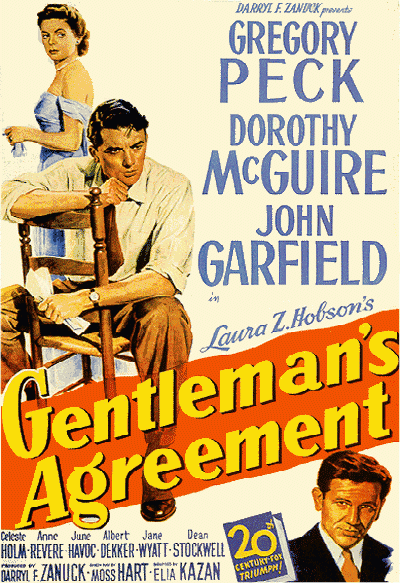
Film Poster for Gentleman's Agreement, 1947

man·ner [man er] n. [<L manus, a hand] 1. a way of doing something; mode of procedure 2. a way, esp. a usual way, of acting 3. [pl.] a) ways of social behavior / bad manners b) polite ways of social behavior / to learn manners/ 4. Kind; sort.

The first thing that pops into my head when I think of the word “manner” is the concept of “minding your manners,” attending to the guidelines we are given as a child. Usually this involves gentility, how we treat other people and how we present ourselves. It is about character, about respect for self and others. These ways of doing something were created to provide structure in our society and our communities. But oftentimes, manners are used synonymously with the idea of good moral behavior and this is not always the case. I think of it being good manners for the host family to sit at one table while the servants ate in the kitchen. I think of outdated rules like not wearing white after Labor Day or women wearing girdles and pantyhose, which once implied—and in some places still do—good manners and an acceptable way of dressing.

The second thing that I think of when I think of “manner” is those people who have a distinctive way of being. I think of old Hollywood celebrities who were recognizable not only for their appearance, but for the characteristics of their demeanor. Celebrities like Katherine Hepburn, Cary Grant, Rita Hayworth, Gene Kelly, and Gregory Peck.

I have been thinking about Gregory Peck often lately. I saw Roman Holiday when I was younger, but I don’t think I saw To Kill a Mockingbird until I was in my mid-twenties. Unlike many people, I wasn’t assigned the book in high school. I read it when I was twenty-one or twenty-two and I was struck by the book’s poignancy and universality. Although I had not grown up in the same time as Scout, I had grown up in the South very aware of class and racial differences around me. I had grown up with a very keen desire to understand injustice, which I saw seemingly everywhere around me. I identified with Scout and revered her father Atticus Finch as an upstanding citizen and moral voice amidst a community ruled by lunacy and fear.

I didn’t see the movie until years later. I was living in San Francisco at the time and had visited my local independent video store. I picked up To Kill a Mockbird then. I was again moved by the story, now told through film, and by the way each character works through their own relationship to the trial of Tom Robinson, a black man accused of raping a white woman in a rural Southern community. I was particularly moved by Peck’s performance as Atticus. I watched the special features, which included a documentary about Peck’s life.

Atticus Finch (Gregory Peck) and Tom Robinson (Brock Peters) in court

Here, I thought, was a man with a unique manner. It was he who had pushed for the production of To Kill a Mockingbird after having read the book. He devoted himself to films whose stories also held a greater social importance. I remember watching the documentary and feeling a real affection for him. This feeling was renewed when, that same year, I saw the film again on the big screen of San Francisco’s Castro Theatre. The screening included a question and answer period with Mary Badham, the actress who had played Scout as a child. She described Peck as having been very much a father figure to her. He was so similar in real life to the character he played in the film, she said.

To Kill a Mockingbird Poster, 1962

Recently, I watched the film The Gentlemen’s Agreement, which stars Peck. Dennis Hopper had just died and I decided I wanted to watch Rebel without a Cause, his first film in which he played a minor role. While browsing the Classics Section at Casa Video, I picked up The Gentlemen’s Agreement, read the back, and decided to rent it. The film is about a newspaper reporter Phillip Skylar Green who is asked to write a feature on anti-Semitism. He is searching for an angle for his story and arrives at pretending he himself is Jewish for a given period of time. No one is to know except his boss, his mother, and his fiancé, who he has just recently met. As the story unfolds, his interpersonal relationships are challenged by this choice to pretend to be Jewish. His fiancé doesn’t understand why he needs it to be a secret amongst her family. His son is threatened at school. His Jewish friend Dave even advises him against it. He is used to discrimination because he has been Jewish his whole live, but he fears that Skylar will not be able to handle it in one concentrated time period.

The film asks large questions of the viewer and challenges the viewer by the subtlety with which the characters come to realizations. The effect of prejudices like anti-Semitism, is revealed through interpersonal relationships, where the impact is felt in real life, and there are no true villains only complicated people. The film also makes a strong statement about people who are good-hearted and thoughtful but who remain silent or apathetic.

Another thing that makes this film so remarkable is its context. The film was released in 1947, just after World War II, just after anti-Semitism so strong it resulted in the genocide of over six million Jews in Europe. When Elia Kazan (who himself is a complicated character as he testified in 1952 in front of the House Un-American Activities Committee and named eight Hollywood associates who were former members of the Communist Party) decided to make the film, several Jewish studio heads told him not to make it. One said it would be “like stirring up a hornets’ nest.” That conversation ended up being worked in as a scene with the newspaper’s editorial board and its dissenting voice against the “anti-Semitism” story.

Skylar Green is a character who has manners but who is unwilling to abide by social constructs without critical thinking. He embodies a persecuted group in order to challenge certain social norms and to understand better where anti-Semitism is rooted and what impact it has on individuals. And yet, it is not Skylar who ends up being the hero, but his friend Dave, who in a strong speech talks about the eventual impact of being silent while others are mischaracterized, mistreated, and oppressed.

The actor who played Dave, John Garfield, was an actor who was a headlining leading man at the time, and he took a supporting role in the film because he so believed so strongly in the worth of the project.

The film’s title itself refers to a unspoken agreement that allows and endorses discrimination. At one point, Skylar Green goes to a hotel that he has reserved for his honeymoon and asks point-blank if they allow people who practice Judaism to stay there. The manager comes out and asks in a nuanced way if that is a hypothetical question or not. Eventually, he is asked to leave.

I think of today’s celebrities who get more attention for their outrageous, scandalous and often disgraceful behavior instead of getting revered for who they are. They become caricatures of how not to behave instead of models of how to be. And oftentimes, their loud lives are more recognizable than their body of work. I am grateful to actors like Peck who were more concerned with the impact they made with their work than with being famous and who picked their roles carefully, choosing the stories that were worthy, that asked questions and that ultimately modeled a way of being and asked viewers to question the way they themselves moved in the world.

1 Comment

Filed under weekly words