Monthly Archives: June 2010

man·ner

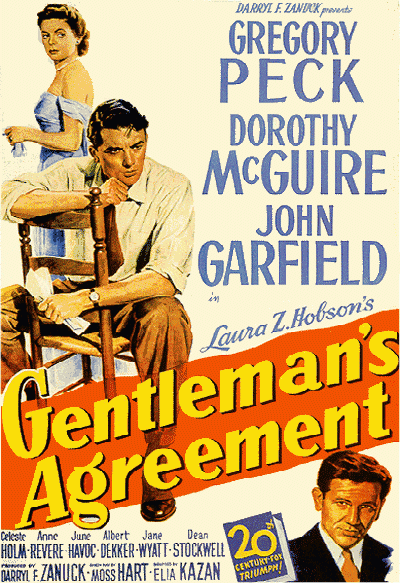
Film Poster for Gentleman's Agreement, 1947

man·ner [man er] n. [<L manus, a hand] 1. a way of doing something; mode of procedure 2. a way, esp. a usual way, of acting 3. [pl.] a) ways of social behavior / bad manners b) polite ways of social behavior / to learn manners/ 4. Kind; sort.

The first thing that pops into my head when I think of the word “manner” is the concept of “minding your manners,” attending to the guidelines we are given as a child. Usually this involves gentility, how we treat other people and how we present ourselves. It is about character, about respect for self and others. These ways of doing something were created to provide structure in our society and our communities. But oftentimes, manners are used synonymously with the idea of good moral behavior and this is not always the case. I think of it being good manners for the host family to sit at one table while the servants ate in the kitchen. I think of outdated rules like not wearing white after Labor Day or women wearing girdles and pantyhose, which once implied—and in some places still do—good manners and an acceptable way of dressing.

The second thing that I think of when I think of “manner” is those people who have a distinctive way of being. I think of old Hollywood celebrities who were recognizable not only for their appearance, but for the characteristics of their demeanor. Celebrities like Katherine Hepburn, Cary Grant, Rita Hayworth, Gene Kelly, and Gregory Peck.

I have been thinking about Gregory Peck often lately. I saw Roman Holiday when I was younger, but I don’t think I saw To Kill a Mockingbird until I was in my mid-twenties. Unlike many people, I wasn’t assigned the book in high school. I read it when I was twenty-one or twenty-two and I was struck by the book’s poignancy and universality. Although I had not grown up in the same time as Scout, I had grown up in the South very aware of class and racial differences around me. I had grown up with a very keen desire to understand injustice, which I saw seemingly everywhere around me. I identified with Scout and revered her father Atticus Finch as an upstanding citizen and moral voice amidst a community ruled by lunacy and fear.

I didn’t see the movie until years later. I was living in San Francisco at the time and had visited my local independent video store. I picked up To Kill a Mockbird then. I was again moved by the story, now told through film, and by the way each character works through their own relationship to the trial of Tom Robinson, a black man accused of raping a white woman in a rural Southern community. I was particularly moved by Peck’s performance as Atticus. I watched the special features, which included a documentary about Peck’s life.

Atticus Finch (Gregory Peck) and Tom Robinson (Brock Peters) in court

Here, I thought, was a man with a unique manner. It was he who had pushed for the production of To Kill a Mockingbird after having read the book. He devoted himself to films whose stories also held a greater social importance. I remember watching the documentary and feeling a real affection for him. This feeling was renewed when, that same year, I saw the film again on the big screen of San Francisco’s Castro Theatre. The screening included a question and answer period with Mary Badham, the actress who had played Scout as a child. She described Peck as having been very much a father figure to her. He was so similar in real life to the character he played in the film, she said.

To Kill a Mockingbird Poster, 1962

Recently, I watched the film The Gentlemen’s Agreement, which stars Peck. Dennis Hopper had just died and I decided I wanted to watch Rebel without a Cause, his first film in which he played a minor role. While browsing the Classics Section at Casa Video, I picked up The Gentlemen’s Agreement, read the back, and decided to rent it. The film is about a newspaper reporter Phillip Skylar Green who is asked to write a feature on anti-Semitism. He is searching for an angle for his story and arrives at pretending he himself is Jewish for a given period of time. No one is to know except his boss, his mother, and his fiancé, who he has just recently met. As the story unfolds, his interpersonal relationships are challenged by this choice to pretend to be Jewish. His fiancé doesn’t understand why he needs it to be a secret amongst her family. His son is threatened at school. His Jewish friend Dave even advises him against it. He is used to discrimination because he has been Jewish his whole live, but he fears that Skylar will not be able to handle it in one concentrated time period.

The film asks large questions of the viewer and challenges the viewer by the subtlety with which the characters come to realizations. The effect of prejudices like anti-Semitism, is revealed through interpersonal relationships, where the impact is felt in real life, and there are no true villains only complicated people. The film also makes a strong statement about people who are good-hearted and thoughtful but who remain silent or apathetic.

Another thing that makes this film so remarkable is its context. The film was released in 1947, just after World War II, just after anti-Semitism so strong it resulted in the genocide of over six million Jews in Europe. When Elia Kazan (who himself is a complicated character as he testified in 1952 in front of the House Un-American Activities Committee and named eight Hollywood associates who were former members of the Communist Party) decided to make the film, several Jewish studio heads told him not to make it. One said it would be “like stirring up a hornets’ nest.” That conversation ended up being worked in as a scene with the newspaper’s editorial board and its dissenting voice against the “anti-Semitism” story.

Skylar Green is a character who has manners but who is unwilling to abide by social constructs without critical thinking. He embodies a persecuted group in order to challenge certain social norms and to understand better where anti-Semitism is rooted and what impact it has on individuals. And yet, it is not Skylar who ends up being the hero, but his friend Dave, who in a strong speech talks about the eventual impact of being silent while others are mischaracterized, mistreated, and oppressed.

The actor who played Dave, John Garfield, was an actor who was a headlining leading man at the time, and he took a supporting role in the film because he so believed so strongly in the worth of the project.

The film’s title itself refers to a unspoken agreement that allows and endorses discrimination. At one point, Skylar Green goes to a hotel that he has reserved for his honeymoon and asks point-blank if they allow people who practice Judaism to stay there. The manager comes out and asks in a nuanced way if that is a hypothetical question or not. Eventually, he is asked to leave.

I think of today’s celebrities who get more attention for their outrageous, scandalous and often disgraceful behavior instead of getting revered for who they are. They become caricatures of how not to behave instead of models of how to be. And oftentimes, their loud lives are more recognizable than their body of work. I am grateful to actors like Peck who were more concerned with the impact they made with their work than with being famous and who picked their roles carefully, choosing the stories that were worthy, that asked questions and that ultimately modeled a way of being and asked viewers to question the way they themselves moved in the world.

1 Comment

Filed under weekly words

sal·e·ra·tus


Bonneville Salt Flats


Today, we have a guest post from writer and friend of the project, Julie Lauterbach-Colby*:

sal·e·ra·tus (sal’e’ra’tes), n. [Mod. L. sal aeraius, aerated salt], sodium (or sometimes potassium) bicarbonate; baking soda, as used in cooking.

A space opens to provide context—topographic lines separating what runs away (what I have run from). Almost as soon as we crossed the Californian border into Nevada we start to see the dried salt flats. What used to be lakes, appear as opening voids on the altas. Points, here. An exact location rendered gone. Those first explorers into the open lands: the badlands, wastelands. Where the earth has dried and cracked, opened up from sudden change, sudden pressure (the constant ebb of flow of life, of family units), chasms of depth and darkness. How deep is each cut (of the earth)? Around the outer rims, white powder still visible. Traces of. Portraits of. The past. Water marks: where seawater dug its way gently into the sides of the land. With each receding, circular line: a closing in upon itself. Earth’s vacuum effect. From a bird’s eye view, cartographers map each concentric shape wider, farther apart from the last. On a map, what we have is an inverse mountain, a valley that appears to create a wide vortex but which, from the ground, appears nothing but flat for miles and miles and miles.


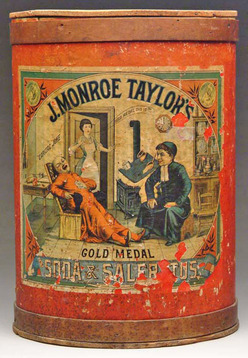
saleratus cannister


The cake, too: flat and even when I peek into the oven to check its progress. Sudden change, sudden pressure: my mother, a lesson. Set on the counter to cool, the soft center closes in upon itself. Baking soda, saleratus powder, likes heat and time to converge with the flour. What I have is (What appears from my bird’s eye view.) cartographic crater.

My family, driving the winding Californian coast each summer, past Carmel and Monterey out to the coast where we dug for abandoned shells and overturned abalone. On the edge, where saltwater plunges itself into porous rock, what remains? Collected in shallow pools, sun-evaporated during low tide, this white powder. Remains of after collected on the tip of one’s finger.

Ground up and put next to each other, sodium chloride (sea salt) and sodium bicarbonate (baking soda) look almost identical. (As in the saying, Like mother, like daughter.) But we must think back to the tracing of one’s concentric circles: each enclosed within the other (Do we interpret those inner rungs, those that, on a map, appear to be digging themselves into a hole?) but standing on the edge one sees that no: what we have is (       ).


*Julie Lauterbach-Colby is a writer, teacher and artist living in Tucson. She is currently working on a project that incorporates cartography, mathematical equations and cadavers, and owns her own editing business called Chicken Scratch Editing.

1 Comment

Filed under weekly words

belle

belle (bel) n. [Fr., fem. of beau; see beau],  1. A very attractive woman or girl.  2. The most attractive or most popular woman or girl of a certain place or on a given occasion: as, the belle of the ball.

Rue McClanahan as Blanche Devereaux

This is one of those uncharacteristic times when I choose a word to ruminate on in addition to the word of the week. And this word is “belle.”

In the last month and a half, we have lost two iconic actresses who created iconic characters: Dixie Carter as Julia Sugarbaker and Rue McClanahan as Blanche Devereaux.

I have been uncharacteristically sad about these celebrity deaths. I have always loved Designing Women. As an avid fan of The Golden Girls, I grieved the loss of both Bea Arthur and Estelle Getty this past year. However, there

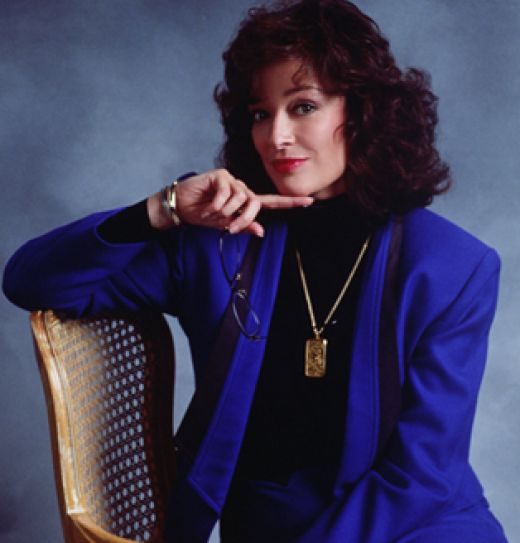
Dixie Carter as Julia Sugarbaker

was something different about the loss of Rue.

Let me offer some context. I was born and raised in New Orleans, Louisiana—in a place where, despite modern times, I learned that women were supposed to dress, act, and behave in certain ways. I wore tights as a little girl and at about age eleven switched to pantyhose (even in summer, in Louisiana). My mother never let me leave the house without something being pressed. I learned to have pride in my appearance, in the way I dressed and the way I conducted myself.

I learned that there was no white after Labor Day. I learned about pearls and handkerchiefs and linen and seersucker. I learned the importance of presenting oneself in a certain way. I also learned that women were to be smart (but not too smart), interesting (but not too interesting).

I was fortunate enough to be raised by progressive parents, who encouraged me to do whatever I wanted to, who believed I could do anything a boy could do. They encouraged me to follow my dreams and to pursue whatever held my interest. However, despite their support, I always had a feeling that I might have to sacrifice one part of myself for the other. I would have to cover up my femininity in order to be strong. I would have to pretend to be passive to maintain my girl-ness.

I watched The Golden Girls and Designing Women during formative years in my life. The first time I remember watching The Golden Girls was when I went to my grandmother’s house after school in junior high. It was a hard time for me. My parents were separated, which had come to me as a total shock. I was at a new school for the first time, and for the first time, I was in class with boys. I felt like I didn’t fit in and had no chance of being popular. I have always loved these two shows, but it wasn’t until the stunning sadness at the loss of these two women that I have begun to understand why.

I realize now that in Julia and in Blanche, I found role models of what it means to be a real Southern belle. Not a Scarlet O’Hara or a Blanche DuBois, but a belle for modern times. A belle who is self-defined instead of defined by men’s expectations of her.

These were woman who were attractive and not just because of what they looked like. These were women who were smart and educated. They had family lives and professional lives. They had quick wits and were quick to use them. They were classy, well-dressed and gorgeous. They had beautiful, intimate friendships and sometimes challenging but fulfilling romantic relationships. They had grown into themselves and were responsible for that growing.

And they were older. Rue McClanahan once said of The Golden Girls: “that when people mature, they add layers.” And the show was a revelation of that fact, a fact that women need to hear. Because I think there is still an idea in our culture, which is much too rampant, especially in the South. That being that women are to be respected because of their beauty and when they are older, they become washed-up, objects to be forgotten about or thrown away. The show proved that women become even more assured and knowledgeable and interesting with every year that passes. Women become more beautiful with more life experiences and lessons learned, with more laugh lines and wrinkles.

The shows themselves had substance, unlike most shows today, and were not afraid to tackle controversial issues, like HIV/AIDS and racism. Because the writing was so good and the acting was so strong, these issues worked seamlessly into the dialogue and action of episodes. And one of the commonalities between them was a strong feminist thread. In their episodes, Designing Women and The Golden Girls dealt with: abusive relationships, domestic violence, sexism and sexual harassment, violence towards women and self-defense courses, expectations for women’s beauty, and sex and sexuality.

These shows weren’t produced as Public Service Announcements but as powerful dramatic and comedic programming that revealed real characters working through and struggling with these realities in their day to day lives. And so, when I was young, I learned vicariously what it meant to stand up for myself, and how I should be treated, with respect and love.

I want to use these women to redefine the conception of Southern belles. The thing about real Southern belles is that they don’t restrict themselves. At the same time, and in the moment they sashay their hips, they are feminine and strong, they are classy and kitschy, they are sweet and what some may call bitchy. They are bold with their own ideas and receptive to others’. They are sexy and innocent. They are the ultimate hostesses and vulnerable to making mistakes. They refuse to be defined as one thing or another. They can be both and all.

I learned from these women that it was okay to be myself, that it was fullness and contradiction that makes women beautiful. I learned to accept all my qualities as valuable. Some might call Julia a bitch because she spoke her mind. Some might call Blanche a slut because she took charge of her own sexuality. I call them strong Southern women who I was lucky to see as an impressionable little girl. I will always be grateful to Dixie and to Rue for creating such lovely and lovable complicated women who became role models of how to be it all, how to have it all, and most of all: how to be myself.

3 Comments

Filed under other words