Tag Archives: dictionary project

glass·man

glass-man


Day 12 of the 30 days, 30 words challenge:


glass·man (ˈgläs mən),  n., pl.  —men  1.  a person who makes or sells glass.  2.  a glazier.  [GLASS + MAN]


The glassman lived in a glassy house on a street near a glassy sea. His life was, by design, careful. His whole house covered in carpet. All surfaces smooth, all parts plush. It wasn’t particularly sanitary: pillowtop countertops in the kitchens, bathroom sink basins made of soft clay. But for the glassman, softness was survival. Each morning, he slowly pushed off his covers and inched his legs to the edge of the bed, then he inched his legs over the side, then inched his feet towards his slippers, lying waiting on the floor. I would tell you about how he happened to arrive at the kitchen but, as you might imagine, that would take a very long time. In the kitchen, he went to his custom-made, foam-covered refrigerator to find jello or yogurt or smoothies, nothing that could get caught in his windpipe. His bones had always been brittle. He had always been prone to breaking. The possibility of fracture was a constant reminder in the sounds his body made: his clavicle crunched, his sternum snapped, his humerus hummed. When he found a small fissure, he filled it only way he knew how, and he traced his steps to see how he might have done it. There aren’t cures for glassmen, only tinctures. You could say the glassman lived a very limited life, and you’d be right, but the glassman didn’t know any different.


If he had been a boy not made of glass, maybe he would have grown up playing kick the can and climbing on the jungle gym with the other kids. Maybe he would have fallen and found a thick scrape forming a red grid across his knee. He would have placed his leg over the toilet boil as his mother poured hydrogen peroxide over it. He would have felt the burn. Or he would have played catch, the baseball hitting his arm and forming a large bruise, purple in the center and yellow around the edges until it disappeared completely, the flesh restoring itself, the injury only a memory. He would have had popped blood vessels and sore muscles and cracked lips. He would have had use for Neosporin and lip balm and bandaids. Then, he would have grown up and learned that there are far more damaging kinds of hurt, the ones so visceral you sometimes wish you could feel them in your body, maybe that would be more honest. He would have learned there are hurts that never fully heal.


As it was, the glassman was made of glass. So he only knew what it meant to be breakable. He only knew how to imagine a worst-case scenario and try to protect against it. He could see the glassy sea outside the window but he could not go to it. The glassman knew the risks were too high. The glassman knew what he was made of. The glassman, above all, knew how he could shatter.

1 Comment

Filed under 30 days 30 words

o·ver·kind

madewithover


Day 11 of the 30 days, 30 words challenge:


o·ver·kind  (ˈōvər’kīnd),  adj.  too kind; She means well but is overkind to the point of annoyance.  [ME overkinde. See OVER-, KIND1)  —o·ver·kind·ly, adv.  o·ver·kind·ness, n.


Sandra subscribed to Overkind.com because she needed a little more kindness in her life. She had recently gone through a breakup, she was living away from her family, and she liked to keep to herself. She didn’t want to burden the few friends she had with late night schmaltzy talks about her woes. Even thinking about her problems as woes made her recoil. She just needed some momentary support. She stumbled onto the Overkind site after reading some article on The Huffington Post’s “GPS for the Soul” section—which she couldn’t believe she was actually reading; I mean, “GPS for the Soul,” really?

The website was not as cheesy as she had expected, no rainbows or butterflies, no pink and purple polka dots. There was a cleanness to the font that she liked, a sweet formality to the pages. On the “About” page, Overkind.com promised: “We will be your best friend but without the demands and attachments of real, flawed people. Each day, you will receive a surprise in your inbox. Each week, you will get a package in the mail. Each month, you will receive a special gift tailored for you from your survey submission of likes, dislikes, allergies, etc.”

Sandra had always liked the word “over.” Over always made her think of climbing a mountain and taking in an expansive view, or crossing a bridge to the other side. It was an empowering sort of word: over. When added as a prefix, it could make words better: overjoyed, overlap, overleap, overlay, overcome. She would overcome this moment. Overkind would help.

She went to the subscribe page, picked “Overkind Package #1” and entered her personal information. Then she closed her laptop and went to sleep.

Sandra was pleasantly surprised that first week with the thoughtfulness of Overkind. When she clicked on the email in her inbox each day, she felt recognized and appreciated. That first day, her email message contained links to articles about contemporary art (one of her listed interests), a word of the day (she had said “yes” to the question about loving language). There were also several high-resolution photos: a close-up of a coral hibiscus, a black-and-white photo of a blues singer, mouth open in song. There was a recipe for black bean soup and instructions on how to grow your own herb garden.

When Sandra checked her mailbox on Wednesday, she found a thick envelope with seed packages of basil and thyme and rosemary. They were wrapped up in that pretty paper that has pressed flowers in it. There was a mix CD featuring some of her favorite artists and a card with an inspirational quote by Hafiz.

At the end of the month, she received a notice via email that she would get a UPS package soon: her tailored gift! She rushed home from work on Friday to see if it had arrived and it had. The package was tucked under her front door mat. She could hardly contain her excitement as she rushed to open the door. Dropping her bag on the kitchen table, she tore through the envelope to reveal what was inside and she found: a purple pencil skirt.

Something was deeply wrong.

Maybe she had gotten someone else’s package by mistake. But she checked the address and the invoice inside. No, this was for her. But it wasn’t for her. She tried to think of anything she could have answered to make this gift make sense as “tailored for her” but it wasn’t. She hated purple. She hated tight-fitting clothing. She wasn’t a huge fan of skirts. She wondered what to do. Overkind had been spot on so far but something was amiss.

Sandra flipped open her Macbook and pulled up the site. She looked everywhere but could find no phone number to call, only a generic “Contact Us” form. In the subject line, she wrote “Urgent Matter,” and then she wrote: “Dear Overkind Employee, I am deeply disturbed at the ‘tailored gift in the mail’ I just received. There seems to be no attention to my likes or dislikes in the creation of this gift. Please get back to me as soon as possible.” She signed with her name, email, and cell number.

The weekend passed and she expected to hear back on Monday, but she didn’t. Emails kept coming: with quotes and recipes and photos and links. There was a pdf of a short story from The New Yorker. She couldn’t keep up. It was all too much. She went to the website to cancel her subscription, but the website said to use the “Contact Us” form to cancel. She wrote a second message, this one saying that she just wanted to end her subscription. She didn’t need a new gift, but she was done with the service. No response. She sent several more messages and they all went unanswered. Her virtual best friend, the one she had paid for, was ignoring her. Her messages became more irate, more defensive. She stopped using a salutation.

One evening, Sandra returned home from work to find her empty house: the slick floors, the clean kitchen, the keys hanging in place on their hook. She hung her coat and put her bag on the chair. She could hear her heels clicking against the hard wood floors and suddenly she couldn’t bear the impenetrable sound: solid hitting solid.

She collapsed in a heap on the living room floor—on top of the rug she and her ex picked out together, next to the couch they used to lie on, under the lighting fixture they installed themselves—overcome. Her attempt to buffer herself from it all was backfiring. No amount of kindness would undo what was over. And she wouldn’t be over until she moved through. The messages and packages and gifts would still arrive, or they wouldn’t, but they wouldn’t be for her, not really. This kindness was paid for and manufactured. And they hadn’t gotten it right. No matter how many questions she answered, she wasn’t really known. Not by some random people running some website.

What had been comforting the first few weeks now overwhelmed her. She hadn’t thought about the excess of “over,” the overage. But that’s what all this was: too much. Now, the words flooded her—she could hear them all in a refrain: overflow, overgrow, overlook, overrun, overwork, overwrought, overload, overblown, oversleep, overspend, overstay, overpower, overboard, overburden, overdrive, overdress, overdone. Over. Over. Over.


Leave a comment

Filed under 30 days 30 words

by·name


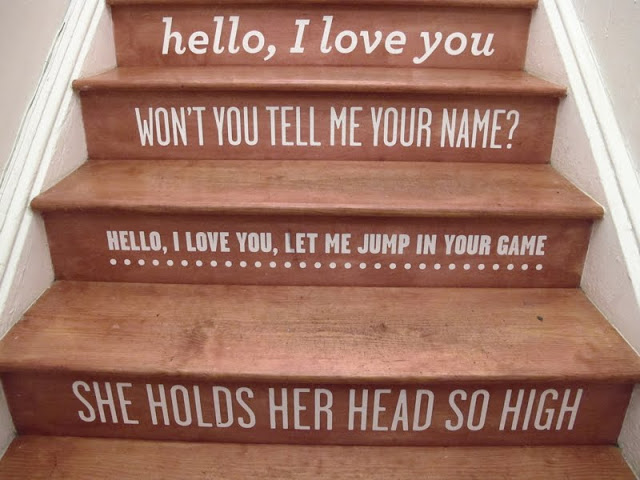
helloiloveyou by ivan rodic


Day 10 of the 30 days, 30 words challenge


by·name (ˈbī-ˌnām),  n.  1.  a second name; surname.  2.  a nickname.


hellomynameisdifferentlangs


We humans are obsessed with what to call things. We need names for everything. And then we need new names. We gives names as a way of formalizing behaviors. We name new technology and add it to the lexicon. We name babies and then we immediately come up with nicknames for them. Once we have uniqued their existence, we need to unique them again.

Bynames often refer to shortened versions of someone’s name. In many cases, the name is shortened because there is someone else in the family with the same name. Many of my family members were nicknamed: my grandmother Celeste was Sally to family members, my grandfather Eugene was Gene, my maw maw Josephine was Tante Fine to her nieces and nephews. And my father and his brothers all had nicknames growing up, some of them lasting to adulthood: Tommy, Jimmy, Johnny, and Tommy. A point guard on her high school basketball team, the announcer always called my mom “tall drink of water.” My dad studied theology in Italy, where Romans referred to all the seminarians in their long dark robes as bagarozzi, or cockroaches.

The word nickname comes from the compound word ekename, meaning additional name, which dates back to 1303. Ekename comes from the Old English phrase “eaca,” an increase. The word changed from ekename to nekename and then to its current spelling: nickname.

There is a surprisingly large amount of information written about nicknames on the web. There are articles on the impetus to nickname, the origin of the word nickname, how certain nicknames for popular Western names came to be, why certain cities have their nicknames, why we should stop naming hugely destructive storms with generic names and instead  name them after climate change deniers, and why you should let people in professional contexts call you by your nickname.

hello_collage


Nicknames can arise from teasing or poking fun, but often even these names are bestowed with a sense of endearment. Japanese honorifics are nicknames that reveal the specific relationship between family members. Nicknames are made out of last names if multiple people share the same first name.

I was always jealous growing up as my name isn’t very nicknameable. My first name itself was originally intended as a nickname. My parents planned to name me Elizabeth and call me Lisa, but then when they realized they had no intention of calling me Elizabeth ever, it made more sense to just make Lisa my name. I tried several times over the years to nickname myself (a clear no-no) but nothing ever stuck. So I consoled myself with having a name I actually liked and moved on. I have several friends who want or wanted to go by their full name but constantly had to battle for this to be the case. There is something in us that wants to shorten and simplify—we want to create intimacy with one another and we do this by using as few letters as possible.

The President and Chief Operating Officer of Buzzfeed Jon Steinberg wrote an article called “Why You Should Let People Call You By a Nickname.” In it, he talked about how until a decade ago, he went by Jonathan. However, people always tried to call him Jon. After grad school, he began to question his insistence on being called his full name. He writes, “It was akin, in my mind, to telling people who wanted to befriend me or be close to me that they in fact could not be. I decided that I valued closeness more than I valued my formal name, and switched to Jon. Never looked back.”

Steinberg also talks about a study by The Ladders that revealed that executives with short names tend to earn more. In his own informal study, he found that of the Fortune 50, “14 CEOs or 28% go by Nicknames and 32% have Nickname-like First Names. Combined, 60% of Fortune 50 CEOs go by a Nickname or have a Nickname-like First Name.” He cites successful people who go by nicknames: Steve Jobs, Bill Clinton, Jamie Dimon, Meg Whitman, Bill Gates, Mark Zuckerberg. He says this is less about convenience than it is about trust. When we call each other by nicknames or shorter versions of our names, there is more of a capacity for emotional connection.  He writes, “a short name or nickname is a sign of intimacy, trust, and friendship. These can often be critical attributes in the building of a successful organization. Whereas a long and formal name creates a barrier, a short one can break down walls.”

What about you all? Do you have bynames? What are they? Where did they come from? What do they mean to you? I’d love to hear from you.


baby_name

I don't know why I find this so hilarious.

I don’t know why I find this so hilarious.


3 Comments

Filed under 30 days 30 words

Dutch oven

dutch-oven-review


Day 9 of the 30 days, 30 words challenge:


Dutch oven,  1.  an iron kettle for baking, with a tight-fitting convex lid, on which live coals can be placed.  2.  a metal container for roasting meats, etc. with an open side placed so that it is toward the fire.  3.  a brick oven whose walls are preheated for cooking.


The casseroles started arriving on Sunday. Large glass baking dishes covered in foil. Aluminum pans. Dutch ovens in every size and color. Usually, scotchtaped to the top was a handwritten note with the same kind of words and the name of the family who left the dish. We took the casseroles off the stoop and lined them up on the countertop. Then we took post-its and labeled them: broccoli and cheese, sweet potato and marshmallow, tuna, baked ziti, lasagna, shepherd’s pie. There were round tins of quiche. There were a few kinds of pie. Someone had started a list on a legal pad with columns drawn down the page: what dish had been brought on what day and by whom, ostensibly to know how long they would keep or for future thank you notes. None of us felt much like eating. It’s funny how the impulse in times like these is to want to make food: as if the void that needs filling is in someone’s stomach. And it’s funny how at this time of others’ great generosity, it is hard to bring yourself to cut a piece of something, put it on a plate, and stick it in the microwave. These meals are gestures made to simplify but they serve as reminders of how much energy it takes just to decide to put food on a fork and stick it in your mouth, of how much time it takes to chew. We kept filling the refrigerator, stacking and organizing and reorganizing, negotiating apple pie and potato salad, until there was no longer any room. We didn’t want to be wasteful so we put a sign on the door that said, “Thank you for your thoughtfulness but there’s no more room in our fridge.” We heard the sounds of people coming by, their footsteps on the front walk, arriving and receding, but none of us could bear to go to the door. Instead, we sat in the living room with the lights off and the T.V. on a program that none of us was watching. We didn’t need to go out. We had all that food already. We knew it was there, just in case any of us ever felt hungry again.


1 Comment

Filed under 30 days 30 words

ma·ha·lo

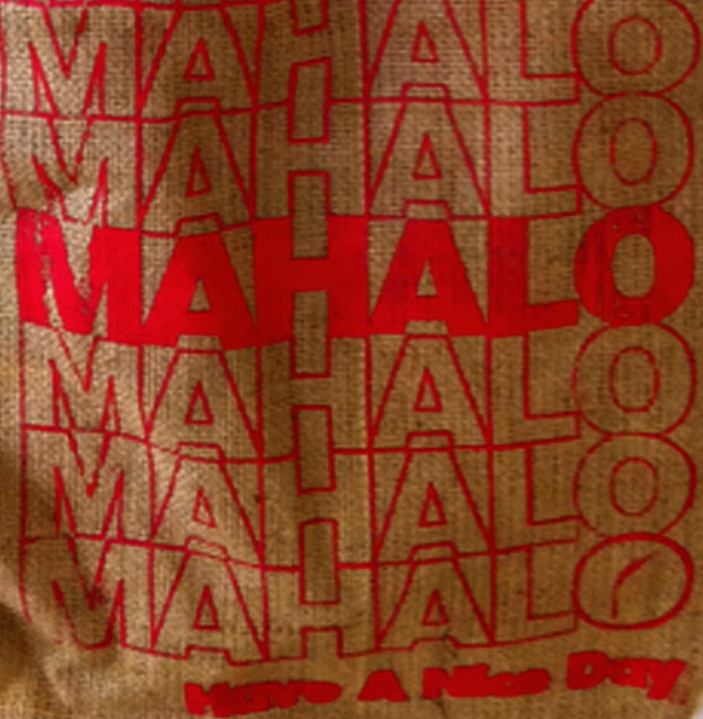
Mahalo_Recyecled_CoffeeBean_Bag


Day 8 of the 30 days, 30 words challenge!


ma·ha·lo  /ˈmäˌhälō/   [Hawaiian] :   thank you


How many times during the course of your day do you say the words “thank you”?


Most of us are well trained to offer thanks throughout the course of the day: to the person who lets us go before them in line at the grocery store, to the barista who pours our coffee, to the fellow rider who offers us his or her seat on the bus, to the person who whispers a “bless you” or “gesundheit” when we sneeze. The act of giving thanks can sometimes lose its meaning in mundane repetition, even if the words are sincere. How often do we actually connect with what we are saying? How often are we really offering thanks rather than going through the motions?


Sometimes, we can say the word “thanks” in a way that actually implies the opposite. As in “thanks a lot,” when we don’t feel we have gotten what we needed in an appropriate time or manner. Our “Thanks” is canceled out when we add “for nothing” to it.


Anthropologist David Graeber writes about the origins of niceties in the English language. He writes, “Consider the custom, in American society, of constantly saying ‘please’ and ‘thank you.’ To do so is often treated as basic morality: we are constantly chiding children for forgetting to do it…We often assume that the habit is universal, but … it is not. Like so many of our everyday courtesies, it is a kind of democratization of what was once a habit of feudal deference: the insistence on treating absolutely everyone the way that one used only to have to treat a lord or similar hierarchical superior.”


He writes about it deriving significance from commerce: “it is the language of bureaus, shops, and offices, and over the course of the last five hundred years it has spread across the world along with them.” He continues to say that it is related to assumptions about “what humans are and what they owe one another, that have by now become so deeply ingrained that we cannot see them.”


But I wonder, isn’t offering thanks more than fulfilling an unwritten obligation? Doesn’t saying “thank you” have the capacity to be an act of generosity rather than a repayment of what is owed? Regardless of what our collective rituals are, isn’t there some desire within us to acknowledge someone else standing before us with his or her gifts?


The Hawaiian word mahalo is translated as “thank you” but much is lost in this translation. Kūpuna, Hawaiian elders, speak about the word as a spiritual blessing. Ma means “in.” Hâ means “breath.” Alo means “presence” or “front” or “face.” So a more accurate interpretation of mahalo would be: “May you be in Divine Breath” or “May you be in the presence of divine spiritual breath of life.”


In this way, saying mahalo is not dependent on having had anything done for you. Saying mahalo can be an honoring of what another is offering just by being alive and present, standing before you.


In the United States, we live in a culture that very much thrives on a scarcity mentality. We are told we need more and more to be happy, and when we get more and are still not happy, advertisers tell us it is because we didn’t get the right kind of “more.” We are sold solutions for problems we didn’t even know we had. If we continue to believe these stories of scarcity then what we have is never enough and it becomes nearly impossible to be satisfied, much less grateful.


Photo by Andrew Pescod

Photo by Andrew Pescod


I keep hearing in different stories in different places that although you may think that giving would grow in proportion to one’s income, the reality is the opposite. An NPR story last week discussed the work of UCLA researcher Patricia Greenfield who tracked families in Chiapas ,Mexico over four decades. Many of her study’s participants began poor but grew in wealth over time. She explains wealth increases, “We become more individualistic, less family and community oriented.”


Greenfield argues that this trend has happened in the United States over a longer period. This shift where individual wealth is the ultimate goal is reflected in the way we communicate with one another. According to the article, Greenfield did an analysis of more than one million books published between the years 1800 and 2000 in the U.S. As the country grew wealthier over that 200-year period, Greenfield found a difference in the words used:  “the frequency of the word ‘get’ went up and the frequency of the word ‘give’ went down.”  Her study also revealed changes in the way in which Americans referred to themselves, with “individual,” “self,” and “unique” becoming more popular than words that reflect community like “give” and “belong.”


I worked in the lower Garden District of New Orleans at a small nonprofit community center when I was in my early twenties. This was years after the St. Thomas Housing Development had been torn down and the River Garden “mixed income” housing development had risen in its place. Those who worked at the center talked about how, yes, there had been issues with drugs and violence, but these were spoken of as a hindrance, as something that could have been fixed with time and attention. They spoke with grief in their voices of what had been lost. When the housing development was torn down, the community was torn apart. Neighbors used to be able to rely on one another for childcare. They would look out for each other, making extra food when they knew a friend was hurting or slipping a five or ten dollar bill into their next-door neighbor’s pocket when she wasn’t looking. There was a sense that times were hard and nobody had a lot, but that what they had could be shared, had to be shared. When the housing development was torn down, community members were left to fend for themselves.


This same issue was magnified years later when the city council chose to tear down many housing developments after Hurricane Katrina. None of these had much or any damage from the storm; most of them had been built in the sixties and the materials used easily withstood the winds and water. The damage that did exist was from years of neglect from HUD, not from the impact of the winds of the storm or the levees failing. When I would check in with friends back at the community center, they talked about how many calls a day–80, 100–they were getting about rent assistance and utility assistance. People couldn’t get Section 8 housing. People weren’t able to afford rents. Residents from public housing were scattered around the city, which not only made living hard but less joyful. When we don’t live in community, we don’t have as many opportunities to be generous or as many opportunities to be grateful. Our failures become solitary and have to be borne alone. We believe we have to make it by ourselves and when we can’t (as we all experience at some point or another), it is easy to fall into despair.


Professor of Psychology at U C Berkeley Dacher Keltner grew up poor himself and felt a shift in his responsiveness to others when he moved into a position of prominence and wealth. Data from his research quantifies what he felt in his own experience. On NPR, he said, “ In just about every way you can study it, our lower-class individuals volunteer more, they give more of their resources — they’re more generous,” he said. “The poor, say with family incomes below $30,000 and $25,000, are giving about 4.2 percent of their wealth away, whereas the wealthy are giving away 2.7 percent.”


As people grow wealthy and able to take care of themselves, they don’t have to rely on the support of their community and so they may not strive to maintain or create new connections. And they may not feel the need to help others.


When we are focused only on ourselves and our own wellbeing, we not only lose sight of those around us but we cheat ourselves out of the opportunity to be part of a larger community. We cheat ourselves of the gift of offering our generosity and the gift of accepting the generosity of others. We deny ourselves the beauty that can only come through connection.


I know that using the sanskrit word namaste has become a sort of cliche, mostly because of its use in the American yoga community. And I understand the problems with cultural appropriation. However, I think the desire to use this word–to bring in words like namaste or mahalo–comes from a deep yearning for a word that is stronger than thank you. Namaste translates as “the divine in me honors the divine in you.” To recognize the divine in someone else is to imply careful, deep attention. To offer a spiritual blessing means that you honor the other person in their complexity, that you see them for their deepest and most divine self.


I think that we need opportunities to give to one another. I think we crave this. We are not completely fed when we feed only ourselves. The Buddha said, “If you knew what I know about the power of giving, you would not let a single meal pass without sharing it in some way.” In the African dance classes I go to regularly, there are certain moves that the teachers refer to as “give.” Arms and hands are extended, palms open, to the sides or to the front or to the sky, the gesture an act of offering the energy of the movement and of oneself. And as we do the movements, the teacher will repeat the reminder as we move our arms to the beat to the drum, “And give, and give, and give, and give…”


3 Comments

Filed under 30 days 30 words

sheep dog

sheepdog


Day 7 of the 30 days, 30 words challenge:


sheep dog,  a dog trained to herd and protect sheep; specifically a)  a collie  b) a large, gentle dog with a short talk and long, rough hair covering the face and eyes: also called old English sheep dog.


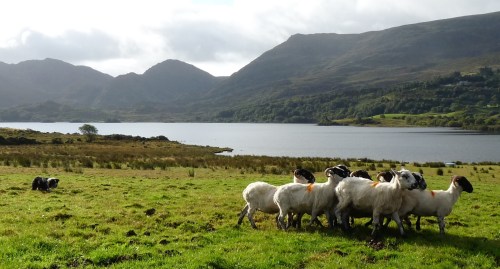
O’Brien looked at the pup.  He had been the runt of his litter. When he was just born, O’Brien had to put the other dogs away, in a pen, to let him feed. Otherwise, he was always just waiting behind the others, still blinded from new birth and unable to find a way over his brothers and sisters and to the teats. O’Brien named him Bídeach, but most of the time he called him Bid or Biddy. Siobhan thought it was a waste to time to train him for the herd, “Such a bitty body, bitty brain,” but O’Brien sensed she was wrong. And the first time he let him out with the sheep when he was barely a month old, he didn’t run them ragged the way most young pups did. Without training, he began to move closer to the herd, to crouch low, and after a moment, to move close again. From that time, O’Brien took Bid out to the fields with him almost every day, even when the other dogs were working. And when the other dogs herded, Bid stayed right by his side until the color started to drain out of the sky and they headed back to the house. O’Brien had been raised to love animals but hold them at a distance, and he had been able to do that most of his life. He knew that animals came and went and that was the natural order of things. It was best not to become attached. But something about the way Bid had changed things.  So when Bid started to take breaks when he was running, to pant and lie down, O’Brien felt a knot form inside his chest. Runts are apt to live shorter lives, to have more health issues. Nature makes them work harder to survive. “You’ve done a good job here,” O’Brien said, reaching down to stroke the pup’s black and white fur. “You can leave whenever  you’re ready.” Such a small thing to have taken up such  a large space, he thought to himself. Such a very small thing.
3 Comments

Filed under 30 days 30 words

shelled

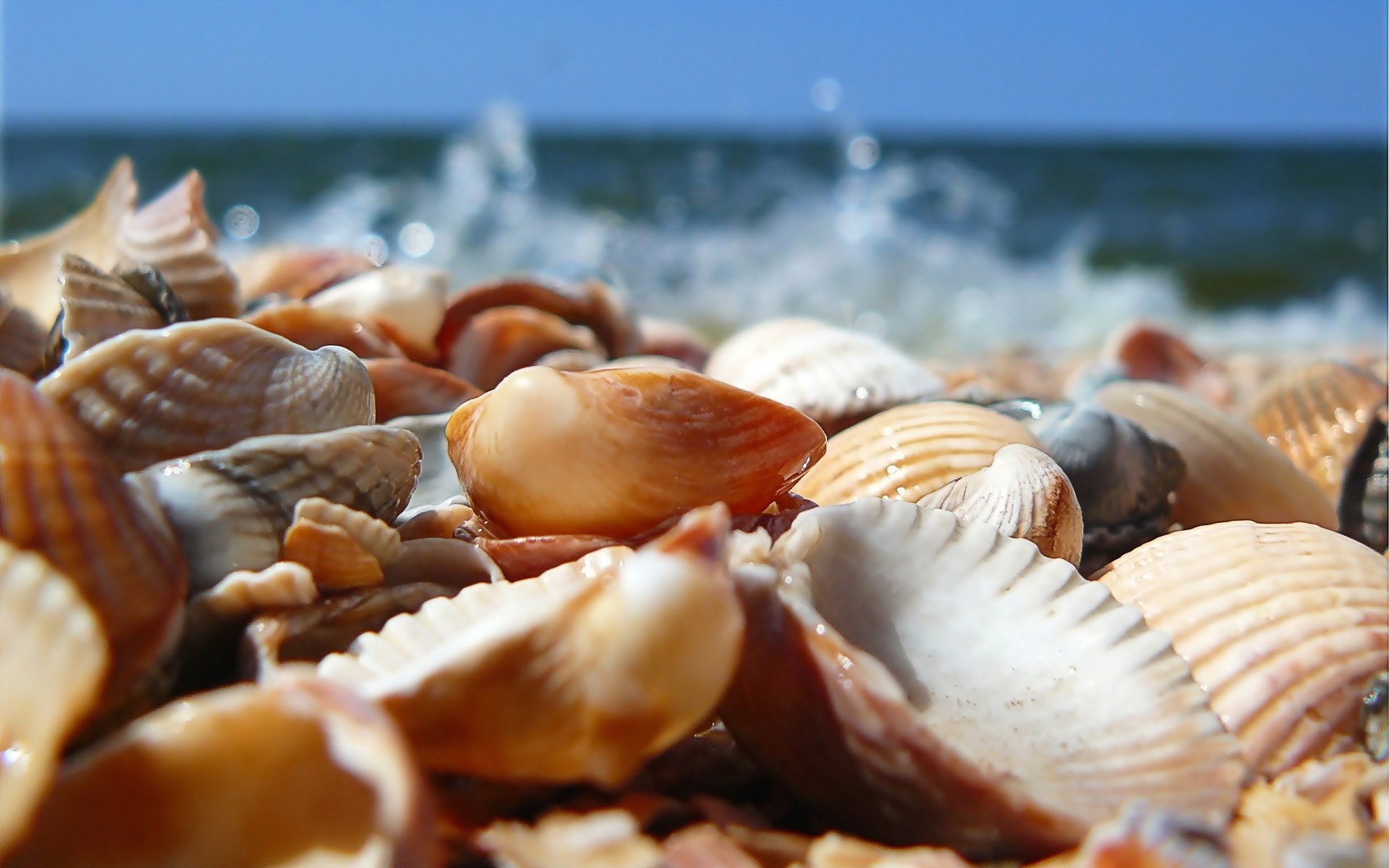
Shells-on-the-beach

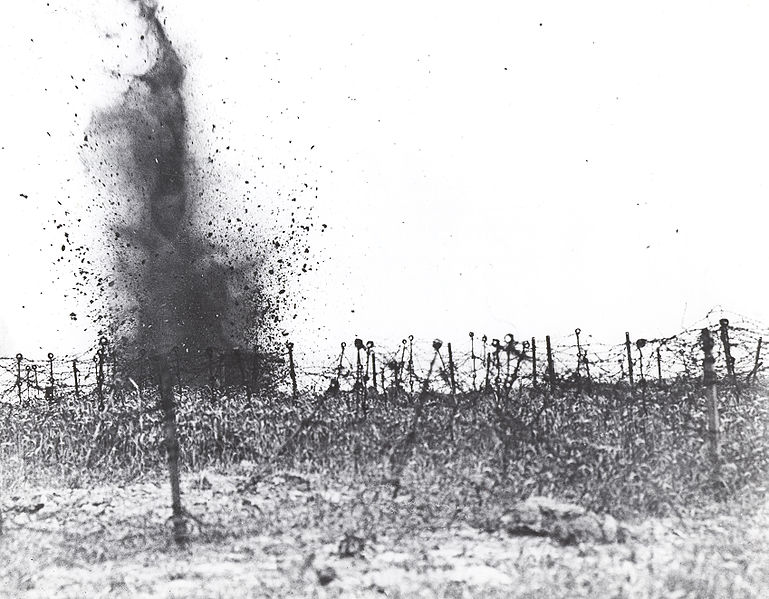
769px-Smashing_barbed_wire_with_trench_mortar_shells

bombshell


Day 6 in the 30 words, 30 days challenge.


I happened to be sitting around a table with Elizabeth Frankie Rollins and Elizabeth Smucker today so I asked them to join me in the challenge. Thanks for playing y’all!  The three of our compositions included below.


shelled  (sheld), a combining form meaning having a (specified kind of) shell, as in soft-shelled.


Elizabeth Frankie Rollins:

frankie1frankie2frankie3

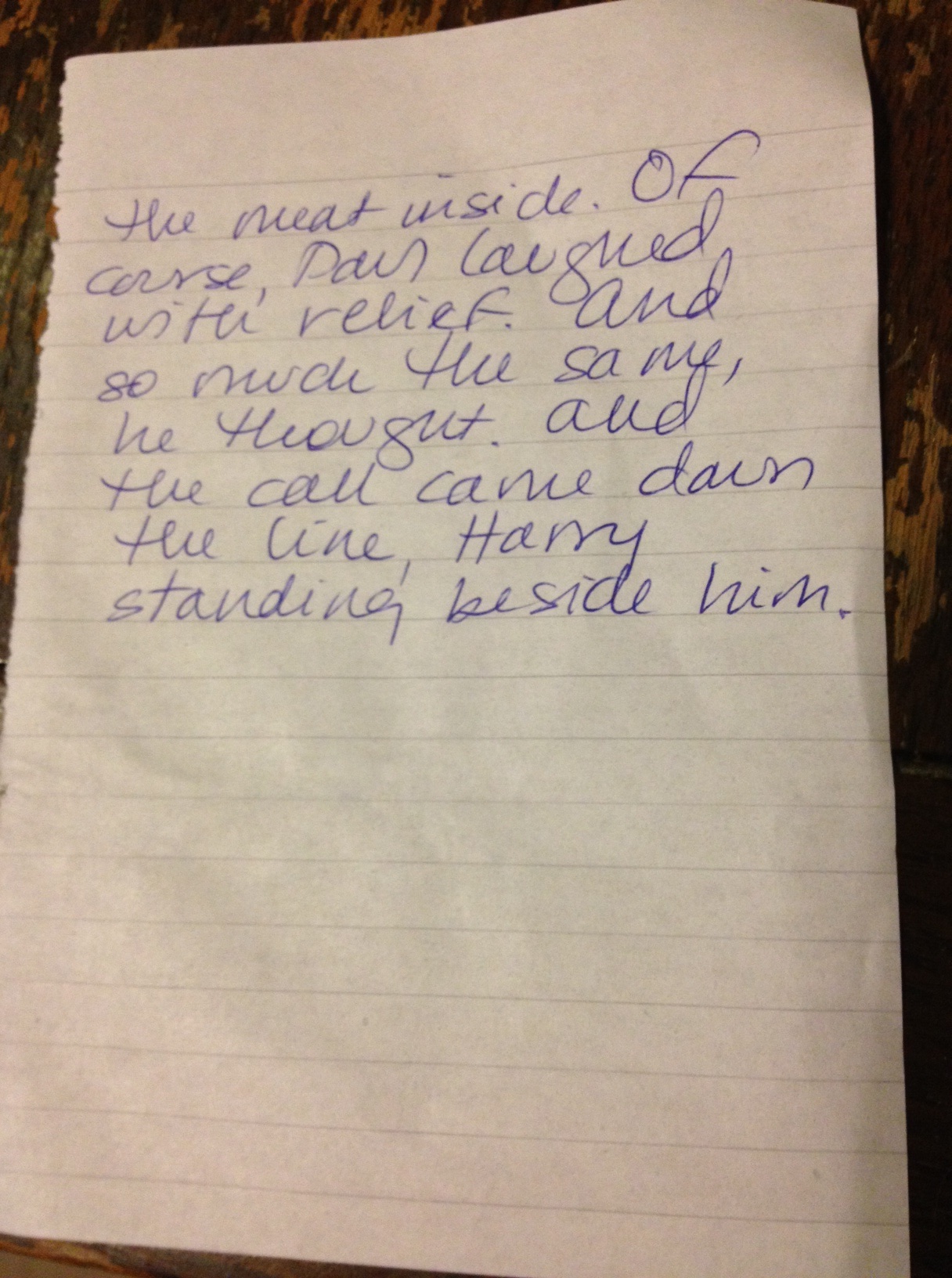
It had another meaning. Paul searched his memory while gouting dirt showered him, while the booming deafness sank into his brain, shelled, shelled—it was so obvious, why couldn’t he think of it. Next to him, Harry clutched his rifle and stared resolutely at the sky. Shelled, of course, was what it meant to be in war. He knew that. A call came down the line—they’d be going over soon—so he’d better think of it because once they went over he might not ever think again. He kept seeing the kitchen, Carmelita stirring a pot and smiling, but it wasn’t abou thtat but it was about something like that. Sh-elled. It came to him. Pecans. Nuts. Shelled. Where you peel back the hard surface to reach the meat inside. Of course, Paul laughed with relief. And so much the same, he thought. And the call came down the line, Harry standing beside him.


Elizabeth Smucker:

photo(1)

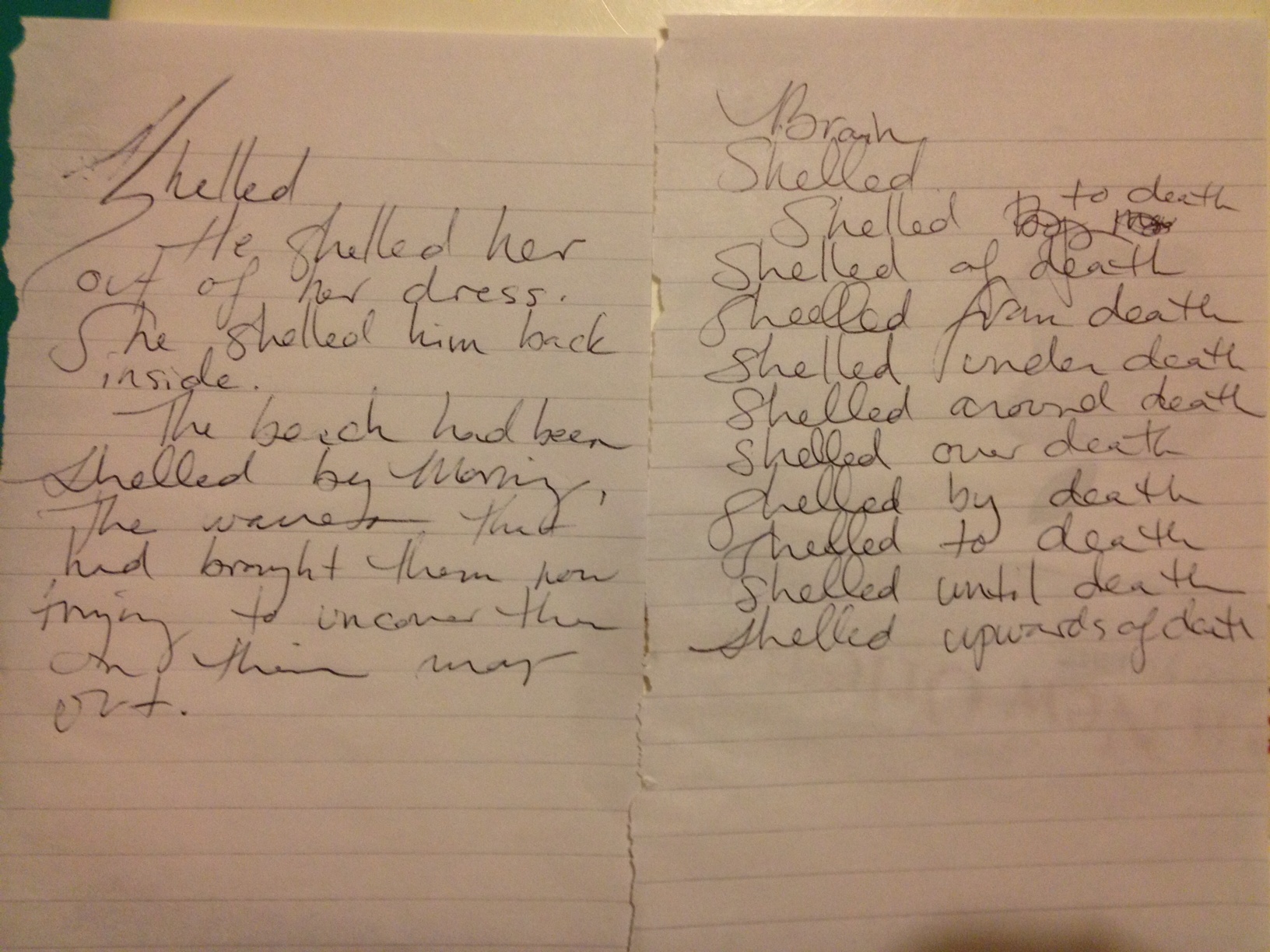
Shelled

He shelled her out of her dress. She shelled him back inside.

The beach had been shelled by morning, the waves that had brought them now trying to uncover on their way out.

Brain

Shelled

Shelled to death.

Shelled of death.

Shelled from death.

Shelled under death.

Shelled around death.

Shelled over death.

Shelled by death.

Shelled to death.

Shelled until death.

Shelled upwards of death.


Lisa O’Neill:

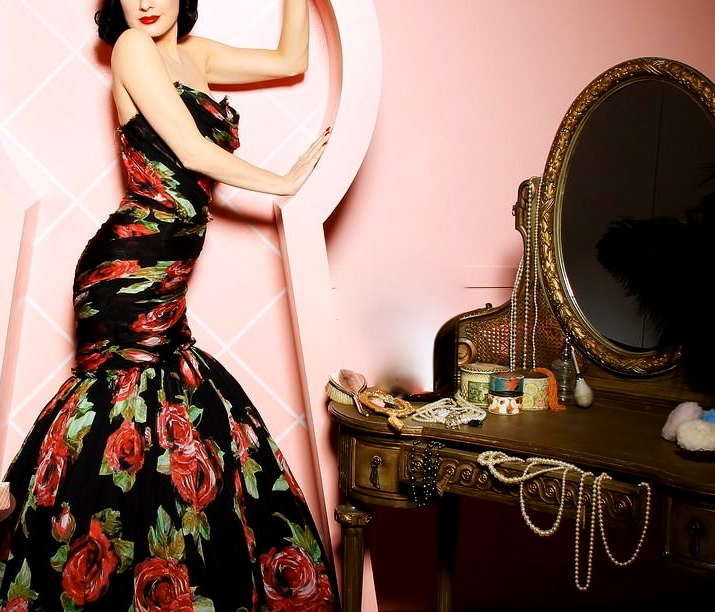
photo(2)

Shelled

She sat down in front of the mirror, vials and jars and brushes spread out on the countertop. The bulbs burned as she applied herself: a sweep over the brow, a slick black line on the lid. She layered lashes. She tweezed and teased. She lacquered her hair and nails. Lips red, hair high, she slowly pulled on her sheer stockings. She slipped into her strapless dress. She stepped into her heels. Her pinky corrected a smudge at the corner of her mouth. She assessed. She nodded. She headed out the door.


Leave a comment

Filed under 30 days 30 words

stem

chalkblackboard


Day 5 of the 30 days, 30 words challenge.


1stem  n.  1  :  the main stalk of a plant; also: a plant part that supports another part (as a leaf or fruit)  2  :  the blow of a ship  3  :  a line of ancestry: STOCK  4  :  that part of an inflected word which remains unchanged throughout a given inflection  5:  something resembling the stem of a plant —stemless  adj  —stemmed adj.


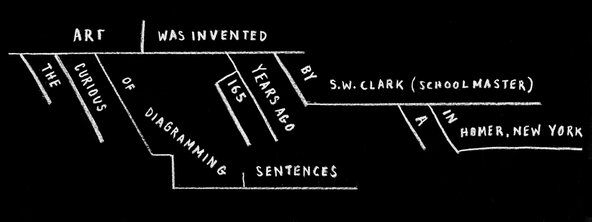
When I was a kid, I used to love diagramming sentences. Every time the teacher asked for a volunteer, my hand would shoot up. Sometimes she would pick me and I would walk down the narrow aisle to the chalkboard. Getting to write on the board was always exciting as it bestowed a feeling of authority and significance, but I didn’t love it when I had to answer math problems, when I worried I might get it wrong. But words, I understood how words worked. I wanted to understand how words worked. What they meant, how they were spelled, how they were connected to one another. There was something thrilling about drawing that initial horizontal line, placing the subject and verb there, and then finding where the diagonal lines needed to be made, where the other words fit in. I could feel the chalk pressing into my hand and could feel that this was important work: learning how words were arranged to make meaning. As a kid, I worried a lot: about grades, about friends, about what to wear to school on non uniform days, about what it meant that I was picked last when dividing into teams for freeze tag, about running or not running for student council. I also had an active imagine so I worried about potential catastrophes that could befall me, my family, the world. I didn’t often feel like I had much control over impacting any kind of change in the injustices I saw, even from a place of privilege, around me.  I was a kid in need of something to rein these worries in. I was a kid in need of a refuge. I found one in language. Diagramming, I felt reassurance in the words’ connection through these lines. The lines made the words’ existence tangible and real. They weren’t just things to be said, tossed away into the air. Here, they were concretized, even if momentarily so given the ephemeral quality of chalkboards, of chalk. As I drew the lines and continued to build the branch of the sentence, I understood that words could be made to do something, that the way they were positioned mattered, that they could be used to make meaning and that I could learn the system for the time when, maybe, I would want to use them to make meaning of my own.


draft-florey-diagram1-tmagArticle

writingletters


*Author note: funny where my mind went with this. I wonder if I was still also ruminating on chalk from yesterday. I guess one possibility with this month is that the words could continue to unfold and also fold over and touch and interact with one another.

Leave a comment

Filed under 30 days 30 words

chalk

Day 4 of the 30 days, 30 words challenge.


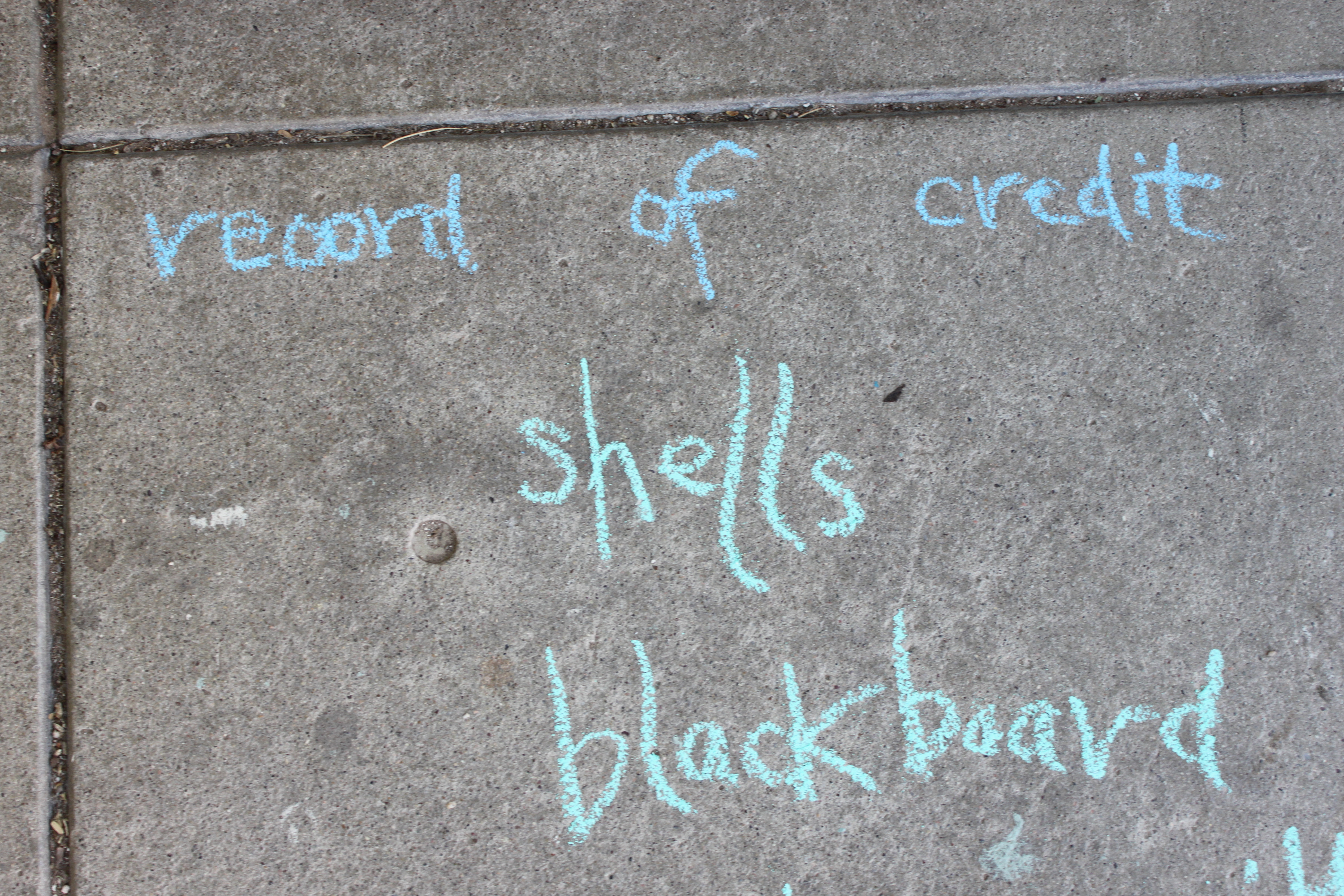
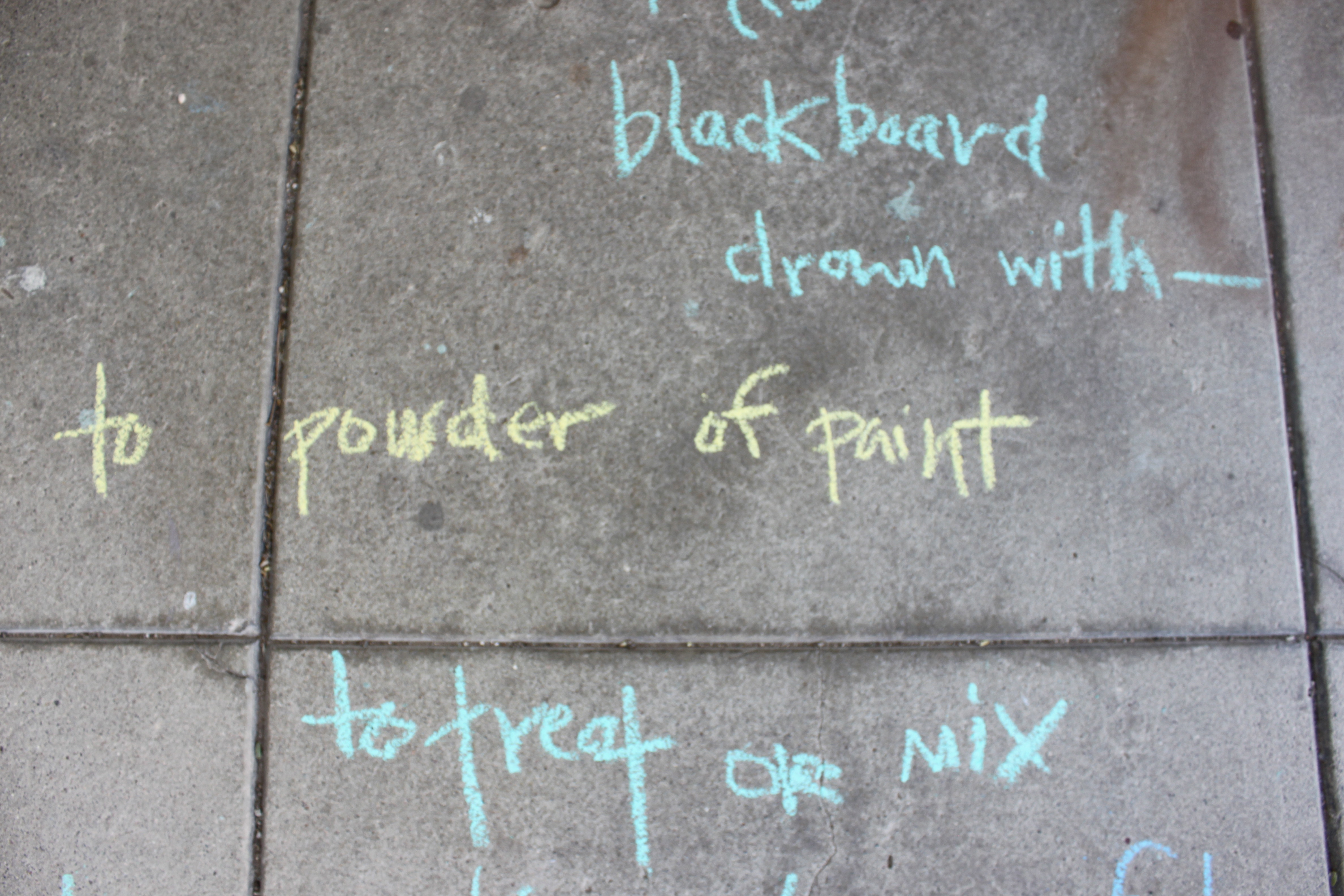
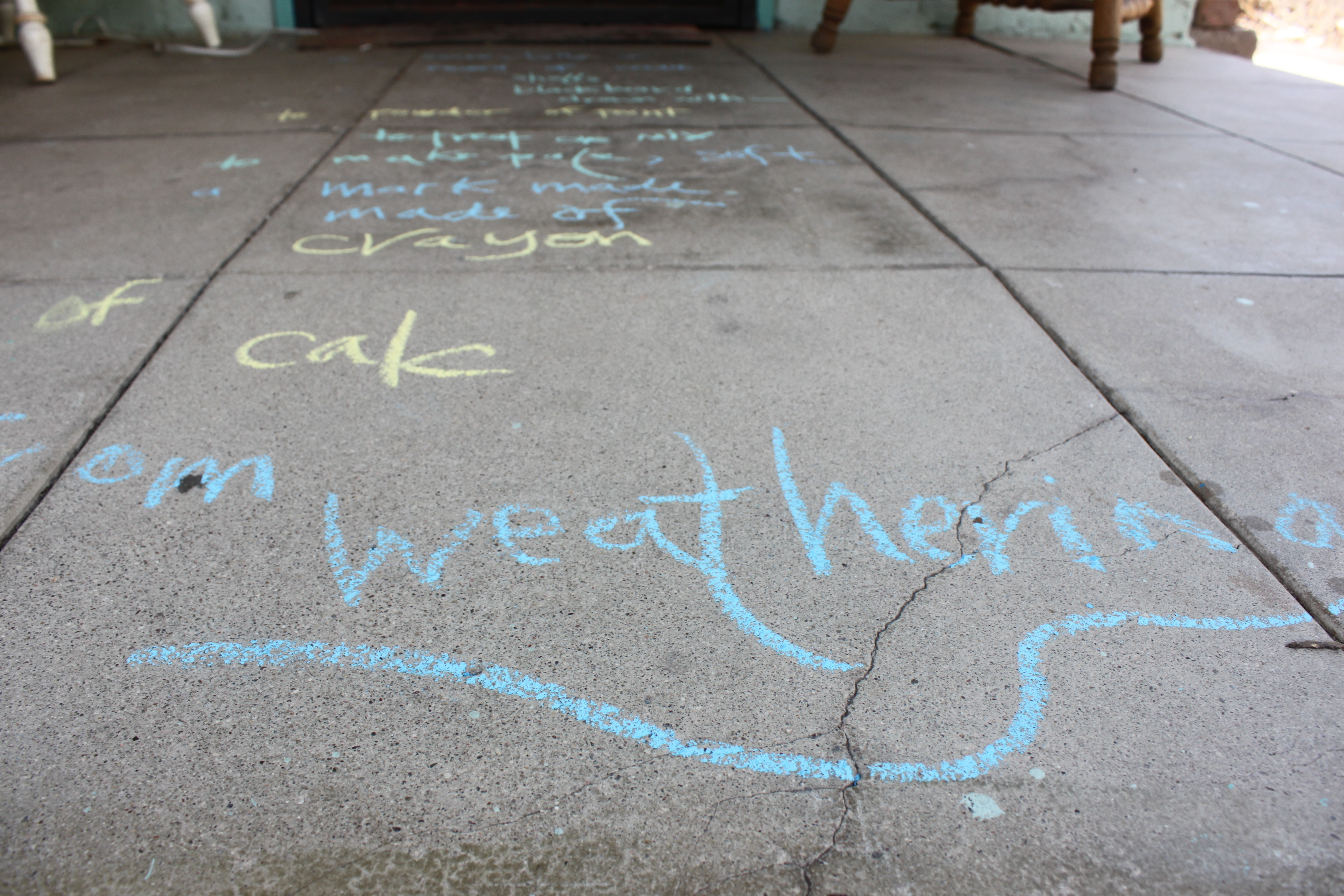
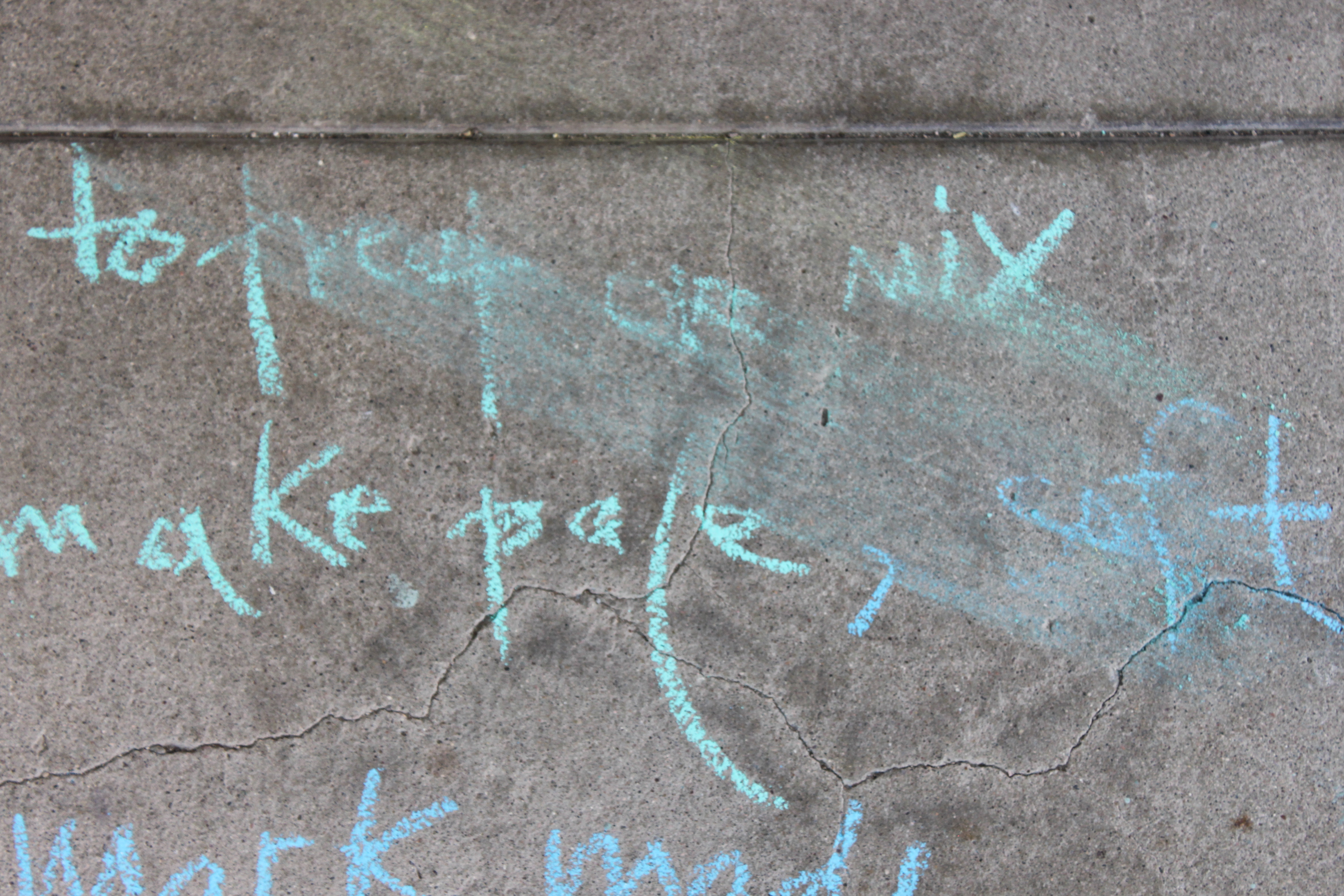
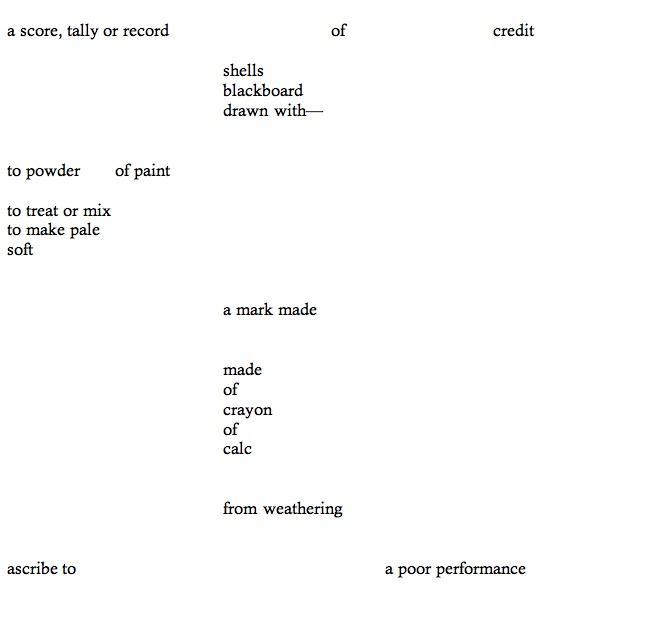
chalk  (CHôk)  n.  1.  a soft, white powdery limestone consisting chiefly of fossil shells of foraminifers.  2.  a prepared piece of chalk or chalklike substance for marking: a blackboard crayon.  3.  a mark made with chalk.  4.  a score, tally, or record of credit  v.t.  5.  to mark or white with chalk.  6.  to rub over or whiten with chalk.  7.  To treat or mix with chalk: to chalk a billiard cue.  8.  To make pale; blanch; Terror chalked her face   v .i.  9.  (of paint) to powder from weathering  10.  chalk up, a. to  b. to charge or ascribe to: It was a poor performance, but may be chalked up to lack of practice  —adj.  11. of, made of, or drawn with chalk.  {ME chalke, OE cealc  <  L  calc- (s. of calx) lime]  —chalk`like, adj.


IMG_0932

IMG_0936

IMG_0959

IMG_0963

IMG_0967

IMG_0970

IMG_0973

IMG_0974

IMG_0976

IMG_0975

IMG_0979

IMG_0980

IMG_0964

IMG_0989

IMG_0994


chalk1chalk2


Leave a comment

Filed under 30 days 30 words

Tun·gus·ka

tunguska-01


Day 1 of the 30 days, 30 words challenge and the word is:


Tun·gus·ka (toon goosˈka)  n.  any of three rivers (the Upper, Stony, and lower Tunguska rivers) in central Siberia, flowing westward to the Yenisei River.


A Second Sun*


The forest was a forest and the river was a river. That is until the day the forest flattened.  I was sleeping in the hut with my brother. Somebody shoved me and I awoke. My brother had been shoved too. But no one else was there. We heard the whistling and felt a strong wind. Brother said, “Can you hear all those birds flying overhead?” And I heard the sound he meant: the echo of thousands of wings flapping against the air. We stepped out of the hut but the sound was not birds.


I saw the sky split in halves, high and wide over the forest. The entire northern side of the forest covered with fire. The forest flattened, as far as I could see, trees red with ember leaves. The split in the sky grew larger. Suddenly, I became so hot I could not bear it, as if my shirt was on fire. I wanted to tear off my shirt and throw it down, but then the sky shut closed, a strong thump sounded, and I was thrown.


After that, such noise came. As if rocks were falling or cannons were firing. A thunder like I’d never heard.


The earth shook.


I was shoved again and fell into the fire. We got scared. We cried out, for our father, our mother, our sisters, our brothers. But they didn’t seem to hear. The earth below us began to move and rock, wind hit our hut and knocked it down.


My body was pushed down by sticks, but my head was clear. Then I saw a wonder: the sky became bright—how can I say it?—as if there were a second sun. My eyes burned from the way it blazed. Brother said, “Look up” and pointed with his hand. We watched the treetops get snapped off. Another flash, another thunder. We were knocked off our feet, struck against fallen trees.


In the air where the flashes had been, a blue cylinder, a billow of smoke. We thought sure it was the end of us. Then, suddenly the sky began to clear. There had been five of them. The thumps. No, six.  Now I remember well there was also one more, but it was small, and somewhere far away, where the Sun goes to sleep.


* Words and images from this piece taken from multiple eyewitness accounts of the a powerful explosion called the Tunguska Event, which took place in 1908 near the Tunguska River in what is now Krasnoyarsk Krai, Russia. While the cause is debated, the most popular explanation is that the explosion was caused by an air burst of a small asteroid or comet five to ten kilometers above the Earth’s surface.


Lake Cheko: In June 2007, scientists from the University of Bologna led by professor Giuseppe Longo identified a lake in the Tunguska region as a possible impact crater from the event. They do not dispute that the Tunguska body exploded in midair but believe that a one-meter fragment survived the explosion and struck the ground. Pollen analysis reveals that remains of aquatic plants are abundant in the top post-1908 sequence but are absent in the lower pre-1908 portion of the core. These results, including organic C, N and δ13C data, suggest that Lake Cheko formed at the time of the Tunguska Event.

Lake Cheko: In June 2007, scientists from the University of Bologna led by professor Giuseppe Longo identified a lake in the Tunguska region as a possible impact crater from the event. They do not dispute that the Tunguska body exploded in midair but believe that a one-meter fragment survived the explosion and struck the ground. Pollen analysis reveals that remains of aquatic plants are abundant in the top post-1908 sequence but are absent in the lower pre-1908 portion of the core. These results, including organic data, suggest that Lake Cheko formed at the time of the Tunguska Event.


2 Comments

Filed under Uncategorized