Category Archives: weekly words

strum*

1strum \ˈstrəm\  noun : an act, instance, or sound of strumming

2strum \ˈstrəm\ verb strummed  strum·ming

transitive verb 1.  a : to brush the fingers over the strings of (a musical instrument) in playing <strum a guitar>; b: to play (music) on a stringed instrument <strum a tune>           2. : to cause to sound vibrantly <winds strummed the rigging — H. A. Chippendale>

intransitive verb

1: to strum a stringed instrument 2: to sound vibrantly

strum·mer noun

(definitions this week taken from merriam-webster.com)

I took piano lessons for eight years. I started when I was six. I don’t remember if I asked for lessons or whether my parents just signed me up. In any case, the decision would have been a logical one as I adored music. From an early age, I loved to sing and did so pretty much all the time to anyone who would listen. My dad remembers me sitting fixated in front of the television as a young child, watching ballet and opera. As a toddler, I carried around my Fisher Price tape recorder with attached microphone everywhere I went.

I was always very moved by music, but as memory serves, I never really enjoyed playing or practicing the piano. I appreciated the delicacy of the movements of fingers over the keys and the sort of sweetness that emerged when a classical piece was played by someone who understood the instrument. It’s just that I always had the feeling that that someone was not me.

My father played the guitar in the evenings when I was small. If he knew more than two songs, I don’t know them. My memories are of dancing around in my Annie nightgown and accompanying him with my toy tambourine to the sounds of Peter, Paul and Mary’s “I’m in Love with a Big Blue Frog” and Captain and Tenille’s “Muskrat Love.”

When I was in seventh grade and a guitar class was being offered at my new school, I decided to take it. I packed up my dad’s old Takamine in a soft case and toted it with me to school. The first week we learned “He’s Got the Whole World in His Hands” (This was a logical choice for the instructor: All of us attended a Catholic school and the entire song is two chords: G and D). We also learned to pick the riff to “Can’t Touch This”: neer-neer-neer-neer-neer-neer-neer-neer (And by now, you should be able to pretty accurately assess my exact age). I scanned the room that first day, and I noticed quickly that I was the only girl there. I didn’t know hardly any women who played guitar. I had vaguely heard of Joni Mitchell and Joan Baez, but I hadn’t heard of Joan Jett, Bonnie Raitt, Sarah McLachlan. Instead of feeling empowered, I felt like I didn’t belong, and I quit.

Dar Williams

In college, I met my friends Julie and Sarah, who both played guitar, and I became curious again. I was also exposed to a world of music I hadn’t heard before. I found a home in contemporary folk music and here there were women playing guitars all over the place: Dar Williams, the Indigo Girls, Ani Difranco, Erin McKeown, Lucy Kaplansky, And yes, some of my early attempts at finger picking were to songs from Jewel’s first album.

I got a guitar for Christmas my freshman year of college and I began to play. And immediately, there was something different here than with piano. From that first strum, I felt a current in my body. It sounded like a heart beat. It sounded like a footstep. It sounded like the hitting of a boot on a plank of wood, like the hollow clang of a metal, like a voice echoing in a tower.

Woody Guthrie

Also, I was really, really bad. It took me three hours to make chord changes, and initially, I couldn’t sing when I played unless I phrased my singing in time with chord changes. But I didn’t care. There was something about the sound that kept me coming back. There was something about the sound that was satisfying, even if I wasn’t good. There was something about the sound that made me want to be better at making it.

The music I am most attracted to is music that over all else feels sincere. I love music that is sung on porches or in living rooms. I love music that has imperfections, where voices crack or one note is picked a lot louder than the rest. It gathers its beauty not from its proficiency but from its earnestness. It is beautiful because I can tell that the person making it needed to make it. This music is made to fill a void or to celebrate a milestone. This music is made because in the making, life becomes a little easier. Or suffering is shared. Or something needs to be said and this is the way to say it.

Sonny Terry and Brownie McGhee

One of the definitions of strum is: “to cause to sound vibrantly.” I guess this is what drew me to the guitar and what draws me to folk music, to the blues, to old country. There is a vibrancy in these songs that ultimately reminds me of what it means to be alive—in all its loveliness and heartbreak, in its seamlessness and messiness.

A few years ago, a very talented singer/songwriter friend of mine and I recorded some songs together. We had sung together in college and after years apart, we reconnected and we sang again. The first time we attempted to record one song, Stephen Foster’s “Hard Times,” we did it in parts. I played the guitar. Then I sang. Then she did. But it felt mechanical. It didn’t work. We decided to do it the way we actually performed it. And when we sang, I played guitar and we harmonized, singing together with eyes closed because we didn’t need to look at each other to know when to begin or when to end. And that creation of sound is one of my favorite moments.

Elizabeth Cotton

Just a few songs that come to mind in relation to strum:

Disclaimer: Some of these don’t have “strumming” at all, the first one is acapella, actually. Many of them are finger-picked. But I mean strum as in “to sound vibrantly.”

Hazel Dickens “Little Pretty Bird” (even though there is no strumming involved in this one; it’s acapella)

Gillian Welch & David Rawlings “Time (the Revelator)”

Stephen Foster “Hard Times (Come Again No More)”

Elizabeth Cotton “Freight Train”

Woody Guthrie “Do Re Mi”

Dar Williams “If I Wrote You”

Bob Dylan “Don’t Think Twice”

Mark Erelli “The Only Way”

Lucinda Williams “World Without Tears”

Joni Mitchell “A Case of You”

Sonny Terry & Brownie McGee “A Better Day”

Doc Watson “The Coo Coo Bird”

Patty Griffin “Sweet Lorraine”

Po’Girl “Old Mountain Line”

Jeff Buckley “Hallelujah”


*It’s funny that this word is assigned this week as I’m playing a gig with an old bandmate Mark at The Neutral Ground in my hometown New Orleans.

1 Comment

Filed under weekly words

re·cline

re·cline \ri-ˈklīn\ transitive verb : to cause or permit to incline backwards

intransitive verb 1. to lean or incline backwards 2. repose, lie

Origin: Middle English, from Anglo-French or Latin; Anglo-French recliner, from Latin reclinare, from re- + clinare to bend. First Known Use: 15th century

(from Merriam-Webster.com)

The Lazyboy was a sort of garish orange threaded through with white. Susan picked at the worn section on the left arm, as if she could do no further harm to this eyesore of a chair that had no business existing in the first place. She could tell it was annoying her therapist, her picking not the chair itself, which he had apparently chosen after all. He had just asked her what she presumed was a pivotal question in her “therapeutic process” and he had a look of expectation on his face, although he was trying to hide it. This was the moment, she imagined, when she was supposed to have an epiphany. No, wait, it was called an epiphany in novels. In therapy, it was called… What the hell was it called again? Well, anyway, she was supposed to be overcome with emotion. She was about to disclose something major, something life-changing, something she had never realized until this exact moment. Maybe she would cry, a river or perhaps a single dramatic tear. A tear which she would let slide down the length of her cheek without wiping it away, feeling the poignancy of the moment grow as it slid and slid and then dropped below, leaving a mark on her cotton t-shirt.

But the truth was, she didn’t feel a damn thing. Hours and hours of therapy, hundreds of dollars and she had arrived at the moment when she was supposed to finally come to some sort of realization, perhaps provide herself with some restitution for years of self-harm and self-doubt. She almost felt bad for her therapist, who sat there calmly waiting for her to speak. He had worked hard to get her here and for what? For her to feel nothing at all? Perhaps she could fake it. Make some shit up. Babble about her subconscious desires. But no. This, she imagined, was one of the few things in life impossible to fake. You cannot feign knowledge about something if you have no idea what that something is supposed to be.

She looked down at the arm of the chair and realized what she had done. There was a large oval area on the chair’s arm that now resembled the bald spot on a mangy dog. Through one sliver at the side, you could even begin to see the metal rod inside the chair.

“Oh my God, I’m so sorry,” she said, only it came out muddled and muted.

“What was that?” her therapist asked.

“I said I’m so sorry. I wasn’t paying attention. I ruined your chair. I’ll pay for it.”

He dismissed the idea with a wave of his hand. “It’s not a problem, Susan. I’ve been meaning to re-cover or replace that chair for months. Really, you helped me out.”

“But shit, I just, I mean, I can’t believe I did this without noticing.”

“Really, it’s fine. If I was worried, I would’ve said something or asked you to stop.”

She could tell by the calmness of his eyes that he was telling the truth, but she couldn’t let it go.

“How much do you think a new chair costs? I can add it to my check for today. Really, I’d feel better.”

“Why do you feel it is necessary to compensate me for the chair when I’ve told you that it’s not important? Do you not believe that I’m telling you the truth?”

“No, I do believe you.”

“Then what it is it?” he asked.

“I messed it up, okay? I messed it up and I can make it right. This, this I can fix. I can fix this stupid fucking chair that is the ugliest goddamn thing I have ever seen. And it’s something that shouldn’t even be fixed because it’s that worthless. But I have the power to fix it and I know I can. So will you let me fix the fucking chair?”

She suddenly felt like she was going to vomit. She could feel the sensation of fullness in her belly and knew that the accompanying nausea would soon be followed by a warming of her esophagus as everything rose. But just as she felt it coming, she instead began to sob. Her whole body shook, convulsing in a way she had never experienced before. She did not fight it. She didn’t try to make herself stop. She put her head in her hands and she felt the water teem. Her nose was running but she didn’t reach for the tissues. She wanted to feel like the mess that she was. Oh right, she thought, it’s called a breakthrough.

1 Comment

Filed under weekly words

under sail

under sail, from my dictionary

under sail, sailing, with sails set.

SAILS ON A FULL-RIGGED SHIP

1. flying jib; 2. jib; 3. fore-topmost staysail; 4. foresail; 5. lower fore-topsail; 6. upper fore-topsail; 7. fore-top-gallant sail;  8. foreroyal;  9. fore-skysail;  10. lower studding sail;  11. fore-topmost studding sail;  12. fore-topgallant studding sail;  13. foreroyal studding sail;  14. main staysail;  15. main-topmast staysail;  16. main-topgallant staysail;  17. main-royal staysail;  18. mainsail;  19. lower main topsail;  20. upper main topsail;  21. main-topgallant sail;  22. main royal; 23. main skysail;  24. main-topmast studding sail;  25. main-topgallant studding sail;  26. main-royal studding sail;  27. mizzen staysail;  28. mizzen-topmast staysail;  29. mizzen-topgallant staysail;  30. mizzen-royal staysail; 31. mizzen topsail; 32. lower mizzen topsail;  33. upper mizzen topsail; 34. mizzen-topgallant sail;  35. mizzen royal; 36. mizzen skysail; 37. spanker

1. flying, we 2. left 3. them, headed to sea 4. without 5. without manuals 6. we’ll learn to survey 7. the water, the wind 8. with no map 9. we, map-less               10. lower our demands 11. low, we go in cabin 12. foreswear the compass, foreswear 13. those running rigging lines 14. we will steer 15. using other tools  16. mid-wives of this vessel 17. mid-breath, we assist  18. with limbs  19. used as wood rutters 20. with balance, from scales 21. we climb, to check sails 22. main royal 23. we tighten 24. that which needs tightening 25. and we loosen just to see 26. what billows, what flies out 27. we need staysails 28. we need this, to stay, sail 29. and to hoist, to work, to move 30. to handle, steer, manage          31. beneath shape sheets 32. needing only to spread 33. and to catch and deflect 34. this full air, this strong wind  35. no, we are not 36. prepared, only             37. steady.

Leave a comment

Filed under weekly words

con·duct

Pullman Parlor Car, 1883

con·duct (ˈkän-dəkt)  n. [<  L.  conductus, pp. of conducere; see CONDUCE],  1. a leading; guidance.  2. management; handling.  3. behavior; deportment; way that one acts.  4. [Obs.], an escort; convoy  v.t. 1. to lead; escort.  2. to manage; control; direct; carry on.  3. to direct (an orchestra, etc.) 4. to behave (oneself).  5. to be a channel for; convey; transmit: as, this wire conducts electricity.  v.i. 1. to lead.  2. to act as a conductor.

SYN.—conduct, in this comparison, implies a supervising by using one’s executive skill, knowledge, wisdom, etc. (to conduct a sales campaign); direct implies less supervision of actual details, but stresses the issuance of general orders or instructions (to direct the construction of a dam); manage implies supervision that involves the personal handling of all details (to manage a department); control implies firm direction by regulation or restraint and often connotes complete domination (the school board controls the system). See also behave.

For a long time, I had a tin can in which I kept prized items. One of the items was a brass button that had been removed from the blazer jacket of my paternal grandfather. On it were the raised letters: P-U-L-L-M-A-N.

Grandpa was a superintendent for the Pullman Company. When I explained his job as a child, I often mistook him for the conductor, imagining my portly Grandpa donning one of those navy and white striped caps and, for some reason unbeknownst to me, always carrying a clipboard. I imagined him standing on the step leading up to the car, holding onto the sidecar handle as the train pulled away.

The truth is that he had at one point been a conductor. He worked himself up the ranks from positions I don’t even know the names of to conductor to vice-superintendent in St. Louis and then superintendent in New Orleans.

My Grandpa was a self-made man. Although he never went to college, he had an insatiable appetite for learning. He always had a stack of a dozen books on the coffee table: library books about sociology, about history, about psychology. He encouraged his children’s curiosity, asking them questions and engaging in their learning process. He died when I was seven so I did not get to know him well. Much of my memory of him has been fleshed out in hearing stories from family members.

Pullman Car Built in 1928

In 1952, he relocated his wife and, at the time, four children from St. Louis to New Orleans to take a promotion to be superintendent there. The family traveled by train.

My dad told me that he and his siblings used to love to look out the windows at the countryside, as they did on every trip they made from New Orleans back to St. Louis to visit extended family. It was still the heighday of trains and the riding coaches. Their sleeping cars not only featured pull-down beds but sofas to relax on. The dining car served passengers their meals on fine china. On their laps lay linen napkins. At night, Grandpa would leave his shoes in a locker and the porter would put a fresh coat of polish on them by morning.

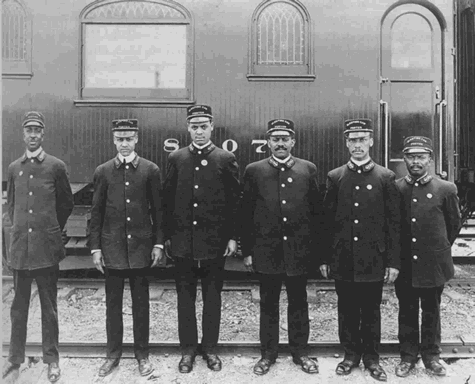
Pullman Sleeping Car Porters

As superintendent, Grandpa was in more of a behind-the-scenes role, managing staff and schedules, making sure everything ran on time. He was in charge of hiring and supervising employees like porters and conductors, cooks and waiters. He had to ensure the cars were in condition to roll on the rails and that his staff took care of their responsibilities. Although he did a lot of this from his office, sometimes he would ride on trips himself, like from New Orleans to Baton Rouge on LSU game days, to directly supervise and make sure everything ran smoothly.

***

The first time I traveled by train was when I was nine years old. As I recall, I was traveling from New Orleans to Atlanta to visit family there. All that I remember about that trip is playing travel Yahtzee and eating Little Debbie snack brownies from the concession car. I had expected the concession car to be more like dining cars I had seen in movies so imagine my disappointment when I saw that it more closely resembled the snack bar at our community pool.

When I studied abroad in Rome in college, I traveled by train frequently, throughout Italy and Europe. Traveling by train felt exotic to me. It was a symbol of my independence and each new trip felt like an adventure. Although I was nowhere near a vagabond, I sometimes indulged myself in feeling like one. I have a vivid memory of traveling through Ireland with my friend Heidi and looking out the window at the blur of the hills, thinking I had never seen anything so green. I remember trying to journal about it and being so dissatisfied with all the descriptions I attempted: verdant, fresh, like a football field. The green there was a sort of violent green, impatient with its beauty.

And then there was the time when I mistakenly filled out my Eurorail pass before the train porter came to my cabin. At this point, I was traveling alone from Barcelona to Madrid, and I didn’t speak Spanish or Catalan. I couldn’t explain myself to the porter. Some compassionate middle-aged women in the cabin tried to communicate with me, me in Italian and them deciphering through Spanish. They tried to argue with the porter for me, but it was to no avail. I had lost one of my trip tickets, and I was angry at myself and frustrated. As I lay on my bunk crying, I felt the opposite of independent.

When the train trips meld together, I experience them in a whirring sort of way that replicates the sounds of metal on metal, the echo of wind banging up against the sidecar. These rides were a contrast of things for me—the calm of watching the landscape pass by and the exhilaration, but sometimes fear, of the unknown. These trips were about discovering new worlds and also about overcoming my hesitancy and timidity to enter these worlds alone.

While I know that my journey to feeling more independent and understanding myself better was a gradual one, I remember a breaking point. It was my last week in Rome, and there were some things I wanted to do: return to the Spanish steps, find an Italian cookbook at this specific bookstore, wander back to the Pantheon. None of my friends wanted to do these with me. Instead of abandoning my mission, I had the sudden realization that I could do this on my own. This might seem like an obvious progression. However, I had spent much of my adolescence deciding  what I would do based on other people’s decisions. I did not like to be alone.

And here, there were added intimidations. I was in a foreign country with a foreign language. I had to navigate public transportation in this other language. I had to risk being lost. I had to risk making a fool of myself. I had to risk being alone. I had to risk finding my way by myself.

However, I had lived in Rome at this time for four months, and I could speak the language enough to get by. I knew how to read the bus maps. I knew how to get around. The biggest motivator, though, was that I wanted to do these things and I didn’t care whether someone else was with me or not. I would get myself there. And also, I felt at that moment that I was enough. I remember intense satisfaction when I returned home from my day adventure. I had figured out how to navigate the terrain, without needing anyone else.

***

My dad speaks of his father with pride, not only because he was good at his job but because he had a commitment to equality and justice in the South during times of deep prejudice and injustice. It was his desire to treat everyone fairly.

Inventor of the Pullman Railroad Car, George Mortimer Pullman --- Image by © CORBIS

While I had misremembered that he retired, Grandpa actually left that job when the Pullman Company went out of business in the late 60s, the company no longer able to keep afloat with competing business from air and interstate travel.

My uncle was still living at home at that point and he remembers that on his last day, Grandpa brought a card table and chair to work because the office furnishings had been sold. When the day was done, he packed them up and came home.

I wonder how it felt to him to have worked his way up the system like that, based on his own willingness to learn and develop his skills. I wonder what it felt like to have to experience that loss, to have to make a change not out of desire but out of necessity. I wonder what it felt like to watch a world, a way of life, so unique and compelling become obsolete. And I wonder what it felt like to him to live a life defined by motion, to hear the wheels, to look out the window as states flew by. I wonder what it felt like to walk from car to car, talking to passengers and reviewing schedules, seeing the inner mechanisms of the railroad run like the engine at the front of the train. I wonder what it felt like to witness family vacations and business trips and honeymoons unfold and know that, in simply doing his job, he had played a role in making them happen.

5 Comments

Filed under weekly words

jad·ed

jad·ed (jā-dəd),  adj. [pp. of jade, v.I],  1. Tired; worn-out; wearied.  2. Dulled or satiated, as from overuse.

The interesting thing about language is how just one letter can create a seismic-size shift in meaning. For example, jaded is a word that means disillusioned, worn down, made dull, apathetic or cynical. One form of the word “jade” is also a verb signifying these sentiments. But the noun version of jade is of course, a gem, a green natural stone that in Chinese culture is revered for the qualities it signifies.

When I think of certain aspects of my life lately, I think of the grooves that form in wood after wheels have run over the same patch over and over again. My creative life feels as if it has stalled. I have moved to a new house and although it is beginning to feel like home, there is more I want to do to personalize my space and make it my own. After some difficult experiences over the past few months, including the break-ins I wrote about here on the blog, I don’t feel like I have the energy or inventiveness to jump the track.

So, I reordered a Feng Shui book I owned years ago in the hopes of at least manifesting what I want in my life in my personal space. Maybe by being intentional about the qi (pronounced chee) in my house, I thought, I would find some insights into what to work on now. Feng Shui literally translates to “wind-water”. Feng Shui, for those unfamiliar, is an ancient Chinese practice in aesthetics that is based in the idea that the energy in your home can be enhanced by the ordering of your home and the placement of the items within it. With intention, you can enhance areas of your life. Your space is divided into baguas, or zones. There are nine baguas: prosperity, fame & reputation, relationships & love, family, health, creativity & children, skills & knowledge, career, and helpful people & travel.

Jade Plant, photo by Matt Baume

For each, there are associated colors, elements and shapes that can be used to enhance the area. By enhancing the qi in your space, you enhance the qi in your life.

I think there is something to this stirring of energy. It makes logical sense to me that the way in which our home is structured would affect our internal structures. I think most readily of clutter. When clutter infests our homes, it also takes up space in our lives. Instead of taking the time needed to do some clearing, we live with the knowledge that there are bills to be paid, paintings to be hung, dishes to be attended to. And those items and the knowledge of them takes up psychic space that could be better used focusing on more important matters. If we neglect the spaces we live in, that neglect can wear us out.

The first year I lived in San Francisco, my room was painted a fluorescent green color. This green was a compromise with the prior resident, who agreed to paint over his one royal blue accent wall with this green. “I was envisioning the colors of the earth when I painted,” he told me. “Uh huh,” I responded. It was hideous.

I intended to paint over it immediately, but little did I know that I was entering one of the most difficult periods in my life. I had a hard time functioning much less considering things like decorating or qi (maybe I should have). So through that difficult time, the fluorescence remained. When I was starting to come out of it and began to reconsider how to organize my space to restore balance and wellbeing in my life, I finally went to the hardware store down the street and bought some paint.

I don’t remember the chip name, but I picked a sagey, jade-toned green. Green has always been one of my favorite colors. I remembered that it was said to be a calming color, fitting for a bedroom. I just needed a shade that suited me.

Chinese Jade

In Chinese culture, jade symbolizes beauty, nobility, perfection, constancy, power, and immortality. There is a Chinese saying that states: “God has a value; jade is invaluable.”  Stones have been found in the country that date back to 5,000 B.C. Whomever wears jade is believed to be protected from misfortune (Could it be said that in wearing jade, this person is “jaded”?)

Chinese Jade

I wonder what attracts me to this shade of green. The color is pleasant to me. It reminds me of Louisiana, of the color of leaves when lit by the sun.

I know for sure that it wasn’t repainting my walls that made me reconnect with important parts of myself that had been neglected. I do know that when it was time to paint, I felt a sense of urgency about it. I went from waiting a year to take care of it to feeling like I needed to paint immediately. So, I bought the paint and brushes, moved all my furniture to the center of the room, draped the floor and the furniture with dropcloths, and began to cover the walls with a new color.

When I was done, my arms were covered in specks of jade that would take a week to finally come off. I found them funny, these stubborn bits of paint. While I tried my best to scrub them off, I also took a kind of pleasure in the testament to small changes I was making in my life.

I know for sure that painting my walls didn’t change my life. But I also know for sure paying attention to my environment was a step in taking care of myself and my needs. I was paying attention to all the spaces I lived and moved and breathed in, the spaces without and within.

My room in the Western Addition, San Francisco


Leave a comment

Filed under weekly words

Germany

Germany* (jûr m -n ), n. a country in north central Europe, on the North and Baltic Seas; area, 182,471 sq. mi.; pop., 65,899,000 (1946): in 1945, Germany was divided into four zones of occupation, administered respectively by France, Great Britain, the Soviet Union, and the United States, in 1949, the United States, British, and French zones were constituted as (the Federal Republic of) West Germany and the Soviet zone was constituted as the East German Democratic Republic (East Germany): capitals, Bonn (West Germany), Berlin (East Germany): German name, Deutshland: abbreviated Ger., G.
*reminder that the dictionary I typically pick from is from 1955

What is it that defines a place? Its borders? The way it is placed in our collective memory, in our history books? How is that a place comes to conjure certain emotions? What about the way in which people use the land? What about the personalities, values and passions of the people that live there? How do these people’s way of life embed the place with meaning? The study of geography fascinates me because of all these questions. When people move thousands of miles from their native land, why do they often choose places with similar topographic features or climate? How do their bodies or souls gravitate there? How do they know where to go—to the place that feels most like where they come from, the home they left behind? And how does what humans do in a given space define it permanently?

Although my last name is Irish and my mother’s side is mostly Acadian French, a good chunk of my ancestry is German. And I remember when I found this out not wanting this to be the case. I had learned about the Holocaust and was horrified by the stories I read, the black and white photos I saw. I remembered the image that Elie Wiesel wrote of in Night that described babies being thrown up in the air and speared by German soldiers bayonets. And I wanted to not be from there, from the place that produced ethnic genocide, suffering, death, pain. I wanted to not be associated with or related to people who were able to participate in the mass slaughter, in a very methodical and personal way, of millions of people solely because of the God they worshipped and the way their features were shaped.

In knowing that my ancestors came from there, even if it was long before the Holocaust, it somehow made them and me complicit or related to these unimaginable actions, this behavior so divorced from the human capacity for compassion, understanding, kindness. So I found pride in my Irish roots, my Cajun roots, and I ignored my German ones.

And I wonder how we untether a place from its history. We can’t, I guess. And we shouldn’t. But what if a place only becomes about the painful parts of its history? I grew up in the South, in Louisiana—a place lush with cypress and magnolia trees, with humidity, with music streaming out of bars and out of the bells of brass instruments. This is also a place with long ugly celloid scars from the scourge of slavery and the racism that followed (and continues to follow) long after the Civil War was over. And yet it is my home. There are so many things about my home that I am proud of. I see that it is not one thing or the other, not evil or good, not about suffering nor about the overcoming of it. This place, as with all places, is defined by it all.

I also don’t know how to reconcile the fact that the suffering of a place and its peoples also shapes and informs the important and positive cultural identification of that place. Before Katrina, New Orleans was 65 percent African-American, and it is the spirit, music, family and cultural values of the African-American community that is the foundation of the streets we walk on back home. Without this community, New Orleans is not New Orleans. And this community is there because their ancestors were brought over to be slaves to white colonizers.

Germany is not just the Holocaust, but the scars are there. And the scars are visible not only to Germans but to me and the rest of the world. When I went to Germany on a high school trip to Europe, we went to two places. We walked around the cobblestones streets of Munich, where we visited the Hofbräuhaus and watched the Glockenspiel tell the hour in the evening. And yet all the time, I was thinking of the next place we were to visit: Dachau. It was raining and cold when we visited Dachau. We walked around and saw the empty plots, with wooden borders to show where the camps had been. We saw one of the brick ovens (a reconstructed one? A remaining one? I don’t remember now).

At some point, I distanced myself from the crowd and went with my umbrella to stand off alone taking in the scene. I remember thinking: This is where the Jews were persecuted. This is where they stood in rain and cold like this except with threadbare clothing and shaven heads. And I wanted more than anything to cry. But I couldn’t cry. The truth was that I could not feel their pain. How could I? I had never had to experience the sort of suffering they had undergone. So all I could do was stand there and try to understand.

I have had a hard time writing this post because whenever I thought of Germany, these thoughts came to my mind. And I thought, is that all there is to write about? I guess that’s not what matters because this is what, I suppose, I needed to write about. That my Grandma’s name is Rothermich. That my great grandfather’s name was Hupfer. And that it is problematic to come from a place—from multiple places—in which human beings were impossibly cruel to other human beings.

The key to understanding a place, I suppose, resides in the ability to not only read or understand but absorb the feeling of it all as much as possible. To see the broken down barns as well as the stately mansions, the dead trees and the ones that bear fruit. I guess it is about never forgetting the human-created sorrow that will never be absent from the place and yet to not allow that feeling of sadness to be the only feeling. To know a place, in my mind, is to know that it is a space in which both hurt and healing can occur. What happens in that space, all of it, should never be forgotten. And our responsibility to that place is to try to tip the scales, to be better to each other than future generations were and to repeat their kindness but not their cruelty.

Leave a comment

Filed under weekly words

Ash Wednesday

photo by Bob Thayer for The Providence Journal


Ash Wednesday, the first day of Lent and seventh Wednesday before Easter: so called from the practice of putting ashes on the forehead as a sign of penitence.


Remember, you are dust and unto dust you shall return.


The words were a litany about life, about death, and about sins that need forgiving.

I took these words to heart, with the seriousness and face value only possible from a small child. And as the years went by and the words were repeated, I learned not only that I was going to die but that because of this death, I better repent from my sins. Oh my God, I am heartily sorry for having offended thee.

What are the sins of a five-year-old, seven-year-old, eleven-year-old? Breaking a glass? Saying a bad word? Talking back to a parent?


Remember, you are dust and unto dust you shall return.


The occupation of chimneysweep is (debatedly) one of the oldest in the world. The act of collecting soot, of piling dust, of preparing the hearth for a new fire.


Remember


The ash felt dirty on my forehead. Oftentimes, I would look in the mirror and forget, wondering how the smudge got on my forehead, going to wipe it before remembering that today is a day for penitence, a Holy Day of Obligation.


Remember, you are dust.


*How often should my chimney be cleaned?

All chimneys should be inspected yearly by a certified professional and cleaned as required. The inspection is necessary to ensure that the chimney has adequate draft, is free of debris and cracks, has no loose or missing mortar joints and is otherwise free of damage.


Remember, you are dust.


I knew that the ashes came from the palms that were folded into pretty crosses for Palm Sunday. I knew this because my father told me so. One time, when we missed Ash Wednesday services (what kind of sin is it to miss a Holy Day of Obligation meant for repenting one’s sins?), my dad took the folded palms from the previous year and burned them in a small ceramic bowl. Then he pressed his thumb into the dark gray specks and moved his finger from left to right, then up and down on my forehead. He did this because I was worried. I thought God would be irreparably mad at me for not going to mass.


Remember, you are dust.


*Will the chimney sweep cause a mess in my home?

No. By cleaning the chimney from inside your home we maintain control over the dust. All our equipment is laid out on clean drop cloths in front of your fireplace. The hose of our chimney vacuum collects the debris as we brush the chimney.

We can only brush the chimney as fast as our vacuum collects the dust.

The dirtier the chimney flue, the slower we brush.


Remember, you are dust.


When I was twenty, I spent a semester in Rome. While in Ireland on spring break, a friend and I went to Dublin. The only day the Guinness Brewery was open during our time there was on Wednesday, Ash Wednesday. She was Episcopalian and I Catholic. We found a church. I remember the urgency of finding somewhere to receive ashes. Then, we went to the Guinness Brewery. We took pictures with our heads inserted in ridiculous old advertisements with parrots holding pint glasses. At the end of the tour, we drank our free pints with the marks on our foreheads, marking a day of penitence and abstinence and fasting. Later, I joked about this time to friends. Wasn’t that funny? But at the time, I remember sipping my pint slowly, aware of each swallow as it sank down my throat.


You are dust.


*Does a chimney sweep remove the black from the wall of the fireplace?

No. We can only clean off the soot on the surface of the brick. Each time you burn a fire, this black changes according to how hot you burn your fire.


Remember, you are dust and unto dust you shall return.


I don’t remember the last time I went to Ash Wednesday mass. I still observe Mardi Gras, as any good New Orleanian should. But I don’t feel the desire to have ashes on my head to remind me of my mortality or of the need to be a good person. Sometimes though, when I remember, I fast. And the absence of food in my belly, that gnawing feeling, reminds me of what it means to be cleared out, cleaned out, purified and also, of my need for sustenance.


Note:   FAQ on chimney-sweeping taken from Clements Chimney Sweep and Repair in Feasterville-Trevose, Pennsylvania.

6 Comments

Filed under weekly words

mud·min·now


mud·min·now /ˈmʌdˌmɪnoʊ/ [1865–70, Americanism]  n. any of several small, carnivorous fishes of the genus Umbra, found in muddy streams and pools.

Continuing in the elusive word of the week club, this week is “mudminnow.”

(Sorry for the late posting, hectic does not even begin to describe my last month)


What can be said of the resiliency of creatures on this planet?


I remember watching the Oceans movie with horribly cheesy narration by Pierce Brosnan. The voiceover was awful, but the footage itself was breathtaking: In part for the revelation of underwater creatures that we had never seen before. And in part for the revelation of the crazy adaptive features these creatures had to allow them to survive in deep deep water.


look at love
how it tangles


Mudminnows make their home in the muck. They thrive in it, actually.


They live with low levels of oxygen and low water temperature. And when they need to escape, they escape into layers of soft sediment. They bury themselves underground.


They have adapted to do so.


look at spirit
how it fuses with earth


Mudminnows come from the genus Umbra. In Latin, “umbra” means shade. It is the root word for antumbra (negative shadow on the Earth’s surface as the Moon moves across the face of the Sun), penumbra (a partial shadow where the cast light is partly cut off by a body between the light source and the shadowed surface), umber (a brown earth darker in color than ocher and sienna due to manganese and iron oxides, used as a pigment by painters because it is permanent), and of course, umbrella.


In the case of the fish, umbra likely refers to where they choose to live most of their lives, underground, in the shadows.


why are you so busy


These are fish that are hardy. They are resilient. They can make it even with very little light, very little air.


with this or that


Bogs, marshes, small ponds, ditches, slow-moving streams. These places, undesirable to many fish, are where the mudminnows make their home.


or good or bad


They are tiny, approximately three inches long, and perhaps it is because of their size that they have adapted the way they have, sinking underground and away from predators.


pay attention


They also survive times of low water levels by burrowing into the ground.


to how things blend.


(Notes: Some definitions for “umbra” words taken from http://www.billcasselman.com/wording_room/antumbra_umbra.htm. Italicized lines from translation of Rumi by Nader Khalili)

1 Comment

Filed under weekly words

sco·to


sco·to /sko-to/ [<Gr. skotos, darkness; akin to Eng. shade] a combining form meaning darkness

This week’s post is by writer Elena Aguilar.


scoto:

prefix meaning darkness.


But it wasn’t the darkness that caught my attention; it was the light that streamed through the corridor and bounced off the freshly polished floors, scrubbed tile walls, and gleaming lockers. The light flooded the space, suggesting a way out of the despair that has long engulfed this middle school deep in East Oakland, in the flatlands inhabited by only the dark-skinned, the dark-haired.

I have worked in the Oakland Unified School District for fifteen years, many of those as a teacher and now as a leadership coach, supporting principals to transform their schools. I arrived at Frick Middle School early. I like to be early. In the last few years, this school has slowly, steadily been getting better. I had time to appreciate the generic appearance of the hallway, devoid of the tagging that will soon be scrawled on walls. The summer cleaning was complete; the new year would start in a few days.

I meandered into the office, where I met the administrator who was expecting me, where I was told: “One of our kids was killed last night. An eighth grader, 13 years old. He was walking down the street with his brother and was shot.”

I want information, I seek it out. But as the details emerge, the official and the unofficial, they make no sense, none at all; they create a sad, messy narrative of poverty and violence, another grim end result of centuries of institutionalized racism and classism. Yet the details also raise uncomfortable questions about individual responsibility, because ultimately, one man chose to pick up a gun and kill another human being. I reach for academic theories, spiritual explanations, words and meditations, but they offer nothing to quell the senselessness.

It is very unlikely that my own son, my own dark-skinned child, will be another black man killed in the ghetto. I know why my boy is most likely assured of a different outcome than thousands of other boys in Oakland. And yet, on a fundamental level, I do not understand why I will sleep well tonight while Jimon Carter’s mother will not.


scotopia:  vision in dim light; the ability of the eye to adjust for night vision.


I returned to Frick the following week. The principal reported that the opening days had been smooth, that grief counselors had been on site, and that learning was underway. “We have to preserve this place as a refuge,” I was told. “We try to keep it as normal as possible.”

Jimon was shot three blocks away on a bleak boulevard traversed by hundreds of kids every day on their way to and from school. I stood on the narrow sidewalk, imagining the body of the teenager on the ground. When he saw Jimon fall, his brother ran to get an uncle who was nearby. The uncle described holding the boy: “I wanted to see if he would flinch to let me know he was there, but there was nothing there. His eyes were closed, his mouth was open, and I saw the hole in the back of his head.”

A couple of girls approached me. “Did you know Jimon?” asked the tall one with long braids. “He was my neighbor.” They exchanged memories of Jimon and his identical twin brother, Jivon; then they listed the men they knew who’d been shot, stabbed, beaten, and “messed up” on the streets of East Oakland.

“I wonder if he saw that light when he died,” said the short one. “My granny told me you see a bright light and you just have to go into it and that’s where you get to find all your loved ones who’ve already passed.”

I had to leave. I had to pick up my boy from school. We’d walk the three blocks home, along streets lined with oak trees and rose bushes, where no child has ever been gunned down, where there are no memorials to remind children of their murdered neighbors, memorials that another mother walking her six year old home from first grade will have to explain.


Elena Aguilar is a writer and educator in Oakland, California. She writes about education for Edutopia www.edutopia.org/spiralnotebook/elena-aguilar and has a personal blog at www.elenaaguilar1.wordpress.com

Leave a comment

Filed under weekly words

key·way

key·way (kēˈwā) n. 1. a groove or slot cut in a shaft, hub, etc. to hold a key (metal piece to fasten a wheel or pulley to the shaft) 2. The slot for a key in a lock operated by a flat key.

*

My childhood bedroom was locked using a skeleton key. I remember holding the wrought-iron key in my hand and feeling there was something exotic about it. The way the key inserted in the keyhole and the substantial turning of the lock was way more satisfying than with a plain old dead bolt. I would stand there, only slightly taller than the knob and turn the key back and forth, practicing locking and unlocking.

I knew the key was old. I knew it was different than other keys. I was a kid and had neither the fear required to lock my door or anything to hide, but the fact that I had this thing that could give me privacy, that could keep my things and myself stored away, made me feel important.

That room no longer has a door, no longer has walls. The floor that had been covered in brown carpet is stripped down to bare wood. And the key is gone as well. I’m not sure when I lost it or where it got tossed, amongst knick-knacks and cleaning supplies in the bathroom closet? In a spare drawer?

*     *     *

The front door of the house had been warped by the humidity so that you had to hold it in a little when you turned the key in the front door. Otherwise the latch wouldn’t lock or come unlocked.

I remember fighting with that lock over the years:

When, on a trip from the grocery store as a child, my mom handed me a key and asked me to unlock the door.

When, returning home from a date in high school, I tried and failed to make a seamless and graceful exit and had to resort to banging my hip up against the door.

When I came home for holidays on break at college and moved in and out of the house, going out to hear music and then returning home to visit with my parents.

When I unlocked the front door to bring in Christmas trees and furniture, to let in family members, best friends, and potential suitors.

When I unlocked the front door to allow myself inside.

*     *     *

The side door, like the front door, was wooden with glass panes. It used to be the back door but then my parents added on to the house when I was eight. We hardly ever used the side door except when going to the side yard to or to the shed. Sometimes, we would open the door to let the dog out.

Now, when you look in, you can see crumbs of sheetrock lying on the ground. The rooms are no longer rooms but a skeletal wooden frame. The house looks much smaller this way, without all of our stuff to take up the space.

You can see straight through from the living room to the dining room to my bedroom to the guest room. You can see all the way to the front of the house to the kitchen, without walls to block your view. You can see the entire house at once and yet you see none of it.

*     *     *

When we arrived there on October 1, 2005, there was a large yellow X spray painted on the front of the door. And there were numbers. The numbers were code for rescue workers. Zero dead bodies. Zero dead animals.

The house had been filled with five and a half feet of water. But now the water was drained. So there was only the reminder of the water, in the form of wet furniture and mold covering the walls.

We put on masks and went in through the side door. We surveyed the damage. We carried our possessions out the front door and dumped them in a heap on our front lawn.

When we left that day, my dad locked the front door. Out of habit? Surely there was no longer anything worth taking.

*     *     *

Every time I come home, I drive to my old neighborhood. I park in front of my childhood home. I get out and walk up the front stairs and peek through the front door. I don’t know what I am expecting, to see our house as it was before brought back to its original state? Maybe I just need to be reminded of what’s gone so I can handle missing it.

*     *     *

I talked to my mom just an hour after my parents had sold our home to the city of New Orleans. They had met with a Road Home officer and after they signed the paperwork, they gave her the keys to the house.

Afterwards, my parents went to the house to say goodbye. My mom told me that before she left, she walked around the house, taking pictures.

I picked up some stuff we’d left at the house, she said. Remember the books there. I took all that. And I don’t know why but I took a picture of all the doors. I just kept thinking of that image. Doors closing. Doors opening.

*

1 Comment

Filed under weekly words