
Monthly Archives: March 2011

on·o·mat·o·poe·ia

Billie Holiday, using her voice

on·o·mat·o·poe·ia (ä-nə-ˌmä-tə-ˈpē-ə, -ˌma-) [Late Latin, from Greek onomatopoia, from onomat-, onoma name + poiein to make]  n. 1 : the naming of a thing or action by a vocal imitation of the sound associated with it (as buzz, hiss) 2: the use of words whose sound suggests the sense

A poet friend of mine said recently that he writes by sound. He hears the sound a poem in his head before he knows the actual words and content. He can hear the rhythm, the progression, the qualities of consonants and vowels.

It makes sense to me because his poetry has a real resonance on several levels. It is about the actual words, but it is also about their arrangement and about the ways they clash and clang up against one other. Or the way they rush together like running water, the way they cull and stand, like a still pool.

This week in my creative writing class, we have been talking about voice. Some students expressed frustration at the chapter in our book that discussed voice, because, they said, it was too abstract. It felt as if the book’s authors were speaking in generalizations: you know it when you know it, you have to experiment but you have to work to find what feels true to you. I can see how these proclamations can feel frustrating as they do not provide a road map to finding your voice. Then again, while not the most practical information, at least it is information that is true. I think of how often over the course of my life, I have been given instructions as guidance to things that really are uninstructionable. Yes, I said uninstructionable. The truth is, in art, in life, in our physical bodies, we have to find our own voice.

About a year and a half into my MFA program and into writing my first book-length manuscript, language began to break down for me. I was writing narratives and somehow these narratives were not sufficient to do what I wanted to do, to explore the territory I was navigating. One day, in the midst of a good deal of psychic anxiety over how the hell this thing was going to come together, I sat down to write about the landscape of Louisiana. I began to type descriptors—colors and geographic features and events—the words that made me think readily and instantly of the place. The words just rushed out, but they were story in the way I had been telling stories, they were words connected to, reacting to other words. In ten minutes, I wrote and finished and what came out was a prose poem about Louisiana. In the words and the space between them, I was finally able to articulate the struggle I have with this complicated place that is so incredibly powerful and beautiful and also full of tremendous sorrow. Opening myself up to the option of focusing on this lyrical relationship of words allowed me to perceive what I had already written in new, exciting ways, and this process resulted in the creation of many more lyrical pieces that securely anchor the pages in between chapters. These pieces also help to explore ideas and emotions that cannot be experienced using a straightforward narrative. Without paying attention to my intuition, these pieces would have never emerged. These poetic sections also helped me to revision the rest of my manuscript in a way that allowed me to open up room and keep writing.

I guess this is one of the keys to voice: being able to see outside the parameters of what one has done with language before. To use your voice, on some level, is to follow your intuition and instincts and allow the necessary sounds to surface.

I think this is always the greatest challenge as a writer: to not merely get the story down but to reveal the story using the right words for a given narrative or piece of information. This is why we agonize. This is also why, when we get it right, the words resonate in our bodies and in our mouths. We know we have said something true.
Leave a comment

Filed under weekly words

hale

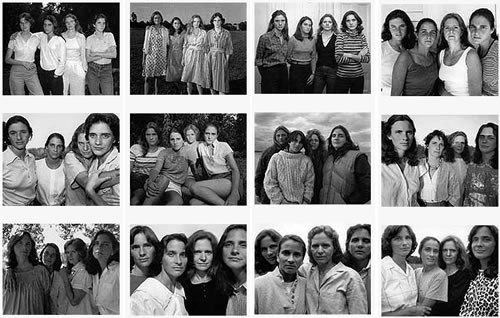
Every year since 1975, photographer Nicholas Nixon has taken a black and white image of his wife Beverly "Bebe" Brown and her three sisters. In each image, the sisters are photographed in the same order.


hale (ˈhāl),  adj. [northern ME, hal, same as Midland hool (see WHOLE); AS. hal, sound, healthy)  sound in body; vigorous and healthy, especially as used of an older person: also spelled hail. –SYN. see healthy.


By the time I was ten, I had lost both my grandfathers. By the time I was twenty, I had lost my grandmothers too. I look on my friends who have their elders still in their life with no small bit of envy because I wish I had gotten the opportunity to get to know these beloved family members as an adult.

Our culture in this country is so youth-centered. We are anti-aging. We deny death. We deny our own impermanence. We buy creams designed to stop fine wrinkles. We do crosswords to keep our minds active. Tummies are tucked. Faces are lifted. But this is just crown molding. Structurally, we are the age we are. Our bones know how long they have belonged to this body. Our sinew stretches, our skin shifts, our faces and our minds begin to lose some of their elasticity.

Something is lost in our inability to recognize our own mortality, in our unwillingness to acknowledge the act of death as inexorable from life as the act of birth.

As we age, several things happen to us physically. Among them: our cells multiply slower. We produce fewer of some cells, like T-cell lympocytes, which help with our immunity. Other cells don’t die when they are meant to and we can be at increased risk for infection. Aging changes our responses when exposed to environmental toxins. We lose height because our discs compress, our posture changes, our hips and knees curve, our joints shift. We lose the arches in our feet. Our bodies can’t regulate temperature as easily as we age. Our weight changes: by the time we are seventy-five, the amount of our body made up of fat has doubled since we were twenty-five.

Other things happen to us mentally. With the normal aging process, not accounting for instances of Alzheimer’s and dementia, we begin to lose our memory. This process actually begins around age thirty and progresses steadily from then. Monika Guttman writes in the article “The Aging Brain” that brain weight and brain volume decrease as we age, with brain weight decreasing five to ten percent from age twenty to ninety. Other physical changes in the brain include the grooves on the brain’s surface widening and the swellings on the surface decreasing. Also, we develop clusters of dying or damaged neurons, called “Senile Plaques.”

Our bodies and minds age largely not only in accordance with our genetics and environment but with how we treat them. If we exercise and eat well, our bodies age better. If we keep active and keep learning, our minds age better.

However, whatever we do to keep healthy, inevitably, we age. We age because that is a natural part of the process of life. And as we lose certain aspects of our body and mind, we gain others. Our bodies bear the marks of our experiences in the form of stretch marks and scars and injuries. Our minds serve as containers for all the stories we have learned, the books we have read, the conversations we have had. Containers for days of celebration and days of mourning. And as these memories pile on each other, we may have less control over which ones appear, but we also have way more to choose from.

I know I am young still, but I have, even over the past five years, seen changes that reflect aging in my face and in my body. For the first time ever last month, I had an experience with tendonitis from overusing the muscles in my shoulder. And while sometimes I bemoan these changes, I also recognize that these changes mean that I have had this time to live, these experiences to live in and through.  I look back at pictures of myself in my early twenties and what I notice more than the changes in my physical appearance is the difference in my experience which seems to be evidenced in my carriage, in my eyes. So much has happened since then.

The last pose in all forms of hatha yoga is shavasana or corpse pose. Some yoga teachers say this is the most challenging pose, to lay on the ground, completely still, feet and hands facing up. In taking care of our bodies but not trying to stop their natural process of aging, we honor all that is contained within them. In doing the shavasana pose in yoga, we prepare ourselves for our final shavasana. In this position, our entire being is vulnerable. And this is how we are in death, when our lives are over and we have no more left to do. We rest.

Leave a comment

Filed under weekly words

off duty


*off duty, temporarily relieved from one’s work.


Three weeks ago yesterday, I started a meditation class. I had begun practicing hatha yoga regularly again, and after some events, both personal and communal, that brought me a good deal of sorrow, I thought it would be a good time to take some steps to take better care of myself.

One of the first things mentioned in the practice of mindfulness is that most of the time we are asleep in our lives. We are physically awake, but we are asleep to the present moment. We function in auto-pilot. We operate from knee-jerk conditioned responses. We often don’t take the time to consider what is happening to us, what sensations are rising within us. And because of this, we are off duty, off duty to our true selves. We are relieved of the work of being mindful—by succumbing to distraction, by judging others and ourselves, by being unable to step outside and observe ourselves for a moment.

I have been thinking of the ways in which I feel dutiful. When I think of the word duty, it feels synonymous with obligations. I have certain duties: to be a good daughter, a good friend, a good teacher, and the list goes on. But the truth is that I have a larger duty, and that is to be a compassionate human being. I think of how often in being on duty to our commitments, we are off duty to our present selves, to our real needs.

Maybe I am running late to meet a friend for coffee, and when the light turns green and the person in front of me doesn’t immediately drive, I hold down the horn. Or maybe I don’t even honk, but I yell at him from inside my car. I have this reaction because he is a barrier, he is in the way of me fulfilling my current duty. What I do not realize is that he is also my duty because, in that very moment, it is my job to drive my car and to have an attitude of civility and patience to those on the road with me. But since I am already steps ahead, thinking about my friend sitting at the table alone and about my own judgment of myself for being late, I am unable to be present to the driver. And in honking my horn or yelling at him, I am also causing my own suffering.

Mindfulness is not easy. I am used to planning ahead. I am used to the frenzy that comes with checking off my to-dos. And when I’m not working, I have a habit of procrastinating, which is the opposite of mindfulness. In this action, I am not enjoying whatever I am doing—reading, surfing the web, watching t.v.—because I am trying to pretend that I am not avoiding my work. With this too comes suffering.

The first week of meditation, I found myself feeling so happy about it, a feeling, I would later come to recognize as ego. Look at me, I’m taking steps to be more healthy. I’m meditating. Yeah, it’s hard but I totally have this. And once I hit the first bump, which for me was our teacher saying we had to meditate daily for longer than I felt ready for, I instantly became resistant and even hostile. I kept doing my daily meditation, but the first few minutes were spent with me thinking of how I didn’t want to be sitting for as long as we were supposed to. Some mornings, I even gritted my teeth as I said the morning gatha—which, by the way, was: As I wake up this morning, I smile. A brand new day is before me.  I aspire to live fully in each moment and to see all beings with the eyes of compassion. I mean, what is more lovely than that? But for some reason, I just could not accept it.

I see similarities between the arising of resistance in meditation and the arising of it in my writing life. When I have resistance in my writing (oh, no, I can’t write about that, it’s too imperfect, it’s too raw, it makes me too vulnerable), I know that whatever I am resisting is exactly what I need to write into. In meditation, the resistance itself seems to be the affirmation that I need to continue doing it. I believe what I am resisting is not the meditation itself but the change, even if it is good, to old behaviors and old ways of seeing. To be engaged in mindfulness in one’s daily life is to commit not only to living in the present but to being completely honest with oneself. See how I defensively switched to “one” there? To be engaged in mindfulness in my life is to commit not only to living in the present but to being completely honest with myself. That sort of bareness sometimes feels daunting.

This week has been easier. By easier, I don’t mean that I always want to sit or that I always handle situations, meditation or otherwise, with grace. However, I think I am becoming more aware of the overall benefit of being more mindful and this allows me to have more acceptance of the discomfort that can arise. Because ultimately, I want to be on duty to the things that matter in my life. I want to be loving and kind to myself. I want to be loving and kind to those around me, both those known and unknown to me. I want to be present to the subtleties that life presents me with.

I’ll leave you with this quote by Buddhist monk, teacher, and poet Thich Nhat Hanh:

Meditation is not to escape from society,
but to come back to ourselves and see what is going on.
Once there is seeing, there must be acting.
With mindfulness, we know what to do and what not to do to help.


*[du·ty \ˈdü-tē also ˈdyü-\  n. [pl. DUTIES (-tiz)], [ME, dute, deute; OFr. Duete, what is due (owing); see DUE & – TY], 1. conduct owed to one’s parents, older people, etc.; behavior showing a proper regard or sense of obligation; obedience; respect.  2. any action necessary in or appropriate to one’s occupation or position.  3. conduct resulting from a sense of justice, morality, etc.  4. a sense of reeling of obligation: as duty calls.  5. a payment due to the government, especially a tax imposed on imports, exports, or manufactured goods.  6. [British], the performance of a machine as measured by the output of work per unit of fuel.  7. the amount of work that a machine is meant to do: as, a heavy-duty tractor.  8. in agriculture, the amount of water needed for irrigation per acre per crop: also duty of water.]


Leave a comment

Filed under weekly words