Monthly Archives: December 2010

auld lang syne

auld lang syne

auld (ôld) Scots adj. Old.

lang·syne also lang syne (lăng zīnˈ) Scots. adv. long ago; long since.  n. time long past; times past.


For times gone by. For old times. The song that no one knows*, that everyone mumbles while exchanging kisses on the striking of the New Year seems to be really all about what we all do at the end of the year. We remember. We reflect. We think back on what has happened since our last December 31st. We wonder about what the year to come will bring, and we also consider the experiences that have changed our lives in those twelve months. For me, from year to year, I seem to have polarizing reactions. Either it is “Amen, this year is over. Good riddance!” or it is “How will next year ever compare?” So this year, I challenge myself to remember all of the happenings of this past year and to move forward with a spirit of adventure, acknowledging and letting go of this past year, the joys and the sorrows, as I head forward into the next.


Happy New Year!


*The original song was written by Scottish poet Robert Burns in 1788, and, for the record, here are the original lyrics and the English translation:

Burns’ Version English Translation
Should auld acquaintance be forgot,
and never brought to mind ?
Should auld acquaintance be forgot,
and auld lang syne?CHORUS:

For auld lang syne, my jo,
for auld lang syne,
we’ll tak a cup o’ kindness yet,
for auld lang syne.

And surely ye’ll be your pint-stowp !
and surely I’ll be mine !
And we’ll tak a cup o’ kindness yet,
for auld lang syne.

CHORUS

We twa hae run about the braes,
and pu’d the gowans fine ;
But we’ve wander’d mony a weary fit,
sin auld lang syne.

CHORUS

We twa hae paidl’d i’ the burn,
frae morning sun till dine ;
But seas between us braid hae roar’d
sin auld lang syne.

CHORUS

And there’s a hand, my trusty fiere !
and gie’s a hand o’ thine !
And we’ll tak a right gude-willy waught,
for auld lang syne.

CHORUS

Should old acquaintance be forgot,
and never brought to mind ?
Should old acquaintance be forgot,
and old lang syne?CHORUS:

For auld lang syne, my dear,
for auld lang syne,
we’ll take a cup of kindness yet,
for auld lang syne.

And surely you’ll buy your pint cup !
and surely I’ll buy mine !
And we’ll take a cup o’ kindness yet,
for auld lang syne.

CHORUS

We two have run about the slopes,
and picked the daisies fine ;
But we’ve wandered many a weary foot,
since auld lang syne.

CHORUS

We two have paddled in the stream,
from morning sun till dine ;
But seas between us broad have roared
since auld lang syne.

CHORUS

And there’s a hand my trusty friend !
And give us a hand o’ thine !
And we’ll take a right good-will draught,
for auld lang syne.

CHORUS


And here’s a clip from one of my favorite movies of all time:

Leave a Comment

Filed under other words

strum*

1strum \ˈstrəm\  noun : an act, instance, or sound of strumming

2strum \ˈstrəm\ verb strummed  strum·ming

transitive verb 1.  a : to brush the fingers over the strings of (a musical instrument) in playing <strum a guitar>; b: to play (music) on a stringed instrument <strum a tune>           2. : to cause to sound vibrantly <winds strummed the rigging — H. A. Chippendale>

intransitive verb

1: to strum a stringed instrument 2: to sound vibrantly

strum·mer noun

(definitions this week taken from merriam-webster.com)

I took piano lessons for eight years. I started when I was six. I don’t remember if I asked for lessons or whether my parents just signed me up. In any case, the decision would have been a logical one as I adored music. From an early age, I loved to sing and did so pretty much all the time to anyone who would listen. My dad remembers me sitting fixated in front of the television as a young child, watching ballet and opera. As a toddler, I carried around my Fisher Price tape recorder with attached microphone everywhere I went.

I was always very moved by music, but as memory serves, I never really enjoyed playing or practicing the piano. I appreciated the delicacy of the movements of fingers over the keys and the sort of sweetness that emerged when a classical piece was played by someone who understood the instrument. It’s just that I always had the feeling that that someone was not me.

My father played the guitar in the evenings when I was small. If he knew more than two songs, I don’t know them. My memories are of dancing around in my Annie nightgown and accompanying him with my toy tambourine to the sounds of Peter, Paul and Mary’s “I’m in Love with a Big Blue Frog” and Captain and Tenille’s “Muskrat Love.”

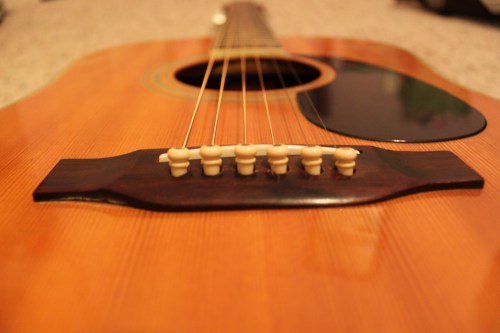
When I was in seventh grade and a guitar class was being offered at my new school, I decided to take it. I packed up my dad’s old Takamine in a soft case and toted it with me to school. The first week we learned “He’s Got the Whole World in His Hands” (This was a logical choice for the instructor: All of us attended a Catholic school and the entire song is two chords: G and D). We also learned to pick the riff to “Can’t Touch This”: neer-neer-neer-neer-neer-neer-neer-neer (And by now, you should be able to pretty accurately assess my exact age). I scanned the room that first day, and I noticed quickly that I was the only girl there. I didn’t know hardly any women who played guitar. I had vaguely heard of Joni Mitchell and Joan Baez, but I hadn’t heard of Joan Jett, Bonnie Raitt, Sarah McLachlan. Instead of feeling empowered, I felt like I didn’t belong, and I quit.

Dar Williams

In college, I met my friends Julie and Sarah, who both played guitar, and I became curious again. I was also exposed to a world of music I hadn’t heard before. I found a home in contemporary folk music and here there were women playing guitars all over the place: Dar Williams, the Indigo Girls, Ani Difranco, Erin McKeown, Lucy Kaplansky, And yes, some of my early attempts at finger picking were to songs from Jewel’s first album.

I got a guitar for Christmas my freshman year of college and I began to play. And immediately, there was something different here than with piano. From that first strum, I felt a current in my body. It sounded like a heart beat. It sounded like a footstep. It sounded like the hitting of a boot on a plank of wood, like the hollow clang of a metal, like a voice echoing in a tower.

Woody Guthrie

Also, I was really, really bad. It took me three hours to make chord changes, and initially, I couldn’t sing when I played unless I phrased my singing in time with chord changes. But I didn’t care. There was something about the sound that kept me coming back. There was something about the sound that was satisfying, even if I wasn’t good. There was something about the sound that made me want to be better at making it.

The music I am most attracted to is music that over all else feels sincere. I love music that is sung on porches or in living rooms. I love music that has imperfections, where voices crack or one note is picked a lot louder than the rest. It gathers its beauty not from its proficiency but from its earnestness. It is beautiful because I can tell that the person making it needed to make it. This music is made to fill a void or to celebrate a milestone. This music is made because in the making, life becomes a little easier. Or suffering is shared. Or something needs to be said and this is the way to say it.

Sonny Terry and Brownie McGhee

One of the definitions of strum is: “to cause to sound vibrantly.” I guess this is what drew me to the guitar and what draws me to folk music, to the blues, to old country. There is a vibrancy in these songs that ultimately reminds me of what it means to be alive—in all its loveliness and heartbreak, in its seamlessness and messiness.

A few years ago, a very talented singer/songwriter friend of mine and I recorded some songs together. We had sung together in college and after years apart, we reconnected and we sang again. The first time we attempted to record one song, Stephen Foster’s “Hard Times,” we did it in parts. I played the guitar. Then I sang. Then she did. But it felt mechanical. It didn’t work. We decided to do it the way we actually performed it. And when we sang, I played guitar and we harmonized, singing together with eyes closed because we didn’t need to look at each other to know when to begin or when to end. And that creation of sound is one of my favorite moments.

Elizabeth Cotton

Just a few songs that come to mind in relation to strum:

Disclaimer: Some of these don’t have “strumming” at all, the first one is acapella, actually. Many of them are finger-picked. But I mean strum as in “to sound vibrantly.”

Hazel Dickens “Little Pretty Bird” (even though there is no strumming involved in this one; it’s acapella)

Gillian Welch & David Rawlings “Time (the Revelator)”

Stephen Foster “Hard Times (Come Again No More)”

Elizabeth Cotton “Freight Train”

Woody Guthrie “Do Re Mi”

Dar Williams “If I Wrote You”

Bob Dylan “Don’t Think Twice”

Mark Erelli “The Only Way”

Lucinda Williams “World Without Tears”

Joni Mitchell “A Case of You”

Sonny Terry & Brownie McGee “A Better Day”

Doc Watson “The Coo Coo Bird”

Patty Griffin “Sweet Lorraine”

Po’Girl “Old Mountain Line”

Jeff Buckley “Hallelujah”


*It’s funny that this word is assigned this week as I’m playing a gig with an old bandmate Mark at The Neutral Ground in my hometown New Orleans.


1 Comment

Filed under weekly words

re·cline

re·cline \ri-ˈklīn\ transitive verb : to cause or permit to incline backwards

intransitive verb 1. to lean or incline backwards 2. repose, lie

Origin: Middle English, from Anglo-French or Latin; Anglo-French recliner, from Latin reclinare, from re- + clinare to bend. First Known Use: 15th century

(from Merriam-Webster.com)

The Lazyboy was a sort of garish orange threaded through with white. Susan picked at the worn section on the left arm, as if she could do no further harm to this eyesore of a chair that had no business existing in the first place. She could tell it was annoying her therapist, her picking not the chair itself, which he had apparently chosen after all. He had just asked her what she presumed was a pivotal question in her “therapeutic process” and he had a look of expectation on his face, although he was trying to hide it. This was the moment, she imagined, when she was supposed to have an epiphany. No, wait, it was called an epiphany in novels. In therapy, it was called… What the hell was it called again? Well, anyway, she was supposed to be overcome with emotion. She was about to disclose something major, something life-changing, something she had never realized until this exact moment. Maybe she would cry, a river or perhaps a single dramatic tear. A tear which she would let slide down the length of her cheek without wiping it away, feeling the poignancy of the moment grow as it slid and slid and then dropped below, leaving a mark on her cotton t-shirt.

But the truth was, she didn’t feel a damn thing. Hours and hours of therapy, hundreds of dollars and she had arrived at the moment when she was supposed to finally come to some sort of realization, perhaps provide herself with some restitution for years of self-harm and self-doubt. She almost felt bad for her therapist, who sat there calmly waiting for her to speak. He had worked hard to get her here and for what? For her to feel nothing at all? Perhaps she could fake it. Make some shit up. Babble about her subconscious desires. But no. This, she imagined, was one of the few things in life impossible to fake. You cannot feign knowledge about something if you have no idea what that something is supposed to be.

She looked down at the arm of the chair and realized what she had done. There was a large oval area on the chair’s arm that now resembled the bald spot on a mangy dog. Through one sliver at the side, you could even begin to see the metal rod inside the chair.

“Oh my God, I’m so sorry,” she said, only it came out muddled and muted.

“What was that?” her therapist asked.

“I said I’m so sorry. I wasn’t paying attention. I ruined your chair. I’ll pay for it.”

He dismissed the idea with a wave of his hand. “It’s not a problem, Susan. I’ve been meaning to re-cover or replace that chair for months. Really, you helped me out.”

“But shit, I just, I mean, I can’t believe I did this without noticing.”

“Really, it’s fine. If I was worried, I would’ve said something or asked you to stop.”

She could tell by the calmness of his eyes that he was telling the truth, but she couldn’t let it go.

“How much do you think a new chair costs? I can add it to my check for today. Really, I’d feel better.”

“Why do you feel it is necessary to compensate me for the chair when I’ve told you that it’s not important? Do you not believe that I’m telling you the truth?”

“No, I do believe you.”

“Then what it is it?” he asked.

“I messed it up, okay? I messed it up and I can make it right. This, this I can fix. I can fix this stupid fucking chair that is the ugliest goddamn thing I have ever seen. And it’s something that shouldn’t even be fixed because it’s that worthless. But I have the power to fix it and I know I can. So will you let me fix the fucking chair?”

She suddenly felt like she was going to vomit. She could feel the sensation of fullness in her belly and knew that the accompanying nausea would soon be followed by a warming of her esophagus as everything rose. But just as she felt it coming, she instead began to sob. Her whole body shook, convulsing in a way she had never experienced before. She did not fight it. She didn’t try to make herself stop. She put her head in her hands and she felt the water teem. Her nose was running but she didn’t reach for the tissues. She wanted to feel like the mess that she was. Oh right, she thought, it’s called a breakthrough.

1 Comment

Filed under weekly words

under sail

under sail, from my dictionary

under sail, sailing, with sails set.

SAILS ON A FULL-RIGGED SHIP

1. flying jib; 2. jib; 3. fore-topmost staysail; 4. foresail; 5. lower fore-topsail; 6. upper fore-topsail; 7. fore-top-gallant sail;  8. foreroyal;  9. fore-skysail;  10. lower studding sail;  11. fore-topmost studding sail;  12. fore-topgallant studding sail;  13. foreroyal studding sail;  14. main staysail;  15. main-topmast staysail;  16. main-topgallant staysail;  17. main-royal staysail;  18. mainsail;  19. lower main topsail;  20. upper main topsail;  21. main-topgallant sail;  22. main royal; 23. main skysail;  24. main-topmast studding sail;  25. main-topgallant studding sail;  26. main-royal studding sail;  27. mizzen staysail;  28. mizzen-topmast staysail;  29. mizzen-topgallant staysail;  30. mizzen-royal staysail; 31. mizzen topsail; 32. lower mizzen topsail;  33. upper mizzen topsail; 34. mizzen-topgallant sail;  35. mizzen royal; 36. mizzen skysail; 37. spanker

1. flying, we 2. left 3. them, headed to sea 4. without 5. without manuals 6. we’ll learn to survey 7. the water, the wind 8. with no map 9. we, map-less               10. lower our demands 11. low, we go in cabin 12. foreswear the compass, foreswear 13. those running rigging lines 14. we will steer 15. using other tools  16. mid-wives of this vessel 17. mid-breath, we assist  18. with limbs  19. used as wood rutters 20. with balance, from scales 21. we climb, to check sails 22. main royal 23. we tighten 24. that which needs tightening 25. and we loosen just to see 26. what billows, what flies out 27. we need staysails 28. we need this, to stay, sail 29. and to hoist, to work, to move 30. to handle, steer, manage          31. beneath shape sheets 32. needing only to spread 33. and to catch and deflect 34. this full air, this strong wind  35. no, we are not 36. prepared, only             37. steady.

Leave a Comment

Filed under weekly words