Monthly Archives: August 2010

key·way

key·way (kēˈwā) n. 1. a groove or slot cut in a shaft, hub, etc. to hold a key (metal piece to fasten a wheel or pulley to the shaft) 2. The slot for a key in a lock operated by a flat key.

*

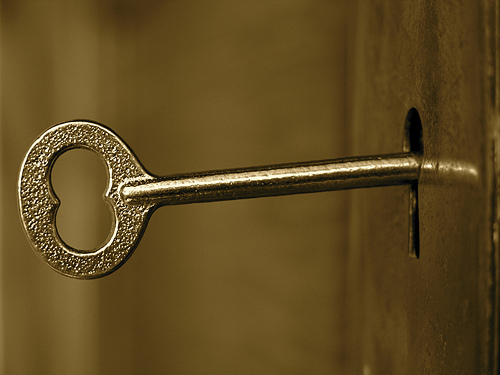
My childhood bedroom was locked using a skeleton key. I remember holding the wrought-iron key in my hand and feeling there was something exotic about it. The way the key inserted in the keyhole and the substantial turning of the lock was way more satisfying than with a plain old dead bolt. I would stand there, only slightly taller than the knob and turn the key back and forth, practicing locking and unlocking.

I knew the key was old. I knew it was different than other keys. I was a kid and had neither the fear required to lock my door or anything to hide, but the fact that I had this thing that could give me privacy, that could keep my things and myself stored away, made me feel important.

That room no longer has a door, no longer has walls. The floor that had been covered in brown carpet is stripped down to bare wood. And the key is gone as well. I’m not sure when I lost it or where it got tossed, amongst knick-knacks and cleaning supplies in the bathroom closet? In a spare drawer?

*     *     *

The front door of the house had been warped by the humidity so that you had to hold it in a little when you turned the key in the front door. Otherwise the latch wouldn’t lock or come unlocked.

I remember fighting with that lock over the years:

When, on a trip from the grocery store as a child, my mom handed me a key and asked me to unlock the door.

When, returning home from a date in high school, I tried and failed to make a seamless and graceful exit and had to resort to banging my hip up against the door.

When I came home for holidays on break at college and moved in and out of the house, going out to hear music and then returning home to visit with my parents.

When I unlocked the front door to bring in Christmas trees and furniture, to let in family members, best friends, and potential suitors.

When I unlocked the front door to allow myself inside.

*     *     *

The side door, like the front door, was wooden with glass panes. It used to be the back door but then my parents added on to the house when I was eight. We hardly ever used the side door except when going to the side yard to or to the shed. Sometimes, we would open the door to let the dog out.

Now, when you look in, you can see crumbs of sheetrock lying on the ground. The rooms are no longer rooms but a skeletal wooden frame. The house looks much smaller this way, without all of our stuff to take up the space.

You can see straight through from the living room to the dining room to my bedroom to the guest room. You can see all the way to the front of the house to the kitchen, without walls to block your view. You can see the entire house at once and yet you see none of it.

*     *     *

When we arrived there on October 1, 2005, there was a large yellow X spray painted on the front of the door. And there were numbers. The numbers were code for rescue workers. Zero dead bodies. Zero dead animals.

The house had been filled with five and a half feet of water. But now the water was drained. So there was only the reminder of the water, in the form of wet furniture and mold covering the walls.

We put on masks and went in through the side door. We surveyed the damage. We carried our possessions out the front door and dumped them in a heap on our front lawn.

When we left that day, my dad locked the front door. Out of habit? Surely there was no longer anything worth taking.

*     *     *

Every time I come home, I drive to my old neighborhood. I park in front of my childhood home. I get out and walk up the front stairs and peek through the front door. I don’t know what I am expecting, to see our house as it was before brought back to its original state? Maybe I just need to be reminded of what’s gone so I can handle missing it.

*     *     *

I talked to my mom just an hour after my parents had sold our home to the city of New Orleans. They had met with a Road Home officer and after they signed the paperwork, they gave her the keys to the house.

Afterwards, my parents went to the house to say goodbye. My mom told me that before she left, she walked around the house, taking pictures.

I picked up some stuff we’d left at the house, she said. Remember the books there. I took all that. And I don’t know why but I took a picture of all the doors. I just kept thinking of that image. Doors closing. Doors opening.

*
1 Comment

Filed under weekly words

di·u·ret·ic

di·u·ret·ic /dī’ə-rĕt’ĭk/ adj. : tending to increase urine flow—diuretic n.

[NOTE: Okay, seriously, dictionary gods?!?!?! Last week, “reins” and now “diuretic?” These last two words were really the first ones that I have felt pretty stumped by. I mean, what does one really care to write about “urine flow.” I can answer for myself, nothing, nothing at all. But rules are rules. This was the word I landed on this week. I could try to fool y’all and say I landed on the word just below it, which was “diurnal”: daily; of, relating to, occurring, or active in the daytime. That would be pretty easy to write from. But that wouldn’t be honest. But no matter the word, I will not subject you to talk about my own bathroom habits. So please don’t be concerned about that.]

This is maybe going to sound silly or too big of an analogy to make here, and you have every right to think that and to stop reading. But I think sometimes about bodily functions, our response to these functions and what they have to say about the ways in which we move through life. For example, I think about the sensation of having to go to the bathroom when the situation becomes urgent. It requires your entire focus. You can’t imagine a more uncomfortable feeling. You are going to explode. You are literally going to die.

And then the moment you go, you feel that instantaneous relief. It is hard to conjure or even imagine the feeling of hopelessness and anxiety that existed a mere thirty seconds before.

I feel that way about life sometimes. This is especially true because right now I am in the midst of one of those “gotta go” moments. I can’t even begin to explain the amount of brokenness I have experienced and witnessed in the last few months (and even more so in the last few weeks)—broken relationships, broken engines, broken windows, broken words, broken trust. Everywhere, everything is broken and I’m not sure what to do. It feels silly and naïve to just pick up the pieces: almost like, what is the point when something else is bound to break again? Why not just live in the battered shell? Why not just abide in the wreckage?

And it is hard for me, in the midst of these experiences, to have any comfort in the idea that relief will come. When? For how long before something else happens? For how long must I endure this feeling of powerlessness or the deep desirous need for relief whose arrival I cannot predict? I don’t know. And I don’t have a ribbon with which to tie up this post or answer these questions. These feelings are very real and palpable to me.

I am someone who believes in redemption and repair, and yet in this very moment, all of this feels so far away from reality. The only thing that gets me through moments like are the little things that are not broken. The phone call of a friend to check in. The offer of a safe place to stay or a car to drive. A compassionate embrace.

And these little gestures, these moments of connectivity do not do away with the brokenness. The pieces are too small to fill the cracks. But they do help clot the bleeding. They do hold back the dam from bursting further. They stop the cool air from rushing in.

Someone once told me that a religious leader was talking about the beauty of a broken heart. It had to be broken open, he said, so that more love could pour in, could pour out. I have definitely experienced moments of brokenness in my life that led to more fullness and beauty than I could have ever imagined. But that didn’t make the breaking nor the putting back together any easier. That didn’t make me know that relief would someday come. Maybe there is something about the intensity of these moments, their never-ending quality and the feeling that we might not make it through them, that makes us truly love the act of letting go.

1 Comment

Filed under weekly words

reins

reins (rānz) n. pl. [ME. Reines; OFr. Reins; L. renes, pl. of ren, kidney], [Archaic], 1. the kidneys, region of the kidneys, or loins 2. the loins as the seat of the emotions and affections; hence 3. the emotions and affections.

In using a dictionary from 1955, there is always the possibility of coming up with words that are now defunct or seldom used. However, for this week, I came upon a word that I was familiar with but whose listed definition is no longer associated with the word.

After searches on multiple online dictionary sites, I was unsuccessful in finding this dictionary definition anywhere. Everywhere reins involved horses and the strap used to make them yield. It was about the act of restraint, of pulling back. But a search with reins and the word kidney revealed that the word in this context was used often biblically:

Psalms 16:7 My reins also instruct me in the night.
Proverbs 23:16 My reins shall rejoice.
Psalms 7:9 God trieth the hearts and reins.
Isaiah 11:5 Faithfulness the girdle of his reins.
Job 16:13 He cleaveth my reins asunder.

In ancient Hebrew tradition, the kidney was of equal value to the heart. According to Dr. Giovanni Maio at the University of Lübeck’s Institute for the History of Medicine and Science in Germany, the kidneys were where the deepest emotions and passions resided. Kidneys were representative of the secret inner world all humans have and were a metaphor for deep reflection. Kidneys were also referenced as both a place of great strength and also one of great vulnerability.

It is compelling then that the definition of reins that we use currently relates to and tempers the older one. Reins are something that facilitate control: of a horse, of a passion, of our innermost desires. Instead of, as it was, the organ that produces those desires themselves.

In traditional Chinese medicine, the kidney is responsible for growth and maturation as well as for reproduction. So, when the kidney is malfunctioning or imbalanced, the person suffering can emotionally manifest this by feeling fearful or isolated or insecure.

I guess it makes sense too that kidneys were seen as the site of passions because when kidneys are working properly, they regulate the body, keeping it balanced. They filter the system and get rid of waste. And when they don’t, there is build up. The rest of the body suffers. These are passions that need to be honored for their power and also controlled.

1 Comment

Filed under weekly words

port⋅ance, v2


port⋅ance (pôr/t’ns), n. [Early Mod. Eng. < porter, to bear, carry; cf. –ANCE], [Archaic], conduct; bearing; carriage; demeanor

This post by the fabulous Drew Krewer


:::::::::::::::::::::::::::::::::::::::::       :::::::::::    ::::::::::::::    : : :     :

From Kindergarten until I left my small, rural school in Georgia as a Junior, the same man took my yearbook photograph every year.  He had a stuffed frog named, appropriately, “Mr. Froggy.”  For all the kids who didn’t want to smile, Mr. Froggy hopped out of his frog cave to be animated by a wide-faced, mustached Mr. Photographer.

I didn’t want to smile.  At least in the way he wanted me to smile.  To him, smiling meant teeth, and I really didn’t want teeth in my pictures.  When it came my turn, I would give a slight, tight-lipped smile, and out would come Mr. Froggy.  The photographer would switch on his goofy frog voice––personable, perhaps child-friendly on the surface, but beneath it there was this impatience, this sense that I was the one cattle who wouldn’t listen to his herding call.  Finally, he would take the picture anyway, teeth or no teeth.  I think over my school career I alternated between the tooth and non-tooth yearbook photos, depending on how annoyed I was with the frog voice that year.

This scenario has continued to happen throughout my life––why the long face?  Cheer up.  Give me a little smile.

Just because I don’t walk around with a continual, pep-rally grin on my face does not mean that I’m sad.  In fact, I’m content 80% of the time.  Well, maybe 70%.

But why are people, even strangers, so concerned about it anyway?  Maybe that’s what the song “It’s My Party and I’ll Cry if I Want To” is really about:  the freedom to come off as sad or as happy as one damn well pleases.  Maybe a happy demeanor became expected with the rise of consumerism, salesmanship, and retail; the expectation that if one looks happy enough, talks friendly enough, stands upright enough, that the customer will feel happy and perfect, too.

Stop frowning.  You’re invading everyone’s HAPPYSPACE!

But I’m not frowning.  I’m content.

One day, I was driving back home with a friend, and she asked me about the word “content.”  I had always had a positive relationship with the word “content.”  But my friend said, “Content means that things are routine, normal, and satisfactory.  Happiness is so much more than that.”

So, maybe people just aren’t content with being content anymore.  The world can never be too Technicolor.  A world flash-flooded with routine yet vibrant compliments.  A world where Mr. Froggy hops out at unsuspecting, content strangers, convincing them that no matter how wide their smiles may be, they’ll never be wide enough.


*Drew Krewer’s work has appeared in Trickhouse, Poor Claudia, Pequod, and Quick FictionArs Warholica, a chapbook of poetry, was recently published by Spork Press.  He holds an M.F.A. from University of Arizona, where he received the Academy of American Poets prize.  He runs the multimedia culture site mars poetica.

Leave a comment

Filed under weekly words

port⋅ance, v1

As I mentioned in my last post, this week I will be featuring posts by guest contributors who are offering their own insights and observations on the first word ever randomly selected for the dictionary project:

port⋅ance (pôr/t’ns), n. [Early Mod. Eng. < porter, to bear, carry; cf. –ANCE], [Archaic], conduct; bearing; carriage; demeanor

This first post is from Julie Lauterbach-Colby*.

“Lines Appearing, Distant Points”

We study the line. From point A to point B we have the closest distance. Draw a footpath, map out a solid trail of breadcrumbs. Denote journey and begin.

Intersection of lines, latitude and longitude, a knitting, a stitch. Sense of security; single location of one self in space. I say one, because, can we ever possess our whole selves in any given moment? Denote a journey, a beginning.

We are all familiar with the history of the GPS (I wasn’t). Devloped by the military to deliver an exact point, an exact location. We are talking precision here: the most authoritative mode of travel, point A to point B and nothing else, nothing outside. Similar to (and at the same time, nothing like) medieval road maps.

Matthew Paris, an English monk from the 1200s, was famous for them. He made the maps in likeness to Roman army parchment maps: thin strips, the maps only showing road and important places along that journey. Most often, these journeys were spiritual: how to travel from London to Jerusalem for a holy pilgrimage.

(How to, with accompanying pictures for each: Start in London [A]; cross the English Channel [B]; through France [C, where the whole country was drawn as a single castle with three spires]; into Italy [D]; across the sea [E]; onward to the holy land [J, with a few undeciphered points in-between].)

Notes in the margin of the parchment scaled distance, how long it would take one to travel between destinations. Roads were straight—study the line: from point A to point B we have the closet distance. Nothing exists outside the frame, no chance for wandering minds, no detail for lay of the land. These maps were about getting. About time-management, efficiency. Exactness, with a clear sense of exclusion. As in, “Shoulders back, chin up.” Presentation of one self and oneself. (I cannot seem to stress this enough.)

It was from a fear of its exactness that military personnel insisted that the GPS technology remain hidden from the world citizen. In 199__ the Clinton administration “unscrambled” the codes and put the GPS on the public’s radar.

Take a GPS and map out a ten-mile radius from where you are (your house, your car, your supermarket, your post office, your church) and follow that breadcrumb trail from each direction: go N, NE, E; SE, S, SW; W, NW. Upon arrival, turn 360° and take in the view.

You’re going to this one spot, and it’s a dictated spot. Once you get there, infinite possibilities. The first sea cartographers used x to mark not treasure but danger. Define trespassing: there are a million ways in which I lie.

*Julie Lauterbach-Colby is a writer, teacher and artist living in Tucson. She is currently working on a project that incorporates cartography, mathematical equations and cadavers, and owns her own editing business called Chicken Scratch Editing.

Leave a comment

Filed under weekly words

an·ni·ver·sa·ry

an·ni·ver·sa·ry (ænɪˈvɜːsərɪ) adj. [L. anniversaries < annus, year + versum, pp. of veriere, to turn],  1. recurring at the same date every year; occurring annually.  2. of or connected with an anniversary.  n. [pl. ANNIVERSARIES (-iz)], 1. the yearly return of the monthly date of some event  2. the celebration of this.

Today is the one-year anniversary of The Dictionary Project. Thanks to all of you for reading and being a part of this experience. Anniversaries are times to reflect and be grateful. This project has been a wonderful way for me to explore different ideas and thoughts. The constraint of blindly selecting each week’s word has forced me to think about words and definitions I might have never considered otherwise. This has been a challenging and enriching experience. Beyond that, I have become even more sensitive than I was before about the use of language, how we imbue words with meaning and how we bring our own experiences, ideology, and environment to each word we use and consider.

Throughout this week, I will be posting writing from guest contributors who are writing on the first random word selected when I began The Dictionary Project last year. The word is portance.

Thank you again for being part of this journey.

Leave a comment

Filed under other words

wa·ter ta·ble

wa·ter ta·ble  n. :  the upper limit of the portion of the ground wholly saturated with water.

“The water table is the level at which the groundwater pressure is equal to atmospheric pressure. It may be conveniently visualized as the ‘surface’ of the groundwater in a given vicinity. It usually coincides approximately with the ‘phreatic surface’, but can be many feet above it. As water infiltrates through pore spaces in the soil, it first passes through the zone of aeration, where the soil is unsaturated. At increasing depths water fills in more spaces, until the zone of saturation is reached. The relatively horizontal plane atop this zone constitutes the water table.” –from wikipedia

I find it interesting that my finger landed on a page filled with words about water—waterway, water wheel, water wings—because water is what I desire almost constantly lately. I live in the desert so am unaccustomed in my daily life to seeing water anywhere else besides a drinking glass, the sink spout or the occasional swimming pool.

My thumb landed on two words: water strider and water table. As I discuss in the rules, in the event of such a situation, I get to pick. And I’m picking water table. I invite you to write your own posts about water strider in the comments section, if you so desire (wa·ter  stri·der  n. : any of various long-legged bugs that move about swiftly on the surface of water).

* * *

Water and I have a complicated relationship. I was born in July and regardless of how much astrology is or is not true, I feel a strong pull to water. Before Tucson, I have always lived in places that were anchored to large bodies of water—New Orleans, Washington, D.C., Rome, San Francisco. When I lived in New Orleans, I would often bike to a park alongside the Mississippi called The Fly. Especially on difficult days, I found looking out at the waves of the Mississippi, seeing the river curve around the bend and keep going, very reassuring. Here was this thing that just kept flowing. It’s sheer size was a comfort to me. No matter what was going on with me, the river would always be there, and I found a certain peace in that thought.

When the levees broke following Hurricane Katrina, the water rose through the streets of New Orleans and filled my childhood home with five feet of water. The water seeped into cabinets, into the mattresses and box springs. The water soaked the curtains. The water bled the photos in albums on my bookshelf. The water took indiscriminately and it took almost everything.

When my parents and I returned to the house a month after the storm, when we were finally let back into the city, we sorted through our saturated belongings. We held each other after we saw the watermark on the wallpaper and the smattering of mold on the sheetrock.

Then, I wasn’t thinking about water’s ability to provide sustenance. About its beauty or largeness. I was heartbroken. Water had ruined everything.

In the months to come, I would assess and reassess all my family and I had lost. I would remember books and journals and photo albums that had been in the room. Each time I remembered something new, I felt the grief afresh. A memory gone. I also grieved for the items I would never remember, for the ruined photographs that would have reminded me of past experiences, experiences I might not ever recall again on my own.

Then slowly, my parents began to rebuild their lives. I began to see changes, even if small ones, in the city and its progress. I began to worry less about lost items I could no longer hold in my hands.

Earlier this week, my house was broken into. The window was pried open and the burglars, likely teenagers looking for some quick cash, took some jewelry of sentimental value to me and my digital camera. They didn’t take my guitar or my computer or backup drive or other things I would have felt lost without. My house had been broken into, and I felt the  violation of my space. But my dog was safe and so was I.

And surprisingly, I didn’t feel outraged. I wasn’t panicked. I felt a bit less safe but not totally shaken. The robbers had taken some things that belonged to me, but they hadn’t taken anything I could not live without. And while I was sad at the loss of these things, I didn’t feel hostile. They were taking these things to fill a need they had: for money, for drugs, for something to maybe make them feel better about themselves and their own trials.

And I had the sense, even just a short time after I discovered the house in disorder and my things missing, that I would be okay. And I somehow knew that my previous losses had prepared me for this moment, had prepared me to handle it with grace.

We are taught in our culture to value objects. We are what we own. We need things that are pretty, and once we have these things, we need things that are even prettier. But I found that losing these things, even ones that had been given by loved ones, did not shake my sense of self. I still had the people who gave these objects to me in my life. And I was okay. In caring too much about objects, we become bound to them. I think we give those objects too much power over us. And ultimately, when these possessions break or are lost or stolen, we are the ones who choose to decide how to let their absence affect us.

This month will be five years since the storm, and while I still believe it should have never happened–the city of New Orleans and its people drowned and it was completely unnecessary, the city and its citizens were abandoned (and continue to be) when help was (and is) so desperately needed—the time hasn’t passed without me learning something really important: I am capable of handling loss, of dealing with heartbreaking grief and of coming out on the other side.

I still think sometimes about what is lost in the storm, and it is with a sense of sadness. But my sadness now is measured. All this was lost and I still stand. My parents still stand. We made it through this experience, fortunate to have our lives and each other. And it turns out that the funny thing about memories is that you keep making them. New ones are created to fill the spaces of the ones that are missing. We keep living. We keep remembering. And the water cannot take that away.

2 Comments

Filed under weekly words