
Love Hate Graffiti New Orleans, 1937
his·to·ri·an (hist-tor’i-en, hist’to’ri-en), n. [Fr. Historien], 1. A writer of history; chronicler. 2. An authority on or specialist in history. Abbreviated hist.
On Friday, I visited the Center for Creative Photography, where there was an exhibit by John Gutmann entitled “The Photographer at Work.” Gutmann’s work, with its dynamic use of contrast and figure placement, moved me. My response to his images was gutteral, emotional. I found myself scrutinizing each photo—trying to better understand his subjects, why he was drawn to them. I found his story equally moving. Gutmann was an artist who lived life, with his photos as a documentation of that life lived. A Jewish man fleeing the Nazis in Germany, he arrived in the United States in the thirties. He was attracted to those marginalized—carnival performers, misfits, people often ignored or left unconsidered by others. And he made them the focal point of his work.
Many of his photos took place in San Francisco, a city where I lived for three years, and I enjoyed seeing the place revised in my own mind with these images from the 1940s of places I was familiar with: City Hall (except with a Nazi flag hanging next to the American one from a visit from German leaders), Mission Street (with a corner store that looked exactly like ones I used to walk by), and the Golden Gate Bridge (including a photograph of the first post before the bridge was even completed). In addition to his interest in people, animals and buildings as his subject, Gutmann also liked to see the interplay of language as seen through his lens. He took pictures of graffiti: art depicting art. He elevated graffiti on walls and popular culture signage to high art. He wanted to consider the way people used language in their day to day lives, what meaning could be made, and by doing so, he made all those who saw his photos consider the same questions about language.
The curator’s biography of Gutmann described his fascination with the intersection of language and physical environments. Rather as seeing billboards or signs on grocery windows as the backdrop of photographs, he saw them as the focus. Not only were they interesting to examine but they were markers of the time. One of his photographs of a painted car reveals the scribbler’s politics and hopes for the next election. The language painted on the car is critical of banking, of Roosevelt, of war, and of poverty even in “a land of plenty.” While it could be seen as discouraging to some since the same troubles we face today were ones of yesterday that are reoccurring, I see it differently. For me, this image reminded in, in a hopeful and inspirational way, that there have always been dissenters, that there will always be political art. Remembering that it was that way, is that way now and will continue to be that way helps me stay grounded, helps me feel better about the struggles we have to face as a country and world. These political signs are next to signs advertising ham and eggs, liquor and wine. The political and the everyday. The criticism of the greed of those that keeps others hungry and the advertising for food that would feed us all. In capturing images like this, Gutmann is a witness to what people saw in their everyday lives but maybe did not really look at.
I talked to my friend who visited the gallery with me about Life magazine. “We don’t really have a publication like that anymore since Life stopped in the seventies,” I told him. “A mainstream magazine that is responsible for iconic photographs, for photographs that are artistically done.” I find it intriguing that as photography has become more accessible to the masses, photography as art is less accessible. You have to visit galleries to see it. You have to buy expensive magazines to see it in print. The role of photographers was often that of documentarian. In a time when cameras were more challenging to use and oftentimes prohibitively expensive, photographers were the holders of collective memory, they were the ones who rendered cultural issues and time periods into treasured artifacts. They were our visual historians.
Now, everyone has access to a picture-taking device—whether it be a digital camera or their cellular phone. Images are taken hastily, without thought, and quickly forgotten. It seems now that we are all able to document our own lives we are less concerned with or create less demand for good photojournalism. There is very little sacred in picture taking now. How many people actually keep photo albums instead of folders on their computer?
Walking into the second room of the gallery, I saw images of men and women wearing masks. “Jitterbug in New Orleans,” one of the images read. The curator’s notes said that Gutmann had intentionally stopped in New Orleans for Mardi Gras, not to document the celebration but to examine and capture the complicated racism and race politics of the city. One of the pictures shows a “Black Davy Crockett,” with a jokey smile and fur coat and hat, surrounded by well-dressed white people. I was reminded of how African-Americans were not permitted to celebrate “White Mardi Gras,” and thus were forced to develop their own parade (Zulu), to come up with their own traditions (Mardi Gras Indians, Skeletons).
While it may sound silly as it is often artists that are challenging the status quo, I found myself surprised at Gutmann, a white European man, and his interest in issues of race. It is true that in some ways, his Jewish faith made him marginalized but his skin was white. I felt grateful that he was invested in exposing inequality even when he personally had little at stake. I appreciated his interest in those who were not paid attention to by many in power in this country at the time. He saw the beauty of a life fully lived and the people he thought lived that life were those at the margins, people who for lack of acceptance or belonging in the mainstream made their own communities—the poor, the working-class, minorities, women, drum majorettes, horse stunt women, tattooed sailors, members of the Indian school band, rural farm boys winning competetions, little black boys who made soap box cars.
Undoubtedly his own placement on the fringes, from being a Jew in Nazi Germany and then an immigrant in the United States, made him more appreciative of and interested in others who shared this same trait.
Gutmann chronicled the lives of people we might not otherwise know about and he depicted them in strong contrast, with interesting angles. His work not only brought these subjects to life both also offered a critique of the environment around them that placed them on the outskirts.
I think the thing that most struck me looking at the images is that I could tell by the picture itself the respect that Gutmann had for his subjects. This wasn’t just about artful composition to him. It wasn’t just getting paid. Gutmann was committed to the integrity of the people and landscapes in his images. That sincerity is something that cannot be faked.

"We Want The 40 Hour Week", San Francisco, 1934
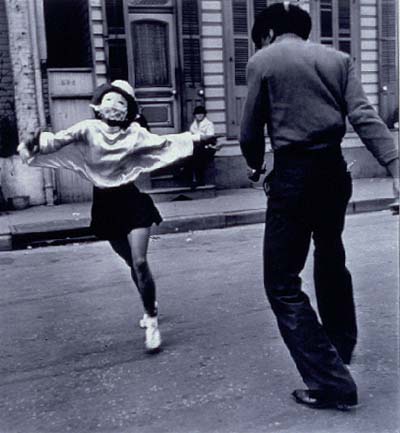
Jitterbug, New Orleans, 1937
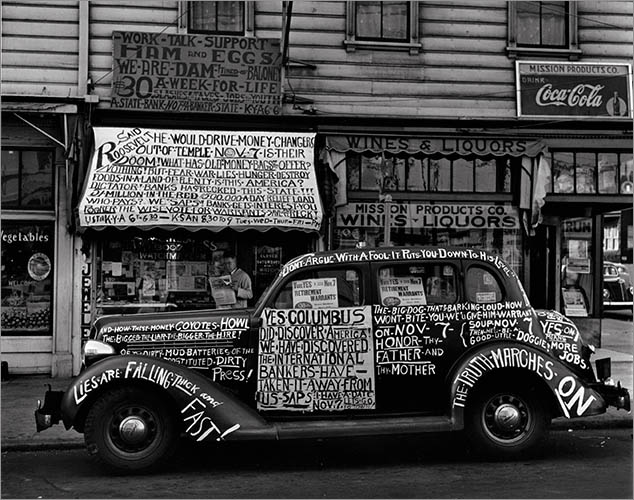
"Yes, Columbus Did Discover America!", San Francisco, 1938
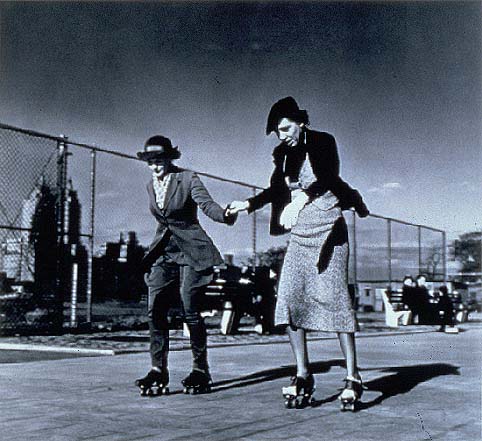
The Lesson, Central Park, New York, 1936
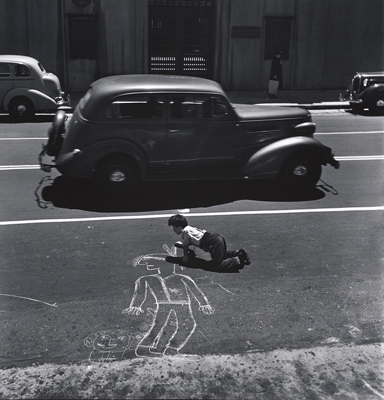
The Artist Lives Dangerously, San Francisco, 1938

Indian High School Band Traveling Through Desert, Arizona, 1937

The Game, New Orleans, 1937

Pop Advertising, San Francisco, 1939

 the dic·tion·ar·y pro·ject